Sources for an Imperial History
Something over 1,200 stone inscriptions in Sanskrit or Khmer are known within the territory covered by the empire at its apogee; all are written in the same script, one that was derived from an Indian prototype.
They are found on individual stele and, more often, on stone temple architecture, particularly door jambs. The history put together over decades by French epigraphers such as George Coedes[1234] was almost entirely based on the Sanskrit texts. These are essentially poems recording incantations, dedications, and the like, and they usually invoke Hindu deities and royal personages and royal doings.Historian Michael Vickery[1235] tells us that the hard data about pre-Angkorean and Angkorean history are not in the Sanskrit inscriptions, but in the Khmer ones, and “that when a Sanskrit text covers the same subject as one in Khmer, the former is an abbreviated paraphrase.” It has only been in recent times that much attention has been paid to the Khmer texts; although much more mundane in content, they give us important anthropological and economic information on the empire.
Second in importance for Khmer history are the bas-reliefs of Angkor, above all the sculptured narratives of the Bayon, the state temple of the greatest Khmer ruler, Jayavarman VII (r. 1181-ca. 1215). Some of these show in vivid detail scenes of land and naval battle, armies and camp followers on the march, and everyday activities like temple-building, cooking, and gambling (Figure 15.1). They certainly bring to life the terse accounts available in the inscriptions. The earlier reliefs in the galleries of Angkor Wat are far more artistic and less concerned with daily life, but give detailed information about royal military reviews and the royal court and courtiers.
We have only one eyewitness account of the city of Angkor before the collapse of the empire.
This is by Zhou Dakuan, a member of a commercial delegation sent out by the Chinese court in Beijing. He spent about two years in the Khmer capital at the very end of the thirteenth century, probably staying with Chinese merchants. On his return to his homeland, he wrote a long report (usually translated as “The Customs of Cambodia”); the version that has survived to us is probably only a fraction of the original, but it is recognized as a unique window into the ethnology of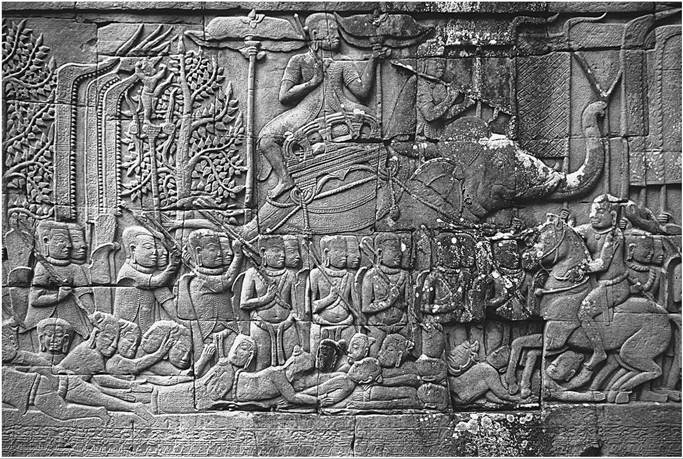
Figure 15.1. Detachment of Jayavarman VII’s army on the march. Detail of a relief on the Bayon, Jayavarman’s state temple, ca. 1200 ce.
Photo: Michael D. Coe.
the city and its empire, giving us much information that is nowhere to be found in the inscriptions.[1236]
Remembering that wet, tropical conditions have always prevailed in lowland Southeast Asia, it is hardly surprising that virtually all organic materials from earlier times have perished over the centuries. We know from reliefs, and from Zhou’s account, that much was written on palm leaves and on paper folding-screen books, but none of these has survived. What have disappeared probably include census records, economic accounts, tax records, personal and official correspondence (including governance of the provinces, administration of the state irrigation works, and the like), and dealings with foreign friends and enemies.
There are other sources that have been consulted by historians. These comprise official Chinese records of their relations with the “barbarian” polities and peoples fronting the South China Sea. Historians concerned with the early Khmer of pre-Angkor times (that is, prior to the ninth century ce) have dealt with these in various ways, sometimes taking them at face value, other times stressing the severe difficulties of working with supposed Chinese versions of Khmer place and proper names.
The Khmer language is totally dissimilar to Chinese: it lacks tones, and has an extremely complex system of vowels. The Indic-derived phonetic script that the Khmer used was probably never fully understood by the Chinese, with their basically logographic writing system. An even deeper problem is that the Chinese, with their overriding interest in trade, projected onto the inhabitants of these lands (that is, Cambodia, northeast Thailand, and the Mekong Delta) their notions of a unified state, rather than the collection of fractionated chiefdoms or simple kingdoms that they probably were.[1237] Thus, in spite of the dubious feasibility of matching up the Chinese names with Khmer language ones, some scholars have concluded that during the time interval between the first century and 802 there really once was a state called “Funan,” eventually overthrown by a supposed kingdom called “Zhenla” (the latter divided by Chinese sources into “Water Zhenla” and “Land Zhenla”). Michael Vickery[1238] and other scholars have accordingly stressed that early Cambodian history (before the founding of Angkor) should be firmly based on the Khmer inscriptions, rather than on these interesting but probably misleading foreign reports.