SPATIAL AND TEMPORAL ASPECTS OF DECOLONIZATION
The pattern of phase 5 decolonization, as it unfolded across space and over time, is shown in table 7.1. Whereas phase 2 was confined to the New World, phase 5 occurred primarily in the Old.
Also affected were Caribbean basin territories insulated from the independence movements of phase 2. The territorial scope of phase 5 was thus far more comprehensive than in the earlier period. States emerging from phase 2 were predominantly on the New World mainland. In contrast, approximately 30 percent of phase 5 new states were islands.Space and time were linked in new-state formation (see table 7.1). The first wave was in South Asia and the Near East. Southeast Asia followed, then North Africa, then sub-Saharan Africa, with a general shift from western to eastern to southern Africa. Independence for island territories was achieved over a relatively protracted period, most of the transfers of power occurring relatively late, after 1970.
It took far less time to dismantle European empires than to construct them. Phases 2 and 5 lasted for about five and four decades, respectively, in contrast to more than three centuries for phase 1 and almost a century for phase 3. The historical depth of colonial ties varied enormously for the new states of phase 5. At the low end were Syria and Lebanon, acquired as mandates in the 1920s and declared independent in the 1940s. Libya was a colony for four decades, most of Africa and Oceania for six to eight. At the upper end were Caribbean islands like the Bahamas, Jamaica, and Trinidad-Tobago (more than 450 years) and islands off the African coast like the Cape Verdes and Sao Tome and Principe, where Portuguese trading enclaves were established more than 500 years ago. Phase 2 new states lay within these extremes, the colonial experience for the great majority lasting between 150 and 300 years.
For European powers phase 5 marked the end of empire.
By contrast, at the end of phase 2, all the imperial powers had managed, despite permanent losses in every case except Holland, to retain a portion of their original possessions. The two largest empires as of 1940—those of Great Britain and France—were the most drastically reduced in size by 1980. The two largest as of 1773—Spain and Great Britain- followed divergent paths during phase 2. Spain ceased to count as a major international actor following loss of its New World mainland territories, while Britain compensated for losing the bna colonies by expanding in South Asia and the Indian Ocean basin. The British were well positioned by the end of phase 2 to start a new phase of empire building in Asia and Africa, which they proceeded to do. In contrast, by the end of phase 5 neither they nor any other world powers were about to create new overseas empires. Britain and France did assert themselves in the old style in 1956, when they and Israel invaded the Suez Canal Zone following nationalization of the canal’s assets by President Gamal Abdel Nasser of Egypt. But their attempt to apply nineteenth-century gunboat diplomacy to the very different conditions of the mid-twentieth century generated a universal outcry of protest. Britain and France had to withdraw, under humiliating circumstances, the troops they had landed. The fiasco cost Prime Minister Anthony Eden of Britain his job.This is by no means to say that power ceased to matter in international affairs after 1945. Rather, pressures grew to exercise it in more subtle, indirect, and informal ways than in the past. There have always been inequalities in economic and military resources among states and world regions. Prior to World War II Europeans felt few compunctions about expressing and reinforcing these inequalities in the legal/political sphere by establishing colonies in which the powerful openly dominated the weak. Indeed, having colonial possessions was a classic indicator of a metropole’s great-power status.
After 1945 interstate inequalities remained. If anything, gaps between richest and poorest and between militarily strongest and weakest grew steadily wider over time. But it was no longer acceptable to express inequalities overtly in legal and political terms. Would-be great powers no longer had the option to create new empires because colonialism violated norms of national self-determination and state sovereignty that now applied not just in Europe but throughout the globe. Decolonization placed ex-colonized and ex-metropolitan states on a footing of legal and political parity. That kind of equality could not be dismissed as insignificant or rhetorical no matter how unequal the units might be in other respects.5TABLE 7.1.
FROM EUROPEAN COLONY TO INDEPENDENT STATE, I946-8O
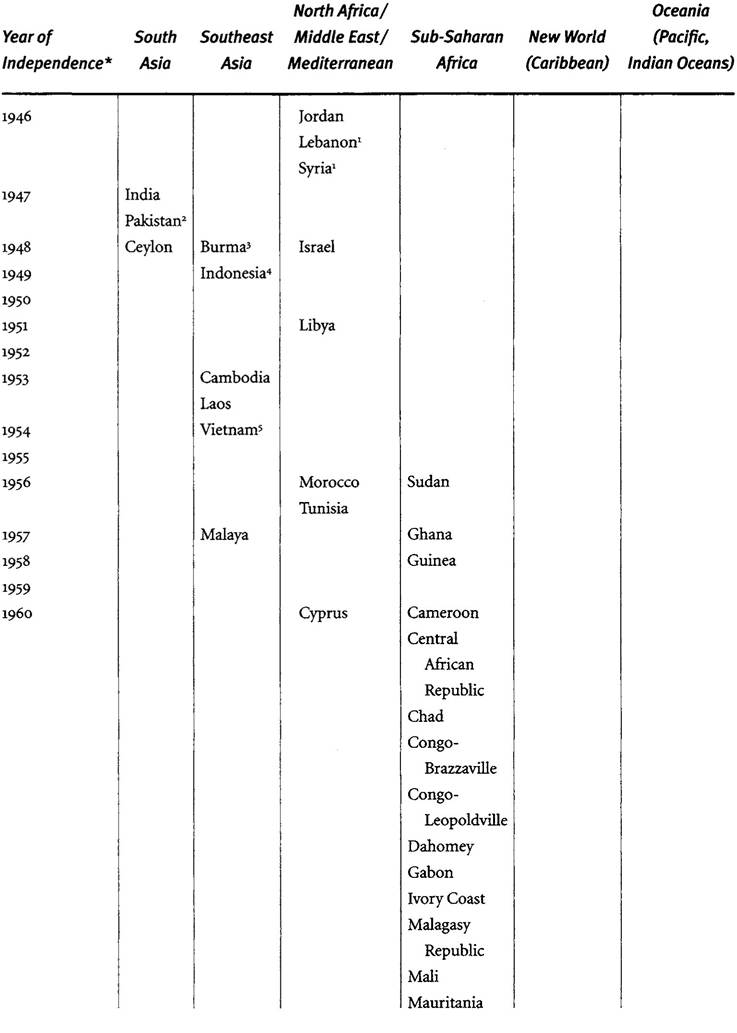
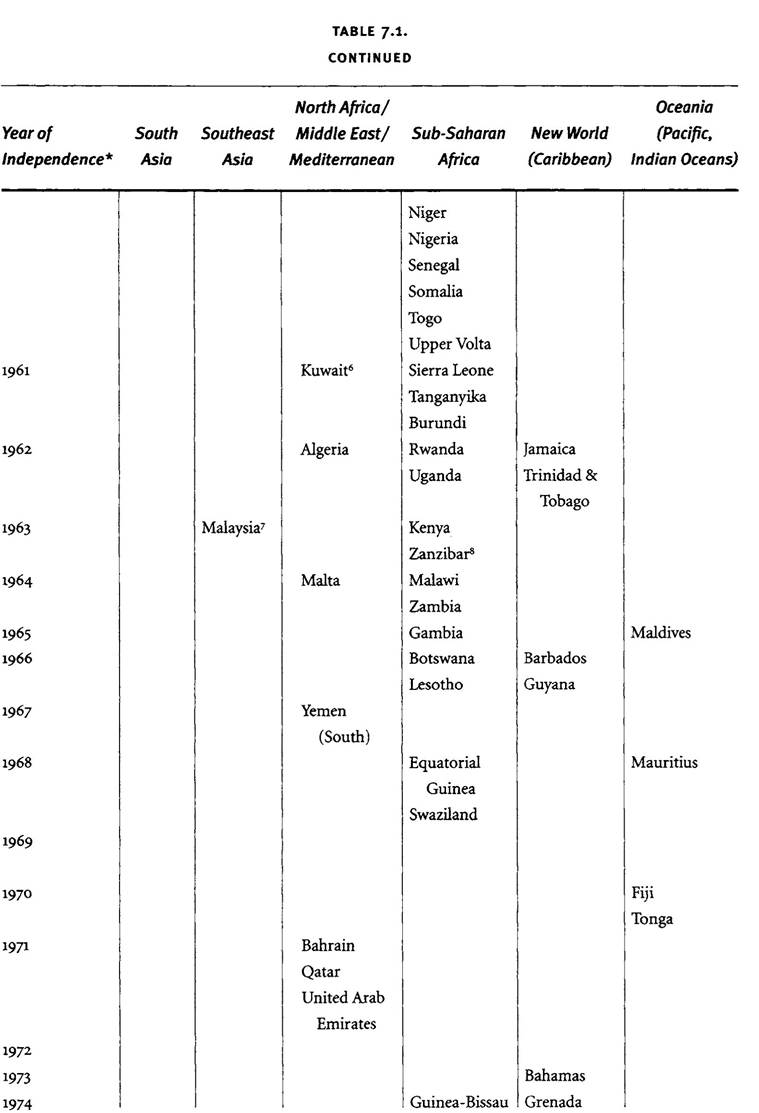
TABLE 7.1.
CONTINUED
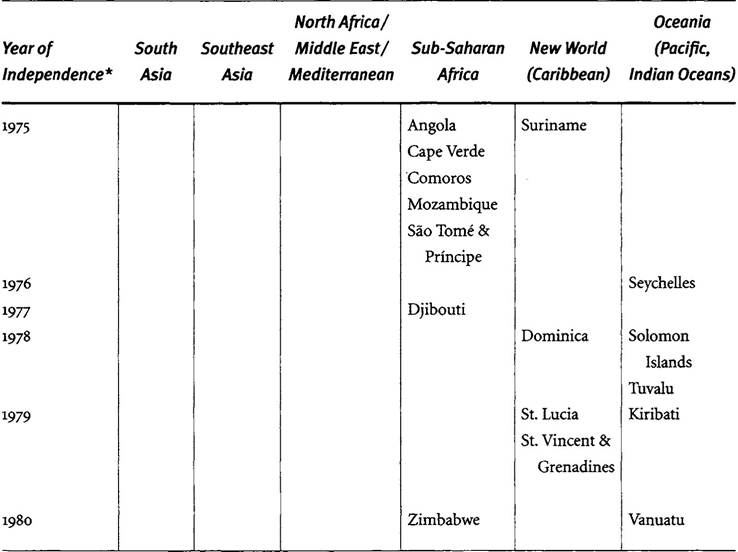
* Date of independence is the year in which leaders of the metropole and leaders of the colony mutually agree that the territory is independent. Exceptions and special cases are noted below. The country’s name is as formally listed or commonly called at the time of independence.
1 Lebanon and Syria were declared independent by the Free French in 1941. But they did not consider themselves independent until French troops departed in 1946, following a formal request that the French evacuate their former mandates.
2 At independence Pakistan consisted of two noncontiguous areas, West and East. The East broke away in 1971, and West Pakistan forces were unable to prevent secession. The former East Pakistan was internationally recognized in 1972 as Bangladesh. (West) Pakistan acknowledged the independence of Bangladesh in 1974.
3 The Japanese proclaimed the independence of Burma in August 1943.
But even the Burmese nationalists who collaborated with them did not regard this gesture as genuine.4 Indonesian nationalists proclaimed the independent Republic of Indonesia in August 1945. In 1946 the Dutch recognized the Republic but not its claim to represent the entire Netherlands Indies. Dutch recognition of the sovereignty of a federal United States of Indonesia came in 1949.
TABLE 7.1.
CONTINUED
5 Vietminh nationalists led by Ho Chi Minh declared Vietnam’s independence in September 1945. War between Vietminh and French forces raged almost continuously until 1954, when at the Geneva Convention France recognized the independence of Vietnam. The Geneva Convention also “temporarily” divided Vietnam into a northern and southern half. After more than two decades of intense armed conflict between these two entities and their respective outside supporters, North Vietnamese forces brought the South under their control and unified Vietnam politically in 1975.
6 Kuwait, Bahrain, Qatar, and the United Arab Emirates are classified in the Appendix as quasi colonies.
7 The Federation of Malaysia linked Malaya (already independent) with three former British colonies: Singapore, Sarawak, and Sabah. In 1965 Singapore left the Federation—or, more accurately, was expelled from it by Malayan leaders—and became an independent state.
8 In the wake of a social and political revolution in Zanzibar in January 1964, a few weeks after its independence, the island state merged with mainland Tanganyika in April 1964. The new entity was known as the United Republic of Tanzania.
More on the topic SPATIAL AND TEMPORAL ASPECTS OF DECOLONIZATION:
- Abernethy David B.. The Dynamics of Global Dominance: European Overseas Empires, 1415-1980. Yale University Press,2002. — 524 p., 2002
- The medieval abrogation and the modern temporal conflict of laws
- INDEX
- A Brief Overview of the Important Aspects
- COMPONENTS OF POWER AND UNITS OF ANALYSIS