The First Nomads Become Farmers

One of the best places for nomads to live was in an area called the Fertile Crescent.
It was called a crescent because it was shaped like a crescent moon—like this: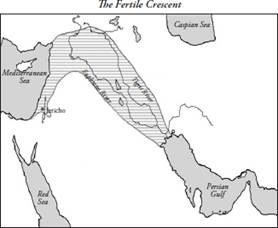
And it was called fertile because two rivers, called the Tigris and the Euphrates, ran through it. Rich grass, wild barley, and wild wheat grew in the damp soil of the river banks.
When nomads wandered through the Fertile Crescent, they saw herds of animals feeding on the grass. They saw grain that they could harvest, and wide rivers where they could fish and get fresh water to drink. Because it was so easy to find food, nomads returned to the Fertile Crescent again and again. Some of these nomads began to live near the two rivers all year long, instead of wandering from place to place in search of food.
Nomads who settled in the Fertile Crescent couldn’t just pick leaves, nuts, and berries to eat. Soon, they would run out of wild plants to harvest. Instead, they had to begin to plant grain for themselves. The nomads of the Fertile Crescent were turning into farmers.
These new fields of grain needed extra water to flourish. The land near the rivers was damp enough to make growing easy. But it didn’t rain very much in the Fertile Crescent, and farther away from the shores, the land was dry for much of the year. So the farmers learned to dig canals from the rivers out into their fields. That way, even if it did not rain, they could bring water to their crops.
Today, irrigation machines are enormous metal sprinklers, higher than a house and longer than three or four semi trucks. They pump water out of lakes and spray it over entire fields. But long ago, farmers had a simpler machine to get water out of the canals and onto their crops.
This machine was called a shaduf. Early farmers balanced a pole lengthwise on top of a pillar. They tied a weight to one end of the pole, and attached a leather bucket to the other. Then the farmers lowered the bucket into the canal, raised the bucket by pushing down on the weight, and then swung the bucket around to pour the water on the crops. The shaduf was one of the first farm machines.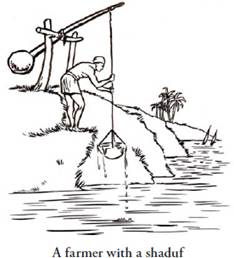
Farmers had to tend their crops every day for months. So they began to build houses that would stay in one place, instead of living in tents that could be moved every few days. They used whatever materials were around them. Farmers who lived near the river built houses out of reeds, or out of bricks that were made from mud and left to dry in the sun.
Soon, farmers discovered that it was best to build houses close together so that they could help each other to water and tend their fields. These were the first villages. The farmers also learned that they could tame animals such as sheep and goats, feed them grain, and then use them for meat. This was easier than hunting wild animals! Villages were often built around a central pen or field where the tame animals were kept.
Some villages were very successful in growing grain and raising sheep and goats. They even grew rich by trading grain, sheep’s wool, and animal skins to others for metals, pottery, wood, and other goods. Because they were afraid that they might be attacked and robbed by bandits, they built stone walls around their villages. These were the first cities.
One of the earliest was the city of Jericho. Jericho had one of the thickest, strongest walls of the ancient world; it was ten feet thick and thirteen feet tall, with a circular tower on one side so that village lookouts could see enemies approaching. The tower was thirty-five feet high—taller than a two-story house!
Not long after the day that Tarak catches enough lizards for her mother’s lizard stew, Tarak and her family wander into the Fertile Crescent, searching for food.
They find plenty of roots, nuts and berries to eat. Tarak’s uncle is excited because he sees large herds of horses and small deer to hunt.But the most exciting thing Tarak sees is a huge river, flowing by right at her feet. She has never seen so much water in one place in her life. Usually, her family and the other nomads only find small pools of water, or tiny streams trickling through the rocks. They need this water for drinking—so Tarak has never been swimming. As a matter of fact, she has never had a bath in her whole life. Now, she can walk right into the water up to her chin.
At first, Tarak and her brother are afraid to get into the water. They just squat on the shore and splash each other. But slowly they put one foot, and then the other into the water. Tarak wants to show her brother how brave she is, so she wades out almost to her knees. She hears her brother wading in behind her. He splashes her all over, so she turns around and dunks his head under the water. He comes up spluttering and yelling. He’s never been under water before.
Tarak and her brother spend the whole morning in the river. When they get out, Tarak notices that her brother smells much better than he used to.
That night at dinner, there is horse meat to eat. Tarak’s uncle says, “I met other men a little farther down the riverbank. But they weren’t hunting. They were putting seeds into the ground. They told me that if we put seeds into the ground too, grain would grow right here where we are. We could pick it, and we wouldn’t have to keep looking for new fields to gather food in. I think we’ll stay here for a while and watch what they’re doing.”
Tarak grins at her brother. She likes living on the bank of the river; she likes eating horse meat instead of lizards; she likes the idea that she won’t have to go searching for roots every day. And most of all she likes swimming.

Note to Parent: Nomads roamed through the Fertile Crescent around 7000 BC/BCE. The stone wall at Jericho dates to around 6800 BC/BCE.