Two Kingdoms Become One
Tarak could go swimming almost any day she wanted to, because the Tigris River was full of water all year round. But the farmers who lived along the banks of the Nile River had a very different kind of river to deal with.
Sometimes the river was very low—so low that you could almost see the bottom. Other times, it was so full that it flooded all over their farmland.The Nile River is a long river in Africa. At the top, it splits into several different little rivers and runs into the Mediterranean Sea. This area is shaped like an upside-down triangle. The Greek letter for D, delta, is shaped like a triangle too. So this part of the river is called the Nile Delta, after the Greek letter of the alphabet.
Every year, the Nile flooded. During rainy seasons, water would fall on the mountains in the south, where the Nile River begins. The water would pour down the mountains, into the river, and run down towards the delta. So much water poured into the Nile at once that it overflowed its banks and spread all over the farmland on either side. The wettest place of all was the Nile Delta—all the little rivers ran over their banks and spread out so that the whole delta was underwater. Would you like to live on the banks of the Nile? Do you think it would be a good place to build a house? What would happen to your house?
If a farmer had a river flood all over his crops today, he’d think it was a disaster. It would wash his crops away. But the farmers who lived along the Nile liked to see the river flood. The river flooded at the same time every year, so they were ready for it. When the water came up out of the river, rich dirt from the bottom of the river came with it. This dirt was called silt, and it was full of good vitamins and minerals for plants. The floodwater would spread the silt all along the edge of the river, and then the water would recede—go back into the river until the next year.
Then the farmers, who lived a little ways away from the riverbank so that their houses wouldn’t flood, would come out and plant their crops in the rich silt. They learned to dig canals leading away from the river, so that floodwater would run into their canals. Then they would block the ends of the canals so that the water couldn’t run back into the river. They could use the water in the canals during dry seasons.The people who lived along the Nile were called Egyptians. Early in Egypt’s history, there were two Egyptian tribes who lived along the Nile. The Egyptians who lived in the north, in the Nile Delta, were called the “Lower Egyptians.” The Egyptians who lived along the straight part of the river, further south, were called the “Upper Egyptians.”
When you look at a map, “north” is usually at the top and “south” is usually at the bottom. So it might seem to you that the Nile Delta should be “Upper Egypt.” After all, it’s on the upper part of your map.
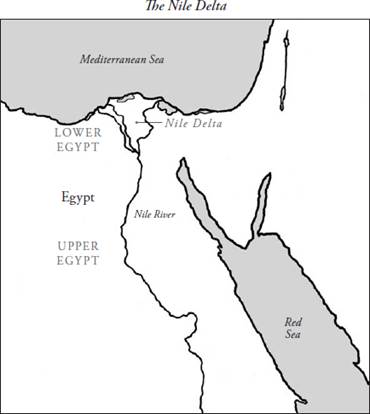
But the ancient Egyptians didn’t think about the world in that way. The Nile River flowed from the mountains in the south, down to the delta in the north. So the ancient Egyptians thought about the southern part of their country, Upper Egypt, as “up the river,” and the northern part, Lower Egypt, as “down the river.” If you turn the map at the top of this page upside down, you’ll see the world as the Egyptians did.
The Lower Egyptians were ruled by a king who wore a red crown, and the Upper Egyptians were ruled by a king who wore a white crown. Both kings wanted to rule over all of Egypt. So for years, the White Crown King and the Red Crown King fought with each other, and the Upper Egyptians and the Lower Egyptians sailed up and down the Nile and fought with each other too.
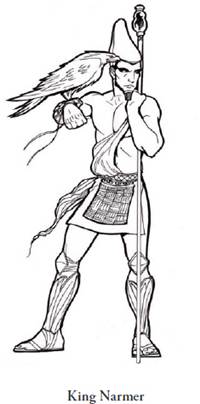
Finally, the two kings fought one great battle to settle, once and for all, who would rule Egypt. The Upper Egyptian king, the White Crown King, was named King Narmer. Around five thousand years ago, King Narmer defeated the Red Crown King and took his crown away. Then he put the red crown overtop of his own white crown and announced that he was the king of all Egypt. From now on, the king of Egypt would wear the Double Crown of Egypt, which had a white spike at the center and a red band around the outside. This showed that he was the ruler of the entire country.

More on the topic Two Kingdoms Become One:
- Romance of the Three Kingdoms
- ISLAMIC KINGDOMS, SYNCRETISM, AND LOCALCUSTOMS
- Kingdoms
- The Spanish kingdoms
- The Bulgar and the Frank Kingdoms
- Europe, after the collapse of Roman government in the West in the fifth century, became a mosaic of comparatively small kingdoms.
- The Birth of a Composite Monarchy: Medieval Foundations and Institutional Framework
- The Historical Background
- THE FORTY-THREEFOLD EGYPTIAN WISDOM
- Introduction
- Rex imperator in regno suo est
- What Is an “Egyptian Empire”?
- A Seventh-Century Chinese Visitor
- Networks of Power in the Parthian and Sasanian Empires
- Roman law entered medieval political reflection in the late eleventh century as the law of the universal Roman empire, an organization foretold by Old Testament prophecy as the last empire to rule the world before Apocalypse and hallowed by Christ himself who had lived under the Caesars.
- 6 ‘BECOMING GREEK’ 322 BCE–27 BCE
- SULTAN MOHAMMED IV TO THE ZAPOROZHIAN COSSACKS