The First World War in East Asia
In trying to understand the origins of the Pacific War, it is important to see that Japan's desire for regional hegemony and the West's attempts at containment did not begin in the 1930s.
Indeed, it could be said that the seeds of war went back to the breakdown in the mid- to late nineteenth century of the traditional China- centred international system that had dominated East Asia. The steady erosion of imperial China's authority under the weight of both external challenges from the West and internal challenges from a series of large-scale rebellions led Japan into a fundamental reassessment of its own relationship with the outside world. In one sense China's plight posed a grave danger, for there was the possibility that the resulting power vacuum might be filled by hostile Western powers, particularly Russia, which would seek to gain not just economic but also political control over the region. However, at the same time, Chinese decline also provided Japan with the opportunity to fill this power vacuum itself and to create a new East Asian international order in its own image. Thus, concerned for its security and desiring to raise its status, Japan from the 1870s onwards moved to increase its influence in East Asia. Its fears and ambitions eventually led it into war, first with China in 1894—95 and then with Russia in 1904—05, and conquest, most notably ofTaiwan (1894), South Manchuria (1905) and Korea (1910). In addition, its growing see Map 3.1 prestige led it in 1902 to acquire Britain as an ally, for the latter too had misgivings about Russian ambitions in the region.For countries such as the United States that were interested chiefly in trade with East Asia, Japan's expansion became a matter of some concern. It was feared that Japan's pursuit of security might prejudice the right of other countries to trade
open door
The maintenance in a certain territory of equal commercial and industrial rights for the nationals of all countries.
As a specific policy, it was first advanced by the United States in the late nineteenth century as a way of safeguarding American economic interests in China.freely in the region, and in particular that it might limit their access to the Chinese market, thus compromising what the United States referred to as the ‘open door' to China. Their apprehension might not have been so great had China been in a position to resist Japanese pressure, but this was not the case. By the start of the twentieth century the Qing dynasty that ruled China was in terminal decline, its authority so compromised that it was not able to persuade the provinces to finance the reforms that it needed to redeem itself. In 1912, due to a rebellion that had begun the previous year, the Qing abdicated and a Chinese Republic was established, ending thousands of years of imperial rule. The republic proved, however, to be no stronger than its predecessor, for it soon found itself mired in controversies about its political direction and was no more able to control the provinces than the Qing had been. As China could not protect itself, Japan was kept in check largely by the presence of the Western Powers, but this situation changed with the start of the First World War.
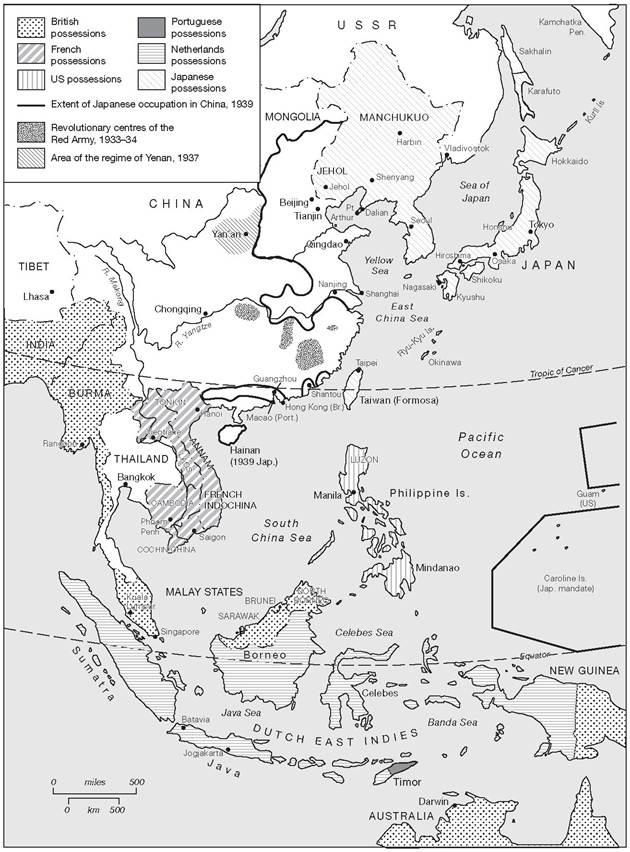
Map 3.1 Japanese expansion in East Asia until 1939
Source: After Iriye (1987)
The First World War was for Japan an unprecedented opportunity to strengthen itself and expand its power in the region. As the Western Powers turned their attention to the conflagration in Europe, Japan took advantage of their absence in a number of ways. In the economic sphere, the drying up of European trade with the region meant that it was in a position to fill the vacuum and its exports flourished. In addition, the absence of imports from Europe of iron, steel and chemicals encouraged the development of Japan's own heavy industrial base. Japan was thus able to emerge from the war richer than ever before and with a modernized economy.
Above and beyond this, however, the circumstances were ripe for a further expansion of Japan's political power in the Asian continent.Japan entered the First World War in August 1914 when it honoured its alliance with Britain by declaring war on Germany and attacking the latter's Jiaozhou lease in China's Shandong peninsula. In January 1915 it then attempted to acquire a predominant position for itself in China by issuing the Twenty-One Demands, which called for recognition of the secession of Jiaozhou to Japan and for a variety of economic and political concessions that would dramatically increase Japan's influence in Manchuria, the Yangtze valley and Fujian. Owing to Chinese intransigence and diplomatic pressure from Britain and the United States, Japan gained only some of its objectives. Undaunted by this opposition, it turned between 1916 and 1918 to a new strategy, which involved utilizing its new financial power in the form of loans to China to gain by largess what it could not seize through coercion.
Japan's activities in China and its commercial penetration into the hitherto European-dominated markets in India and South-East Asia did not endear it to its Entente partners, and in particular alienated its ally Britain. However, as long as the war dragged on and there was still a need for Japanese naval assistance against Germany, particularly in the Mediterranean, little could be done to restrain Tokyo. As well as irritating Britain, Japan also strained its relations with the United States. To the Wilson administration, Japan's China policy was a flagrant violation of the principle of the ‘open door'. Added to this was naval rivalry, as Japan sought to keep pace with the large-scale expansion of the United States navy announced in 1916. Moreover, the decision by the United States and Japan in July 1918 to intervene to restore order in Siberia, while, on the surface, a demonstration of solidarity, in reality only added another bone of contention, as each suspected the other of desiring a monopoly over the region's economic resources.
The Paris Peace Conference of1919 did little to dissipate these tensions. Japan attended with three main aims: first, to formalize its control over the Jiaozhou lease; second, to acquire the German islands in the west Pacific; and third, to insert
League of Nations
An international organization established in 1919 by the peace treaties that ended the First World War. Its purpose was to promote international peace through collective security and to organize conferences on economic and disarmament issues. It was formally dissolved in 1946.
mandates
The colonial territories of Germany and the Ottoman Empire that were entrusted to Britain, France, Japan, Australia and South Africa under the supervision of a League of Nations Commission.
a clause opposing racial discrimination into the Covenant of the League of Nations. It thus sought to expand its empire and to seal its position as the equal of the other Great Powers. It met with only partial success. The United States initially opposed the transfer of Jiaozhou to Japan, and only relented after the latter had indicated its intention to ensure the eventual retrocession of the lease to China. Meanwhile the racial equality clause fell prey to Australia’s absolute refusal to make concessions over its immigration policy, while Japan gained the former German Pacific islands only as League of Nations mandates rather than outright possessions. Japan thus left the conference only half-satisfied, while the United States and Britain sought new means to curb Japanese power.