The Washington Conference
From 1919 to 1921 American-Japanese relations remained tense and fears grew of an all-out naval arms race. In the end, however, the spiral of escalation was controlled. In November 1921 a conference of the Powers with interests in the western Pacific convened in Washington to discuss international co-operation in the region, particularly in regard to China, and how to establish a framework for naval arms limitation.
The conference proved, at least in the short term, to be a marked success, for by February 1922 it had led to the return of the Jiaozhou lease to China and the conclusion of three new treaties. These were the Five-Power Treaty on naval arms limitation, the Four-Power Pact to preserve the status quo in the Pacific (which allowed for the abrogation of the Anglo-Japanese alliance), and the Nine-Power Treaty to uphold the open door policy in China.The obvious question that arises is: why at Washington did Japan abandon its former policy of single-minded expansion and accept the need for a new international order in East Asia? One could, of course, rely on a purely realpolitik explanation, and state that the end of the First World War and the apparent formation of an Anglo-American bloc forced Japan to accept its relative powerlessness. To an extent this is true, for Japan clearly realized that its diplomacy at Paris had failed and that it could not win a naval race with the United States. However, it is also possible to see its acceptance of the Washington treaties as symbolic of a new spirit in the country, reflecting the worldwide trend towards greater idealism in both foreign and domestic policy. Certainly some elements in the foreign policy elite welcomed Wilsonian ‘new diplomacy’, for they realized that Japan could benefit from multilateral co-operation as this would both guarantee its security and allow expansion of its economic stake in China.
The most notable proponent of this view was Kijuro Shidehara, the ambassador to the United States at the time of the conference, and later foreign minister in 1924-27 and 1929-31.In addition, Japan was at this time shifting from oligarchical rule towards government by party politicians: the so-called period of ‘Taisho democracy’. In 1918 Takashi Hara, the head of the Seiyukai Party, became the first commoner to
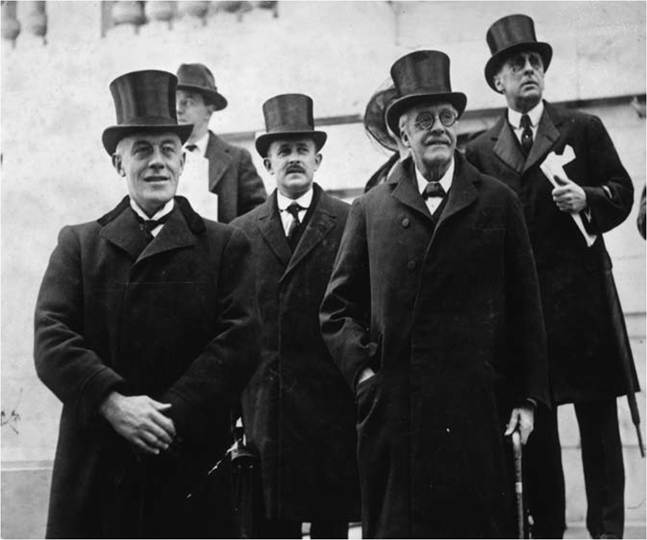
Plate 3.1 Washington Conference, USA, November 1921. From left to right: British ambassador, Sir Auckland Campbell Geddes, Sir Maurice Hankey, Arthur Balfour and Arthur Lee in Washington, DC for the International Conference on Naval Limitation. (Photo by Topical Press Agency/Getty Images)
be made prime minister, and from 1919, as in many other states at the time, the political agenda came to be dominated by debates about universal suffrage and labour issues. This shift towards a new mass politics was aided by the relatively high rate of literacy in Japan, which meant that the new ideas emanating from the West about issues such as morality in international affairs, unionization and women's rights received a wide audience. Indeed, by 1925 Japan would introduce universal male suffrage and in 1928 socialist parties would stand in a general election. This change in the nature of Japanese politics had implications for foreign policy, for the rise of the parties saw a growth of anti-militarist sentiment, as the military were perceived to be the last bastions of oligarchic government. This in turn meant that plans for international co-operation, including naval arms limitation, found a ready constituency in Japan, for such measures would clearly help to curb the military's political power.
The treaties signed in 1921—22 helped to shape the nature of international relations in East Asia for the next twenty years. Indeed, some historians have described them as constituting a ‘Washington system', in that they established a new overarching framework for international co-operation in the region.
Linked to this concept is the idea that the Powers agreed to take a ‘gradualist' approachself-determination
The idea that each national group has the right to establish its own national state. It is most often associated with the tenets of Wilsonian internationalism and became a key driving force in the struggle to end imperialism.
Versailles Treaty
The treaty that ended the Allied state of hostilities with Germany in 1919. It included German territorial losses, disarmament, a so-called war guilt clause and a demand that reparations be paid to the victors.
Bolsheviks
Originally in 1903 a faction led by Lenin within the Russian Social Democratic Party, over time the Bolsheviks became a separate party and led the October 1917 revolution in Russia. After this ‘Bolsheviks' was used as a shorthand to refer to the Soviet government and communists in general.
Comintern
The Communist or Third International founded in Moscow in 1919 as an organization to direct and support the activities of communist parties outside Russia. It was abolished in 1943 in a short-lived effort by Stalin to reassure Britain and the United States that the Soviet Union no longer sought to export Marxism-Leninism.
towards China, in which they would slowly shed their privileges as the latter became more politically stable. This can be seen in the terms of the Nine-Power Treaty, which committed its signatories to respect China's sovereignty and territorial integrity, and to consider in the near future the raising of its external tariffs and in the longer term the abolition of extra-territoriality. It is possible, however, to overstate this case, for in practice little was done to assist China; indeed, continued economic competition between the Powers seemed to be the order of the day. For example, at the tariff reform conference of 1925, each of the Powers viewed assistance to China solely in terms of trade advantages to themselves. It is therefore possible to exaggerate the degree of Great Power cooperation engendered by the Washington Conference and the extent to which the Powers were committed to end China's inferior status. In practice, the main focus of the conference was to contain Japan and to restrict international competition in China to the economic field.