The Grand Alliance at war
No one except Adolf Hitler could have united the United States, the Soviet Union and the British Empire for a common purpose, but even during their united struggle against Nazism, pre-war hostilities lingered.
The Americans opposed British imperialism and protectionism. The British resented American economic dominance and anti-imperialism. Both the Americans and the British loathed Russian communism, and the Soviets remained wary of Anglo-American capitalism. Yet the ‘Grand Alliance' — a term coined by Churchill — remained steadfast, and out-produced and out-gunned the aggressors. The strategic cycle of the Allied war effort followed that laid out by pre-war Anglo-French planners (albeit with the United States in France's place). The Allies initially absorbed furious Axis onslaughts, then accumulated overwhelming superiority in men and weapons while wearing down those of their enemy, and, finally, launched crushing offensives.protectionism
The practice of regulating imports through high tariffs with the purpose of shielding domestic industries from foreign competition.
The precondition for the Allied victory over Nazi Germany was the survival of Britain, and even more so, of the Soviet Union. Had the British opted for a negotiated peace, or succumbed to an invasion, the United States would have retreated behind the walls of a ‘fortress' America. Instead, faced with the Luftwaffes bombing ‘blitz' of London and other cities, and the relentless menace of prowling U-boats to its merchant shipping, the British endured, and so became the heroic cause for American interventionism to rally behind. Once the United States mobilized, Britain supplied the air bases, staging areas and port facilities required for the combined bomber offensives of 1943—44 as well as the invasion of France in June 1944. Had the Soviet Union collapsed under the pressure of the Wehrmacht's knockout blows in the summer of1941, then Britain would certainly have had to sue for peace or, in the following year, yield to the full weight of the Wehrmacht.
Few in the summer of 1941, including most British and American military and intelligence officials, gave the Red Army more than a few weeks.Not only did Russia endure, but in the following year the Soviets began to turn the materiel balance. In 1943, Soviet industries produced more than twice as much steel, nearly twice as much artillery, and thousands more tanks and aircraft than the Reich. How? Part of the answer can be found in German shortcomings, specifically the Wehrmacht's inability to crush the Red Army, and the failure of the German war economy to exploit its full potential. Yet the Soviet Union, and especially the Soviet war economy, suffered blows that should have initiated collapse. Barbarossa cost Stalin one-third of his rail network, 40 per cent of his electrical generating capacity and three-quarters of his steel and iron supply. From July to December 1941, however, 1,523 iron, steel and engineering plants were dismantled and relocated to the Urals—Volga-Siberian heartland, well beyond Hitler's reach. Despite this disruptive exodus, Russia out-produced Germany on a much slimmer resource base because the Soviet people sacrificed everything for military output. The rapid decline in production for civilian consumption did not result in a breakdown in popular morale. Coercive measures were enforced to keep workers working, but fear alone cannot account for a willingness of millions to
Free French Forces
General Charles de Gaulle commanded an armoured division in the battle of France and then, briefly, held a junior post in Paul Reynaud's cabinet on the eve of France's defeat.
In June 1940, in radio broadcasts from London, he called upon French people everywhere to join him in the struggle to free France from the Nazi occupation and, later, Marshal Petain's Vichy regime. At first, the general's calls went largely unanswered. His abrasive, overbearing personality and his lack of diplomatic finesse ensured that his relationship with Roosevelt and Churchill was always rocky at best.
By 1943, however, he had become the undisputed leader of the Free French movement, whose growing volunteer forces participated in Allied military operations in North Africa and the Middle East. In 1944, Free French Forces triumphantly participated in the liberation of France. The Allies recognized his administration as the French provisional government in October 1944, and de Gaulle, a national hero, was elected president in November 1945. He resigned shortly thereafter when the National Assembly refused to grant him American-style executive powers. He again served his country as president from 1958 to 1969.toil day in, day out on meagre rations and under harsh working conditions. Perhaps this popular Soviet groundswell of resolve sprang from sources similar to those that kept the British fighting in 1940. Ultimately, it would have all been in vain had Soviet managers not displayed a remarkable capacity for planning and organization. Unlike the Germans, the Soviets dedicated resources to massproducing a few proven designs, including the KV-1 and T-34 tanks. Abundant machines wielded by the revitalized Red Army turned the defensive battle at Stalingrad into an offensive. In July 1943, at the Battle of Kursk, where Hitler and his generals tried one last great pincer movement to blunt the Red Army advance, General Zhukov’s armies ground down the Germans in the largest tank battle ever, and then counter-attacked.
Before Hitler declared war on the United States, he predicted that the Americans would take five years to organize full-scale war production. He was wrong: in 1940, the Americans built 331 tanks and 12,804 aeroplanes; in 1941, the numbers jumped to 4,052 tanks and 26,277 planes; by 1942, the figures skyrocketed to 24,997 and 47,826. Nothing explains the Allied victory over the Axis better than the magnitude of American rearmament. By 1944, Americans were cranking out 40 per cent of all the weapons produced globally, and two- thirds of the arms fielded by the anti-Axis forces.
This industrial miracle was facilitated by the American political culture. The state did not need to conscript industry or labour; they volunteered. Americans embraced mass production, civilian ingenuity, healthy competition and profit. Washington issued targets, and private industry worked out clever ways to meet ever more ambitious goals. The slack in the American pre-war economy — a legacy of the slump — and North America’s remoteness from the battlefronts of Europe and Asia also help to explain the gigantism of its rearmament. For instance, at an empty field called Willow Run near Detroit, the Ford Motor Company (which alone manufactured more arms than Italy) built the world’s largest assembly hall in 1941 to manufacture four-engine heavy bombers, the B-25 Liberators. The 5,450-feet long assembly line covered 67 acres and orchestrated the fitting of 1,550,000 parts for each B-25 bomber. By 1944 well-fed and well-paid American workers could put together one B-25 Liberator every sixty-three minutes.Not only did the Allies win the arms race, but they pooled resources, coordinated strategy and maintained a unity of purpose better than their adversaries. Lend-Lease was the principal means for the redistribution of surplus materiel and resources within the alliance. Precise values are difficult to calculate, but about $45—50 billion worth of food aid, military hardware, oil and industrial goods and services was sent overseas. The first and largest recipient was Britain, followed by Russia. The Free French Forces under General Charles de Gaulle and the Nationalist Chinese under Jiang Jieshi were also major beneficiaries. How significant was Lend-Lease? It rescued Britain from insolvency in 1941. About one-fifth of all British arms were American in origin. Moreover, the aid from the United States permitted Britain and Russia to focus their war industries on what they could do for themselves best. As Stalin said in 1942, ‘Send us trucks instead of tanks.’ More than 400,000 sturdy American trucks provided the Red Army with superior battlefield mobility over their increasingly horse- and wagon-reliant German foe.
The Americans likewise helped the Soviets to overcome serious shortages of food and machine tools. Even so, the influx of Lend-Lease was more marginal to Soviet staying power than it was to that of Britain. Large quantities of Lend-Lease goods were in fact stockpiled by Soviet officials. Nonetheless, as a sign of the commitment to Russia's war effort, few things compared with the safe arrival of a convoy carrying American cargoes, escorted by Royal Navy warships, through submarine-infested Arctic waters. Of course, we should not paint too rosy a picture, for American aid was also a source of political friction. Washington exploited Lend-Lease in order to compel London to agree to abandon imperial preference after the war, and Soviet officials always viewed any interruption to the flow of goods with a sceptical eye.Strategy was the principal source of inter-Allied tension. For Moscow, the priority was an early ‘second front' to ease the burden on the Red Army. Although America's war had begun in the Pacific, Roosevelt prioritized the war against Germany, the most dangerous foe, and his staff devoted the bulk of American strength to a campaign on the European continent. Successful landings in France, however, depended on the Red Army's continued resistance in the east. The spectre of a separate Nazi-Soviet peace never vanished. In May 1942, therefore, when Molotov questioned General George Marshall about a cross-Channel invasion of Europe during a visit to Washington, the army chief of staff, according to the president's wishes, replied that preparations were in hand for a ‘second front' within the year. Few in Moscow took this promise at face value, yet it became a sore point, especially as delays mounted. Put simply, there were too many demands on scarce shipping to prepare for an early invasion. American forces, with all of their heavy kit and supplies, had to be shipped to British ports, and Britain still required large imports of food, fuel and arms to fight.
The British, moreover, who had developed a healthy respect for the German army, feared that a premature invasion would fail and thus prolong the war. Time was needed to gain more experience of landing operations and to develop amphibious craft. In the meantime, Churchill and his advisers preferred a peripheral strategy of blockade, bombing and subversion against the Nazis, while the Anglo-American forces were used in North Africa and the Mediterranean against Italy. After the landing in Vichy-controlled North Africa in November 1942, and the final surrender of Italian and German troops in Tunisia in May 1943, the Americans, who never thought that decisive results could be achieved this way, found themselves drawn deeper into the Mediterranean. After Italy's defection from the Axis, the British spoke alluringly of strategic possibilities for landings in the Balkans, but the Americans refused to be diverted. The cross-Channel invasion of Europe was scheduled for 1 May 1944. This target was confirmed at the Teheran Conference in November 1943, where Churchill, Roosevelt and Stalin all met for the first time. Publicly, the Big Three affirmed their partnership in the fight against Hitler. Behind closed doors, Stalin agreed to attack Japan once Germany fell, and to mount an offensive on the eastern front to correspond with the Anglo-American landings.Despite these bitter and persistent squabbles, therefore, the Allies fought a more co-ordinated war than the Axis. Co-operation was closest between Britain
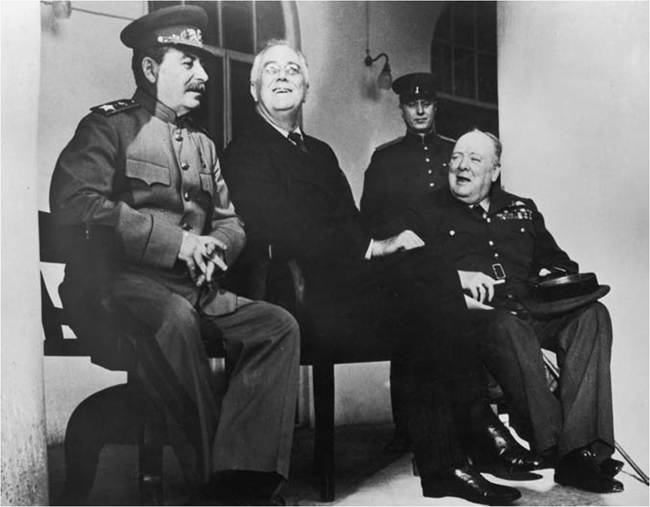
Plate 8.1 The 'Big Three', December 1943. Left to right: Soviet Premier Joseph Stalin, US President Franklin Roosevelt and British Prime Minister Winston Churchill sit together at the Teheran Conference, Persia (now Iran), during the Second World War. (Photo: Hulton Archive/Getty Images)
and the United States. After 1941 the two governments developed an integrated organization to wage war, from the combined chiefs of staff at the top, down to an elaborate series of subsidiary committees for joint shipping, industry, technical and scientific research, and intelligence. In the first phase, the Anglo-American war emphasized naval and air power. Without command of the sea, the invasion of France was unimaginable. From 1940, when the German navy could exploit easy access to the Atlantic, U-boats organized in deadly ‘wolf packs’ held the upper hand, claiming a horrific toll on cargo ships and crews. Fortunately, the offensive developed slowly enough for British, Canadian and American forces to perfect U-boat counter-measures before the Germans could respond with their own countervailing innovations in submarine technology. By March 1943, when the Germans were forced to abandon the Atlantic after crippling U-boat casualties, convoys were provided with constant close air support from land-based long-range patrol aircraft or from short-range planes launched from escort carriers. Allied destroyers had also become ruthlessly proficient in locating U-boats with sonar below (or with radar above) the surface and sinking them. Information centres on both sides of the Atlantic co-ordinated the progress of convoys, aircraft and escorts, and shared excellent intelligence on U-boat locations. In addition to winning the long battle of the convoys, the Allies also devised more efficient ways to transport more cargo with fewer ships. With equal ingenuity, the Americans mass-produced thousands of replacement merchant ships. A standard design, the Liberty Ship, was built in prefabricated sections and then swiftly welded together on slipways. Try as they might, the U-boats could never sink enough shipping to starve Britain out of the war or impede the steady buildup of American ground forces assigned to the liberation of Europe.
Before the invasion of France, the British and the Americans relied entirely on air power to strike directly at German targets. In fact, only the Anglo-American air forces developed the big four-engine bombers required for mass bombing. This readiness to attempt ‘strategic’ bombing in part reflected pre-war anxieties about a Luftwaffe ‘knockout’ blow, and in part expressed the desire to avoid bloody land battles by fighting quick air wars. Although the German ‘blitz’ of London and other cities had shown that civilian morale was more resilient than anyone had anticipated, and that economies were more difficult to dislocate than air theorists had predicted, the British tried to obtain decisive results in 1940—41 with twinengine medium aircraft. Photographic analysis of bomb damage revealed that the effort was ineffectual. However, bombing was Churchill’s only reply to Stalin’s sallies that the British had no stomach for the fight.
The combined Anglo-American bomber offensive was launched by Roosevelt and Churchill at Casablanca in January 1943. The appearance on British airfields of large numbers of four-engine American B-17s and British Lancasters turned the delivery of big payloads into a reality. The British, who sought to shatter German civilian morale, bombed cities at night, while the Americans, who believed that ‘precision’ was possible, struck industrial targets by day. Both day and night raids were costly. By the spring of 1943, the Germans had diverted 70 per cent of their fighter force and thousands of men and anti-aircraft guns to the west. In this way, the air war constituted a ‘second front’, but losses as high as 11 per cent per mission meant that the bomber offensive could not be sustained. The battle turned in late 1943, however, when the Allies focused their air power on the destruction of the Luftwaffe. British and American bomber fleets targeted the German aviation industry, while American-made fighters, equipped with disposable fuel tanks for extended range, escorted the bombers deep into the Reich. Not only did the long-range escorts offer constant protection, and thereby quickly reduced loss rates, but they also shot down attacking fighters, which began to appear in ever smaller numbers. By June 1944, therefore, when American, British and Canadian soldiers stormed the Normandy beaches, the Luftwaffe had been eliminated as a serious menace, while Allied aircraft pounded German troops at will. Although the fire-storms in Germany’s cities did not break morale, Albert Speer observed that the Allied bombs stunted munitions production, ate up scarce labour and accelerated the collapse of the German war economy in 1944—45.
Besides strategic bombing, Britain and the United States also secured a tremendous lead in the collection, analysis and exploitation of most forms of intelligence, especially in the interception and breaking of coded Axis radio transmissions. Before the war, Germany (and later Italy) adopted an electromechanical encoding machine (known as the Enigma) to protect its secret diplomatic and military radio traffic from code-breakers. Most experts believed that secret messages encoded by a cipher machine were too complex to be broken.
However, thanks to the work of Polish code-breakers in the 1930s, Britain and France were able to obtain a window on to the German code. Before Warsaw fell, Polish officials turned over two Enigma machines as well as prototypes for devices known as the ‘bombes’, which ‘solved’ mechanically the settings for the Enigma machines. The British progressively developed an elaborate system for the exploitation of Enigma. The hub was a Victorian mansion north-west of London called Bletchley Park. Listening stations in Britain and abroad intercepted and retransmitted enemy signals to Bletchley Park, where teams of code-breakers and service analysts turned the secret Axis messages into useful information (codenamed Ultra) for select distribution. In the first two years Ultra was of only limited value, for excellent intelligence could not make up for inadequate fighting strength. For example, although the British had forewarning via Ultra of the German plan to capture Crete in May 1941, little could be done to prevent the German paratroops from securing the island’s airfields. It also took time for the British to establish secure methods to disseminate Ultra in a timely manner and to educate field commanders to integrate signals intelligence into their decisionmaking process.
After 1942 the secret war tilted decisively in favour of the Western Allies, when they began to collaborate. The Americans revealed Magic, the codename for the American cracking of Japanese codes, and the British unveiled Ultra. In 1943, the Allies were reading more than 4,000 German signals a day, as well as a large volume ofJapanese and Italian traffic. To be sure, Ultra alone was not a war winner. Intelligence was a ‘force multiplier’. Thanks to reliable information, the British and the Americans were able to concentrate forces where they were most needed, to seal most of their own security leaks, and to gain a day-by-day insight into the intentions and capabilities of their foes. In the Atlantic, Ultra was invaluable because listening to the constant chatter between U-boats and the German command permitted the Allies to re-route vulnerable convoys away from lurking wolf packs. Sometimes code-breaking could be decisive. The American ability to break the Japanese naval codes, for example, proved indispensable to their triumph against the odds at Midway. Usually it was the painstaking accumulation of seemingly unimpressive pieces of the enemy puzzle that supplied the edge. Insights gained in this way allowed planners to fine-tune deception campaigns to play on Axis preconceptions. Supremacy in signals intelligence likewise enabled the British to capture all of the Nazi spies sent to England and then to compel them to transmit misinformation to Berlin. Overall, the secret war reveals much about the modernity of the Western war effort. The Axis too had victories in the covert war, but the authoritarians failed to create the integrated and free-thinking institutions to exploit intelligence systematically.
Did values play a wider role in the Grand Alliance’s victory? Britain, the Soviet Union and the United States were attacked and could thus call on their people to fight for the just cause of national self-defence. The war was also portrayed as an epic struggle of human progress against the nihilistic forces of slavery. Propaganda depicted the Axis dictators as carnivorous beasts bent on global domination. The Axis record afforded ample evidence: aggression in Asia and Africa, a string of broken treaties, the persecution of the Jews, the rape of Nanjing, the German
terror bombing and so on. In Russia, few who experienced the Nazi occupation had any doubt about what the war meant for them. Not only was the moral high ground vital to rallying the public will at home (and, in Britain's case, within the Commonwealth and Empire), but it was also a powerful inducement to neutrals and occupied peoples to resist the aggressors. Thousands of Czechs, Poles, French, Norwegians and others fought beside or in the uniforms of the Allies to win legitimacy for their exiled governments and assure national liberation. In August 1941 Roosevelt (with Wilsonian gusto) and Churchill affirmed the principles of peace, democracy, self-determination and prosperity in the Atlantic Charter. In January 1942 the normative distinction was drawn sharply again with the declaration of the United Nations, which underscored the Allied aims of freedom, justice and peace in the new world order. As always in politics, the moral case was ambiguous. The Allied war effort was not free of the barbarities of modern warfare, especially city bombing, and the Alliance included some with dubious ethical credentials. Stalin, after all, had signed a wicked pact with Hitler, had occupied Poland and attacked Finland. How could the representative of this murderous regime sit in judgement on Axis officials at the war crimes trials? In the end, what counted was that the moral choices at the time were clear enough to bind the anti-Axis coalition for long enough to win.
Atlantic Charter
A document signed by Franklin Roosevelt and
Winston Churchill in August 1941 which committed the United States and Britain to support democracy, selfdetermination and the liberalization of international trade.