The Axis at war
Pacific War
The phrase usually used to refer to the Allied war against Japan from 1941 to 1945.
For the Axis, the way to win any one war was to start another. In 1941, this escalatory approach seemed to pay.
Unable to end the war in the west, Hitler ordered Barbarossa in the east. Germany won great victories in the first six months. Russia lost a staggering 3,138,000 fighting men killed, captured or missing, as well as 20,000 tanks, 100,000 guns and 10,000 aircraft. Unable to defeat China, Japan launched the Pacific War with an attack on Pearl Harbor. On 7 December, Japanese carrier-based aircraft sank six American battleships, badly damaged two other battleships, wrecked 292 warplanes and inflicted 3,581 casualties. Two days later, with equal efficiency, Japanese aircraft sank the British warships Prince of Wales and Repulse and started a lightning campaign to occupy the British colony of Malaya that ended on 15 February 1942 with the capture of the naval base at Singapore.Barbarossa and Pearl Harbor were the Axis high points. German tank crews and Japanese aviators were invincible. However, signs appeared even at this stage that the Axis advance had begun to falter. The Red Army stopped the Wehrmacht in front of Moscow. Admiral Isoroku Yamamoto, who had led the attack on Pearl Harbor, knew that his nation could not win a long war against the United States. ‘We can run wild for six months or a year,' he said, ‘but after that I have utterly no confidence.' He was right. Instead of breaking Washington's will to reverse the Japanese conquest, the Americans resolved to crush Japan. The turning point arrived in early June 1942. In the seas around the American island base of Midway, US navy aircraft carriers attained a decisive victory over the Japanese. At the battle's end, four Japanese aircraft carriers, with their magnificently trained sailors, aircraft mechanics and pilots, were lost.
Midway also cost the Americans a carrier, but more of these key vessels than Japan would ever build were already on order from American shipyards. The turning point in the German-Russian war arrived in November 1942 when six Soviet armies broke through ill-prepared Romanian forces on the flanks of the German Sixth Army, which was besieging Stalingrad. This ruined city on the lower Volga was a compelling symbol: Hitler, who had promised the city's capture, ruled out a retreat; Stalin knew that the city bearing his name could not fall. In a few weeks, General Zhukov demonstrated that the Red Army too had mastered the art of manoeuvring massed tanks to encircle enemies. The German Sixth Army was surrounded and starved. On 31 January 1943, General Friedrich Paulus, the German commander, and 200,000 of his men surrendered.After these two defeats — Midway and Stalingrad — the war efforts of Japan and Germany never recovered. Axis fighting power eroded while that of the Allies rapidly grew. Winning the war for the Allies was a hard slog fought at tremendous cost against often fanatical yet poorly equipped and supplied defenders. Why did the course of the war turn? One clue lies in the pre-war policies of the Axis Powers: Germany, Italy and Japan had all worked to achieve autarky and to build the industrial base to wage total war, but the target dates for the completion of their ‘armaments in-depth' programmes were all well into the 1940s. Economies preparing for a long war could not be converted overnight to adjust to the sudden burst of output needed to win a short war. The Axis Powers could not therefore maximize their striking power in the early years of the conflict, when victory through knockout blows seemed possible.
see Chapter 7
autarky
A policy that aims at achieving national economic selfsufficiency. It is commonly associated with the economic programmes espoused by Germany, Italy and Japan in the 1930s and 1940s.
total war
A war that uses all resources at a state’s disposal including the complete mobilization of both the economy and society.
Half-completed armaments factories and synthetic oil plants alone do not explain the Axis's loss of momentum. Poor organization and misguided policies also played a part. Germany, the only Axis state that could have competed economically with the United States and the Soviet Union, was the most telling case. The image of a thoroughly militarized, command economy was largely a prewar Nazi facade. Indeed, the Reich did not make the most of its productive potential because of wartime mismanagement. Excessive layers of bureaucracy, myriad independent agencies working at cross-purposes, not to mention incompetence at the top, all combined to generate economic chaos. Output lagged and long manufacturing runs were interrupted by the military's self-defeating quest for the perfect design and an aversion to the ‘American' practice of mass production. Astonishingly, up to 1943, Britain's much smaller yet more efficient economy churned out more arms in almost every category than Germany's did. The situation improved after 1942, when Hitler appointed Albert Speer, his favourite architect, as the minister for armaments. By 1944, with mass production underway and resources rationally allocated, arms manufacture had trebled. Yet, with the Allies closing on the Reich from the west and east, Speer's production miracle arrived too late.
In 1941, Japanese ministers knew that they could never equal the industrial might of their new foes. Once the gamble of a short war backfired, defeat was only a question of time. The unending war in China proved to be the largest drain on manpower and materiel. Though Japanese forces controlled large parts of China and South-East Asia, these resource-rich regions lacked the infrastructure and industrial development that would enable them to be systematically exploited for Japan's war effort. Moreover, Tokyo was too reliant on the seaborne supply of raw
see Map 8.2
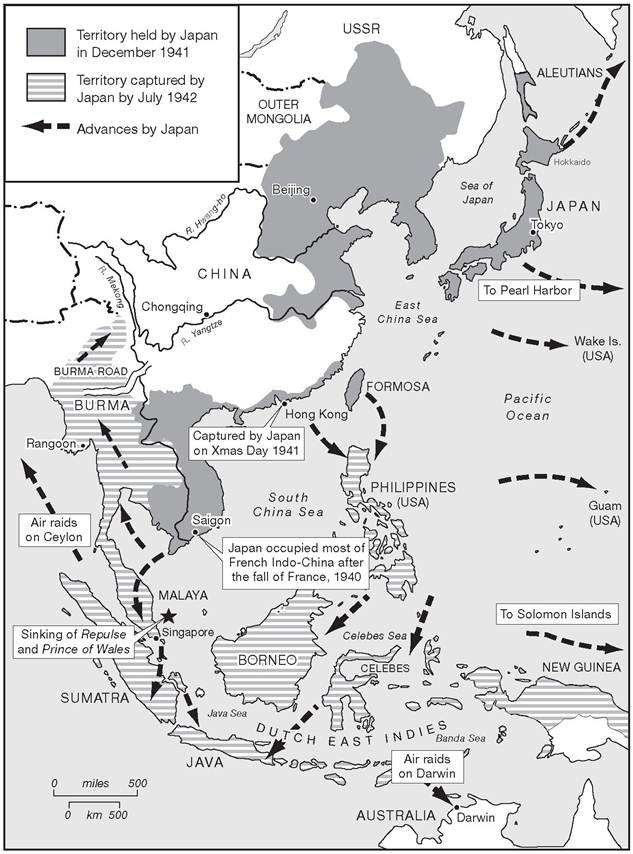
Map 8.2 Japanese expansion in Asia, 1940-42
Source: After Nye (1993)
materials.
Once the balance at sea turned against Tokyo, Japanese shipping suffered relentless attrition from American submarines. In 1943-44, Prime Minister Tojo and his ministers instituted last-ditch measures to raise aircraft production at the expense of all other sectors of the economy. Output doubled, but it was too late to do anything except prolong the agony. Too few skilled pilots were available to do more than organize suicidal kamikaze attacks on advancing American warships, while American B-29 bombers systematically fire-bombed Japan's large urban centres. In defence of the home islands, everyone expected that Japanese soldiers would die fighting rather than surrender. For that reason, Washington did not relish thoughts of an invasion; seizing the vital islands of Saipan, Iwo Jima and Okinawa from zealous Japanese defenders had, after all, already cost tens of thousands of American lives. In Washington, some argued that a promise to leave the emperor on his throne would promptly end the war, but no such pledge was possible as it would have contravened the Allied doctrine of demanding unconditional surrender. Instead, the war in the Pacific was settled with the use of atomic bombs. On 6 and 8 August, two atomic bombs destroyed the cities of Hiroshima and Nagasaki. After Hiroshima, Tokyo remained silent. After Nagasaki and the almost simultaneous entry of the Soviet Union into the war, the emperor called for peace and the Pacific War came to an end on 15 August.Italy's military performance was briefer and far less tenacious than that of Japan. As Mussolini's officials had warned, a premature European war did spell disaster. Yet in the predatory climate of 1940—41, the expansionist zeal was irresistible. As the Duce explained, Italians ‘seek to break the territorial and military chains that suffocate us in our sea'. Operationally, however, the task was well beyond Rome's reach. Italian troops who had attacked Egypt in September 1940 were three months later forced by the British to retreat back into Libya.
In October, Italy's unprovoked aggression against Greece was repelled. In November 1940, British carrier-launched aircraft sank three battleships in harbour. The economy underperformed: chronic scarcities of resources and technical backwardness were reinforced by poor organization. In 1941—42, the aviation industry turned out far fewer warplanes than ordered. Instead of propelling forward the Fascist revolution, Italians resisted full mobilization. Defeat exposed how shallow the roots of the regime really were. In July-August 1943, intense Allied air attacks and landings in Sicily initiated the collapse of the Italian economy as well as Rome's defection from the Axis. Mussolini was arrested, while his military chief, Marshal Pietro Badoglio, negotiated in secret with the Allies for an armistice. Pre-emptively, Hitler ordered the Wehrmacht to secure northern Italy while his paratroops rescued the Duce. Meanwhile, Anglo-American armies landed in the south. Italy thus ended the war as a secondary battleground for the major combatants.Fascist Italy's brief war underscores another reason why the Axis failed: there was no co-ordination in Axis strategy. Given the predatory norms of their shared view of world affairs, it is not surprising that each partner fought a separate war, and gave the other little notice before touching off another conflict. Hitler provoked the European war before Rome was ready. In starting his ‘parallel' war, Mussolini was eager to secure gains in North Africa and the Balkans without Germany. At their meeting in October 1940, the Duce did not tell the Führer of his designs on Greece, while Hitler was silent about Russia. Days later, the German move into Romania ahead of Operation Barbarossa reinforced Mussolini's anxiety about Germany's domination of the Balkans, and confirmed his decision to attack Greece. In 1941, to prop up his Italian ally, Hitler sent forces to Libya to push the British back into Egypt and diverted divisions gathering for Barbarossa to roll into Yugoslavia and Greece.
While Hitler's personal admiration for Mussolini remained unshaken, Germany's treatment of Italians as unworthy vassals became much more pronounced. After Italy's surrender, the Germans took savage revenge in the north and exploited Italian labour and wealth for their war economy. Strategic co-ordination was little better between Berlin and Tokyo. Hitler had shocked his Anti-Comintern partner by signing the Nazi-Soviet Pact in 1939. Shortly after the Japanese had signed a neutrality pact with the Soviets in April 1941, the Germans attacked Russia. Hitler's declaration of war on the United States was not an act of Axis solidarity. As Gerhard Weinberg suggests, had such unity existed, Berlin and Tokyo could have co-ordinated their wars with some success. Hitler might have sent powerful forces to break through to advance across Egypt into the Middle East, while the Japanese might have moved into the Indian Ocean and linked up with the Germans. Instead, the Japanese tried to seize Midway and later locked themselves into a long attritional battle in the Solomon Islands for Guadalcanal, while the Germans plunged deeper into Russia.unconditional surrender
A doctrine first articulated at Casablanca in January 1943 by President Roosevelt at the Anglo-American summit meeting. The view that there could be no negotiated peace with the Axis stemmed from the sharp moral distinction between the Grand Alliance and the Axis as expressed in documents such as the Atlantic Charter and the United National Declaration, as well as the desire on the part of the Allies not to repeat what they saw as the chief error of 1918—19 — that Germany had not been thoroughly beaten before the Versailles Treaty was imposed.
pan-Asianism
The idea that Asia should free itself from Western imperialism and unite in a common effort to modernize. Espoused chiefly by Japan before 1945, but some Indian and Chinese nationalists were also attracted to the concept.
Final Solution (Endlosung) The Nazi euphemism for the mass murder of European Jews.
What part did values play? Were the Axis Powers, especially Germany, doomed because they stood for evil causes and fought like criminals? Perhaps there was something to Hitler's cynical formula: ‘Once we have won, who is going to question our methods?' Alternatively, while values were not alone decisive, the ethical war shaped the final outcome. Certainly propagandists in Berlin, Tokyo and Rome thought it would do so, and worked to portray the struggle as a just cause, fought defensively against immoral foes who craved to wipe out their enemies. While the Axis legions were unstoppable, this case was simple to make. Once the bombs began to fall and reversals at the front could no longer be kept quiet, civilian morale flagged. The importance of morale depended on the context: in Italy, defeat undermined support for the war; in Germany and Japan, where public loyalty to national leaders ran deeper and was in part enforced by terror, both states could rely on at least the resigned consent of workers and soldiers, and often on much more. Omar Bartov argues that with the coming of the ideological war against Soviet Russia, the Wehrmacht became Hitler’s army, faithful to his vision of Lebensraum and race war. Moreover, the army's identification with the Führer explains why so many fought tenaciously on the long road back to Berlin. Fear and greed won the Axis many temporary allies of opportunity, but dread of an Axis victory also repelled neutrals and inspired resistance movements in occupied countries. Japanese atrocities in China, Manchuria, Korea and beyond made its pan-Asian propaganda of ‘Asia for the Asians' ring hollow. Arguably, Hitler's Final Solution, the murder of six million European Jews, diverted resources away from the front and denied the German economy millions of potential workers. Yet a balance sheet to measure this crime is a grim and difficult thing to draw up, and the scale of the mass murder was only fully exposed after the war. What is certain is that these revelations confirmed what many fighting on the Allied side had long known: that Hitler and his allies stood for an inhumane and barbaric world order.
More on the topic The Axis at war:
- Seasonality results from the tilt of Earth's axis
- ‘Roman way of war' in the title of this chapter is a variant of ‘Western way of war', the theory first articulated by Victor Davis Hanson that has been the subject of much critique, and which I do not accept.1
- CHAPTER 9 The War at Home: Toys, Media, and Play as War Work
- From European war to World War
- Capabilities for War and Operations Other than War
- during the russian-ukrainian war, which began in early 2014 and was somewhat misrepresented in Western media as a kind of Ukrainian “civil war,” rather than a Russian invasion, there emerged a number of supposedly new images of Ukrainian warriors.
- 50 War and Peace, and More War
- The state made war but war did not make the state
- No one is fool enough to choose war instead of peace—in peace sons bury fathers, but in war fathers bury sons.—King Croesus of Lydia (Herodotus I: 87)
- War or Just War
- Cold War Divisions
- WAR AS A SOVEREIGN RIGHT
- JUSTIFICATION OF WAR
- The First Gulf War