The Nature of Qing Governance
The great dynasties of China paid careful attention to government and the maintenance of order, but were also concerned with questions of equity. There were frequent periods of corruption, but during its periods of confidence and prosperity, such as the eighteenth century, the system was highly successful.
Chen Hongmou (1696-1771) was one of the most prominent administrators and thinkers on statecraft of the High Qing. Chen's visions of government were centered on the creation of an efficient bureaucracy.[2438] Chen and his contemporaries in the Qing bureaucracy showed a commitment to the traditional Chinese patriarchy, yet Chen also declared that moral excellence was inherent in all people, even commoners or non-ethnic Han Chinese. Chen and his contemporaries also put into place policies that encouraged social mobility and popular education (including literacy for women), as well as merchant enterprises, not ideas often popularly associated with Confucian norms.Wei Yuan (1794-1856), one of the most prominent thinkers of the late Qing era, wrote extensively on the nature of political participation. He was a Qing loyalist, but strongly argued that the dynasty needed to reform its administration to cope with new threats from the outside world. He did not favor populist politics, but wrote extensively about the need to extend and freshen the pool of those who could give political advice. Wei argued for a competition in ideas that would enable the ruler to choose between rival proposals, and in 1826 made his own contribution to that discussion by publishing the “Collected Essays on Statecraft.”[2439]
Yet if the eighteenth century was a period of growth and increasing power for China, the nineteenth saw the Qing dynasty disintegrate under a series of crises both internal and external. One cause of the collapse was the arrival of the Western imperial powers demanding that China should open itself for trade on their terms.
But the arrival of the Western powers was not the only crisis that endangered the Qing. The grave internal stresses and strains interacted with the external crisis, creating ultimately intolerable strains.Ironically, the success of the eighteenth-century state in expanding its territory sowed the seeds of the later crisis, as the bureaucracy did not increase to match its new responsibilities. Tax collection became more difficult in the more remote regions of China, and increasingly corrupt. Between 1600 and 1800, the size of China's population doubled to some 350 million; the number of people who were poor and dissatisfied increased also.[2440] This type of overstretch had also been visible in previous dynasties.
Nonetheless, the arrival of European imperialism was a major and disruptive new factor. The development of the East India Company by the British meant that large quantities of opium being produced in Bengal now needed a market. The Chinese
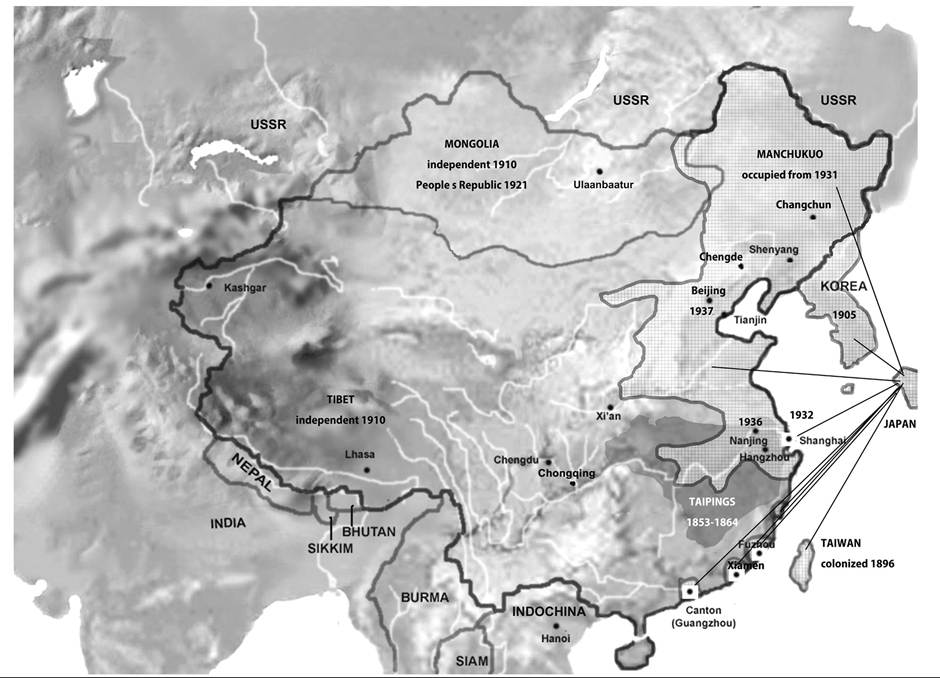
Map 39.2. Dismemberment of the Qing Dynasty and the Early Republican Era. Copyright: Pamela Kyle Crossley.
OTTOMAN TURKEY AND QING CHINA 1073
government had debated whether to legalize the drug, but then decided to ban the sale of opium within China, alarmed at its popularity and addictiveness. The British government, newly concerned with empire in Asia, took the ban, and the destruction of British-owned opium in Guangzhou (Canton) harbor, as a provocation. The First Opium War of 1839-1842 saw the Qing government defeated, and forced to concede what would be one of a long list of treaties with foreigners made under duress. Between the mid-nineteenth and the mid-twentieth centuries, Chinese governments were never wholly in control of their own territory. Foreigners under treaty rights had “extraterritoriality” (that is, they were not subject to Chinese law); a whole series of “treaty ports” were established in which foreigners had new trading rights (and some places, such as Hong Kong, were fully colonized); and new and disruptive influences, notably Christian missionaries, had to be allowed into China's exterior for the first time.
The Qing rulers, overall, remained hostile to the foreign presence within China, trying to minimize it as much as their new, weaker status allowed. Within China itself, the ordinary population showed little enthusiasm for the arrival of foreigners in their midst, regardless of whether they were bringing guns or Bibles with them. During the next few decades, there would be a rise in the sense that China was in crisis because of external interventions, which would manifest itself in the emergence of ideological nationalism among China's reformist elites, and anti-foreign anger among parts of the wider population.The foreign presence often had unexpected results. One of the most notable was the Taiping War of1851-1864. Influenced by missionaries, a delusional failed examination candidate named Hong Xiuquan from Guangdong announced that he was the younger brother of Jesus, and that he had come to lead a Christian mission to end the rule of the Manchu “devils” of the Qing dynasty. Recruiting in China's impoverished south, his Society of God Worshippers quickly attracted tens ofthousands of followers. Hong declared that he was establishing the Taiping Tianguo (the Heavenly State of Great Peace), and his army swept through China. By the early 1860s, the Taiping was effectively a separate state within Qing territory, with its capital at Nanjing, in charge of much of China's cultural heartland. The regime was ostensibly Christian, but its interpretation demanded the recognition of Hong's semi-divine status, and Taiping rule was harsh and coercive. However, the regime did manage the remarkable feat of conquering a huge area of central China for nearly eight years. For a while, it looked as if the Taiping might bring the Qing crashing down. Certainly Karl Marx had hopes of this, and of aftershocks even further afield, writing in a New York newspaper in 1853: “The Chinese revolution will throw the spark into the overloaded mine of the present industrial system and cause the explosion of the long-prepared general crisis.” Eventually, the retraining of local armies by loyal generals such as Zeng Guofan, as well as the stresses within the Taiping movement itself, brought the rebellion to an end, although not before countless people had died in what was perhaps the bloodiest civil war in history: contemporary accounts suggest that 100,000 people died in the final battle of Nanjing alone.31
The following decades did see the Qing make efforts to reform its practices, and the “self-strengthening” movement of the 1860s involved notable attempts to produce armaments and military technology along Western lines.
Yet imperialist incursions continued, and the attempts at “self-strengthening” were dealt a brutal blow during the Sino-Japanese War of 1894-1895. Fought between China and Japan (the latter was now a fledgling imperial power in its own right) over control of Korea, it ended with the humiliating destruction of the new Qing navy, and the loss not only of Chinese influence in Korea, but also the cession of Taiwan to Japan as its first formal colony.Most general histories, not least those written in China itself, have been highly dismissive of the last decades of Qing rule, regarding it as a period when a corrupt dynasty that refused to adapt to a new and hostile world was finally overthrown. For years, Marxist Chinese historians argued that the dynasty's overthrow set the stage for a new “modern” era that would eventually usher in the rule of the Communist Party of China (usual abbreviated as Chinese Communist Party, or CCP). However, it is now clear that significant steps toward modernity were taken in the late Qing, rather as happened at the same period in Ottoman Turkey.
One reason was the powerful Asian example of how reform might be carried out, in the shape of Japan. The events that had inspired yet also caused trepidation for the Chinese had followed the Meiji Restoration of 1868. A group of Japanese aristocrats, worried by ever-greater foreign encroachment on Japan, had overthrown the centuries-old system of the shogun, who acted as regent for the emperor. Instead, they “restored” the emperor to the throne under a new reign-title of “Meiji” (“brilliant rule”), and governed in his name. These aristocrats swiftly determined that the only way to protect Japan was to embrace an all-out program of modernization.[2441] They showed little of the ambiguity that conservatives in the Qing court had done. In quick succession, Japan replaced its culture of elite samurai warriors with a conscripted citizen army; the country was given a constitution that established it as a nation-state; and a parliamentary system was set up, although with a heavily limited male-only franchise.
Modernization did not mean abandonment of Japan's past, however; the traditional folk religion of Shinto was reconstituted as State Shinto, a more formalized religion that would give spiritual sustenance to the nation. Meiji Japan also intervened heavily in the economy. The end results were clear. By the first decade of the twentieth century, Japan was a growing economic and imperial power that was even able to defeat a Western power, Russia, in the war of 1904-1905. These headily swift changes in a country which the Chinese had always regarded as a “little brother” gave Chinese reformers plenty of material for consideration. Yet it was not only Japan that China turned to for a model; the Ottoman case was also known, if not fully understood.[2442]One ofthe boldest proposals for reform, which drew heavily on the Japanese model, was the program put forward in 1898 by reformers including the political thinker Kang Youwei (1858-1927). Kang was driven by the conviction that the previous vision of Chinese modernity, based on “self-strengthening,” had failed because it had not been comprehensive enough in its aims. Kang illustrated the need for more thorough reform to the emperor by putting forward two contrasting case studies: Japan, which had reformed successfully, and Poland, a state which had failed so comprehensively that it had disappeared from the map, carved up by powerful neighbors in 1795. The reforms were not just led from the top. Among the phenomena that emerged from that period of change were a greater participation by lower-level Chinese elites in the demand for popular rights, a new flourishing of political newspapers, and the establishment of Peking University, which remains to this day the most prestigious educational institution in China. The reformers also strongly advocated changes in the position ofwomen. However, in September 1898, the reforms were abruptly halted, as the Dowager Empress Cixi, fearful of a coup, placed the emperor under house arrest and executed several of the leading advocates of change.[2443]
Two years later, Cixi made a decision that helped ultimately to destroy the Qing.
In 1900, North China was rife with rumors of spirit possession and superhuman powers exercised by a mysterious group of peasant rebels known as “Boxers.” Unlike the Taiping, the Boxers were not opposed to the dynasty. Rather, they wanted to expel the influences that they believed were destroying China from within: the foreigners and Chinese Christian converts. In the summer of 1900, China was convulsed by Boxer attacks on these groups. Fatefully, the dynasty declared in June that they supported the Boxers, relabeling them as “righteous people.” Eventually, a multinational foreign army forced its way into China and defeated the uprising. The imperial powers then demanded compensation from the Qing: the execution of officials involved with the Boxers, and a sum of 450 million taels (US$ 333 million) to be repaid over 39 years. The Boxer Uprising marked the last time, until Mao's victory, that a Chinese government made a serious attempt to expel foreigners from China's territory. The Qing, unlike Mao, did not achieve their aim.[2444]That failure, and the huge financial burden and political disgrace which it had brought upon the dynasty, led to the most single-minded attempt at modernization that the Qing had ventured. In 1902, the Xinzheng (“new government”) reforms were implemented, a remarkable set of proposals to reform China's politics and society, which in many ways echoed the abortive 1898 reforms of just four years before.
This set of reforms was genuinely far-reaching. Elections were proposed at the sub-provincial level, to be held in 1912-1914, with the promise of an elected national assembly to come. The elections never happened because of the republican revolution of 1911, but it is possible to imagine Qing China transformed into a constitutional monarchy, as indeed did happen in its southwestern neighbor, Siam (Thailand), in 1932. The more immediate example to hand was Japan, and it is notable that many of the reforms of the period, such as in education, technology, and the police and military, were heavily shaped by Chinese who had learned from the Japanese example.[2445]
The elections were limited (as were most such elections in the West at the time) to elite male voters, but they were a major political change. A new commercial middle class was emerging, and the dynasty actively encouraged the formation ofbodies such as Chambers of Commerce to articulate the interests of such groups.[2446] The most significant cultural shift in the reforms came in 1905, with the abolition of the almost thousand-year-long tradition of examinations in the Confucian classics to enter the Chinese bureaucracy. When it had first been implemented, the objective, rational standards of the entrance examination had made the system far more impressive than anything the rest of the world could offer in deciding who would govern; but by the early twentieth century, the system had become inflexible, and the system had become synonymous with backwardness and conservatism to many reformers. In 1905, the dynasty replaced the system with alternative examinations in science and languages.
Despite efforts to reform, however, the dynasty did collapse in the end. There were a variety of reasons for this. First, the economic crisis of the late Qing had been worsened by the poor state of China's agricultural productivity. In addition, the imposition of favorable tariff rates for the foreign powers meant that China's capacity to produce competitively in its domestic market or for export was hampered. Despite later arguments that the impact of imperialism actually helped China to develop, the British and French were clearly not investing in China to assist the Chinese economy, but rather to boost their own imperial projects. (Japan, which swiftly renegotiated treaty rights that were over-favorable to foreigners, was rewarded as its much smaller economy grew much faster over the same period.) In addition, the Qing paid dearly for its support of the Boxer Uprising, which meant that it was faced with an immense indemnity. Debt, which had shaped the politics of the Ottoman Empire, would also be a deeply problematic issue for the Qing in its last years. Taxation revenue continued to be unreliable and marred by massive corruption in the late Qing.[2447]
But just as crucial, ever since the Taiping, authority in China had become much more localized and militarized. The huge increase in the Chinese population during the Qing had made it ever harder for the bureaucracy to cope with administering society as a whole. Tax collection, the basis on which any society operates, had become patchy and venal, with local officials adding “surtaxes” that lined their own pockets rather than going into the state's coffers. Silver shortages also led to inflation, causing further tax rebellions. Local elites had been instrumental in forming New Armies from the 1860s that allowed the threat from the Taiping and other rebels to be beaten back. But this moved influence away from the central government and squarely toward the provinces. This would be a factor when the empire finally did collapse: the ground had been set for China to divide into feuding provinces led by warlords, each with his own local army, something that would have been harder to imagine in 1800.
Finally, it may have been the reforms themselves that hastened the dynasty's collapse. The abolition of the examinations in 1905 created a huge number of
angry local elites; for instance, the kind of dispossessed literatus satirized by the great Chinese modernist writer Lu Xun in his story “Kong Yiji” (1919). For centuries, men would spend years learning the Confucian classics in the hope that they might succeed in the desperately difficult examinations that would let them rise to local and even national status in the bureaucracy. But now, the government had abolished their raison d’etre at a stroke. From 1898 onward, with the sudden ending of a promising series of reforms, too many of China’s elites no longer trusted the Qing to reform China successfully.
Among the figures dedicated to ending, rather than reforming, the dynasty’s rule was the Cantonese revolutionary Sun Yatsen [Sun Zhongshan] (1866-1925). Sun and his Revolutionary League made multiple attempts to undermine Qing rule in the late nineteenth century, raising sponsorship and support from a wide-ranging combination of diaspora Chinese, the newly emergent middle class, and traditional secret societies. In practice, his own attempts to end Qing rule were unsuccessful, but his reputation as a patriotic figure dedicated to a modern republic gained him high prestige among many of the emerging middle- class elites in China. As it turned out, however, his stock was less high among the military leaders who would have China’s fate in their hands for much of the early twentieth century.39
The end of the dynasty came suddenly, and had nothing directly to do with Sun Yatsen. Throughout China’s southwest, popular feeling against the dynasty had been fueled by reports that railway rights in the region were being sold off to foreigners. A local uprising in the city of Wuhan in October 1911 was discovered early, leading the rebels to take over command in the city and hastily to declare independence from the Qing dynasty. Within a space of days, then weeks, most of China’s provinces did the same thing. Provincial assemblies across China declared themselves in favor of a republic, with Sun Yatsen (who was not even in China at the time) as their candidate for president. Yuan Shikai, leader of China’s most powerful army, went to the Qing court to force the ruling dynasty from the throne: on February 12, 1912, the last emperor, the six-year-old Puyi, abdicated.
More on the topic The Nature of Qing Governance:
- Warfare in the Ming-Qing Context
- CHAPTER 13 CRITICAL SOCIAL SCIENCE, NATURE AND HUMAN NATURE (3RD EDITION, 2023, TED BENTON)
- The Legacy of the High Qing
- Inter-ethnic Violence on the Qing Frontier
- Qing Stability before the Nineteenth Century
- Principles of Governance
- 29 The Qing Empire
- ‘Illicit Sex', Coercion and Consent in Ming-Qing Law
- 39 Ottoman Turkey and Qing China
- Perception analysis on Indonesian university governance disclosure
- Institutions of Governance
- Z. A. Ishag, El Tigani Asil, Ali Parsaeimehr, and Guo-Qing Shao