The ‘new world order' and ethnic conflict
The United States was thus able to manage some of the problems that emerged in the Cold War's aftermath and clearly now dwarfed its former Russian rival in
terms of its military and economic power.
The idea, however, that arose in the wake of the First Gulf War, that the United States might be able to use its paramount position in world politics to bring about a ‘new world order', was soon to be tested. In some areas there were signs that with the Cold War over and the United States willing to exert its power, formerly intractable issues were now capable of solution. The most celebrated of these initiatives was the Clinton administration's eventually abortive effort to bring an end to the Israeli- Palestinian dispute. In addition, however, its ability to act as an ‘honest broker' was important in the settlement of the Northern Ireland conflict.see Chapter 18
The conflict in Northern Ireland, which erupted in 1969 on the back of the emergence of a Catholic civil rights movement, had little if anything to do with the Cold War, but the end of the East-West confrontation created a conducive environment for its resolution. Britain and the Republic of Ireland were able to focus fully on developments in Northern Ireland and the sole superpower status allowed the Clinton administration to become actively involved in the negotiations. The official beginning of the peace process came in the form of the August 1994 republican and October 1994 loyalist cease-fires, which were then followed by the 1995 Framework Documents and the 1996 elections to the negotiations. The negotiations were divided into three strands: internal Northern Irish relations, North-South relations with the Republic of Ireland and East-West relations between Britain and Ireland. Crucial to the resolution of the conflict was the establishment of a unionist/loyalist (Protestant)-nationalist/republican (Catholic) power-sharing government, regional autonomy or devolution, the decommissioning of paramilitary weapons, police reform, and the Irish Republic relinquishing its territorial claims.
This was embodied in the 1998 Belfast Agreement, which was endorsed overwhelmingly by referendum in both Northern Ireland and the Republic. From 1998 the main challenge was to ensure the full implementation of the agreement, in particular the disarmament of the paramilitaries which were reluctant to relinquish weapons that they felt might still be needed to protect their communities and that provided them with status and influence within Northern Ireland. It was only after 11 September 2001 and under tremendous American pressure that the first act of decommissioning by the Irish Republican Army (IRA) finally took place.Irish Republican Army (IRA)
Militant Irish nationalist organization formed in 1919 as the military wing of Sinn Fein. The IRA’s original aim was to establish an Irish Socialist Republic in all of Ireland. In 1969 the IRA split into the Official and Provisional IRA. The Provisionals or Provos carried out a militant campaign in Northern Ireland in order to expel the British. In 1994 the IRA called a ceasefire and Sinn Fein entered into negotiations that resulted in the 1998 Belfast Agreement which provided for power-sharing in Northern Ireland.
However, while it was possible for the United States to use its power positively to try to end those conflicts in which it had a particular interest and where both combatants saw potential benefits from appealing to American opinion and largess, the limit of its influence soon became evident. The first sign of this came as early as 1992-93, when the United States intervened in Somalia following public concern about the collapse of governmental authority after the fall of the Siad Barre regime. At first, this humanitarian intervention, which seemed to tally neatly with the optimistic sentiments that existed in the wake of the UN's successful campaign against Saddam Hussein, went well. However, slowly but surely the American forces began to be sucked into the Somalian civil war, and, with the death of eighteen US Rangers at the hands of the forces of General Aideed in October 1993, public opinion in the United States soon did an abrupt about- turn.
Thus, President Clinton's first major policy act was to withdraw fromsee Chapter 17
Somalia. Farce was quickly followed by profound tragedy, for, influenced by its inability to project American power into the Horn of Africa, in 1994 the United States did nothing to prevent the genocide in Rwanda.
see Map 20.2
If this was not enough, the ability of the United States to shape the world was also called into question in Europe, where a new crisis threatened to bring wide- scale war to the Balkans. In retrospect, the disintegration of Yugoslavia should have come as no surprise. Already in the 1970s there was a trend towards growing autonomy for the six republics and two autonomous provinces that comprised Yugoslavia after the Second World War. Following the death of Tito in 1980, the economic problems and ethnic divisions continued to deepen and finally in the early 1990s Yugoslavia violently splintered along ethnic lines. After a failed attempt by Serbia, headed by the former communist leader Slobodan Milosevic, to impose its authority on the rest of the country, Slovenia and Croatia declared their independence from Yugoslavia on 25 June 1991. The federal army responded with a brief, abortive intervention in Slovenia and a more serious effort to support the Serb minority in Croatia. However, once the genie of independence was out of the bottle, its influence soon spread. In September 1991 Macedonia declared its independence, and in October the citizens of Bosnia-Herzegovina voted for independence. Pressure from the international community helped initially to contain the crisis. In early 1992 a cease-fire was negotiated in Croatia, to be supervised by a 14,000-strong UN peacekeeping force. At the same time the EC recognized Croatia and Slovenia as independent states, and this was followed in April by the EC and American recognition of Bosnia's sovereignty. Thus, although Serbia and Montenegro declared a new Yugoslavian federation under Milosevic's leadership, the UN and the EC refused to accept that this regime was the legal descendant of former Yugoslavia, arguing that the federal state's rights and obligations had now been devolved to the new republics.
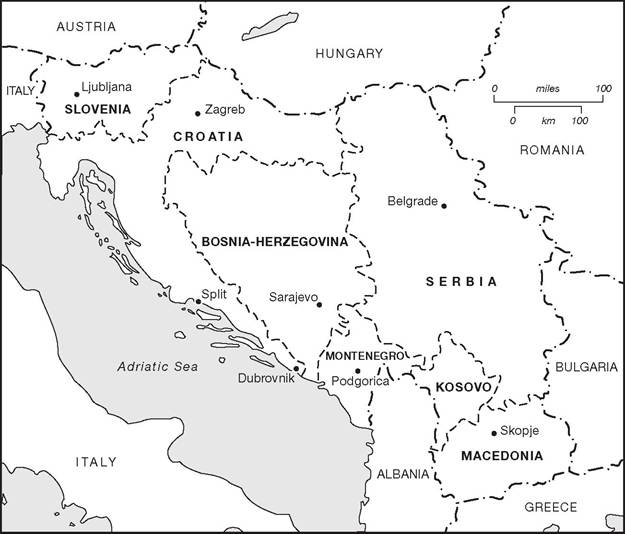
Map 20.2 The former Yugoslavia
Source: After Lindeman et al. (1993)
But, despite the rapid collapse of the old Yugoslavia, the Balkan wars were far from over, for very quickly Bosnia-Herzegovina fell into a long and bloody ethnic war. Almost as soon as Bosnian independence was declared, the Bosnian Serbs, about 30 per cent of the population, seized most of Bosnia's territory and proclaimed the Serbian Republic of Bosnia and Herzegovina. The Bosnian Croats, in turn, seized about half the remainder of the land and proclaimed the Croatian Community of Herceg-Bosna, leaving the poorly armed Muslims, who comprised more than 40 per cent of the population, to hold the rest (15—20 per cent) of the republic's territory. In a subsequent campaign of ‘ethnic cleansing' carried out mostly by the Bosnian Serbs, thousands of Muslims were killed, and many more fled the country or were placed in Serb detention camps. In response, in May 1992 the UN imposed economic sanctions on Serbia and Montenegro and called for an immediate cease-fire in Bosnia. However, this attempt to end the conflict had little effect for there was no will at this point in the major Western European states or in the United States to use coercive power. As a result, a UN Protection Force (UNPROFOR) entered Bosnia but was inhibited from making any active moves to contain the conflict.
The Clinton administration's reluctance to intervene directly in the conflicts of former Yugoslavia until it was manifestly too late to contain the brutality of ethnic cleansing was in part related to the assumption that the conflict lay within Europe's realm of responsibilities. However, Washington was perhaps even more influenced by the impact of the debacle in Somalia, which coincided with the debate over possible intervention in Bosnia. American public opinion was clearly against placing its troops in harm's way again, unless the administration could present a strong case to show that intervention in the former Yugoslavia was clearly in the national interest.
This the administration was unable, or unwilling, to do until shocking pictures of Bosnian prisoners in concentration camps and evidence of mass killings by Serb troops began to appear regularly in the news in 1994. Even then, however, instead of military intervention, the United States opted for the ‘safer' route of tightening economic sanctions. This policy, though, became unsustainable after July 1995 when Serbian forces entered the supposed UNPROFOR ‘safe area' around Srebrenica and brutally massacred 7,000 Bosnian Muslims. When this event was revealed to an appalled outside world, Washington finally began to adopt a more belligerent attitude towards the Serbs. Eventually in late 1995, with the threat of American coercion in the air, the Serbs were forced to participate in talks in Dayton, Ohio, which led to a peace accord between Bosnia, Croatia and Serbia (Yugoslavia).Even then, however, peace was not permanent. In 1997, with Milosevic newly re-elected as the president of the new Yugoslav federation, another conflict began in the province of Kosovo, where the ethnic Albanian Kosovo Liberation Army launched a guerrilla warfare campaign against Serbian rule. In consequence of the mounting repression of the ethnic Albanians, the breakdown of negotiations between separatists and the Serbs, and fear that a new campaign of Serbian ‘ethnic cleansing' was imminent, in March 1999 NATO, in its first-ever military action, began bombing strategic targets throughout Yugoslavia. In the ensuing conflict thousands of ethnic Albanians were forcibly deported from Kosovo by Yugoslav troops. At last in June, with NATO now finally talking of full-scale military intervention, Milosevic agreed to withdraw from Kosovo, and NATO peacekeepers entered the region. Meanwhile, Montenegro sought increased autonomy within the federation and began making moves towards that goal. The turbulence in the Balkans was hardly over when in September 2000 Slobodan Milosevic unexpectedly lost the presidential elections in Yugoslavia. Initially he refused to accept the victory of Vojislav Kostunica, but a series of public demonstrations and external pressure forced him to step down, and by the end of the year the United States and the European Union had begun to lift their economic sanctions against Yugoslavia. In 2001 Milosevic was arrested and indicted as a war criminal by the International Court in The Hague. His trial began in February 2002 and lasted until his death from illness in March 2006.
By the beginning of the new century the wars in the Balkans had thus come to an end and a process of reconstruction and reconciliation had begun. Yet, in an ethnically divided region plagued by memories of ethnic cleansing and the knowledge that countless war criminals were still at large, the task of building a civil society remained daunting.
More on the topic The ‘new world order' and ethnic conflict:
- Community and World Order[‡‡]
- Order in a Divided World
- Islam and Political Conflict in the World Today
- The end of the Cold War and the ‘new world order', 1980- 2000
- A new political order emerged in Eastern Europe after the First World War as nation-states replaced the empires that had, until recently, ruled the region.
- Guinea pigs (Cavia porcellus) belong to the order Roden- tia, suborder Hystricomorpha, superfamily Cavioidea, and family Caviidae. For a brief period, taxonomists proposed that guinea pigs were not within the order Rodentia, but that classification has lost favor.
- Imperial Rule and Ethnic Identity
- SECTION A ETHNIC STRUCTURE OF THE POPULATION
- African and other ethnic minority communities
- Ethnic Relations