The Paris peace settlement
In January 1919, when the representatives of more than thirty Allied and associated nations assembled for the start of the Paris Peace Conference, the First World War had claimed ten million combatant deaths and twice that number maimed.
The destruction in Europe and beyond, not to mention the spent wealth, lost trade and squandered production, defied definitive calculation. Meanwhile, along the borderlands of the Habsburg, tsarist and Ottoman empires, formerly subject peoples took up arms, while the Bolsheviks fought counter-revolutionaries (half-heartedly backed by the Western Powers) and Allied intervention forces. Despite the enormity and urgency of the task, and a great deal of preparation, the opening proceedings of the Paris Conference were marked by administrative chaos and organizational improvisation. A functioning decision-making process, supported by expert committees and commissions, took some time to develop. At first, the Council of Ten dominated. It was composed of two members each from the major Allied Powers (Britain, France, Italy, Japan and the United States). The Council of Ten, however, proved unwieldy. From March to June 1919, the Council of Four (consisting of Wilson, Lloyd George, Clemenceau and, with the least influence, the Italian Premier Vittorio Orlando) dominated and made the key decisions concerning the peace treaty with Germany (signed at Versailles on 28 June 1919). From July 1919 to 1923, the lesser peace treaties with Austria, Hungary, Bulgaria and Turkey were left to government officials and inter-Allied agencies to negotiate through regular diplomatic channels.Critics at the time and since have charged that the Paris peace fell well short of the just settlement promised by Wilson's magnificent slogans ‘peace without victory' and ‘a war to make the world safe for democracy'. The ‘Big Three' — Wilson, Clemenceau and Lloyd George — missed an opportunity to fashion a new
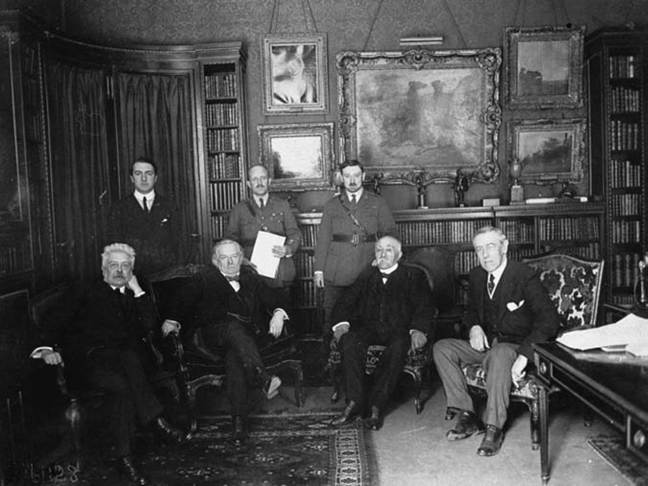
Plate 2.1 Versailles Peace Conference attendees, France, 1919.
Seated left to right: ItalianPremier Vittorio Orlando, British Prime Minister David Lloyd George, French
Premier Georges Clemenceau, and US President Woodrow Wilson. (Photo by US Army Signal Corps/Time & Life Pictures/Getty Images)
and legitimate order, so the usual argument runs, because the Europeans pursued narrow selfish interests, and because Clemenceau and Lloyd George either bamboozled Wilson or the whole exercise was one of supreme cynicism. In reality, it was much easier for a few men in 1914 to destroy the world than for their successors to replace it with something better. After the most destructive war in history, there were limits to the peacemakers’ capacity to refashion Europe. They had little real power to control the pace of events in Central and Eastern Europe. Moreover, Wilson, Lloyd George and Clemenceau did not share a common vision of the post-war order. The Paris settlement represented a series of trade-offs and compromises between the victorious Allies (most notably in the application of the principle of self-determination). More difficult still, the growing threat of anarchy and revolution in 1919—20 placed a premium on timely rather than optimal solutions. Each solution needs to be examined in its own context to be fully understood.
Take, for example, the foundation of the League of Nations. To achieve his great mission of international reform, Wilson made this task his top priority. Many agreed with the president that unbridled military competition and balance- of-power politics had made war in 1914 inevitable. Some suggested that had a permanent machinery for ‘crisis management’ and arbitration existed, then the First World War might have been prevented. Opinions varied, but a standing organization for Great Power co-operation and consultation was seen as the key innovation for future international politics. Radicals demanded the democratic control of foreign policy and a powerful world government; conservatives looked to some refinement of the old Concert of Europe.
Wilson publicly championed the radicals, who took his promises of ‘open covenants openly arrived at' more religiously than he did. Revelling in the role of Europe's saviour, the president personally took the chair of the conference's commission on the question of a new international organization in order to see his vision of a league to enforce peace through the exercise of world opinion come into being. The French, in contrast, wanted a Societe des Nations, backed by its own troops, to perpetuate the wartime alliance against Germany. Not only was there enthusiasm for a League of Nations inside and outside British officialdom, but Lloyd George also calculated that by backing the president he would ease American pressure on more contentious points, such as freedom of the seas.The strategy worked. The Covenant (or constitution) of the League of Nations was based on an Anglo-American draft. It described a system of Great Power management and made gestures towards Wilson's ideals. To promote open diplomacy, the League, based in Geneva, would consist of a Council and an Assembly, supported by a permanent secretariat. The Covenant obliged signatories to observe the rule of law in international affairs, to reduce armaments and to preserve the territorial integrity and independence of member states. Members undertook to consider collective action against covenant-breakers. To prevent another 1914, international disputes would be subject to a three-month period of arbitration. This would allow time for cool-headed diplomacy and for ‘the public opinion of the world' to mobilize for peace. War-weary people everywhere regarded the League as a break from the unscrupulous practices of the ‘old diplomacy'. In reality, it was a workable compromise between the aspirations of liberal internationalists like Wilson and the inescapable limitations of any voluntary association of sovereign states. It was not a world government, nor did any of its makers wish it to be one. As a result, the Covenant contained ambiguities and contradictions: the League would deter war by threatening covenant-breakers with universal war; all members were equal, but the Great Powers would call the shots; and, to function, the League required member states to abide by the Covenant without any binding obligation on them to do so, especially in disputes between the Great Powers.
If the League was the idealistic dimension of the peace, the German settlement was the punitive one. Germany was not dismembered — and so remained a potential Great Power — but it did lose some 27,000 square miles of territory, 6.5—7 million inhabitants and 13.5 per cent of its economic potential. In the west, France gained Alsace-Lorraine, a small border district (Eupen-Malmedy) was handed over to Belgium, and Denmark took northern Schleswig. To compensate France for the sabotage of its coal mines by the retreating German troops, the Saar valley was placed under League administration for fifteen years and its mines under French ownership for at least that period. The Saar's fate would ultimately be decided by plebiscite. The Rhineland would also be demilitarized and occupied by the Allies, who would also control the Rhine bridges. The eventual three-stage, fifteen-year evacuation of occupation forces was tied to Germany's treaty
see Map 2.1
Danzig, Free City of (Polish: Gdansk)
A historically and commercially important port city on the Baltic Sea. In 1919, the Paris peacemakers made Danzig politically independent as a ‘free city' under the League of Nations in order to give the new state of Poland free access to the sea. However, the vast majority of the city's inhabitants were Germans. The return of Danzig to German sovereignty was thus a key issue for German nationalists between the wars. Hitler exploited the Danzig question as a pretext for his attack on Poland in 1939.
see Document 2.1
Versailles Treaty
The treaty that ended the Allied state of hostilities with Germany in 1919. It included German territorial losses, disarmament, a so-called war guilt clause and a demand that reparations be paid to the victors.
compliance. In the east, Germany ceded Posen and much of West Prussia to Poland (the ‘Polish corridor’), and the German port of Danzig was designated a free city under the League, though under Polish customs and foreign policy control. Lithuania seized the German port of Memel.
Berlin also surrendered its colonies, overseas investments and much of its merchant fleet. The German navy was allowed a few obsolete ships; the army was denied heavy weapons and aircraft, and its official strength was limited to only 100,000 men.On reparations, the peacemakers deferred the difficult decisions. Everyone agreed that Germany should pay something. The real questions were: how much should Germany pay; how much could it pay; what form should payment take (money, goods or both); and over how long a period should the instalments be scheduled? The Council of Four recognized that there was an enormous gap between the entire cost of the war and Germany's capacity to pay reparations. Indeed, what constituted the ‘entire cost of the war’ was a major issue. There were also serious technical limitations on transferring wealth from one nation to another. Consequently, in order to address Germany’s theoretical responsibility for the entire cost of the war while in practice limiting its financial liability, the peacemakers inserted two Articles, 231 and 232. In the first, later misleadingly dubbed the ‘war guilt’ clause, Germany and its allies accepted responsibility for the ‘aggression’ of 1914 and its consequences, while the second required Germany to provide compensation for specified civilian damages. Ironically, therefore, the original purpose of Articles 231 and 232 was to protect Germany from the economic ruin of making good on war costs. Finally, instead of fixing a final figure in 1919, the Versailles Treaty only demanded an interim payment of 20 billion gold marks before 1 May 1921 (to pay for the Allied occupation), the date by which the inter-Allied Reparations Commission was to determine a total.
Document 2.1
Extracts from the Treaty ofVersailles
Article 231
The Allied and Associated Governments affirm and Germany accepts the responsibility of Germany and her allies for causing all the loss and damage to which the Allied and Associated Governments and their nationals have been subjected as a consequence of the war imposed upon them by the aggression of Germany and her allies.
Article 232
The Allied and Associated Governments recognise that the resources of Germany are not adequate, after taking into account permanent diminutions of such resources which will result from other provisions of the present Treaty, to make complete reparation for all such loss and damage.
The severity of Versailles cannot be blamed on any one Power. All the peacemakers combined policies of conciliation and punishment. For Clemenceau, French security was paramount, and that could only come in one of three ways.
The first was by permanently weakening Germany. The second was by seeking a lasting and mutually beneficial Franco-German accommodation. The third was by way of a security alliance with the United States and Britain. The French tried all three without much success. Despite secret overtures to Berlin proposing a German commitment to treaty compliance in return for a promise of future treaty revision, there was no chance of such a deal flourishing in the poisonous air of 1919. It was feared in French circles that the Treaty of Versailles would only temporarily strengthen France and cripple Germany. General Foch, the Allied supreme commander, therefore proposed a more permanent solution: France should hold on to the Rhineland as a strategic buffer. Fearful of creating ‘an Alsace- Lorraine in reverse' and mindful of self-determination, Lloyd George and Wilson refused. Instead of a detached Rhineland, France was offered Anglo-American Treaties of Guarantee against unprovoked German aggression. Clemenceau, who would not have otherwise relented, regarded the guarantees as the ‘keystone of European peace'. Unfortunately, the guarantees fell through when the American Senate rejected the Treaty of Versailles in November 1919, and British adherence was conditional on American.
The collapse of the Anglo-American guarantees epitomized France's frustration at the hands of its wartime Allies. It was typical of Lloyd George's opportunism that the British treaty would only come into force if the American one did. His double-dealing would not have mattered had London not pursued a balance-of-power policy — that is, with France cast in the role as the next European hegemon. With Germany's navy sunk and its overseas possessions confiscated, the British cabinet could safely regard its former enemy as the counterweight to what it wrongly perceived as an aggressive France bent on mastery of the European continent. Britain should stand back from Europe, and allow the free play of inter-state rivalry to give rise to a new equilibrium. Balance-of-power calculations such as this blocked British strategic empathy with France. British officials could not see that French security and Franco-German reconciliation were essential to peace, and that France needed Britain in order to feel secure against Germany. Lloyd George's handling of reparations was also questionable. Because Britain had suffered little direct civilian damage from the war, the prime minister insisted that pensions payable to servicemen and their dependants should be included to increase Britain's share of reparations. Even if this blatant violation of the pre-armistice agreement had little impact on the total sum claimed by the Allies, there is no doubt that it helped to undermine the moral authority of the whole settlement. Moreover, fearing a backlash in Parliament if the total for reparations was too moderate, Lloyd George pressed his fellow peacemakers to postpone the painful decisions for two years. Ironically, French officials, who are often portrayed as the villains on reparations, at first proposed very moderate sums based on civilian war damages in accordance with the pre-armistice agreement. They also considered partnership with Germany on iron and steel production as an alternative means of taming the economic might of their former enemy.
Wilson, like Lloyd George, must also take responsibility for the post-war blight of reparations. Although the United States emerged in 1919 as the world's largest
Marshall Plan
Officially known as the European Recovery Programme (ERP). Initiated by American Secretary of State George C. Marshall’s 5 June 1947 speech and administered by the Economic Cooperation Administration (ECA). Under the ERP the participating countries (Austria, Belgium, Denmark, France, Great Britain, Greece, Iceland, Italy, Luxembourg, the Netherlands, Norway, Sweden, Switzerland, Turkey and West Germany) received more than $12 billion between 1948 and 1951.
creditor nation, the American government refused to combine inter-Allied war debts, reparations and reconstruction into one big package. According to Marc Trachtenberg, an American cancellation of war debts and a contribution to reconstruction would have resulted in moderation on reparations. In striking contrast to the generosity of the Marshall Plan in 1947, American ‘tight- fistedness’ in 1919 ensured that the Allies burdened the Weimar Republic with reparations. American policy stemmed more from Wilson’s moralistic approach to international politics than from any narrow American financial interests. Germany had started the war and so the Germans must pay as an act of penance. Until justice had been done, Wilson reasoned, Germany must be treated as a moral inferior and barred from the League of Nations. The conviction that Germany had to be punished before it could be rehabilitated, however, could not be squared with Wilson’s reluctance to commit the American might to peace enforcement. For precisely the opposite reason to Lloyd George — namely, the president’s hostility to balance-of-power politics — Wilson in like manner failed to understand the French position. What France needed was American and British backing to promote a sense of security and reconciliation with Germany; instead, France was largely stranded with an inherently more powerful neighbour, whose hostility was compounded by an indemnity and ‘war guilt’, both of which were contained in a treaty that presupposed Germany’s voluntary compliance.
More on the topic The Paris peace settlement:
- The Paris peace settlement in Central and Eastern Europe
- 1Centre de Recherche des Cordeliers, Universite Pierre et Marie Curie - Paris 6, UMRS 872, Paris, F-75006 France; Universite Paris Descartes, UMRS 872, Paris, F-75006 France; INSERM, U872, Paris, F-75006 France; 2Laboratoire d
- Paris-Verkhivnia-Paris (1848-50)
- The Peace to End all Peace?
- THE PARIS OF SIBERIA
- Settlement, Sulh, Arbitration
- Settlement
- Settlement colonialism in the age of mass migration
- PART THREE From Paris to Verkhivnia and the Sich: The French Connection
- Regulation of Legal Negotiation and Settlement
- Inner Peace
- No one is fool enough to choose war instead of peace—in peace sons bury fathers, but in war fathers bury sons.—King Croesus of Lydia (Herodotus I: 87)
- Chapter 9 Simulating Land Use of Prehistoric Wetland Settlements: Did Excessive Resource Use Necessitate a Highly Dynamic Settlement System?