The Sasanian Revolution and the Creation of Eränsahr
The Sasanian dynasty appears in Iranian history first as a family of local strongmen who systematically eliminated their neighbors within the province of Pärs. This view is present even in Tabari, who reflects late Sasanian official sources.[806] They seized more and more of the province before finally overthrowing the king of Pärs and extending their control over neighboring regions.
Ardawän IV eventually marched against Ardaxsir I to reassert Arsacid control; however, on April 28, 224, in the battle of Hormozdgan, Ardaxsir I defeated the Parthian force, though it would take another four years to remove the last Arsacid resist- ance.[807] In the next five years Ardaxsir I quickly asserted control over the lands of the Parthian Empire, eliminated the Arsacid pretender Vologases VI ca. 228, and began extirpating or supplanting the Arsacids’ legacy. The Arsacid dynasty lived as the royal family of Armenia and periodically reasserted itself there under Roman protection until it was finally extinguished in 428. Even so, other Parthian noble families, such as the Mihrän, Süren, Kären, and Waräz, came to terms with the new royal dynasty and formed one of the powerbases of the empire until its fall in the mid-seventh century.[808]The Sasanians understood themselves to be the latest in a long line of Persian and Iranian rulers, stretching back to the primordial dynasties of ancient Iran.
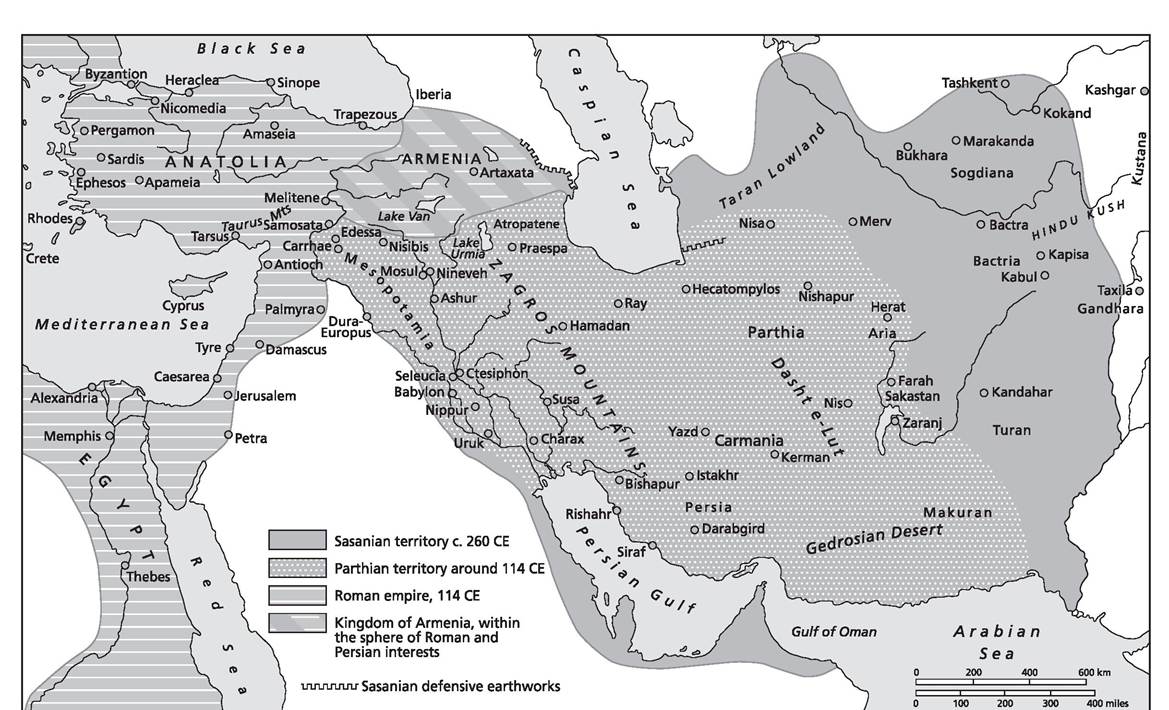
Map 10.1. The Parthian and Sasanian Empires.
Source: Bang and Scheidel, 2013, The Oxford Handbook of the State in the Ancient Near East and Mediterranean, p. 206. Copyright: Oxford University Press.
THE PARTHIAN AND SASANIAN EMPIRES 295
Ardaxsir I forged the idea of Eransahr, “the kingdom of Iran” and thus all Iranians, at which Persia stood at the center.
This no doubt capitalized off of ideas of the “Aryan Lands” in the Avesta, that is, the oldest sacred texts of the Zoroastrian religion, in which many Iranians shared through vernacular epic traditions as well as half-remembered Achaemenid traditions, though it clearly was a new creation for a new political reality.[809] Ardaxsir I called himself “King of Kings of Iran” in his official titulature, which Säbuhr I expanded after his Roman Kushan victories to “King of Kings of Iran and Non-Iran.”Ardaxsir I and his son and successor Säbuhr I (240-272/3) expanded the empire into Bactria and Gandhara at the expense of the Kushans.[810] In the west, the Sasanians took Nisibis and Carrhae (235/6) and destroyed Hatra (240/1). This set off decades of conflict with the Romans, from which the Sasanians, for the most part, emerged victorious.[811] Säbuhr I succeeded in turning back a Roman invasion (244), causing the emperor Philip the Arab to sue for peace. Säbuhr I went on the offensive, exerted control over Armenia, and in the course of invading northern Syria, destroyed a 60,000-man Roman army. Säbuhr I even captured the Roman emperor Valerian (253-260) in the process, which he celebrated in his later rock reliefs. The king of kings invaded the Roman Empire, sacking Antioch, and he deported its inhabitants to populate several cities he founded or refounded to commemorate his campaigns, such as Weh-andiog-säbuhr (“Better Antioch of Säbuhr”) in Khuzistan. The king of kings exploited these victories to maximum effect in the triumphal imagery and architecture of his reign, most notably at his newly founded city of Bisäbuhr (N. Pers. Bisäpür) in Pärs and hydrologic works at Süstar in Khuzistan, where the works of Roman craftsmen and engineers are readily perceptible.[812]
Relations between the Roman and Sasanian empires stabilized after the Tetrarchy, which put Rome on an even footing with Persia and reasserted Roman power in Armenia and in northern Mesopotamia.[813] Despite constant hostilities, this period witnessed the beginning of the development of a system of diplomatic interaction between the Roman and Sasanian courts that would persist and develop until the Muslim invasions.[814] Hostilities that had been building between Säbuhr II (309379) and Constantius II (317-361) eventually came to a head when Julian (360363) invaded Mesopotamia with an 80,000-90,000-man army.
After initial success, Julian died from battle wounds. This forced the Romans to sue for peace and give up control over those territories that the Tetrarchy had conquered. Armenia still lay at the center of Roman and Sasanian conflicts in the late fourth, fifth, and sixth centuries, leading to its eventual division and dismemberment among numerous instances of intervention by both Persia and Rome.[815] While Persia's conflicts with Rome are better known and documented in greater detail, during the fifth and sixth centuries, the Sasanians expended a great deal of resources defending their northern borders from the powerful steppe empire of the Hephthalites.[816] The reigns of Peroz (459-484), Walaxs (484-488) and Kawad I (488-506 and 499-531) were each marred by disastrous defeats at the hands of Hephthalites, which allowed them to intervene in Sasanian dynastic conflicts.[817]The long reign of Husraw I (531-579) brought the late Sasanian Empire to one of its peaks of prosperity.[818] Husraw I is celebrated in the Islamic sources for reforming many aspects of the empire's administrative and military structure.[819] Coinciding with the equally long reign of Justinian I, Roman and Sasanian diplomatic exchange flourished. Despite almost continual conflicts, it facilitated a high degree of cultural exchange and intimacy between the courts.[820] Under Ohrmazd IV (579-590), the rise of the first Turk Khaganate and eventual alliance with the Romans threatened Sasanian control over the Silk Road trade again and put pressure on their northeastern borders.[821] A revolt by a popular Parthian general Wahram Cubin led to Ohrmazd IV's overthrow and replacement by his son Husraw II (591-628). Wahram Cubin forced Husraw I into exile and only with assistance from the Roman emperor Maurice (582-602) was he able to regain the throne.
The second reign of Husraw II brought the Sasanian Empire to the height of its power and, albeit briefly, spread Persian hegemony from the Nile to the Indus.
Husraw II used Phocas' s (602-610) coup against Maurice as a pretext to invade the Roman Empire. Hostilities did not cease even after Heraclius (610-641) overthrew Phocas and was proclaimed emperor. The Sasanians succeeded in capturing Egypt, the Levant, and Anatolia, which the empire held for almost a decade. Heraclius mounted a counter-offensive and invaded the heartland of the Sasanian Empire as the Sasanians besieged Constantinople. Heraclius forced the Sasanian army to retreat, stopping short of capturing Ctesiphon.[822] The Roman invasion eventually caused the overthrow and execution of Husraw II in 628 and ushered in a period of instability that left the Sasanian Empire vulnerable to the Arab invasions. The last Sasanian king, Yazdgerd III (632-651) spent the majority of his reign fleeing the Arab advance eastward. After his murder in Merv, all meaningful resistance collapsed, though Yazdgird's sons and their descendants found refuge in the Tang Empire and lived on for several centuries thereafter, first as a court in exile and eventually as Tang courtiers and officials.[823]While many ancient Mesopotamian cultural, religious, and urban traditions thrived through the Seleucid era, the Parthian and Sasanian periods oversaw the dramatic transformation or final eclipse of many of Western Asia's most enduring traditions. A number of cultural and religious traditions fell into abeyance or disappeared altogether. The great temples and architectural styles of Mesopotamia lost their relevance and were replaced with new traditions, including, for the first time, a widespread and enduring tradition of vaulted and domed architecture applied to palaces and fire temples. Within Parsa/Par, of the languages that the Achaemenid Empire used for official inscriptions and record keeping, Old Persian, Elamite, and Babylonian fell out of use, and knowledge of their cuneiform writing systems disappeared permanently. Within Babylon, cuneiform writing and archives survived the first two centuries of Parthian rule as a local tradition before disappearing entirely in the early first century ce, though some may have still been able to read it into the next century.[824] Only Aramaic, which the Seleucid bureaucracy adopted alongside Greek, flourished as a language of official communication across the empire. In the Parthian and Sasanian empires, Greek persisted as a prestige language and, more significantly, new writing systems for Iranian languages emerged from Aramaic scribal conventions.