The Upswing in Baltic Trade
Baltic trade boomed during the eighteenth century. The duties collected for passage through the 0resund may be gauged by the fact that the number of ships passing through the Sound grew steadily throughout the entire century.
Even the War of Polish Succession, which weighed heavily on Danzig, and the Seven Years’ War caused only minor and brief downturns. Despite short-term fluctuations, Baltic trade remained essentially stable.The Sound was during this period the busiest waterway of the world. Around 1730, more than 2,000 ships sailed annually through the Sound into the North Sea, carrying freight of c. 400,000 tons. This volume rose by 1750 to more than 500,000 tons, which would be four times the annual tonnage of the Atlantic slave trade.[632]
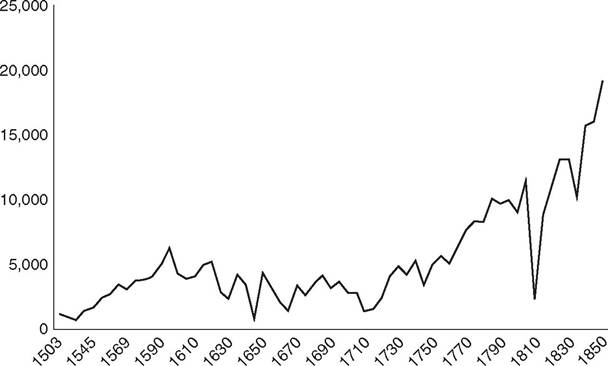
Figure 8.1 Ship passages through the Sound (0resund), 1503-1850.30
Dutch trade with the Baltic during the eighteenth century grew slightly at a time when other sectors, such as herring fishing and commercial production, lagged. If not for the Baltic trade, the Dutch economy overall would have fallen even further behind the expanding English economy than was already the case. Dutch ships continued to dominate the Baltic trade over almost the entire eighteenth century, even though their share declined from 50 percent (1711-29) to 27 percent (1771-80). The English and Scandinavian shares filled the gap: English shipping increased to 26 percent (1771-80) and Scandinavian to 28 percent (1771-80). The English benefited from the structural changes taking place in the Baltic region, where the demand for textiles and colonial products replaced that for herring and salt.[633] [634] Accordingly, English ships now supplied the new Russian port of St Petersburg with English textiles and colonial re-exports such as sugar, coffee and tobacco. Swedish ships took over the transport of timber and forestry products from the Baltic region to Great Britain.[635] If we analyse shipping traffic through the 0resund between the Baltic region and the ports of destination, between 1784 and 1795 Amsterdam outstripped all other Western European ports in that regard (including London, Hull, Bordeaux and Lisbon).[636] However, even shipping nations not known for their Baltic trade, such as France, increasingly sent ships there. Not only did they supply Konigsberg, St Petersburg, Stockholm, Danzig, Stettin, Copenhagen and Lübeck with wine, salt and colonial products, but also they returned with products important to their own domestic shipbuilding industry, including wood, forestry products and metals.[637] The re-export of French and colonial products (such as coffee, sugar and cotton cloth) through Hamburg to the Baltic region should not be underestimated. This trade was conducted using Dutch and, increasingly, merchant ships sailing out of Hamburg. To measure the importance of the region to the Dutch and English economies, we must compare Baltic imports with those from other regions. While the entire volume of English trade between 1701 and 1800 grew from £4.37 million to £20.42 million, the individual maritime regions participated unequally. For example, the Atlantic region (West Indies, America and Ireland) registered the most explosive growth, from £1.21 million to £8.94 million, with 43.8 percent of imports coming from the Atlantic region. The proportion of trade with Asia was relatively small at the beginning of the eighteenth century (10.9 percent); by the end of the century this trade made up about a fifth of English imports. The proportion from the Mediterranean region decreased from 21.3 percent (1701-10) to 10 percent (1791-1800). The North Sea- Baltic region is of particular interest. At the beginning of the eighteenth century (1701-10), this trade contributed 40 percent of imports; that figure had decreased to about 25 percent during the ten-year period between 1791 and 1800. This trade dynamic is also reflected in shipping traffic. Shipping to the East Indies increased slightly and traffic across the Atlantic more strongly, whereas trade with the Mediterranean region decreased significantly and traffic between the North Sea and the Baltic region decreased slightly. When we look at differences between North Sea and Baltic shipping, we again see a decrease in northwestern Europe and an increase in shipping traffic with the Baltic region. Also clearly visible is the importance of trade in mass-produced goods with the Baltic, which required relatively more shipping capacity than such trade was worth by weight. A reconstruction of Dutch imports in the 1770s yields a comparable picture. At 17 million guldens, the Baltic region ranked just barely behind Great Britain, Asia, French colonial re-exports (each 20 million guldens) and the Western Hemisphere (Atlantic) with 18 million guldens.[639] The evolving role of the Baltic region in the world economy also reflected structural changes, with the most important Baltic ports belonging to the Russian Empire, especially St Petersburg. Nonetheless, Danzig, not to mention Stockholm, which was privileged by the Swedish state, continued to play an important role. Stockholm’s trade was so successful that in 1765 it relinquished its previous monopoly on the tar trade and allowed Finnish ports to traffic in tar, which greatly increased Finnish shipping. Merchants from Stockholm and Gothenburg used credits given to iron producers to stimulate exports to Western Europe through its ports. Gothenburg also grew in importance as a result of the founding of the Swedish ‘Ostindiska companiet’ in 1731. After the 1721 Treaty of Nystad, Danzig once again became a supplier of grain to Europe such that annual grain exports (1721-30) came to about 36,000 lasts. This trade dropped to only 20,000 lasts in the 1740s and 1750s, but in the 1760s it topped 40,000 lasts. Danzig also remained an important exporter of timber products, but it was able to defend its leading role in the Baltic only with respect to potash. Danzig ships were involved in about a tenth of the shipping to Western Europe.[643] However, ships coming from the west increasingly sailed to Konigsberg, Riga, St Petersburg, Narva and Viborg. One advantage of these ports was their specialised assortment of wood products. A snapshot of the 0resund is illuminating. The most valuable export goods were the thick balks (beams) used in both ship and house building, which came from Narva and Riga, and then at the end of the eighteenth century increasingly from Memel and its Lithuanian hinterland. Planks were thinner and were offered at most of the ports. Planks may also be distinguished from the even thinner deals, which were available from ports in the Gulf of Finland, but also from Memel and Danzig. Smaller staves were used primarily to make wine casks; these were prefabricated mainly in the hinterlands of Memel, Danzig and Stettin. In terms of size, masts were the largest timber products, and they came primarily from Riga.[644] The huge Western European demand for shipbuilding materials led in the long run to deforestation and displacements in the Baltic hinterlands. As the resources dwindled in Poland and East Prussia, timber harvesting and tar production shifted to the northeastern areas, such as Finland, which is still one of the largest timber and paper producers of the world. The ports of destination for timber exports document the demand for timber in Amsterdam, although the traffic to English ports was even greater. In Bordeaux and other French ports, barrel staves for French wine and cognac exports were even bigger sellers. Pitch and tar from Sweden and Finland were important imports as well. Dutch merchants were especially interested in Riga’s exports, which included ash, flax, hemp, linseed and hemp seed, while the English shopped for different types of timber. The Dutch dominated the Riga trade into the 1770s, with English merchants and ships catching up with the Dutch in about 1780 as a result of their greater timber imports.[645] After the founding of St Petersburg, Dutch and especially English ships dropped anchor there. No Russian merchant fleet yet existed; at the most Russia had only a few ships, captained mainly by Dutch sailors.[646] The main trade - if we exclude supplying the new court with Western European luxury goods - was in flax and hemp, with hemp export double that of Riga after the 1740s. There was also a demand for tallow in Western Europe, which had mainly been obtained from Arkhangelsk, and for Russian leather. Timber exports were banned by the Russian state in 1754, and it was only after this ban was lifted in 1783 that St Petersburg again became a more important timber exporter.[647] However, the most important export product from St Petersburg was pig iron, whose production had greatly increased since the 1730s and had even outstripped English output. In about the middle of the eighteenth century, before the English Industrial Revolution gained steam, Russia had been the largest European iron exporter, exporting 75 percent of the iron it produced, primarily to England.[648] Because exports from the Baltic region were worth more than the imports from Western Europe, Western European countries were regularly forced to make up the difference in precious metals. In the eighteenth century, for example, approximately two million reichstaler were transported annually from Western Europe to the Baltic region. These monies went to producers in the hinterland, but they also flowed farther east in the Russia trade. During the expansion of English-Russian trade in the eighteenth century, St Petersburg and Riga registered, without doubt, the largest export surpluses. As a result, much of the precious metal sent to the Baltic ended up in those cities. England paid for most of its purchases with Dutch coins or with bills of exchange drawn in Amsterdam. The bills of exchange, which could be used to make cashless payments in Baltic ports, came due in Amsterdam, and the cash flowed from there to the merchants and then on to the producers in the Baltic region.[649]