The wedding ceremony of the sea, celebrated each year on Ascension Day in Venice, reminds us of the first important naval campaign that the Venetians undertook, in the year 1000,
when Doge Pietro II Orseolo sailed out to ensure the sovereignty of San Marco over the northern Adriatic. The Rite of Marriage articulated strong political meanings—namely, rule over trade routes, water itself, as well as the overseas populations that were subject to the Most Serene Republic.
It was an imperial rite aimed at emphasizing the autonomy of Venice vis-à-vis both the Holy Roman Empire and Byzantium. Once a remote province of Byzantium, Venice gradually severed itself from imperial tutelage, while maintaining both ceremonial and some political practices in the Byzantine style. They had, by the tenth century, gained full independence. Venetian law, for example, differed from Roman law, whose influence was widespread throughout the rest of the continent. And from the midfifteenth century, after the fall of Constantinople, Venice increasingly showed its willingness to take up the Byzantine imperial legacy and to propose itself as a new “second Rome.” In this context, the use of administrative language recalling the ancient Roman constitution, the transition from the Byzantine architectural style to a Roman one, the strengthening of the symbolic and spiritual role of the doge, and the claim of equality in rank and dignity to kingdoms and even to the Holy Roman Empire—all of these are elements that testify to the new cultural and ideological construction that was emerging in Renaissance Venice.1Beginning in the fourteenth century, the Republic of Venice was run by a patrician oligarchy made up of families that enjoyed the right to enter the Great Council, the large assembly that elected the offices of government. It also selected the doge, the highest representative of the sovereign state, who held the office until his death. But the actual governing organ was the senate, which was composed of about 200 patricians who were made to alternate time in office.
It was the senate that decided on major issues concerning foreign policy, trade, finance, and so on. From the fourteenth century, the government began to establish various boards dealing with economic issues. The number of offices increased over time and their jurisdictions came to overlap, according to Venetian constitutional philosophy. It is worth stressing that all the magistrates were patricians and used to hold their offices for a relatively short period (from just a few months to a year and a half).1 Muir 1981; Lebe 1978; Tenenti 1982.
Luciano Pezzolo, The Venetian Empire In: The Oxford World History of Empire. Edited by: Peter Fibiger Bang, C.A. Bayly, Walter Scheidel, Oxford University Press (2021). © Oxford University Press. DOI: 10.1093/oso/9780197532768.003.0022.
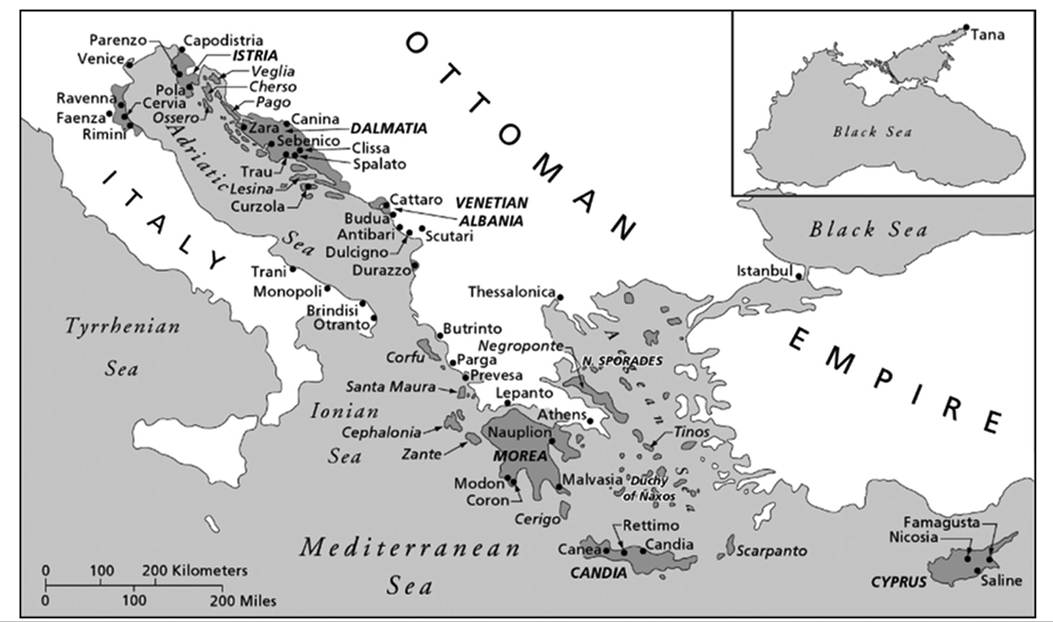
622 LUCIANO PEZZOLO
Map 22.1. The Venetian Empire.
Source: Dursteler, 2013, A Companion to Venetian History, 1400-1797, p. 126. Copyright: Eric Dursteler.
The symbiotic relationship between the lagoon city and the sea was considered so strong and binding that as soon as Venetians appeared to turn to the land, many voices were raised in protest: accusations were made of identity crisis, betrayal, as well as moral and economic decline. In reality the land and sea were not opposed in Venice's destiny, for these two elements came to constitute a larger whole. The Republic's conquest of an extensive territory in northeast Italy in the early fifteenth century was undertaken with the purpose of reinforcing its maritime interests. The control of the mainland proved necessary both to prevent the formation of a powerful, hostile regional state in the hinterland of the lagoon and to protect access to the inland trade routes—rivers, roads, mountain passes—that linked Venice to the markets of northern Italy and continental Europe. It was certainly the case that, from the sixteenth century, the Republic's ruling patriciate shifted its primary economic interests away from traditional maritime mercantile activity toward landowning.
However, the maritime character of the state as a whole was not weakened: it continued to defend its overseas territories, from Istria to the eastern Mediterranean, with substantial military and financial resources. At the end of the seventeenth century, in fact, Venice even went to war to conquer the Peloponnese, thus seeking to acquire another kingdom in the Aegean as a way of compensating for the loss of Crete, which was conquered by the Ottomans only a few years earlier after centuries of Venetian rule.The Venetian dominion extended over a wide area. Dispatches traveled between the capital and Zara in 10 days, between Venice and Crete in 40.[1619] Since news traveled faster than goods, the time for transport of people and goods was longer. A couple of months were necessary to get to the furthest reaches of Venice's overseas territories. The logistical problems facing Venice were no different—in terms of time—from those of London and its empire in the nineteenth century.