Violence, Slavery and Race in Early English and French America
CECILE VIDAL
In 1843 the jury of the Louvre Salon in Paris refused an oil painting submitted by Marcel Antoine Verdier, a former student of Jean Auguste Dominique Ingres, claiming that it could ‘raise popular hatred against slavery'.
It was then shown in a Parisian counter-exhibition with other paintings that had been refused. Entitled ‘Chatiment des quatre piquets dans les colonies' (‘Punishment of the Four Stakes in the Colonies') in the catalogue, the large canvas (approximatively 147.5 x 210 cm) represents a scene of violence taking place on a Caribbean plantation. The corner of a wooden shack, a few leaves of a banana tree and a landscape stretching into the distance recall the crude and exotic character of life on tropical islands. The viewer's attention, however, is first drawn to the people in the centre of the foreground: a black man, entirely naked, with his clothes and iron collar and chain strewn beside him, is lying on the ground on his stomach, tied to four stakes. His nakedness and prone X position deprive him of any possible modesty. He is on the verge of being flogged by a black man, very likely the driver of the plantation, who has raised his whip in the air ready to inflict a lash. Just behind the driver on the right, a slave on his knees is pouring something from ajar, as ifhe may be preparing the mixture of hot pepper and lemon juice put on the wounds after the flogging. On the left, two slaves, a man and a woman, are waiting to be punished. In the background, other enslaved men and women appear busy working, paying no attention to the punishment.In contrast, the scene of violence is watched by the planter leaning casually against the shack and by his wife sitting next to him and holding in her arms their young child, who also watches the flogging. The mistress is attended by a domestic slave, kneeling in front of her and turning her back to the scene as if she was protecting the white woman.
Next to them, a naked black toddler crawls on the ground playing with the chain of the chastised slave while a dog sniffs at him. The proximity of the toddler and the dog stresses the process of animalisation involved in this mode of punishment. Skin colour and body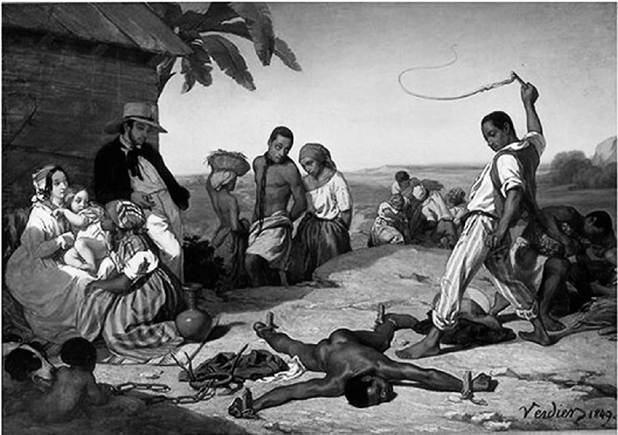
Figure 2.1 Marcel Antoine Verdier, Chdtiment des quatre piquets dans les colonies (Beating at Four Stakes in the Colonies), oil on canvas, 1843.
language as well as degrees of nakedness and diversity of apparel are used by the painter to convey the racial divide between masters and slaves and the social hierarchy among enslaved labourers. Every detail in the painting aims to present such a scene of extreme violence as ordinary. As violence was central and normal in the daily operation of a colonial plantation, it had to be taught to the next generation of both masters and slaves. It both linked and separated everyone on the estate across status, race, class, gender and generation. At the same time, this customary violence set aside colonies from the metropole as exceptional places.
The practice of punishment painted by Verdier was so common that the leading abolitionist Victor Schrelcher referred to it twice, using the expressions ‘to inflict' or ‘to give a four stakes' without any explanation, in his book Des colonies franfaises. Abolition immediate de l'esclavage, published for a metropolitan readership in 1842.1 Four years later, Joseph France, a gendarmerie lieutenant who had served in Martinique, published another abolitionist pamphlet in Paris. In order to condemn the ‘regime of discipline' on which the slave system
1 Victor Schrelcher, Des colonies franfaises. Abolition immediate de I'esclavage (Paris: Pagnerre Editeur, 1842). rested in the Antilles, he insisted first on the whip and then on ‘the three and the four stakes'.[55]
The emphasis that nineteenth-century abolitionists put on this specific form of punishment was no distortion of reality for the sake of propaganda.
It appeared very early on with the development of slavery in the French Antilles, and was not only transmitted across generations within the same plantation but also transferred over space and time between colonies and through centuries. In an edited version of his account of his travels to French Louisiana, former officer Jean-Frangois-Benjamin Dumont de Montigny mentioned that masters there resorted to a mode of chastisement they had learned from Saint-Domingue planters. Even though he did not use the name, the practice he described was the ‘three stakes'.[56] Yet, in their interrogatories and testimonies before the Superior Council, a judicial court, French Louisiana slaves repeatedly referred to the ‘four stakes'. In 1748, Pierrot, a Bambara employed as a cowherd, explained to the judges that he was very careful not to lose any cows because his master would order four stakes to be made ready for him otherwise. In 1766, Democrite revealed that, in a conflict with another enslaved man who was a stranger to the local slave community, he had threatened the outsider ‘to have him tied up to four stakes to flog him' if he came back.[57] The practice had such a symbolic significance that it had been appropriated by slaves to deal with their own internal conflicts. The long history of the ‘four stakes' within the French Empire testifies to the inherent character of violence in racial slavery.Slavery as it developed over the early modern period in every American colony under European sovereignty, particularly those of the English and the French in the Caribbean and in North America where the large majority of the enslaved were of African descent, was a labour regime, a form of property and a specific mode of social domination in which violence played a crucial role. Violence was intrinsic to the slave system, particularly within slave societies, that is societies in which slavery was ‘pivotal to the entire institutional structure and value complex', on which this chapter focuses.[58] This idea is not only a retrospective judgement by twenty-first-century historians.
Social actors at the time viewed American chattel slavery as a particularly violent institution. This was true of slaves and of abolitionists, but also of proponents of slavery and of other white people with mixed feelings about the institution.The tight interplay of slavery and violence came from the fact that the enslaved were legally the chattel property of other men or women, and as such found themselves under the permanent personal domination of their owners. Moreover, as natural growth amounted to zero or was negative in most slave societies - with the exceptions of Barbados and the southern English colonies in North America in the second half or at the end of the eighteenth century - the slave order was always weakened by the massive arrival of new captives from Africa who had to be taught the slave system. This highly unequal and exploitative social order could never become self- evident; it remained contested. Chattel slavery sparked off violent reactions from enslaved men and women. The production and reproduction of the slave order therefore necessarily rested on violence, all kinds of violence, even though social control also took other forms.
Violence ‘here refers to the infliction of pain, whether physical or psychological, or coercion through the threat of violence, whether implicitly or explicitly stated’.[59] Physical violence against slaves included labour discipline, corporal punishment, sexual assault and poor living conditions. Physical violence differs from psychological violence by the harm inflicted on the body, but it always involves a psychic and moral dimension as the personhood, dignity and sense of worth or honour of the victim are affected as well. Besides physical violence, slaves also suffered from all sorts of strictly psychological and moral violence, including the exhibition and examination of their bodies, their sale as commodities, the breaking up of families, the use of women as ‘breeders’ to ‘produce’ new slaves, and watching kin and relatives being abused.
Although chattel slavery relied on a regime characterised by multiple forms of violence, this chapter concentrates on violence including a physical dimension, especially corporal punishment, as it occupied a central place in the debate about the abolition of the slave trade and slavery. The ordinary bodily violence of masters against their enslaved labourers was also matched by sporadic outbursts of physical violence by slaves against their owners.A Systemic Violence That Varied over
Time and Space
Violence was a daily reality within every economic unit relying on slave labour in English or French America. The main reason why slaveholders used physical violence was to constrain their enslaved labourers to work. The harshness and duration of work (the number of working hours in a day, in a year, over a lifetime) demanded from slaves was such that it could not be obtained without resorting to violence. The worst working conditions were found on the large integrated sugar plantations in the Caribbean. On such estates slaves were forced to toil in gangs for cane holing, making and distributing manure, and harvesting the cane under the supervision of overseers and/or drivers who constantly used the whip to impose rapid cadences for long periods of time. In a planter manual published in Guadeloupe in 1792, Jean-Baptiste Poyen Sainte-Marie explained that the slaves had to be woken up by the bell and that, after thirty minutes, they had to exit their cabins once the drivers had made their whip crack: the sound of the whip marked the beginning of the working day.[60]
While the large integrated sugar plantations imposed the most brutal and impersonal form of labour discipline, the whip also played a role in compelling slaves to work in other kinds of slaveholding units, either in the countryside or in town. The ‘Memoirs of the Life of Boston King, a Black Preacher' recounted how, when the young man was apprenticed to a tradesman in Charleston in the late eighteenth century, he was severely beaten, flogged and even ‘tortured' on occasion to the extent that he missed work for three weeks.[61] Indeed, slaveholders not only resorted to physical violence as a stimulus to extract as much work as possible, but also meted out corporal punishment to slaves who rebelled, ran away, stole, moved around without authorisation or did anything that was not allowed.
Violence could also be inflicted for no apparent reason. Moreover, as it was always a possibility, very often masters did not have to actually chastise their slaves: the threat of punishment sufficed to obtain what they wanted. Still, even in the most violent slave societies, violence and negotiation always combined in complex ways if only because incentives and rewards could be more effective in convincing slaves to work and not run away.The level of violence, however, varied in time and space. Despite the lack of quantitative data at the scale of a colony or state, descriptions and discussions of violence in the documentation reveal that globally its level, in terms of both frequency and harshness, escalated at the time of the formation of slave societies, along with the growth of the slave population in absolute and relative numbers and the rising fear among settlers that the enslaved labourers, who had become a majority, could revolt. There was good reason to feel such a threat during the period of transition from a society with slaves to a slave society that many colonies experienced at various times. Jamaica, for instance, experienced the highest number of revolts in the last third of the seventeenth century. Hence, John Taylor, who spent six months on the island in 1686-7, considered the severe punishments inflicted on slaves a necessity: otherwise ‘they would sooner cut your throat than obey you'.[62] After this brutal phase of adjustment to a new slave order, the fear of revolt or other retaliation from slaves, such as poisoning, never disappeared. From top officials to settlers of the middling and lower sorts, a very common idea, present in every slave society, was that slaves constituted domestic enemies who could never be trusted. This assumption fuelled a shared culture of terror that explains why violence was pervasive. Nevertheless, this intense anxiety and the level of violence that went with it was more or less acute across space and time, depending on the degree of demographic imbalance between whites and blacks and the importance of newly arrived slaves from Africa.
The level of violence also varied from one slaveholding unit to another within or between colonies. Only two primary sources provide quantitative data about corporal punishments and they do so for only one Caribbean set of estates and a North American plantation over a limited period of time: the eighteenth-century private diary ofJamaican overseer Thomas Thistlewood, who successively managed the Vineyard pen and Egypt sugar plantation; and a list of whippings on the Bennett Barrow Louisiana cotton plantation in 1840-1. In all cases, violence was common even though a slave was whipped every eleven days on Vineyard pen whereas a whipping happened more than once a week at Egypt and every five days on Bennett Barrow plantation.
Variations in frequency and harshness of corporal punishments from one slaveholding unit to another depended on many factors both structural (labour conditions, which differed according to the activity or the crop in rural settings) and circumstantial (the character, knowledge of the slave system - newcomers had a tendency to be harsher masters - and personal interests of the persons in charge of the slaves' management: when the owner was an absentee who lived in the metropole or the slaves were hired out to another settler, the supervisor did not have an interest in preserving his workforce).