CASE STUDIES
The cases and their analyses are chosen such that they are interesting both from the issue and from the method points of view, as already mentioned. They are chosen such that they are not trivial, but can be presented, together with discussion and comments, on a few pages; more extended analyses will also be mentioned.
The case studies will be organized as follows, although too strict a form will be avoided: first, the conflict will be described. Second, the game theoretical model will be presented and analyzed. Third, some comments on the mathematical model will be given and finally, further applications will be discussed.
Even though some attempts will be made to present a coherent description of game theoretical models, game trees, for example, will always be presented vertically from the top down to the end; we also try to maintain the terminology of different authors in order to ease further reading. Thus, we keep the different words of players, actors, protagonists and others for the same subject intentionally in order to maintain the spirit of the different authors' intentions.
First case: Europe 1914
Let us describe the European crisis in 1914 in the words of Snyder and Diesing (1977) who gave a short outline in order to justify their model and a longer one as an annex in their book.
Even though there were at least five or six great power actors involved in that crisis, one gets a rough approximation if one considers Austria-Germany as the actor and Russia- France as another, with England and Italy as uncertainly aligned states, estimates of whose intentions nevertheless affected the payoff structures of the main protagonists. The high degree of solidarity between France and Russia on the one hand and Germany and Austria on the other makes it plausible to consider the pairs as unitary actors.
The immediate crisis precipitate to the outbreak of hostilities was the assassination of the Austrian Archduke Ferdinand.
This was merely the most dramatic episode in the long-run or general precipitant, the continual Serb agitation in Bosnia, which, in the opinion of Austrian and German decision makers, threatened to escalate to general Slav revolution throughout the empire and cause its likely dissolution. The Austrian challenge followed: an ultimatum to Serbia that, if accepted, would have turned Serbia into an Austrian protectorate; if not accepted, would serve as a pretext to destroy Serbia by force.At this stage, there was vacillation and difference of opinion internally in Austria and Germany as to whether the preferable outcome was war or Serbian acceptance of the ultimatum. From the Russian standpoint, the story was altogether different. Russian reputation for resolve was very low due to events in the previous years. If Russia now acquiesced in the destruction of her last client, Serbia, she would have no more influence in the Balkans, the balance of power would turn dangerously against her, and her resolve, reputation and general influence in world politics would be demolished. Russia felt that she had to fight to prevent the loss of Serbia. However, she was willing to make some concessions on the ultimatum to preserve peace, so long as Serbian sovereignty remained intact. France shared these preferences with a different cost: failure to support Russia would mean the defeat and loss of a badly needed ally.
According to this outline, both actors, Austria-Germany (AG) and Russia-France (RF), had two pure strategies, namely to concede or to stay firm, with the following consequences:
• Both concede: Some Serbian apology and humiliation by Austria.
• AG stays firm, RF concedes: A controls Serbia, end of subversion, Empire saved. R humiliated. Loss of all influence in the Balkans.
• AG concedes, RF stays firm: A is humiliated, more Serb agitation, rapid dissolution of the Empire. Serbia and Russian influence in the Balkans is preserved, prestige is restored.
• Both stay firm: War.
In Figure 5.1, this situation is depicted as a non-cooperative 2 ? 2 two-person game in normal form. The pure strategies of AG are given by the two rows, those of RF by the two columns. The payoffs to the two actors are expressed by so-called utilities which are normalized to one for the worst, four for the best outcomes; they represent the evaluation of the consequences of the pairs of strategies to both actors as described above.
A Nash equilibrium (Nash, 1953) of any non-cooperative game is defined as a pair of strategies with the property that, if one actor deviates unilaterally from his equilibrium strategy, he will not increase his payoff. A Nash equilibrium is called a solution of a game if it is unique. In our case, we can easily find the equilibrium with the help of the preference directions. As a result, the pair of strategies (firm, firm) is the only Nash equilibrium and, therefore, the solution of the game, and the consequence is war.
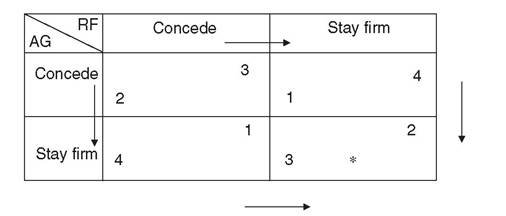
Figure 5.1 Graphical representation of the normal form game describing the European crisis in 1914. AG: Austria Germany. RF: Russia France. Lower-left payoffs are those to AG., upper-right payoffs those to RF. Arrows indicate preference directions, and the asterisk denotes the Nash equilibrium.
The model and its solution explain how it could happen, that the crisis ended in war, a result which none of the actors had really wanted or anticipated if one believes the statements of leading politicians of the time. Even though the model oversimplifies the complicated sequence of actions of the involved states, it describes the situation and provides insight into the mechanism and perceived consequences.
It should be noted in passing that Snyder and Diesing did not make explicit use of the Nash equilibrium concept. They described their model as an illustration of the so-called Prisoners’ Dilemma (PD) paradigm. Without repeating the explanation of the origin of this name, we just note that in such a case a solution is obtained which in fact none of the actors wants.
In general, one speaks of a PD game if there is a strategy combination which has higher payoffs to both players than those given by the equilibrium; this is not the case here if we take the payoffs as they are. Retrospectively, we estimate the war cost much higher than the actors in 1914 did; thus, in hindsight, we may be led to a PD game in its literal meaning.Non-cooperative 2 ? 2 two-person games in normal form have been widely used for analyses of international conflicts and crises. As in our case, they do not describe the details or the dynamics of such events, but provide principal insight for those who are not trained to work with more complicated mathematical models. Snyder and Diesing (1977) discuss several other conflicts of the past in terms of 2 ? 2 games. Recently, Rudnianski and Bestougeff (2007) analyzed the Icelandic fisheries conflict between Iceland and the United Kingdom that way. In particular, the PD game is used frequently to explain why conflicts arose or developed in a way nobody wanted; all kinds of arms races are examples (Brams and Kilgour, 1988; Zagare and Kilgour, 2002; Beetz, 2005).
Second case: cuban missile crisis
Probably the most dangerous confrontation between major powers ever to occur was that between the United States and the Soviet Union in October 1962. This confrontation, in what has come to be known as the Cuban missile crisis, was precipitated by a Soviet attempt to install in Cuba mediumrange and intermediate-range nuclear-armed ballistic missiles capable of hitting a large portion of the United States. The description of that crisis as well as the first part of its analysis follow those of Brams (1985 and 1990).
After the presence of such missiles was confirmed on October 14, the United States Central Intelligence Agency estimated that they would be operational in about ten days. A so-called Executive Committee of high- level officials was convened to decide on a course of action for the United States, and the Committee met in secret for six days.
Several alternatives were considered, which were eventually narrowed down to the two that will be discussed here.The most common conception of this crisis is that the two superpowers were on a collision course. Chicken, which derives its name from a kind of mad sport in which two drivers race toward each other on a narrow road, would at first blush seem an appropriate model of this conflict. Under this interpretation, each player has the choice between swerving, and avoiding a head-on collision, or continuing on the collision course. As applied to the Cuban missile crisis, with the United States and the Soviet Union the two players, the alternative courses of action and a ranking of the players' outcomes in terms of the game of chicken are shown in Figure 5.2. It is again a noncooperative 2 ? 2 two-person game in normal form.
The goal of the United States was immediate removal of the Soviet missiles, and United States policy makers seriously considered two alternative courses of action to achieve this end. First, a naval blockade, or quarantine as it was euphemistically called, to prevent shipment of further missiles, possibly
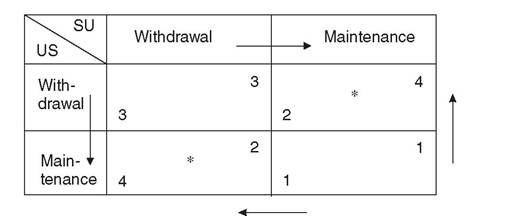
Figure 5.2 Graphical representation of the normal form game describing the Cuban missile crisis in 1962. US: United States; SU: Soviet Union.
followed by stronger action to induce the Soviet Union to withdraw those missiles already installed. Second, a surgical strike to wipe out the missiles already installed, insofar as possible, perhaps followed by an invasion of the island. The choices open to Soviet policy makers were withdrawal of their missiles and maintenance of their missiles.
Needless to say, the strategy choices and probable outcomes as presented in Figure 5.2 provide only a skeletal picture of the crisis as it developed over a period of thirteen days. Both sides considered more than the two alternatives listed above, as well as several variations on each.
The Soviets, for example, demanded withdrawal of American missiles from Turkey as a quid pro quo for withdrawal of their missiles from Cuba, ademandpublicly ignored by the United States. Furthermore, there is no way to verify that the outcomes given in Figure 5.2 were probable, or valued in a manner consistent with the game of Chicken. For example, if the Soviet Union had viewed an air strike on their missiles as jeopardizing their vital national interests, the crisis may well have ended in nuclear war between the two sides. Still another simplification relates to the assumption that the players choose their actions simultaneously, when in fact a continuous exchange in both words and deeds occurred over those fateful days in October 1962.Nevertheless, most observers of this crisis believe the two superpowers were on a collision course. Most observers also agree that neither side was eager to take any irreversible step, such as the driver in a game of Chicken might do by defiantly ripping off his steering wheel in full view of his adversary, thereby foreclosing his alternative of swerving.
Contrary to the game of Figure 5.1, which represented the European 1914 crisis, the game given in Figure 5.2 has two Nash equilibria in pure strategies, as can again be seen immediately by use of the method of preference directions. In fact, there is a third equilibrium in so-called mixed strategies which is not given here. This is the lesson to be learned from this model: because of the existence of several equilibria, each of which was very bad for at least one of the players, the situation was very dangerous.
Although in one sense the United States won by getting the Soviets to withdraw their missiles, Premier Khrushchev at the same time extracted from President Kennedy a promise not to invade Cuba, which seems to indicate that the eventual outcome was a compromise solution of sorts. These results render it plausible to describe the outcome of the crisis in terms of a Nash bargaining solution (Nash, 1950) which, surprisingly enough, to our best knowledge, never has been discussed in the literature.
In order to discuss Nash's concept, we present first the area of expected payoffs to both players, with the United States as player 1 and the Soviet Union as player 2 (see Figure 5.3).
According to Figure 5.2, if theUnited States chooses its first strategy with probability p and its second with 1-p, while the Soviet Union chooses its first strategy with
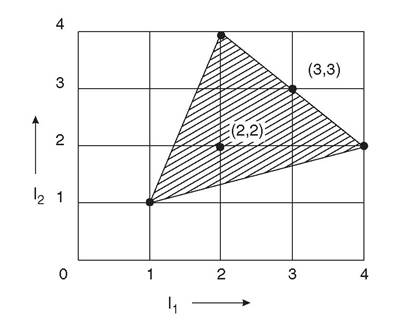
Figure 5.3 Area of expected payoffs to the United States (Ц) and to the Soviet Union (I2). (2,2) are the guaranteed payoffs, (3,3) is the Nash bargaining solution.
probability q and its second with 1-q, the expected outcomes are:
11 = p(3q + 2(1 - q)) + (1 - p)(4q + 1 - q)
12 = q(3p + 2(1 - p)) + (1 - q)(4p + 1 - p).
If we now take all possible pairs (p, q), with values of p and q between zero and one, we get the shaded area in Figure 5.3 which represents the area of expected payoff pairs (I1,12) to both players. For the sake of illustration, the pairs of payoffs for the four combinations of pure strategies are explicitly marked. Of special importance is the upper right border of the area: along this border, which is called the Pareto frontier, none of the two players can improve his expected payoff without decreasing that of the other one.
Now let us describe Nash's concept. He assumes that both sides talk to each other - which means that we now enter the domain of cooperative game theory - and agree on the following six principles on a negotiated outcome of the bargain.
N1. Both players get at least as much as they got if they did not talk to each other.
N2. The outcomes are feasible, that is, they can in fact be obtained under the circumstances given. N3. The outcomes fall on the Pareto frontier.
N4. If the solution lies in a subset of the area of possible solutions, then it is also a solution in the original set of possible solutions (independence of irrelevant alternatives).
N5. The solution is independent of positive linear transformations of the payoffs.
N6. If the area of possible outcomes is symmetric, then the solution is symmetric.
Given these six assumptions, Nash showed that the bargaining solution is determined by maximizing the product of the two players' expected payoffs minus their guaranteed ones, that is, those payoffs which the players obtained if they did not cooperate.
Now let us come back to our case. Since the area of possible expected payoffs as given by Figure 5.3 is convex, it will not be enlarged by the possibility of cooperation. It should be mentioned in passing that this is a special case; in other cases like the famous Battle of the Sexes (see e.g. Luce and Raiffa, 1957), this is not the case for the non-cooperative game, and the first step of the cooperation is to consider an extension of the area of expected payoffs such that it becomes a convex set. As can be seen immediately by looking at Figure 5.2, the guaranteed payoff to both players in case they do not cooperate is two. Therefore, we have to look for the maximum of the product (I1 - 2)(I2 - 2) on the Pareto frontier. The result is, as can again be seen easily, the payoff three to both players, and this is just the pair (blockade, withdrawal) of pure strategies of the non-cooperative game, which is not an equilibrium of that game.
In sum, at the beginning of the crisis, the situation may, in a very simple way, be described as a Chicken-type model, which illustrates the danger the world experienced during those days. Later on, however, the two statesmen talked to each other: in responding to a letter from Khrushchev, Kennedy wrote “if you would agree to remove these weapons systems from Cuba...we, on our part, would agree. (a) to remove promptly the quarantine measures now in effect and (b) to give assurances against an invasion of Cuba.” Thus, an application of Nash‘s bargaining concept seems to describe the situation at a later stage of the crisis, of course in a very simplified way, quite well.
In the game theoretical literature, Nash's bargaining solution has a very important role. The assumptions have been carefully discussed and also criticized, in particular assumption N4, and replaced by other assumptions. Also, the concept was extended to more than two players. Contrary to that, so far there have been surprisingly few applications, especially in the field of international relations.
International water disputes have been analyzed in terms of Nash's bargaining concept by Richards and Singh (1997), but they considered only idealized states and disputes. Trade of emission permits in the context of the Kyoto Protocol provisions were discussed this way by Okada (2007). United States-Japan trade negotiations were studied by Hopmann (1996); he describes their results also in terms of Nash's bargaining model, although not quantitatively. There may be different reasons for this deficiency: the approach is not so intuitive as simple normal form games and, therefore, for a long time it was not so well known among political and social scientists, as well as among practitioners.
Third case: nuclear deterrence
During the height of the Cold War, say in the 1970s of the last century, all responsible parties agreed that nuclear war would be an unparalleled disaster, but under which conditions might a government think about the unthinkable? To set the scene, a greatly simplified discussion of some issues is presented, with some modifications drawn from Morrow (1994).
Some rational leaders might consider launching a nuclear first strike if it would disarm the other side, preventing any response, assuming that long-run ecological damage would not impose serious costs on the striking side. But during the Cold War, both the United States and the Soviet Union had nuclear arsenals that made a first strike that disarmed the other side highly improbable. From the mid-1960s on, each side had a secure second- strike capability; that is, both the United States and the Soviet Union could have responded to any initial nuclear strike with a devastating retaliatory strike, primarily from submarinebased missiles, but also from surviving landbased missiles. First strikes were deterred by this credible threat of retaliation. This case illustrates a general point: neither side will be willing to launch a first strike when an attack will only lead to its own destruction through nuclear retaliation.
This conclusion has a disturbing sideeffect: it eliminates the use of nuclear weapons for extended deterrence - the protection of allies from external threats through nuclear threats. For example, during the Cold War, the United States threatened to use strategic nuclear weapons if the Soviet Union invaded Western Europe - but if such a nuclear first strike had led to the devastation of the United States by Soviet nuclear retaliation, the threat of initiating nuclear war to defend Western Europe would not have been credible. For nuclear weapons to have political utility beyond the deterrence of nuclear war, both sides must believe there is some chance that a nuclear war could begin. Otherwise, the threat was hollow.
Schelling (1960) proposed one solution to this problem: the reciprocal fear of a surprise attack. Assume there is some advantage in striking first if nuclear war occurs: the side that strikes first is somewhat less devastated than the other. Both sides can still launch devastating second strikes, but it is better to strike first than second because the first strike takes out some of the other side's missiles. Each side might contemplate a first strike, not because it expected to win by attacking, but rather because it feared that the other side was preparing to attack and it wished to gain the first strike advantage for itself. These fears could build upon one another in a vicious circle, creating the reciprocal fear of a surprise attack. Nuclear war might then be launched, not because either side thought it could win, but because each side feared the other was about to launch an attack.
This argument places several restrictions on possible models. Neither side must know that the other side has committed itself to not attacking when it must decide whether to launch an attack itself. If neither side decides to attack the status quo, the best outcome for both sides should prevail. If a first strike is launched, the other side retaliates, but the side that strikes first suffers less.
Before modeling the conflict as described, let us first consider a hypothetical conflict, where one power (1) decides first whether to launch an attack (A) or to delay it (D), and where in the latter case the other power (2) decides to launch an attack (a) or to delay it (d). This situation is modeled as a noncooperative two-person game in extensive form with perfect information (see Figure 5.4). In such a game, the players know where they are in the game tree whenever they have to make a choice. We will not give a formal definition of extensive form games (see, for example, Myerson, 1991), but explain this type of game with the help of our case.
The payoffs to both powers are zero if both delay, they are -aι and -r2 if (1) attacks and - r1 and -a2 if (2) attacks with o < ai < ri for i = 1,2. A simple backward induction shows that (D, d) is the only Nash equilibrium, which means that none of the two powers will launch a first strike.
Now let us turn to the original conflict situation as described before. We model it as a non-cooperative two-person game in
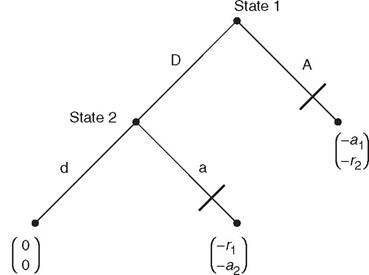
Figure 5.4 Graphical representation of the extensive form game with perfect information describing the superpower conflict. D (d): Delay an attack. A (a): Launch an attack. Crossed alternatives are deleted.
extensive form with imperfect information (see Figure 5.5).
The A and a actions are nuclear first strike attacks, and the D and d actions delay the launching of a first strike. The a payoffs are for launching a first strike, and the r payoffs are for receiving such a strike and then retaliating. The difference between the two measures is the first strike advantage. The larger r - a is, the greater the advantage to striking first. If neither side attacks, the status quo holds - the zero payoff. We assume that striking first is preferable to receiving a first strike, but that no nuclear war is preferable to any nuclear war, that is, again0< ai < ri fori = 1,2.Thechance move and information sets capture the idea that neither player knows whether the other is preparing a first strike when it must decide whether to launch a first strike of its own. Neither player knows whether delaying the strike ends the game at the status quo or gives the other player the opportunity to launch its own strike.
Because of the more complicated information structure of this game, the simple backward induction procedure does not work anymore. Again, we have to take into account so-called mixed strategies, i.e. probability distributions over the pure strategies. Without presenting the solution procedure here, we just give its result. There are three different Nash equilibria.
In the first equilibrium, each side attacks if it wins the draw because each knows that if it does not attack, the other side will attack in turn. This equilibrium describes the reciprocal fear of surprise attack run amok. Each player attacks out of the fear that the other will attack if it does not.
In the second equilibrium, neither side attacks because each knows that the other side will not attack in turn. Here, we have mutual confidence in restraint; neither player launches an attack because they both believe the other player will not launch one.
In the third equilibrium, both sides play mixed strategies, with each side's probability of attacking increasing as the other side's first strike advantage r - a decreases. If the third equilibrium seems bizarre, we remember that
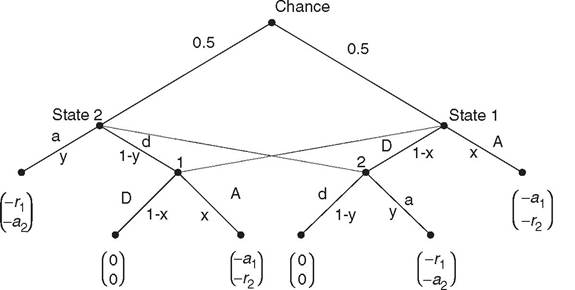
Figure 5.5 Graphical representation of the extensive form game with imperfect information. Dashed lines indicate information sets. x resp. y are probabilities for choosing A resp. a.
each side's probability of attacking is chosen to make the other side indifferent between attacking and not attacking.
Because of our assumptions, the second equilibrium provides the highest payoffs to both players, in other words, it is payoffdominant as compared to the other ones. The second equilibrium leads to the worst payoffs, and the third one is just in between. We see, that even though both parties would be well advised to agree on the second equilibrium, this is not automatically the solution to the game, since no mechanism is foreseen, or, there is no confidence in any kind of agreement, which allows them to take a joint decision for the benefit of both of them.
These results may explain why the situation during the Cold War was so serious. Since there are several equilibria, two of which foresaw the possibility of a first strike, there was a paralyzing uncertainty about the intentions of the other side. On the other side, a first strike did not occur, perhaps since there was a silent agreement on the payoffdominating equilibrium. Or, with all due care, considerations like these may have had a normative impact on the decision makers of that time.
There are much less analyses of international conflicts using extensive form games than normal form games. The existing ones primarily use those with perfect information. Just to name a few prototypical cases: the Cuban missile crisis was analyzed that way (e.g. Wagner, 1989; Brams, 1990). Bueno de Mesquita (2002) carefully discussed the Concordat of Worms in 1122, where the so-called Investiture Struggle between the Emperor of the Holy Roman Empire German Nation and the Pope was resolved. Extensive form games with two-sided imperfect information are used by Morrow (1989) and by Zagare and Kilgour (2002) in order to discuss deterrence problems in general.
Fourth case: Greek-Turkish territorial waters conflict
A major conflict confronting Greece and Turkey until today is the breadth of territorial waters in theAegean Sea. Greece claims that it has the freedom to extend its territorial waters to twelve miles, while Turkey has indicated that a Greek move to extend territorial waters constitutes a casus belli. Currently, both countries apply the six-mile limits, even though several crises have already occurred over the issue. The following description and analysis which has been simplified here is from Guner (2007).
Greece and Turkey are the only littoral states in the Aegean. More than 3000 islands, islets and rocks cover the sea. All, apart from three small islands, belong to Greece with some rocks and islets forming contested sovereignty zones. The 1923 Treaty OfLausanne fixed the extension of the littoral states' territorial waters at three miles. Greece unilaterally declared territorial waters of six miles in 1936 during a detente period between the two states. Turkey responded in 1964 with a similar move, and the current status quo formed: both states maintain six miles of territorial sea.
In accordance with the United Nations Convention on the Law of the Sea (UNCLOS), signed in 1982, which entered into force in 1994, signatory states have the right to establish territorial waters up to twelve miles. Greece, as a signatory state, considers the determination of the breadth of its territorial waters to be a sovereign right. It claims it will extend its territorial waters to twelve miles in the future. Arevised status quo, if both littoral states do the same, implies the resolution of the continental shelf issue in favor of Greece and the undersea connection of the Greek mainland with thousands of islands scattered around the Aegean. This constitutes a considerable gain of shelf. While Greece defends the rule of territorial integrity, that the islands and the mainland form an unbreakable whole and cannot be separated from the mainland, Turkey insists that the continental shelf delimitation should be established by drawing an equidistant line between the Greek and Turkish continental land masses and that the Greek islands clustering along the Turkish coast cannot have their own continental shelfs.
Following the ratification of UNCLOS by the Greekparliament in June 1994, the Turkish parliament approved a resolution authorizing the government to use all necessary measures to protect the rights of Turkey should the need arise. The Turkish position stems from Article 300 of UNCLOS, according to which “parties shall fulfil in good faith the obligations assumed under this Convention and shall exercise the rights, jurisdiction and freedoms recognized in this Convention in a manner which would not constitute an abuse of right.” The Aegean, according to Turkey, is a semi-enclosed sea and therefore requires the application of particular rules. Turkey insists that a Greek extension of its territorial waters to twelve miles will imply that even maritime transport between Turkish ports would require Greekpermission. Turkey considers this to be an abuse of a right. Greece argues exactly the opposite, that is, the Aegean is not a semienclosed sea, and that the Turkish declaration of casus belli is against international norms. Greece believes that according to the UN Charter, Article 2, Paragraph 4, its territorial integrity is under threat.
We describe this conflict in terms of a noncooperative two-person game of asymmetric incomplete information in extensive form. In such a game, at least one of the players does not know the other’s preferences for every outcome. We take the Greek Government’s point of view (see Figure 5.6).
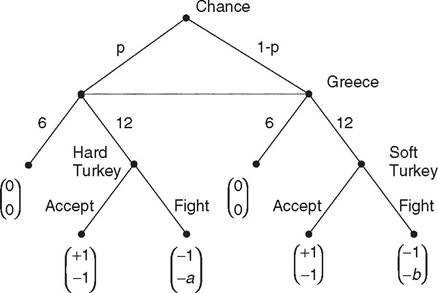
Figure 5.6 Graphical representation of the extensive form game with incomplete information describing the conflict between Greece and Turkey. -b < -1 < -a < 0.
Greece is uncertain as regards to the nature of Turkey: while it knows that in case of an extension of the territorial waters, Turkey will evaluate both alternatives, accepting it or going to war, it knows only with probability p that Turkey will prefer accepting to fighting, and with probability 1 - p the other way round.
Following Harsanyi (1967-68), we model this conflict as a three-person game with Greece, Hard Turkey and Soft Turkey as the three players. Before presenting its solution, let us consider the two games with complete information: in the first one, Greece against Hard Turkey; in the second one, Greece against Soft Turkey (see Figure 5.7).
A simple backward induction shows that in both games war is not an equilibrium strategy: in the first game, Greece backs down; in the second game, Turkey gives in.
Now let us turn to the original model. Both Turkeys will eliminate one of their alternatives, thus, we are led to the simplified game as given by Figure 5.8.
Greece, not knowing which Turkey it is confronted with, chooses limitation with probability x and extension with probability 1 - x obtaining the expected payoff x(2p - 1). Since it wants to maximize its expected payoff, the following Nash equilibrium is obtained depending on the value of p: for p > 0.5, no extension, and for p < 0.5, extension (p = 0.5 may be ignored since the value of p can be estimated only very roughly anyhow.) As a result, Greece will extend its territorial waters if it considers Turkey to be soft, and vice versa.
The important lesson here is the following: whereas in case of complete information about Turkey either being hard or soft, there will be no war, now with probability p (a more complicated model. For example, he took into account in case of war the two alternatives of Greece or Turkey winning the war. He claims that the model can be used as a tool for politicians anddiplomats, who areencouraged to make their own estimates of probabilities and payoffs, finding out what the possible consequences of their assumptions are. In this sense, the model may be considered to be of the normative type.
There are not so many applications of games with incomplete information in the area of the resolution of international conflicts. Most of them deal with nuclear conflicts (e.g. Powell, 1997) and deterrence in general (Zagare and Kilgour, 2002).
Fifth case: reorganization of the United Nations Security Council
In the resolution 47/62 of the General Assembly (GA) of the United Nations (UN), entitled question of equitable representation on and increase in the membership of the Security Council (SC) and adopted on 11 December 1996, the member states were invited to submit comments on a possible review of the membership of the Security Council. On the basis of these comments, the ensuing discussion should lead to a reform of the SC with a high consensus of acceptance.
Why is there need for such a reform? The UN was founded in 1945 by the 51 victorious states of the Second World War. The SC consisted of eleven members, five of which were permanent and six of which were elected by the GA. The privilege to have permanent membership including the veto right was reserved for the main victorious powers of the war. The ratio of the number of member states in the SC to the number of member states in the GA was R = 22%.
By 1963, the number of member states had increased to 113. At the same time, their representation in the SC was cut in half to R = 10%. This led to an increase in the number of temporary members in the SC to 10 so that the total number of SC members was then fifteen and the above mentioned ratio was R = 13%. In 1997, the UN had 184 and the ratio has decreased to R = 13%. A large majority of UN member states was in favor of a renewed increase of the SC to guarantee adequate representation. A number of member states suggested further reforms of the UN structure, such as changes in the regional distribution of the SC seats or a weakening or even abolition of the veto right.
A mathematical tool to analyze a given voting system is the Power Index Analysis (PIA). It offers the possibility to calculate the power distribution in a voting system over its members which are the voters. It has to be said that with the PIA, only the formal voting power in the system can be determined. It is assumed that the voters are totally independent of each other. The economic, political, military, social and cultural factors which influence decision making are not taken into account. Nevertheless, power indices are meaningful objects which may serve as a guide for setting up norms or standards when designing or revising a legislative body such as the UNSC. The following analysis is taken from Kerby and Gobeler (1996).
A mathematical abstraction of a voting system is determined by the number of voters and a rule which gives the conditions that must be satisfied for a decision to be passed. For example, in the present SC where all important issues confronting the UN are decided, the voting rule for non-procedural issues says the decision is carried if a coalition of supportive voters forms such that the five permanent members and at least four other members belong to the coalition.
The power of an individual voter in such a voting system is measured in terms of the number of times the voter casts the deciding vote. Suppose the voters cast their votes in some given order. Further, suppose the first voter in this order votes in favor of the decision, then the second voter and so on. A voter casts the deciding vote if the voting rule is not satisfied until he casts his vote. The number of such orderings in which a voter makes the decision in this way divided by the number of all possible orderings of the voters is defined to be the power index or Shapley value of this voter. This index was first introduced by Shapley (1953), who also gaveit its axiomatic justification.
Here, we will not present the mathematical derivation nor the resulting formula for the power index, but apply it immediately to the SC. A non-permanent member casts the deciding vote in precisely those cases where the five permanent members and exactly three other non-permanent members line up in front of that member and cast their votes in favor of the decision. This leads to a power index of 0.00187 for a non-permanent member and, consequently, since the power indices of all members have to add up to one, to a power index of 0.196 for permanent ones. Thus, each permanent member of the SC has about 100 times more deciding power than a non-permanent member as measured by these indices.
Following the initially mentioned invitation by the UNGA, several proposals for new distributions of the voting power of states in the SC were made, such as by Costa Rica, United States and others. As Kerby and Gobeler showed, they changed only marginally the present voting power since they did not touch the veto right of the present permanent members, nor did they increase their number. They also showed, realistically assuming that a complete abolition of the veto right was - and obviously still is - not possible, that a weakening of the veto right, would lead to a much better distribution: if, for example, two vetoes would be needed in order that some decision is not taken, then the voting power of the permanent SC members would be reduced by a factor of eight; if three vetoes would be needed, by a factor of 32 and so on.
Despite the urgent need and several attempts in recent years, the UNSC has not yet been reformed, and if it will be reformed, Power Index Analysis will not play a decisive role. It can, however, quickly show, as demonstrated by Kerby and Gobeler, if some new suggestion leads to a significantly better balance of voting power of states in the SC or not.
There are other measures for voting power, for example, the so-called Banzaf-Coleman index, which cannot, however, be justified game theoretically, therefore, we do not discuss this index here. Also, it should be mentioned that the Shapley value can be related to Nash's bargaining scheme (see Ordeshook, 1986), which means that we are on safe theoretical ground.
Power index analysis has been widely used to analyze the power distribution in parliaments and other legislative bodies, that is, for descriptive purposes. There are not so many cases like the one discussed above where it is - as mentioned at least in principle - used to discuss new schemes. Avenhaus (2002) has analyzed the power distribution in a future committee of the five littoral states of the Caspian Sea, if votes are distributed according to some geographically determined scale, such as smoothed lengths of coasts of the states.
More on the topic CASE STUDIES:
- Political leaders have engaged in international conflict resolution for millennia, yet it is only relatively recently that scholars have developed explanatory and prescriptive theories about this important phenomenon.
- CONCLUSION
- FURTHER APPROACHES AND CHALLENGES
- REFERENCES
- Introduction
- Notes
- PoststructuralistZPostmodernist
- On Warfare Origins
- THE STUDY OF PEACE OBSERVATION AND PEACEKEEPING: A FIRST CUT
- Oetzel John, Ting-Toomey Stella. The SAGE Handbook of Conflict Communication: Integrating Theory, Research and Practice. SAGE Publications,2013. — 912 p., 2013