Conclusion and the Way Forward
Education is the ability to listen to almost anything without losing your temper or your self-confidence.
—Robert Frost
We conclude the book with a brief summary and discuss the “way forward” particularly looking at the areas of conflict management and dialogue in higher education and its implications for the future.
To effectively address, manage, and resolve conflicts in an academic setting requires strategic planning, thinking, and also skillful reflection. Higher education institutions must find a conflict management system that works for their organizational culture. In addition, leadership is essential and necessary for units to understand the importance of having a structured conflict management system that models the institution’s commitment to conflict engagement and dialogue.First, this book is intended to support individuals and units to reflect about conflict and understand conflict engagement. Second, it is intended
Conflict Management and Dialogue in Higher Education, 3rd edition, pages 191-203 Copyright © 2021 by Information Age Publishing
All rights of reproduction in any form reserved.
to offer ideas for designing and implementing conflict intervention programs, using the mediation method. Third, it is intended to provide ideas for honing individual skill sets to engage in difficult dialogues.
As you read the chapters in the book you had the opportunity to:
■ Think about and understand the importance of discussing conflict, conflict engagement, and conflict management at your institution.
■ Understand how the decision to engage or not engage in conflict can create an environment of low morale and distrust.
■ Reflect on the impact of non-resolved conflicts and how they influence faculty, staff, and student recruitment and retention.
■ Think about effective conflict management tools that are unique to higher education.
■ Engage in a brief overview of the literature related to conflict engagement and dialogue in higher education.
■ Reflect on the roles and responsibilities of leaders to address and manage conflicts in higher education.
■ Learn from examples used at one institution, including those required for a State 40-hour Basic Mediation Short Course.
■ Learn from examples used for an institutionally based difficult dialogues course.
■ Reflect on best practices used for engagement in conflict management and dialogue.
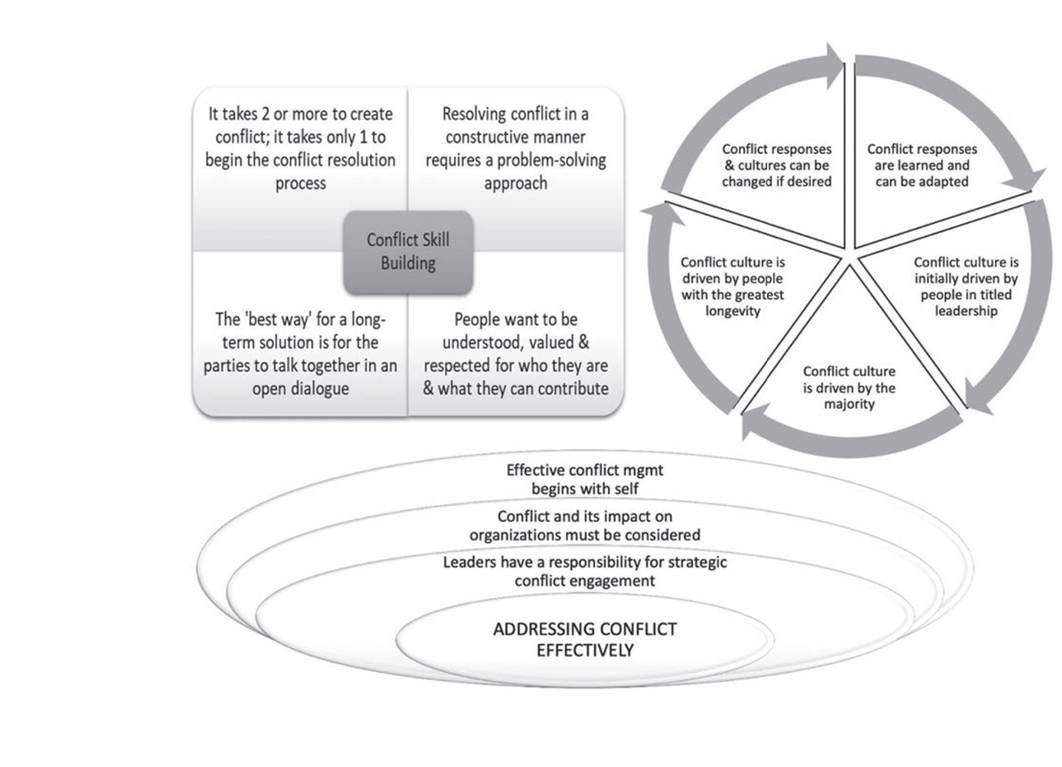
To effectively address conflicts, it is important to remember:
■ Effective conflict management begins with self.
■ Recognizing the impact of conflict on organizations is important for effective conflict management.
■ Leaders have a responsibility for strategic conflict engagement.
In this chapter we will share skill sets necessary for effective and strategic conflict engagement and share programs that have been successful at institutions of higher education.
Most leaders adhere to the following: (a) they want their unit to stay together, (b) they want the people in their unit to learn to use the least energy possible related to “unproductive” and “unaddressed” conflict, and (c) they need to minimize the conflicts that harm people and optimize the conflicts that challenge them to move forward. There are two tenets for conflict management that are grounded in practice. Organizations that practice effective conflict management are strongest when they are (a) well- practiced in conflict management and (b) exercise coaching as one of the most important skills set within their leadership responsibilities.
A leader is ultimately responsible for determining the conflict culture of the organization. As stated in previous chapters—an organization will normally develop a dominant style or a combination of styles for dealing with conflict. We also know:
■ Conflict responses are learned and people who stay in the organization usually adapt their personal styles to the organization’s conflict style over time.
■ The conflict culture is driven by people in titled leadership (especially at first).
■ The conflict culture for the organization is driven by the majority (after time) or the “master narrative” of the unit.
■ The conflict culture within a unit is driven by people with the greatest longevity.
■ Conflict responses and conflict cultures can be changed if desired.
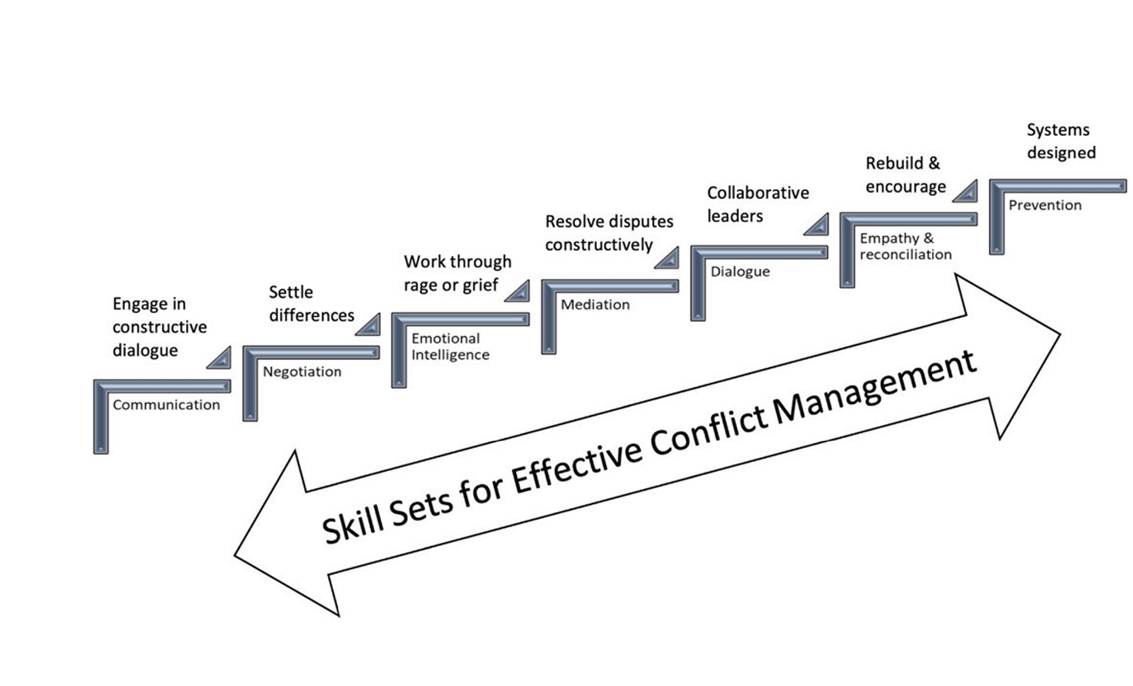
Skill Sets for Effective Conflict Management
In order to challenge the common responses to conflict—which include: (a) paving over the conflict with superficial gestures; (b) blaming, talking, or complaining about the situation with friends or third parties (while failing to talk directly to the other party we are in disagreement with); and/ or (c) trying to get “hired guns” to deal with the problem (they should be able to intimidate the other party; Coleman, 2018; Windle & Warren, 2013; Wright, Mazziotta, & Tropp, 2017)—it is important for leaders to have:
■ communication skills to reduce bias and prejudice and engage in constructive dialogue;
■ negotiation skills to solve problems and settle differences;
■ emotional intelligence skills to work through rage and guilt and possibly grief and loss;
■ mediation skills to resolve disputes constructively;
■ unit building and public dialogue skills to develop interest-based, functional groups, and collaborative leaders;
■ skills to rebuild empathy and compassion and encourage forgiveness and reconciliation; and
■ conflict management systems designed to prevent and resolve future disputes before they become intractable (Putnam, 2004).
Factors That Contribute to Effective Conflict Management
As already mentioned in the beginning chapters of this book, certain factors must be present in order for conflict management strategies to be effective. Conflicts are managed and dialogues are more successful when the parties
1. have the ability to be self-aware (e.g., identify hidden assumptions);
2.
are willing to engage in self-awareness and self-reflection (e.g., utilization of emotional intelligence skills);3. are able to frame the/their relationship;
4. frame the conflict and the issue(s);
5. practice mindfulness of self and others;
6. choose to exercise perspective taking;
7. intentionally and strategically choose their conflict management mode(s) for engaging in the conflict;
8. look for areas of common ground between the parties in conflict;
9. move from positions to the underlying interests and needs of the parties involved in conflict;
10. have awareness of what one wants to accomplish in the dialogue/ conflict management session;
11. articulate the desired end goal(s) to the other party;
12. use an effective communication skill set (described in Chapter 7);
13. use the conflict management tools active listening, perspective taking, recognizing common ground;
14. move self, or the parties, from their positions to underlying inter- ests/needs;
15. own their “stuff” (e.g., biases, assumptions) and let the other person(s) maintain their “stuff”; and
16. stay off the drama triangle.
Best Practices for Successful Conflict Management
Programs
Our experiences show that units within a university that have successful conflict management programs have some or all of the following:
1. a common working definition of conflict and conflict management;
2. an expectation for employees and students to engage effectively in meaningful conflicts when they arise;
3. create opportunities to “develop” employees and students in conflict management opportunities—internal and external workshops for example. This is based on the belief that not everyone has effective conflict management skills;
4. build both individual and organizational capacity to address conflicts;
5. clear modeling by university, college, and departmental leadership to engage in constructive and meaningful conflicts;
6. a shared vision that conflict is not negative; in fact, constructive conflict is always present within a thriving unit;
7.
web presence explaining conflict and the importance of conflict engagement;8. a departmental Code of Conduct or Code of Cooperation;
9. formal and informal structures to address conflict;
10. structures and processes throughout the university to address conflicts at all levels; unit, department, college, and university;
11. aspirant characteristics and values for each college related to dialogue, respect, and inclusion;
12. a formal commitment from college and departmental leadership to lead, manage, and engage in difficult dialogues;
13. briefs or white papers to formalize the college’s commitment to have a culture of dialogue and productive conflict engagement;
14. protocols for students, faculty, and staff to engage in conflicts;
15. regular and appropriate assessment of the climate and culture for diversity;
16. exit interviews for staff, faculty, and students when they leave a program of the college;
17. mechanisms to keep leadership abreast of climate and conflict issues on a monthly or quarterly basis;
18. educational resources that create learning opportunities for faculty, staff, and students;
19. implement formal educational programs at all levels of the institution such as ombuds programs, conflict management workshops, difficult dialogues program as part of a critical dialogues in higher education program, 1-4 day(s) workshops to support department heads and deans in conflict management, and a 40-hour conflict management short course;
20. ongoing dialogue to dispel the myth that conflict is negative, and that conflict is an essential part of a thriving and progressive institution; and
21. formal programs to support all, in particular leadership, for strategic conflict engagement, conflict management, and dialogue.
Creating a Culture of Conflict Engagement
Higher education institutions develop and communicate expectations and protocols about issues that are important to them whether by choice or by university or system mandate.
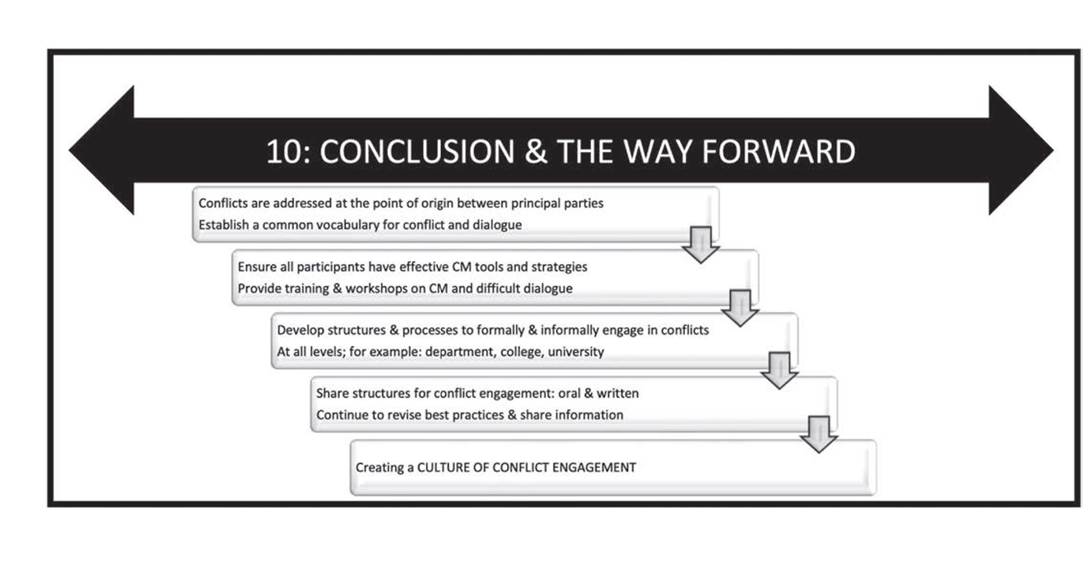
Most academic leaders espouse the importance of conflict management in their units; however, few have the structures or processes in place to address conflict. Many leaders think, “I work with smart people and therefore they should be strong conflict managers”; however, there is no correlation between being “smart” and being a “strong conflict manager.” Therefore, it is important to learn, model, and communicate the conflict expectations you have for self, faculty, staff, and students in your units. Successful programs have a minimum of the following factors present in their unit.1. An expectation and articulation that conflicts are addressed at the point of origin between the principal parties.
2. They have established a common vocabulary related to conflict and dialogue.
3. They work to ensure that all faculty, staff, and students have effective conflict management tools and strategies.
4. They provide internal and external workshops, seminars, and short courses on conflict management and difficult dialogue.
5. They have developed structures and processes on how to engage in conflicts informally or formally. If this does not work, what is the next step for your employee?
6. They have developed structures and processes at all levels—for example, within the department, the college, and university.
7. They have shared the structures for conflict engagement with all personnel through oral and written communication.
8. They continue to revise best practices and sharing of information as new people join the unit.
Our hope is that you have found the contents of the book useful for addressing conflicts within self, with others, and when facilitating a conflict or dialogue between two or more parties. Learning or refining your conflict skill set is essential for building both individual and organizational capacity.
The Way Forward
As we know, conflict skill building is also awareness building. It is important to remember some basic assumptions related to conflict:
■ It takes two or more to create conflict; it takes only one to begin the conflict resolution process.
■ Resolving conflict in a constructive manner requires a problemsolving approach, not a “fix-it” approach.
■ The “best way,” for a long-term solution and to work out differences between parties, is for the parties to talk together in an open dialogue.
■ People want to be understood, valued, and respected for who they are and what they can contribute to the organizational culture. Everyone has basic needs related to having a sense of belonging, freedom, power, safety, and fun.
It is valuable and important to engage in a reflection of your individual conflict engagement style, which entails
■ an understanding of your unit’s conflict culture and
■ reflection, if you are in a leadership role, so that all faculty, staff, and students can be better equipped at conflict management.
Next Steps for Leaders
Leaders need to remember that you have a responsibility to be a strong conflict manager, to model effective and constructive conflict engagement, and to communicate your expectations of conflict engagement with your faculty, staff, administrative team, and students. When conflicts arise, it is important to remember that there are always choices.
1. Consider the trade-offs and consequences of not engaging in the conflict.
2. Frame the conflict as you and others understand it.
3. Attend to the complex layers of the conflict and look for
a. individual patterns,
b. situational patterns, and
c. cultural patterns.
4. Select a style for addressing a conflict.
5. Select a dialogue strategy.
6. Learn about your mental models from the conflict.
7. Establish learning opportunities for others.
All conflict engagement is built on the basic concept of trust. O’Brien (2001) referred to trust as an expectation about the positive actions of other people, without being able to influence or monitor the outcome. People award trust on the basis of fair treatment, respect, and recognition for their contributions. People at the bottom of an organization are continuous and careful “intuitive auditors.” Deference to authority has been found to be based more on trust than on competence. The durability of trust is based on integrity and consistency. The development of trust builds incrementally, distrust is much more catastrophic. Although another book can be written about building trust within academic units, it is important to remind academic leaders that effective leadership occurs in an environment where trust is present.
It is our hope that you are engaged in self-reflection about strategic conflict engagement and dialogue, in order to build a culture of trust within your unit. Trust leads to a willingness to engage in meaningful conflict by following structures and processes predetermined and co-created by everyone in the organization. It can lead to a healthier, engaging, and productive environment for all.
Conclusion
Our goal in this book has been to provide administrators, faculty members, staff members, and others in the higher education environment with conflict management information that can be beneficial both personally and professionally. Some people think that conflict is a topic that should not be discussed and that we should not engage in it. Productively engaging in conflict is always valuable. Most individuals are willing and interested in resolving their conflicts; they just need the appropriate skill sets and opportunities to practice. Without a conflict skill set, individuals wish to avoid conflict, hoping it will go away, or do not want to make a “big deal out of nothing.” There are times when avoiding conflict is the appropriate strategy, but avoidance is usually not the best or most productive strategy, and the implications of not acting to resolve the conflict should always be considered. Research and personal experiences show us that there are always consequences that accompany the decision to engage or not engage in conflict.
Through self-reflection and self-awareness, you can more effectively manage your conflicts and, therefore, your professional and personal relationships. Furthermore, by discussing issues related to conflict management, academic units can establish an expected protocol to be followed by all when in conflict. All colleges, universities, and academic units have a conflict culture (the way that everyone responds or does not respond to conflict). However, most members of the campus community never discuss what the conflict culture is, leading some to make assumptions that can be counterproductive to the unit.
Practicing your conflict management skills leads to more successful engagement in conflict with outcomes of greater understanding, better communication, and increased productivity for both the individual and the unit. When you manage your conflicts more effectively, you spend more of your energy on the issues and relationships that matter most.
References
Coleman, P. T. (2018). Conflict intelligence and systemic wisdom: Meta-com- petencies for engaging conflict in a complex, dynamic world. Negotiation Journal, 34(1), 7-35.
O’Brien, R. C. (2001). Trust: Releasing the energy to succeed. Chichester, England: Wiley.
Putnam, L. L. (2004). Transformations and critical moments in negotiations. Negotiation Journal, 20(2), 275-295.
Windle, R., & Warren, S. (2013). Collaborative problem solving: Steps in the process. Centerfor Appropriate Dispute Resolution in Special Education (CADRE), Eugene, Oregon. USA. Retrieved from http://tnoys.org/wp-content/ uploads/Collaborative-Problem-Solving.pdf
Wright, S. C., Mazziotta, A., & Tropp, L. R. (2017). Contact and intergroup conflict: New ideas for the road ahead. Peace and Conflict: Journal of Peace Psychology, 23(3), 317-327.
This page intentionally left blank.