Dialogue as a Conflict Management Strategy
For difficult dialogues to take place, the necessary condition is to create a safe space while the sufficient condition is to create a courageous space that can allow both meaning and flow to take place.
Courageous spaces are where people can reveal their authentic self.—Dr. Roger Worthington,
Professor and Department Chair, University of Maryland
This chapter is based upon the Difficult Dialogue program at Texas
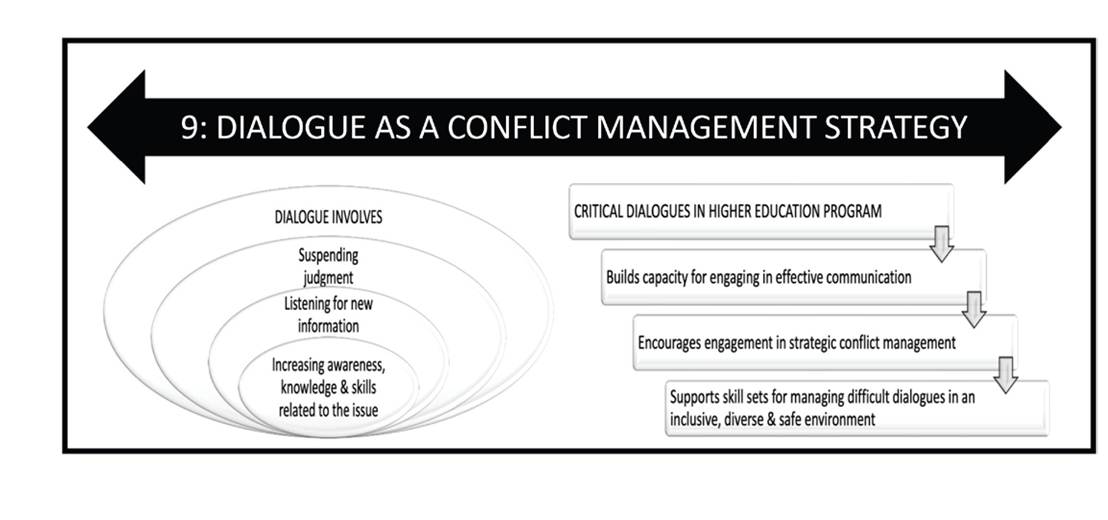
A&M University as well as a book that was written by Dr. Nance Algert and Dr. Clare Gill (2020). This chapter embodies what we have found to be useful, based on our campus climate and organizational culture, in training faculty, staff, graduate students, and undergraduate students in a 12-hour Critical Dialogues in Higher Education program. There are many ways to engage in effective communication and conflict. One communication strategy that can be used is dialogue. Dialogue involves suspending judgment, listening for new information, and increasing one’s awareness, knowledge, and skills related to the issue(s) being discussed.
Conflict Managem-ent and Dialogue in Higher Education, 3rd edition, pages 159-189 Copyright © 2021 by Information Age Publishing
All rights of reproduction in any form reserved.
Difficult Dialogues is a program originated by the Ford Foundation and designed to promote academic freedom and religious, cultural, and political pluralism on college and university campuses in the United States (Ford Foundation, 2005). The Critical Dialogues in Higher Education program developed by the Office of the Vice President and Associate Provost for Diversity at Texas A&M University, serves as a campus resource for building capacity for engaging in effective communication, encouraging engagement in strategic conflict management, and supporting a skill set for managing difficult dialogues with a focus on intact work groups.
The book by Algert and Gill (2020) broadens the original scope of this work, so that it can be a resource to support or augment similar programs at other organizations or academic institutions. A difficult dialogue is where at least one person internally or externally experiences some level of discomfort in engaging in a topic or issue with another. People may be unsure, unwilling, or unskilled at participating in a difficult dialogue for a variety of reasons. Therefore, many people avoid dialogues that may be difficult. For some, it might be fear of the outcome, whereas for others it could be a concern that the dialogue might end in a roadblock. Further, participants are often concerned that the other person may “get upset with them” or that they may “make the situation worse” by engaging in the dialogue. In difficult dialogues, some participants are uncertain about how to proceed and so may avoid an exchange of ideas or perspectives.A planned difficult dialogue is one where there is intentionality about calling the meeting or forum to use the communication mode called dialogue. It is anticipated that the issue or topic will be difficult for at least some of the participants. The steps of the difficult dialogue process are discussed later in this chapter. The convener of a planned difficult dialogue must be an active, skilled, dialogue facilitator and not a passive observer.
An unplanned difficult dialogue is an unforeseen meeting or other interaction with others. When this happens, the individual acting as the facilitator acknowledges the person’s viewpoint, knowing that other participants may have different views. The facilitator must decide whether she/he is willing and ready to engage in this topic right away. She/he assesses, and asks, if others are willing to dialogue about this topic. To proceed with the dialogue, the next step is to follow the standard difficult dialogue process. If participants do not have the interest, willingness, or energy to engage in dialogue immediately, but it is important to the group or team, the dialogue can be scheduled for a later time.
When the topic is deemed inappropriate for the current setting, the facilitator would provide an alternate organizational or campus structure, process, or forum to address the topic (adapted from Iowa State University, n.d.).Goal of a Difficult Dialogues Program
The goal of a difficult dialogues program is to make the campus/organiza- tion climate more welcoming, inclusive, and safe for the free exchange of ideas and differences in perspectives that come with building a diverse and global learning community. Accordingly, a difficult dialogues program can contribute to accountability, climate, and equity goals of an organization or university climate and diversity plans. In particular, a difficult dialogues program can contribute to fulfillment of a commitment in climate and diversity plans of attending to and promoting a positive and supportive climate, which fully recognizes, values, and integrates diversity in the pursuit of organizational and academic excellence In this chapter we
1. offer a modular structure for an organization to create a cadre of dialogue facilitators for its organizational climate program or difficult dialogues program;
2. provide a resource to increase skill sets and preparedness of employees, administrators, faculty, staff, and students to encounter difficult dialogues constructively both internal to their units and external to the organizational environment;
3. provide a framework for the business organization or campus community to engage in dialogue around sensitive topics and issues; and
4. facilitate self-awareness and recognition by individuals that their thoughts, feelings, judgments, and mental models all impact dialogue.
Overview of Modules
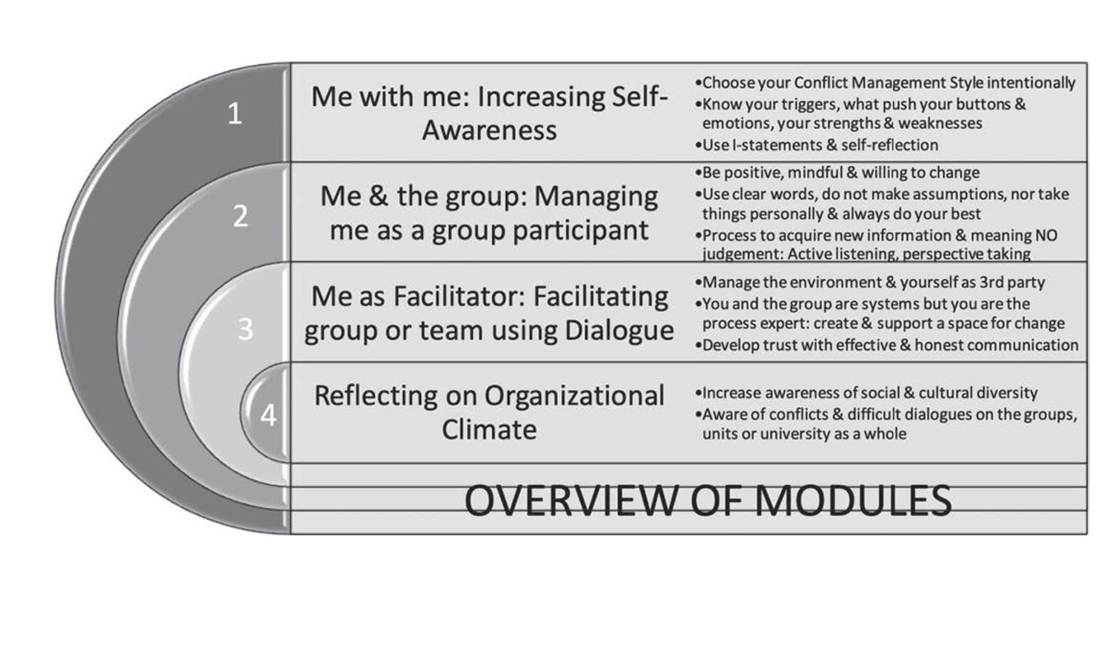
The difficult dialogue program consists of four 3-hour modules; outlined as follows.
Module 1—Me With Me: Increasing Self-Awareness
In this module, participants learn and assess the strength of their skills related to communication, conflict management, and dialogue.
■ Effective communication begins with effective listening.
■ Managing conflict begins with me.
■ Being aware of my strengths in a difficult dialogue.
■ How I might get in the way in a difficult dialogue.
Module 2—Me and the Group: Managing Me As a Group Participant
In this module, participants learn and discuss how they constructively or counterproductively impact group dialogue.
■ My responsibilities as a participant in a difficult dialogue
■ Individual and group strengths
■ Mental models and decision-making
■ Feelings and thoughts
■ Self-management
■ Making suggestions versus making judgments
■ Perspective taking
■ Active listening
Module 3—Me As a Facilitator: Facilitating a Group or Team Using Dialogue
In this module, participants build their facilitation and active listening skill set.
■ Effective facilitation skills
■ Effectively using the difficult dialogue process with a group
■ Common group behaviors
Module 4—Reflecting on Organizational Climate
In this module, participants increase their awareness of social and cultural diversity as well as conflicts and difficult dialogues that occur within a campus unit and/or the university as a whole.
Difficult Dialogue Process
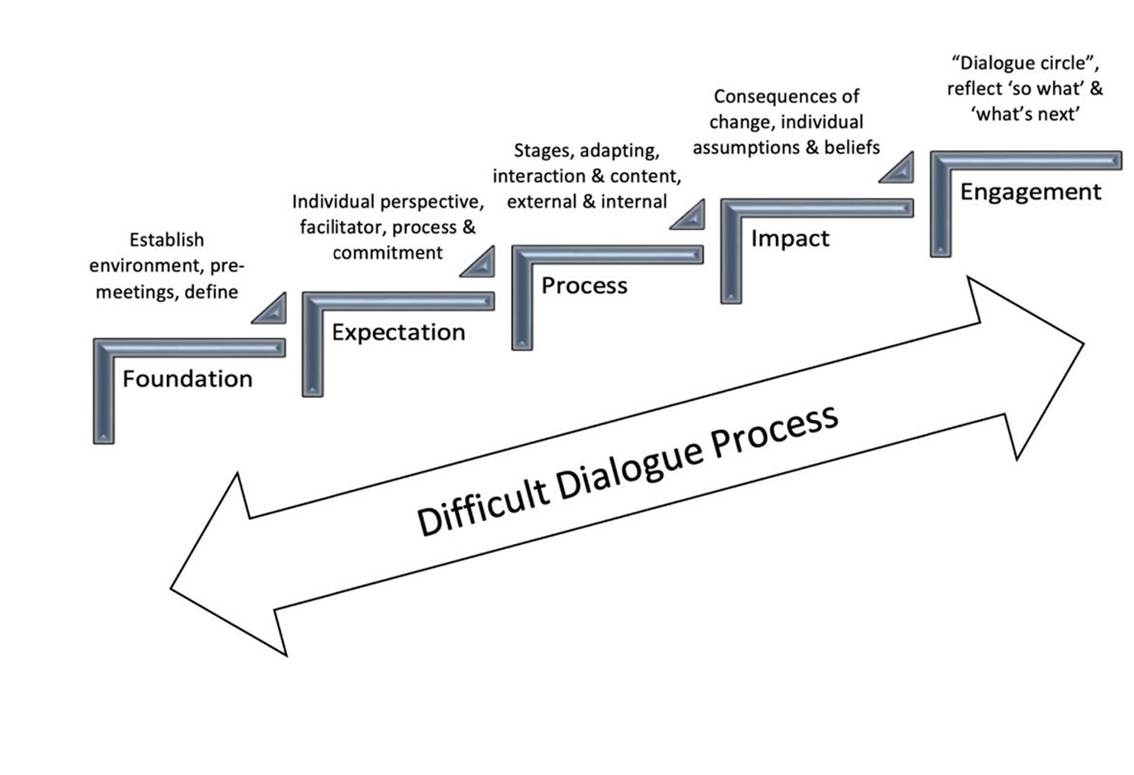
The module steps in the process, which are adapted from Simmons (2006), are in parentheses.
Foundation for Dialogue
From the work of Annette Simmons (2006), A Safe Place for Dangerous Truths: Using Dialogue to Overcome Fear and Distrust at Work, are steps for strategically facilitating a difficult dialogue in higher education. Note that the majority of time is spent establishing an environment and the right conditions for dialogue to occur. This is similar to the mediation process described in Chapter 8.
1. Establish the dialogue environment [discussed in Module 1].
2. Identify current issues through individual pre-meetings [discussed in Module 1].
3. Define dialogue to individuals and the group [discussed in Module 1 and discussed in Module 3].
Expectations for Dialogue
4. Individual perspective—Why and what? [discussed in Module1].
5. Facilitator—What can be expected of the facilitator? [discussed in Modules 1-4].
6. Process and commitment—Expectations for the dialogue [discussed in Module 1].
Meaning and Methods for Teams and Individuals Engaged in Dialogue
7. Team/Group stages and dialogue [discussed in Module 2].
8. Awareness and adapting (e.g., pacing) [discussed in Modules 1-4].
9. Dialogue interaction is the process (how said) and content (what said). Dialogue outcome is the “how” of ending up in a different place [discussed in Module 2].
10. External and internal communication (e.g., behavior and intention) [discussed in Module 2].
Impact of Difficult Dialogue on Group or Team Over Time [Discussed in Module 2]
11. Consequences of change on the group.
12. Consequences of avoiding change on the group.
13. Consequences of avoiding change as an individual.
14. The ladder of inference influences your ability to change.
15. Dialogue means you identify your own assumptions and you are more honest about your hidden beliefs.
Engage in the Difficult Dialogue
16. Choose the “dialogue circle” rules [discussed in Modules 2-4].
17. Engage in dialogue [discussed in Modules 3-4].
18. Allow 2 hours for the dialogue circle and model using a communication skill set.
19. Remind self and participants to suspend judgment and outcomes.
20. Reflect on what comes next [discussed in Modules 3-4].
21. The “so what” of the dialogue and “what’s next?” [discussed in Modules 3-4].
Module 1—Me With Me: Increasing Self-Awareness
Be prepared for conflicts.
Conflict Styles
Typically, we will deal with conflict in one of two modes:
■ Fight to win, ensuring that there is always one or more losers.
■ Flee from the situation.
Furthermore, your conflict style can be impacted by factors such as gender, self-concept or confidence, skills in dealing with conflicts, communication skills, and life experiences.
In addition, you will choose styles to deal with the conflict that will depend on situational factors such as personal expectations and position or power. Conflict style is greatly influenced by the culture, both social and organizational, in which we operate. Numerous researchers have documented differences, in general, in how men and women, or minorities and non-minorities handle conflicts in the United States (Karmali et al., 2019; Robbins, Finney, & O’Rourke, 2008; Trzebia- towski, & Triana, 2020). Learned behaviors in organizations, or units within the organization, influence the styles most often chosen for managing conflicts. The key is to understand that these are learned behaviors, and they can be changed if desired (Watson & Watson, 2011).As discussed in Chapter 1, the Thomas-Kilmann Instrument can be useful in discussing the conflict styles of behavior (avoiding, accommodating, competing, compromising, or collaborating).
Choosing Your Conflict Management Style
There are times when you have a choice to avoid or to engage in a conflict. Ignoring a conflict, once it has come to your attention, is never the best decision. The following variables should be considered when deciding if you will engage in a conflict or not:
■ Ignoring conflict, once it has come to your attention, is never the best behavior.
■ Consciously choose the conflict resolution/management mode that fits your desired outcomes and engaging in that mode is optimal behavior.
■ Ask yourself
a. What are your needs?
b. Resulting status in the relationship
c. Resulting status of the issue
d. Do you have the energy for the conflict?
e. Are you aware of the potential consequences?
f. What are the consequences if you do not engage in conflict?
Self-Awareness
When entering a dialogue, it is an asset if you are well grounded in selfawareness and self-knowledge. You need to know and own your personal history. You must also know your internal triggers. For example, do you know when you have moved to a place of arousal, vigilance, or the markers that indicate your emotions are about to escalate to anger or another strong emotion?
■ What are your triggers?
■ What words rile you up when you’re tired or frustrated?
■ Are there events that push your buttons? (e.g., How is your physical and mental state impacted when someone glares at you?)
Minimize Conflicts by Effective Use of I-Statements
Using I-statements is an effective way to increase clarity in communication by being specific, while simultaneously decreasing the likelihood of defensiveness on the part of the listener (Klose & Olivares, 1999).
I-statements are the process by which:
■ You construct messages that convey accurate information about your feelings and content.
■ You speak so that others may listen and respond in an empathetic or rational way.
Purpose of I-Statements
The purpose of I-statements is:
■ To make a clear, clean statement of your experience of an event, incident, and so forth, in a way that another person will hear and not need to defend.
■ To use in the following situations:
- Where there is a strong emotional feeling or response.
- When you are annoyed or irritated by another person or something that has happened.
- When you want to tell another person, in a safe way, what you think of them or something about how their behavior is affecting you.
Principles for I-Statements
A listener will be much more open to listening keenly if:
1. You send feelings or perceptions, instead of solutions. For example, rather than saying,
Don’t ever take my (book) again. (Message: you are a thief; I don’t trust you.) Say: I get angry when you borrow my book without asking.
2. You take ownership of feelings/perceptions. Blaming or evaluating and judging the other person sets up a wall of anger and defensiveness.
Instead of saying: You are inconsiderate when you borrow my things. Say: I get annoyed when you borrow my things without asking.
3. You are open and direct with these feelings or perceptions:
Instead of addressing the issue(s) head-on, people often avoid the issue(s) directly and say one thing while implying another. This avoidance approach will lead either to total isolation or attack and confrontation.
Use I-statements as openers for the dialogue, not as statements for resolution.
FORMAT:
When you___________________________________________________,
(Neutral description)
I feel_______________________________________________________
(No blame)
and what I would like is________________________________________.
(Change request)
The When is followed by a neutral and objective description of the event or another person’s behavior. It is important that it does not have any words that imply judgment or evaluation or that may provoke a defensive response or any possibility of denial by the other person. The statement must be one of fact.
The Ifeel part must use a word or a few words that describe exactly your feeling response to the event or other person’s behavior. People often describe how they feel by articulating how they want to act (e.g., I feel like withdrawing). It is important to recognize that you must own the feeling without blaming or shaming the other person.
For example:
Instead of saying: Ifeel you are being defensive.
Say: Ifeel angry when you don’t understand my feelings.
The last part of the statement describes why you feel the way you do and/or the outcome or change desired. You need to express how you would like for something or a particular behavior to change, but it is not okay to expect or demand that it will happen. There are no guarantees that the other person will make the requested change unless you are in a position of power over the other individual and can then make a behavior change mandate. However, you have clearly communicated your expected or desired change. You should practice using I-statements when situations are not difficult or intense so that they can become a habit. I-statements are most effective when you have had time to formulate the statements before using them.
Self-Reflection of the Participants During the Module is Important
For the participants in the module, it is essential that they are not simply self-aware when dealing with a conflict, but that they are reflective of the topics and styles of dialogue that are particularly difficult for them. Thus, in the module they will spend some time reflecting and sharing on the following:
1. What dialogues are difficult for you?
2. How do you (if you do) engage in difficult dialogues?
3. What are your strengths when you participate in difficult dialogues?
4. What do you need to improve when you participate in difficult dialogues?
5. Where will you get in the way in a difficult dialogue?
Content of a Difficult Dialogue
It is important to remember that a difficult dialogue is one where at least one person feels some level of discomfort in engaging in discussion of the topic or issue. In addition, almost any topic or issue can lead to a difficult dialogue, for example, budgets, job performance, or responsibilities. Topics will be more difficult for you if you feel they relate to one of your core values, especially when the new information creates cognitive dissonance. Cognitive dissonance is when you experience a psychological conflict resulting from incongruous beliefs and attitudes held simultaneously (e.g., you like a person, but you do not like his behavior). Outside forces (e.g., current economic climate, uncertainty in the work environment) may contribute to or amplify the level of resistance to change.
Below are some ideas for organizations to reflect upon when thinking about using dialogue as a method of communication to address difficult issues.
1. There is a difference between being in a difficult dialogue and being difficult in a dialogue.
2. Most dialogues will involve an issue related to diversity (using Loden’s [1996] definition of diversity as anything that makes us different from one another).
3. Organizations must develop trust (an expectation about the positive actions of other people) in order to effectively engage in dialogue.
4. There is value added in being a data driven organization to identify specific issues or concerns related to diversity.
- Far too often organizations rely on anecdotal information as to what the “problems” are in their units. Systematic evaluation to identify prevalent and pervasive issues is important.
5. Conducting a comprehensive climate survey, regularly, can identify dimensions of an organization’s climate related to diversity, as perceived and experienced by individuals in the organization.
6. In most organizations, a majority of individuals will express high levels of satisfaction with their units. However, many others may have concerns about discrimination and insensitivities.
- Discrimination is defined as the observation of insensitive comments and actions toward an individual or group based upon individual identity attributes and correlated with individuals’ perceptions and experiences.
- Insensitive comments are more frequently directed toward individuals and groups who are targeted and not members of the dominant group (e.g., age, class, gender identity or expression, race, ethnicity, nationality, physical and learning ability, religion, sexual orientation) or those who do not hold privilege.
7. Developing effective conflict management skills is critical to being an effective facilitator of dialogue around issues of diversity.
- Individuals who perceive higher frequencies of inappropriate discriminatory practices more frequently note dissatisfaction with how leaders handle conflict.
- In general, individuals from underrepresented racial and ethnic groups in comparison to individuals who are White, women in comparison to men, individuals with religious identities that are not Christian in comparison to those who identify as Christian, and individuals who identify as gay, lesbian, and transgender in comparison to those who identify as heterosexual, more frequently report an unwelcoming and exclusive environment.
8. It is not uncommon for individuals or groups to avoid dialogue about diversity issues. For example, when campus or unit climate assessment data results are discussed (more often debated), it is typical for the perceptions and experiences expressed by targeted group members to be judged and then discounted or minimized by those in the dominant group as the “comments of a disgruntled few.”
9. Effective leaders must be willing and able to engage in difficult dialogues and have a strong communication skill set.
10. Finally, it is important to remember that engaging in a difficult dialogue involves:
- Listening for new information
- Suspendingjudgment
- Listening to learn (versus critique)
As we refer back to Figure 7.4 in Chapter 7, we must remember that a dialogue, or at least a courageous place for a dialogue has many components. However, dialogue begins with self-awareness and awareness of our inner dialogue (or mental models). Dialogue also involves awareness of how one is having an impact on others.
Module 2—Me and the Group: Managing Me
As a Group Participant
In Module 1, the focus was on you, the individual, and your internal dialogue. Individuals may have over 60,000 thoughts per day. Remembering all of these thoughts is impossible and probably not advisable! However, understanding what contribution you make to your “self” is the first necessary skill and responsibility you have to be effective in difficult dialogues. For this module, visualize yourself sitting in a group entering a difficult dialogue. Think about you and the group together in a dialogue circle. A goal for this module is to be grounded in your knowledge of yourself as a participant in a group.
It is also necessary and important to know as much as you can about others in the group. Sometimes you will have no preparation time or there will be people in the dialogue who you were not expecting. This is okay, an effective engagement in a difficult dialogue can still occur. However, for an intact work group, there is greater likelihood you will know all the participants: how they prefer to be communicated to, what their hot buttons are, and their ease and willingness to engage in dialogue are important to reflect upon.
Enter the dialogue with the belief that everyone’s intention is to have a productive dialogue. Choose and practice mindfulness and adopt a positive attitude. Even if a colleague is venting and their story is very similar to others, there is value added in listening to what they have to share. Although the majority of the group may have similar narratives, each narrative is different and filtered through each person’s mental model. Additionally, there are still other narratives, often unspoken, particularly early on in the difficult dialogue process. So, although there may appear to be no cognitive dissonance, there is typically some discord. All narratives may not yet have been shared, and the tendency sometimes is to shut down these viewpoints consciously or unconsciously. In this situation, you need to manage yourself and the pacing of the dialogue, as others need to share.Just as you are aware of your own triggers, be sensitive to triggers for individuals in the group. Do not stereotype and do not assume. Don Miguel Ruiz (1997) in his book The Four Agreements, challenges people to: (a) Be impeccable with your words, (b) Do not make assumptions, (c) Do not take things personally, and (d) Always do your best. Ruiz’s principles are sound when participating in a difficult dialogue. Practice mindfulness, and particularly mindfulness is crucial when you are a member of the dominant group or in a position of privilege. What you do and say influences others, so consider whether what you say in a dialogue is valuable, productive, and makes a contribution or if your words are destructive, shutting down others, and causing distrust.
Pay close attention to yourself and, simultaneously, do not become consumed with self and completely self-focused, which can be detrimental to listening and participating in the dialogue circle. Observe other people in the group in terms of tone, tempo, words being used, and body language. Know that people tend to focus only on one area (tone or body language, etc.) and interpret that behavior through their mental model. Remember too, you can manage yourself, but you cannot alter any other person in the group. This is the most complex area in a dialogue!
In a difficult dialogue, you and the other participants must commit to suspendingjudgment for the dialogue process to work. For most, this is counter to your typical mode. This change is hard for many people! Remember, the difficult dialogue process is about acquiring new information and new meaning while working to suspend judgment. A difficult dialogue involving a dialogue circle, does not strive to generate an outcome, an end goal, or a solution. Rather, the goal is increased learning and understanding from which additional dialogues can occur to generate solutions and solve problems.
Group/Team Patterns of Interaction
This section is discussed in Chapter 1 of the book; however, it is important to discuss again with regards to leading a dialogue program. There are many models of how teams perform as they enter into difficult dialogues and move toward changing the direction they deem desirable for the organization. One model suggests the following stages in the dialogue circle: (a) politeness and pretending, (b) chaos, (c) discarding and redefining, (d) resolution and collective learning, and (e) closure. Other difficult dialogues programs use Tuckman’s (1965) team development model (Figure 9.1).
Tuckman (1965) advocated that groups first come together, Form, and people are nice to each other because that is the social norm for interacting with people you do not know well—be on your best behavior. So, when your group/team comes together, you will adhere to “traditional” expectations from the group/culture, which are unwritten and unspoken. After the group has spent some time together, you will ideally Storm, meaning the group will move to a deeper dialogue with one another and be willing to engage in
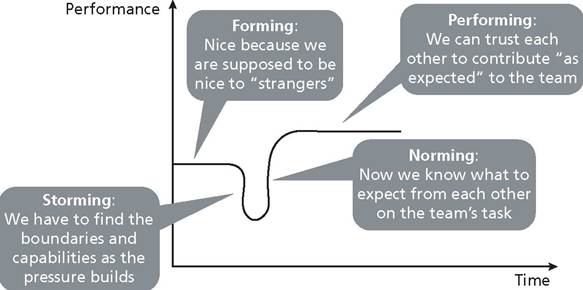
Figure 9.1 Tuckman’s model of group interactions. Source: Tuckman (1965). Adapted by CCCR (2004). Reprinted with permission.
meaningful conflict. Healthy organizations move through this process; ineffective or stuck groups never storm. After Storming, the group moves to Norming—the group or team has begun the process, after engaging in meaningful conflict and having the difficult dialogues, of finding its identity. The group/ team establishes new norms of behavior, communication, and commitment to one another. Finally, the group or team Performs. In a dialogue group, performing would involve participants leading the dialogue instead of looking to the co-facilitators for guidance. You would suspend judgment, listen attentively and actively to learn new information from one another, and share new meaning as you increase your understanding of the topic, issue, or one another. At this point, your group/team typically excels and moves to a higher or stronger level of performance or commitment.
Resisting Change as an Individual
As mentioned earlier, digging in your heels and resisting change, either as an individual or as an intact work group/team, is common. You will typically resist change for several common reasons, whether it is conscious to you or not. There will be times when you turn your opinions into facts. Therefore, when someone challenges your opinions, you resist the person because you believe your opinions really are the facts. This is common in higher education where facts and data are so important to the academy and the work that we do. There will be times when other group members so strongly believe their opinions are the facts, they then believe that you are intentionally working against them.
Resisting change is also common when you make assumptions. Believing you know what a person believes, thinks, and feels are assumptive at best, and arrogant at worst. The third reason you will resist change is related to dichotomous thinking. When you believe there is only one right answer, one way of doing things (and that way, of course, is your way), then you limit opportunity for growth and further learning. Finally, you will resist change when you decide the issue being discussed is not your problem. When you distance yourself from the issue or problem, you distance yourself from the group and from making a collaborative contribution to change. There will be resistance to change in almost every difficult dialogue.
Avoiding Change as a Group or Team
Engaging in dialogue is often related to change; you may change as you learn new information or acquire a new meaning. Common responses that occur with group members when asked to change include:
■ Flight—when one or more group members want to leave the situation or encounter.
■ Fight—when one or more group members want to win over others.
■ Pairing—aligning with another group member to show force and strength by dominating others.
■ Dependency—when a group member expects the facilitator to take care of her or him.
Self-Management With a Group
As a participant of a group, it is important to engage in self-reflection. Specifically, you should reflect on the following (adapted from Watson & Watson, 2011):
■ Feelings and thoughts—what you are thinking or feeling at any given moment.
■ Your “hot” buttons—what events, statements, behaviors trigger you to respond in a nonproductive way.
■ Active listening—includes encouraging others to share, restating and summarizing to check for understanding, and asking pointed, open-ended questions.
■ Judging—counter to the dialogue process, judging diminishes the likelihood of suspending judgment to hear and listen for new information.
■ Internal and external dialogue—at any given time you should be aware of your internal dialogue while simultaneously being mindful of the words shared with others.
■ Adding value to the team—you should reflect on what contribution you are making to the group or team with whom you are meeting, and whether it is the contribution you want to be making.
Self-Reflection
What responsibilities, if any, do you have to a participating group or team? Are your responsibilities different if it is an intact team (e.g., a team within your unit) as compared to a group you will encounter only one time? What responsibilities do you have to yourself when you are part of a group or team engaged in a difficult dialogue? How are your answers different if the dialogue is not difficult for the group/team? How aware are you of your inner dialogue when you are part of a group/team engaged in a difficult dialogue?
Module 3—Me As a Facilitator: Facilitating a
Group or Team Using Dialogue
For this Module, picture yourself and your co-facilitator as third parties to the group or team, standing outside of the dialogue circle. Your role as facilitator is to manage a process of engaging people that gives them the opportunity to learn, move, or shift within. Remember, dialogue is collaborative with two or more people working together toward common understanding. Dialogue involves a real concern for yourself and for the other people and seeks to not alienate or offend. The key to dialogue is listening for “new” information. As discussed by Kathy Obear (2007), facilitating dialogues can be challenging and stressful work. “Whether conscious of it or not, as a facilitator or participant you bring most, if not all, of who you are to the learning environment, including your fears, biases, stereotypes, memories of past traumas and current life experiences” (p. 25). She also said, “Many facilitators report being ‘hooked’ by the comments and actions of participants and feel ‘triggered’ emotions, including anger, fear, embarrassment, pain and sadness” (p. 26).
Facilitation is defined as “to make easier; help bring about; effectively helping a group to solve problems and make decisions.” Facilitating a difficult dialogue is not about solving a problem. Instead, it is about creating an environment where people have the opportunity to be self-aware and where they can be honest and open sharing their perspective on a topic. Thus, facilitating a dialogue, or more specifically a difficult dialogue, is often a challenge for people because your primary responsibility is one of support—support to create an environment for dialogue. Participants in the dialogue must choose to self-reflect, be open to new or different perspectives, be willing to suspend judgment, and be willing to change. The dialogue environment creates a growing space for change. However, as a difficult dialogue facilitator, you cannot make people change. You must have an understanding of self, have the ability to self-dialogue and selfreflect, be adaptive to change, and possess skills in conflict management.
In his book, The Skilled Facilitator, Roger Schwarz (2002) indicated the facilitator’s main task is “to help the group increase effectiveness by improving its process and structure” (p. 40) where
■ process is how the group works together,
■ structure is a stable recurring group process (e.g., group roles), and
■ content refers to facilitating what the group is working on.
Facilitating Change
As a facilitator, it is important that you remember to expect resistance during a dialogue session. Participants are being asked to suspendjudgment, listen actively, and not work to persuade others to their worldview. These practices are different from how they often listen and communicate; you know that when you ask people to change, even during the time they are participating in the dialogue circle, resistance will often occur. Remember that resistance is not bad; it may simply be an indicator that an issue may still need to be discussed.
Facilitating people in a process of potential change means you are supporting individuals as they move from the position of there is no change that needs to occur and therefore “I have no need to change” to deciding, through increased understanding, that they want to consciously take action to change. Following are attributes, actions, skills, and description of the type of communication needed to be a facilitator.
Attributes of an Effective Facilitator
■ Manage the environment and manage yourself.
■ Recognize that you and the group are a system.
Being a Difficult Dialogues Facilitator
■ You are a third party (or you should be)
■ Process expert
■ Content neutral (when not part of the intact group)
■ Neither decision maker nor conflict manager
■ Help group to improve its process in a manner consistent with its core values
Facilitator Skills
■ Develop effective relationships.
■ Work with groups.
■ Deal with difficult dialogues and difficult conversations.
■ Facilitation is impossible without trust.
■ Trust develops from effective and honest communication.
Remember to trust yourself, choose to trust others, trust the process, and work the process the way it was intended!
Facilitating Effective Communication
Communication occurs with
1. a transmitter and
2. a receiver.
The transmitter anticipates what the receiver needs to know to satisfy intellect and feelings. As a facilitator, you will aid the transmitter to present the content of the message in a format that best conveys information to the receiver. You will help the receiver to discern the information presented by the transmitter (being aware of both, your and her or his mental model). Because information is always filtered through an individual’s unique lens, the opportunity for miscommunication and therefore distrust (or at least not enhancing trust) are ever present. However, effective facilitation occurs when trust is present and continues to grow and develop. Typically, groups and teams (and this is appropriate for a dialogue circle) “break down” at the fundamental level of trust and the secondary level of conflict (Algert & Watson, 2005).
A Script for Facilitating a Difficult Dialogue
Below is a brief script, aligned with the five main areas of the difficult dialogue process, for facilitating a group or team in a difficult dialogue circle. Some key phrases are embedded in the script that you may find useful when you facilitate a dialogue. The scenario is that you are one of two third-party co-facilitators working with an intact work group identified as a college leadership team who wants formal support on effectively using the difficult dialogue process related to building trust (the issue for dialogue previously identified by the team).
Part I: Foundation for Dialogue
We, Facilitator 1 (name) and Facilitator 2 (name), appreciate the opportunity to support your leadership team. We would like to review with you what has occurred prior to us being here.
Facilitator Note 1: In a co-facilitation model, together, you support the group by actively listening to both the verbal and nonverbal cues. You support each other by observing when to step in, to continue working the process, particularly if one of you is triggered by behavior of individuals in the group or by the content of the dialogue.
We, Facilitator 1 and Facilitator 2, had the opportunity to meet with you individually to get your perspective of your leadership team—the team’s strengths, areas to grow, and issues related to trust. We appreciate all of you taking the time to talk with us prior to being together today. Each of you said there is value added in talking about how to increase trust among one another so that you can use more energy on accomplishing your team goals and less energy on “each other.”
Remember, before we move into the process for today, that dialogue involves individual and group responsibilities. As an individual, each of you in the group has a responsibility to be self-aware and self-reflective, to be honest, and to think about your impact on the group. Each of you is asked to work to suspend judgment and to use your active listening skills. As a group member, you are listening to understand, not to judge. You are working to be open to change and willing to reassess your viewpoint.
Group responsibilities include the commitment to work toward a common understanding, which is not necessarily agreement, realizing that each of your behaviors impact the group. Your behaviors may be conscious or unconscious and verbal or nonverbal; we are not asking you to be “perfect” as this is not achievable by any of us. We ask you to be reflective and intentional. Self-reflect and think about your impact on the group.
Now, we would like to share with you what you can expect from us as your facilitators and what we expect from you. Our expectations are not about control but rather about how to create the optimum environment and process to best support you in having a productive dialogue.
Part II: Expectations for Dialogue
As we said earlier, we had a chance to talk with each of you individually about how you perceived today’s dialogue. However, some time has passed since we met with each of you. So, we would like to give you the chance to share any new ideas that have arisen that are good for the group and important for you to share. Specifically, focus on “why you are here” and “what you want from today” (not stating an outcome but rather related to process).
Facilitator Note 2: You may spend just a few minutes in process here. Participants, whether an intact group or not, are typically on their "best behavior" and do not have a lot to say. Make sure you do not let one person "create an agenda" or dominate. If one person shares, get several other people's comments, and check multiple times if anyone else has something they would like to share.
Thank you for sharing your comments. Let us restate what we heard you say to check for understanding. Please correct us if we misunderstood or if we missed something.
Facilitator Note 3: Restate and model effective use of active listening. Work to capture main points, be brief but thorough, and write it down for all to see if necessary.
Did we restate (or summarize) that correctly? Thank you.
What you can expect from us as your facilitators, and hopefully you have seen this thus far, is to support you in the creation of an environment where each of you has the opportunity to share your perspective. Our role is to support your process and help you fulfill your commitment to your ground rules, which you will create in a little while. Our role is not to guide, direct, or lead you in the dialogue. We commit to supporting your process and not detracting from the process. We may ask questions or point out an observation we have, and we will “check in” periodically. As your facilitators, we are purposefully going to stand outside of the dialogue circle today because this is your dialogue. So, we encourage you to address other members of the group rather than speaking directly to either of us. It is your dialogue circle, and we respect the process.
Facilitator Note 4: There are times when you will want to sit with the dialogue circle and other times that you should stand around the perimeter of the group. If you are facilitating a dialogue for a group or team and you are also a participant of the group, you will usually sit with them. If you are a third party, you will strategically decide if you will sit with the group or stand outside the group.
Are there any questions related to our role and what you can expect from us?
In our experiences of facilitating dialogues, we (names of facilitators) have found the dialogue group believes the process is far more effective when everyone is clear on what they can expect from one another related to process. So, let’s take the time needed...
Facilitator Note 5: Typically takes no more than ten minutes although some groups will take more time; this usually occurs because this is their very first time together, and there is distrust or turmoil about being with one another. Write the ground rules for all to see. Use your active listening skills here to check for understanding and for modeling.
... for you to generate the ground rules you will each commit to. Who will suggest a ground rule that will assist your dialogue process?
Facilitator Note 6: Dialogue groups typically generate 3-7 ground rules. Get as much specificity as possible. Solicit verbal confirmation of commitment to these ground rules from the group. Common ground rules are: (a) confidentiality—what is discussed in here stays in here, (b) respect—we can disagree strongly and still be respectful, (c) there is no leader, (d) speak for yourself, (e) no decisions are being made today, (f) listen to yourself and listen to others, (g) suspend judgment, (h) acknowledge one another, (i) act as colleagues, and (j) switch off electronic devices.
You all generated these (number) of commitments/rules for today. Let us restate them one more time and get consensus that these are the dialogue circle rules you commit to. Okay, if we observe you are not fulfilling your commitment to one another by adhering to these statements, we may “check in” with the group to help you stay focused. Are there any questions for us? Alright, well done!
Facilitator Note 7: You spend a good deal of time in Part II of the process. Part II helps establish the foundation for the group, model what effective communication looks like, create the loose structure and parameters for difficult dialogue, aid the participants in relaxing (most people become stressed when they hear the phrase difficult dialogue), and ensure participants understand they are responsible for engaging in the process at a level of sharing and vulnerability as they are comfortable and willing.
Facilitator Note 8: Part III should be brief. It is a time to create some additional structure for the participants. Part III consists of (a) presenting a brief explanation of group dynamics, (b) discussing the pace of the dialogue, (c) reminding them what dialogue is, and (d) mindfulness in communication.
Part III: Meaning and Methods
Group dynamics. It is common for groups in dialogue to move through stages of communication and comfort. Briefly, we want to mention that often when groups form, everyone is very nice to one another. We practice the “social conventions” of nice over honest. A group then can move to “storming”—although some groups work to avoid storming at all cost, it really is a very productive time for a group. The dialogue moves from a superficial level to a clearer identification of the group and individual issues to discuss. Storming is often the most uncomfortable time a group has together but, again, it is imperative that it occurs for a group to increase communication.
A group then often moves to what Tuckman (1965) called “norming.” Based upon the honest, although typically difficult, dialogue earlier, the group gets clearer in their communication, increases their commitment to one another and the team, and develops stronger “norms” of group behavior.
Finally, after effectively participating in the dialogue circle, individuals in the group experience the team excelling in a different way, often described as being more productive and consuming less energy.
Dialogue pace. You will find the group moving at different rates throughout the 2 hours of dialogue. Understand this is common and expected. There will be times where there is a lot of discussion, and there will be times in your dialogue where each of you wants more time for internal reflection. We are also both very comfortable with silence if you need extra time to internally process before sharing. So, do not be surprised if the group appears to have different pacing throughout its time. We, as your facilitators, will be mindful in supporting you all in the pace of your dialogue.
Dialogue and mindfulness. Dialogue interaction is the process (how something is said), and the content (what is said). The dialogue outcome is the how of ending up in a different place. There is a quote that says, “We judge ourselves by our intentions and others by their behavior” (Covey & Merrill, 2006). It is important to remember that others can only observe your nonverbal communication and the words you say. Therefore, again we remind you of the importance of “you managing you” and thinking about your colleagues in the group.
Part IV: Impact of Dialogue
Groups and teams that intentionally engage in dialogue as one process of communication in the workplace report a strong environment where diversity has greater value and the importance of engaging in discourse and conflict is understood. When the group changes through dialogue, more time and energy is spent on addressing exciting work challenges such as
teaching, research, and engagement, and less energy is used in “juggling” colleagues that are “different” from you or “difficult” to you.
Schein (1993) talked about mental models. Mental models are the steps we go through, often unconsciously, that drive our decision-making and understanding of situations and people.
Facilitator Note 9: You may share the mental model diagram at this point if there is value added.
What is complex within a group dialogue is that each of us in the room has our own unique mental model operating. And our mental model, we believe, for most of us, has served us well. When one of our colleagues thinks from his or her own mental model, we often think our colleague is wrong, being intentionally difficult, or working against us because her or his thinking and actions may be so different from ours. Thus, we are often resistant to the ideas from another that are divergent from our own. Few of us self-reflect and work to understand our own mental model and evaluate how our colleague’s mental model may be different from our own. This is not about a right or a wrong but rather a different perspective or understanding or belief.
Once we are aware of our own mental models and others, we are generally more willing to work to not personalize someone’s statements, increase our ability to suspend judgment, and move to learning from our colleague. If we make this step of learning from one another, we are well on our way to be willing to change both as an individual and as a group.
Groups sometimes worry about “what will we look like if we change; I know where I fit, what is expected from me, how others behave, and changing may confuse me in regard to all of this.” Once you are willing, through self-reflection and dialogue, to acknowledge change is okay (both individual change and group change), and talking about changing and the consequences of changing is valuable for the group, then exciting group opportunities can unfold.
We appreciate your willingness to listen as we briefly discussed teaming, dialogue, our mental models, and change. Hopefully, some of these thoughts will stick with you, and you see the value of participating in this dialogue today and using this skill set in other settings. Let’s move now to entering your dialogue. We have spent ~20 minutes together, and we asked for a 2 1/2 hour time commitment. The dialogue will be 2 hours in length.
As we near the end of your 2 hours, we will ask you to reflect back on what you heard and to think about next steps for the group.
Part V: Engaging in the Difficult Dialogue
Remember the ground rules you generated a bit ago. Each of you will have the opportunity to share, as you are comfortable. Periodically, we will check in with those of you who have not contributed to the dialogue for some time to see if you have anything to share. You all indicated you wanted to discuss the issues related to trust. So, let’s move to the dialogue. Who will begin to share your thoughts?
Additional Facilitator Notes
1. Notice the deliberate use of “your” rather than “our” dialogue.
2. You can use a talking feather or another item to help people be deliberate in sharing.
3. Be strategic in your word choice. You can use the words “experience,” “feelings,” “perspective,” “understanding.”
4. Remember the group will be working through team stages and will be very polite and cautious initially.
5. There will be awkward silence. Be patient and wait it out. Someone will share.
6. Your role as facilitator is to support people in talking and sharing. You support the group as conflicts emerge. Yourjob is not to create conflict or steer the group in the direction you believe is best for them.
7. Individuals are convinced their viewpoint is right and is the real truth.
8. Manage the conflict that then arises. The group is moving to “storming”; if conflict is left unattended it usually becomes a contest.
9. Use your active listening skills (have people restate, summarize, notice nonverbal communication).
10. Dialogue allows a group to hold the conflict in view yet move to suspending the power struggle because no decision has to be made.
11. The goal during the early dialogue is to encourage exploration into the issue and resist the urge to escape uncertainty.
12. If curiosity, interest, and commitment are strong enough, a group will stay engaged in dialogue. However, if the group is pushed too rapidly into storming (from Tuckman’s model) related to the issue or topic, a group will resist movement, engagement, and vulnerability.
13. If the group stays with the dialogue, a change begins to emerge— there is more silence and more pauses in speaking; the group is moving past entrenchment to more closely suspending judgment and reflecting on others; deconstruction is happening.
14. Members of the group may not agree to suddenly change, and that is okay.
15. Groups typically have the desire to rush to a consensus and to end the process. Facilitators must remind the group there is not a decision that has to be made and they have 2 hours to dialogue.
16. By finally talking about the “tough issues” and sharing “true thoughts and feelings,” group members typically feel relieved.
17. Learning, often new learning, as a team has occurred, and they have a common understanding of something “new.”
18. Remember, you as the co-facilitator, play a small but very important role.
19. Support the group on moving toward the end of the time together—what occurred, what is new (if anything), so what, and what is next (if anything).
20. Wrap up the dialogue time as respectfully as you entered it. Components of wrapping up a dialogue session include:
- Give participants the opportunity to share what they learned, experienced, and their current reflections.
- Explain to participants they may feel tired from the process and uncomfortable as they learned new information and challenged their existing mental model.
- Ask participants what they are going to “do next” related to the dialogue they were just a part of. Some common responses are take a nap, listen more carefully in the future, make a specific behavioral change, or request a follow-up dialogue.
- As the co-facilitator, share the respect you have for each participant for their engagement in the process, their willingness to share, their commitment to the rules of engagement and to one another, their follow-through in suspending judgment and listening for new information, and their challenge of self to grow and learn.
- State to the participants that they have now concluded their dialogue session, asking that they take care of themselves, and thanking them again. The group or team is adjourned.
Self-Reflection
What approaches will you try when you sense the group is struggling with
■ strong emotion,
■ judgment, and
■ domination by one individual.
So what? What does dialogue mean for you, your group, and the larger external group (e.g., organization)?
What do you do after you have co-facilitated (self-care)?
Module 4: Reflecting on Organizational Climate
As you have seen in the Difficult Dialogues program, dialogue is one way to increase awareness and learn new perspectives about issues. The next time you enter a dialogue circle, reflect on the multiple social and cultural identities that you are aware of being represented and be intentional and open to learning about the perceptions and experiences of others. Individuals who have been historically marginalized or underrepresented in society and the academic environment fall in or among several identity groups:
■ age,
■ cultural identity,
■ gender identity or expression,
■ nationality,
■ physical and mental ability,
■ political and ideological perspectives,
■ racial and ethnic identity,
■ religious and spiritual identity,
■ sexual orientation, and
■ social and economic status.
For additional information related to establishing a difficult dialogues program contact diversity@tamu.edu.
References
Algert, N. E., & Watson, K. (2005, April). Systemic change in engineering education: The role ofeffective change agents for women in engineering. Proceedings: Women in Engineering Advocates Network (WEPAN)/National Association of Minority Engineering Professionals Advocates (NAMEPA), Las Vegas, Nevada.
Algert, N. T., & Gill, C. A. (2020). Critical dialogues in higher education. Charlotte, NC: Information Age.
Covey, S. R., & Merrill, R. R. (2006). The speed of trust: The one thing that changes everything. New York, NY: Simon and Schuster.
Ford Foundation. (2005). New Ford Foundation program seeks to foster constructive dialogue about sensitive issues on college campuses. Ford Foundation. Retrieved from http://philanthropynewsdigest.org/news/ ford-foundation-launches-difficult-dialogues-initiative
Iowa State University, (n.d.). Guidelinesforfacilitatingdifficult dialogue. Retrieved from http://www.celt.iastate.edu/teaching-resources/classroom-practice/ teaching-techniques-strategies/difficult-dialogues/guidelines/
Karmali, F., Kawakami, K., Vaccarino, E., Williams, A., Phills, C., & Friesen, J. P. (2019). I don’t see race (or conflict): Strategic descriptions of ambiguous negative intergroup contexts. Journal of Social Issues, 75(4), 1002-1034.
Klose, J., & Olivares, R. (1999). Mediation program. Bryan, TX: Bryan Independent School District.
Loden, M. (1996). Implementing diversity. Burr Ridge, IL: McGraw-Hill.
Obear, K. (2007). Navigating triggering events: Critical skills for facilitating difficult dialogues. The Diversity Factor, 15(3), 23-29.
Robbins, S. P., Finney, M. I., & O'Rourke,J. (2008). Thetruth about winning at work. Upper Saddle River, NJ: Pearson Education. Retrieved from https://books.google.com/books?id=45hbz7xrYsYC&printsec=frontcover&source =gbs_ge_summary_r&cad=0#v=onepage&q&f=false
Ruiz, D. M. (1997). The four agreements: A practical guide to personal freedom. San Rafael, CA: Amber-Allen.
Schein, E. H. (1993). On dialogue, culture, and organizational learning. Organizational Dynamics, 22(2), 40-51.
Schwarz, R. (2002). The skilled facilitator: A comprehensive resource for consultants, facilitators, managers, trainers, and coaches. San Francisco, CA: Jossey-Bass.
Simmons, A. (2006). A safe place for dangerous truths: Using dialogue to overcome fear and distrust at work. New York, NY: Amacom.
Trzebiatowski, T., & Triana, M. C. (2020). Family responsibility discrimination, power distance, and emotional exhaustion: When and why are there gender differences in work-life conflict? Journal of Business Ethics, 162(1), 15-29.
Tuckman, B. (1965). Developmental sequence in small groups. Psychological Bulletin, 63(6), 384-399.
Watson, N., & Watson, K. (2011). Basic mediation training. Bryan, TX: The Center for Change and Conflict Resolution.