Mediation Skills in Managing Conflict
Between stimulus and response, there is space. In that, space is our power to choose our response. In our response lies our growth and our freedom.
—Viktor E. Frankl
In this chapter, we present general knowledge about basic mediation that is particularly effective for training new mediators.
The chapter is best utilized in conjunction with a formal mediation training that is taught by a mediator instructor. It is designed to supplement the 40-hour training standards as recommended by the Alternative Dispute Resolution section of the State Bar of Texas. The contents of this chapter reflect areas of importance addressed in mediation training: conflict literature, alternative dispute resolution practices, the mediation format, and the skill set needed by the mediator. Readers are challenged to reflect upon their perspectives, worldviews, and biases and beliefs that may positively or negatively impact the mediation process. Self-awareness is essential for an individual to be an effective mediator. Awareness involves understanding issues related to diversity, differences, and personal strengths and weaknesses in communication. Most important, self-awareness requires that individuals know their mental, emotional, physical, spiritual, and psychological state duringConflict Management and Dialogue in Higher Education, 3rd edition, pages 123-158
Copyright © 2021 by Information Age Publishing
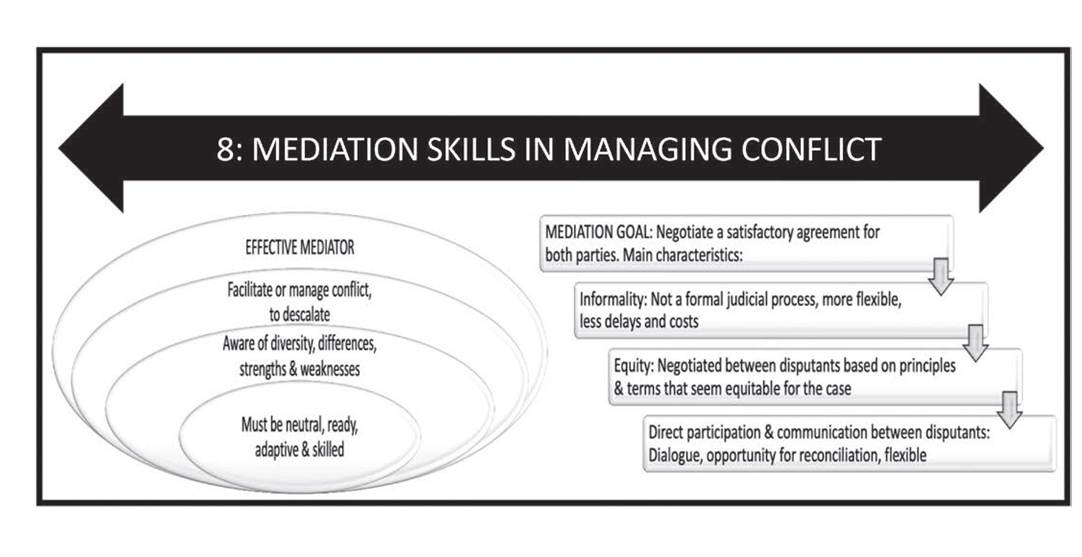
All rights of reproduction in any form reserved. mediation. A knowledge base alone does not make a good mediator. The person acting as a mediator must be neutral, ready, adaptive, and skilled if they are going to facilitate or manage, rather than escalate, conflict.
123
Mediate and Mediation
Mediate and mediation are words derived from the Latin word medius, which means “the middle.” The Merriam-Webster Dictionary gives us: Mediate mede-al vb -at ed; -at ing; 1: to interpose between parties in order to reconcile them; 2: to reconcile differences (Charkoudian, Ritis, Buck, & Wilson, 2009).
Clearly, by definition, the action of a mediator is to place oneself in the middle of a conflict. There are many processes available to aid individuals in reconciling conflicts. However, in judicial situations in the United States, various alternatives to dispute resolution are defined. Examples include mediation, negotiation, and arbitration. This book focuses on mediation. Mediation refers to a voluntary process in which the disputants strive to find a satisfactory resolution to their dispute. The mediator serves as a facilitator for this process and helps the disputants reach an agreement. The mediator does not impose solutions, assess punishment, administer judgment, decide who is right, or persuade the parties to any side of the dispute. The mediator skill set includes anger management, strategic conflict engagement, conflict resolution and management, active listening, creativity, and a guided process to facilitate the mediation. Mediation between engaged disputants requires that the parties agree to■ express their feelings and points of view,
■ identify their needs,
■ clarify issues,
■ understand the other party’s view, and
■ explore solutions.
The goal is that the disputants will be able to negotiate an agreement that is satisfactory to both parties. To enable individuals to operate as a mediator, the framework we present is that change creates conflict, which should be managed by some resolution method and may require mediation.
Change Creates Conflict
In Chapter 1, we discussed how conflict can arise when change occurs. Most of us are comfortable with change as long as it is the other person who has to change. Sometimes, change between people has to be mediated.
We have organized this chapter to first present a brief perspective on change in the workplace and the stress and conflicts that accompany change. Then, we provide a framework for understanding conflict and typical behavior patterns when individuals are dealing with conflict.
With this framework in mind, the reader can begin to understand the processes and role that a mediator should use to operate in “the middle” of a conflict without getting pulled into the conflict. Several tools that the mediator can use in a mediation process are presented. Finally, aspects of a mediation program are presented for those who are striving to preempt the potential of costly conflicts by having known mediators available.Change and the Workplace
It has been said by many that the one constant in life is that change will occur. For each individual, changes occur both internally and externally. Internally, our feelings, emotions, commitments, and attitudes can vary constantly. Externally, the people around us are ever changing, as are organizations, environments, and tools. When change occurs, we are sometimes responsible for the change and at other times the change is imposed upon us. We may desire to changejobs and may activate an effort to search, interview, and move into a new job; on the contrary, a change imposed on us would be a “lay-off” that forces us to leave our currentjob. When change occurs, whether perceived as positive or negative and whether self-imposed or a change driven by someone else, there are some common variables that always accompany change including varying levels of resistance, stress, conflict, and changes in behavior. Referring again to Figure 1.5, people typically do not want to change. They often feel a sense of betrayal when change is occurring and fight against the change. Only when staying “stuck” is more uncomfortable than changing do people typically change. Our common reaction to change is to have a heightened stress level. Stress is not an undesirable aspect of ajob—itjust needs to be managed. Stress that is above or below a certain comfort and motivational level will cause people to look for relief. We search for a resolution to the conflict that causes the uncomfortable stress.
Importance of Managing Conflict
As stated earlier in the book, Mary Parker Follett (1996), a social worker and organizational theorist said,
We can often measure our progress by watching the nature of our conflicts.
If a man should tell you that his chief daily conflict within himself is “shall I steal or not steal?” you would know what to think of his development... in the same way, one test of your [organization] is not how many conflicts do you have, for conflicts are the essence of life, but what are your conflicts, and how do you deal with them? (p. 45)
Conflict exists even if only one person acknowledges the struggle. Typically, people react to conflict in one of two modes: fight to win or flight from the situation. However, beyond the initial reaction to conflict, much more complex behavioral patterns will emerge. Common examples in the workplace would be to deny, lie, cheat, argue, battle, compromise, collaborate, help, give-in, hide, or avoid. It is important to understand your own tendencies for addressing conflicts, because we tend to see our own behavior as the right behavior. In addition, if we can aid others in discerning their conflict styles, rather than assuming people’s intent, we may add valuable insight to management of the conflict.
A Brief History of Alternative Dispute Resolution
Dispute resolution outside of the courts is not new; societies around the world have long used nonjudicial, indigenous methods to resolve conflicts. What is new is the extensive promotion and proliferation of Alternative Dispute Resolution (ADR) models, wider use of court-connected ADR, and the increasing use of ADR as a tool to realize goals broader than the settlement of specific disputes.
The ADR movement in the United States was launched in the 1970s, beginning as a social movement to resolve community-wide civil rights disputes through mediation and as a legal movement to address increased delay and expense in litigation arising from an overcrowded court system. Ever since, the legal ADR movement in the United States has grown rapidly and has evolved from experimentation to institutionalization with the support of the American Bar Association, academics, courts, the U.S.
Congress, and state governments. For example, in response to the 1990 Civil Justice Reform Act requiring all U.S. federal district courts to develop a plan to reduce cost and delay in civil litigation, most district courts have authorized or established some form of ADR. Innovations in ADR models, expansion of government-mandated, court-based ADR in state and federal systems, and increased interest in ADR by disputants has made the United States the richest source of experiences in court-connected ADR.While the court-connected ADR movement flourished in the U.S. legal community, other ADR advocates saw the use of ADR methods outside the court system as a means to generate solutions to complex problems that would better meet the needs of disputants and their communities, reduce reliance on the legal system, strengthen local civic institutions, preserve disputants’ relationships, and teach alternatives to violence or litigation for dispute settlement. In 1976, the San Francisco Community Boards program was established to further such goals. This experiment has spawned a variety of community-based ADR projects, such as school-based peer mediation programs and neighborhood justice centers. In the 1980s, demand for ADR in the commercial sector began to grow as part of an effort to find more efficient and effective alternatives to litigation. Since this time, the use of private arbitration, mediation, and other forms of ADR in the business setting has risen dramatically, accompanied by an explosion in the number of private firms offering ADR services. The move from experimentation to institutionalization in the ADR field has also affected U.S. administrative rulemaking and federal litigation practice. Laws now in place, authorize and encourage agencies to use negotiation and other forms of ADR in rulemaking, public consultation, and ADR.
Internationally, the ADR movement has also taken off in both developed and developing countries. ADR models may be straightforward imports of processes found in the United States or hybrid experiments that mix ADR models with elements of traditional dispute resolution.
ADR processes are being implemented to meet a wide range of social, legal, commercial, and political goals. In the developing world, a number of countries are engaging in the ADR experiment including Argentina, Bangladesh, Bolivia, Colombia, Ecuador, the Philippines, South Africa, Sri Lanka, Ukraine, and Uruguay. The experiences with ADR in these countries provide important lessons for understanding and managing conflict in the United States (Barrett & Barrett, 2004).The Characteristics of ADR Approaches
Although the characteristics of negotiated settlement, conciliation, mediation, arbitration, and other forms of communityjustice vary, all share a few common elements of distinction from the formal judicial structure. These elements permit them to address development objectives in a manner different from judicial systems.
Informality
Fundamentally, ADR processes are less formal than judicial processes. In most cases, the rules of procedure are flexible, without formal pleadings, extensive written documentation, or rules of evidence. This informality is
128 ■ Conflict Management and Dialogue in Higher Education, 3rd edition appealing and important for increasing access to dispute resolution for parts of the population who may be intimidated by or unable to participate in more formal systems. It is also important for reducing the delay and cost of dispute resolution. Most systems operate without formal representation.
Application of Equity
Equally important, ADR programs are instruments for the application of equity rather than the rule of law. Each case is decided by a third party or negotiated between disputants themselves based on principles and terms that seem equitable in the particular case, rather than on uniformly applied legal standards. ADR systems cannot be expected to establish legal precedents or implement changes in legal and social norms. ADR systems tend to achieve efficient settlements at the expense of consistent and uniform justice. In societies where large parts of the population do not receive any real measure of the overall system ofjustice, ADR can mitigate the problems by (a) ensuring that disputants have recourse to formal legal protections if the result of the informal system is unfair and by (b) monitoring the outcomes of the informal system to test for consistency and fairness.
Direct Participation and Communication Between Disputants
Other characteristics of ADR systems include more direct participation by the disputants in the process and design of settlements, more direct dialogue and opportunity for reconciliation between disputants, potentially higher levels of confidentiality because public records are not typically kept, more flexibility in designing creative settlements, less power to subpoena information, and less direct power of enforcement. In the United States, where ADR systems have been used and studied more extensively than in most developing countries, the impact of these characteristics is still not clear. However, many argue that compliance and satisfaction with negotiated and mediated settlements exceed those measures for court-ordered decisions. The participation of disputants in the settlement decision, the opportunity for reconciliation, and the flexibility in settlement design seem to be important factors in the higher reported rates of compliance and satisfaction.
ADR adopted (October 10, 2011) Model Standards for Mediator Certification Programs, which can be found at (www.mediate.com/articles/acrcert1. cfm; Young, 2006).
What Necessitates a Mediation Process?
While there are countless possibilities of human interactions that can be used in a mediation process, two major categories can be identified: the need to change a basic pattern in a relationship or the need to solve a problem in the relationship. In reality, most mediations have varying combinations of these two categories. The two areas to address are: (a) wanting a change in patterns (behavior, protocols) and/or (b) problem solving. Table 8.1 illustrates goals and outcomes of what parties may be trying to adapt when in conflict with one another.
Principles ofMediation
Mediation, which is one method of conflict intervention, has the following principles:
1. Two winners are desired rather than one winner and one loser, or two losers.
2. To have two winners there must be cooperation instead of competition.
3. To truly cooperate, the parties must have equal power in this mediation, regardless of any other status that they may have in their relationship.
| TABLE 8.1 Goals and Outcomes in Mediation Process | |
| Change in Basic Pattern | Solve a Problem |
| Identify the basic pattern. | Identify the problem. |
| Describe the characteristics of the basic pattern. | Describe the drivers that cause the problem. |
| Focus on parties’ responsibility for characteristics. | Discern controllable, influential, and unchangeable drivers. |
| Discuss expected resistance to change. | Discuss realistic constraints on solutions. |
| Generate descriptions of desired basic patterns. | Generate possible solutions. |
| Discuss the changes required for the desired basic pattern. | Evaluate the trade-offs for the various solutions. |
| Plan steps that “unfreeze” resistance to change. | Analyze the quality of the solutions. |
| Plan steps that create momentum for desired change. | Select a solution. |
| Plan steps for making the change permanent. | Write an agreement that describes the solution to the problem. |
4. While the past must be mutually understood, even if not agreed upon, by all parties, the future is the primary focus.
5. To focus on the future, concentration must hone in on the interests and needs of the parties and not their current positions.
6. To truly understand needs we must not only consider the facts and thoughts the parties can share, we must also consider their feelings and emotions.
7. An environment where facts, thoughts, feelings, and emotions are to be shared must be based on openness and honesty.
8. To trust that this kind of environment is possible, the parties must choose to be positive rather than negative about the prospects of success.
9. Therefore, mediation must be a voluntary experience, not a mandated one.
10. The outcome must be a mutually agreed upon solution, not an order by which all must abide.
The Ethical Guidelines for Mediators Model mediation training guidelines can be found at https://www.txmediator.org/aboutmediation/ guidelines.php (Young, 2006).
Ethical Guidelines are intended to promote public confidence in the mediation process and to be a general guide for mediator conduct. They are not intended to be disciplinary rules or a code of conduct. Mediators should be responsible to the parties, the courts, and the public, and should conduct themselves accordingly. Ethical Guidelines are intended to apply to mediators conducting mediations in connection with all conflict matters whether conducted in the workplace (e.g., such as a university) or in a civil case.
Standards of Practice and Code of Ethics: Preamble
In April of 1994, the ADR Section of the State Bar of Texas (the “ADR Section”) adopted Ethical Guidelines for Mediators (the “Guidelines”). The Guidelines have been widely accepted in Texas as the ethical standards of practice for mediators. The Texas Mediator Credentialing Association (TMCA) Board of Directors has adopted the Guidelines, with modifications, to make them mandatory rather than suggestive or permissive, as standards of practice and a code of ethics for TMCA credentialed mediators, to be known as and referred to as the “Texas Mediator Credentialing Association Standards of Practice and Code of Ethics.” In 2005, the Supreme Court of Texas adopted the Guidelines and, in 2011, the Supreme Court of Texas adopted amendments to the Guidelines that had been suggested by the State Bar ADR Section. The TMCA Standards of Practice and
Code of Ethics are identical to the Guidelines and the amendments, with a few exceptions: generally, the permissive word “should” in the Guidelines is replaced with the mandatory word “shall” in every place that the word “should” appears in the Guidelines and the amendments (Texas Mediator Credentialing Association, n.d.).
The Mediation Process
The act of bringing a group of people together to work toward a common goal is the basic definition of a team. In a mediation process, the disputants and mediator have a common goal of developing a resolution, or at least a management plan, to address a common problem for the disputants. Thus, in the mediation process, the participants must become a team. It is important to recognize that a set of team members do not have to like each other. Rather they have to acknowledge and value all members of the team, stay focused on the goals, and stay with the team process (plays or plans) so that the required interdependence of the team is used for progress instead of interference. The mediator can benefit from understanding some basics concerning how effective teams normally progress together. From Scholtes, Joiner, Streibel, Mann, and Streibel’s (1998) Handbook of Teams, we acknowledge that, often, we must appear to move away from good performance in order to set up the team dynamics that will foster performance in the long run. Figure 8.1 is based upon Tuckman andJensen’s (1977) model of teams. Recall from the previous chapter that teams do not just happen. They go through stages before they perform well.
Conflict Intervention Strategies
In Chapter 7, we discussed that there are many intervention styles (Figure 7.6). When teaching conflict intervention strategies to higher education personnel, we use mediation as the teaching modality. Mediation is used because it is typically the most challenging conflict intervention strategy for higher education faculty and staff to use; therefore, if our faculty and staff can hone their mediation skills, then they have meaningfully added to their toolkit of conflict intervention strategies. Mediation is challenging for many conflict managers because the options for resolution or management of the conflict are determined by the parties in conflict (referred to as the disputants in this chapter), and not the conflict managers (referred to as the mediators in this chapter). Most of us in higher education want to solve problems and challenge ideas and generate solutions and outcomes.
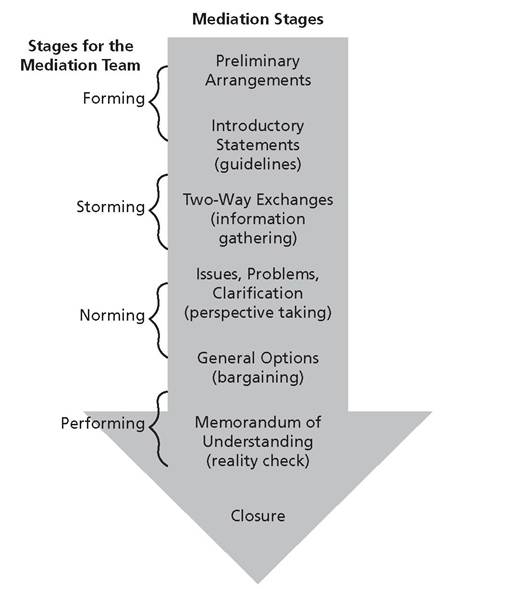
Figure 8.1 Traditional mediation process framework.
Therefore, using the conflict intervention strategy of mediation feels counterintuitive to most faculty and staff in higher education.
The information that follows can be used to educate and train mediators. The remainder of the chapter provides information on: (a) the traditional mediation process, (b) the multiparty narrative model (MNM) of mediation, (c) the traditional mediation script, and (d) skill sets needed to be effective conflict managers.
The Mediation Process
Mediation is a multistage process. It is important to remember that the process is flexible. The mediator must use flexibility in controlling the stages of mediation so that a suitable resolution is found. Rigidity through the stages of the process can lead to an unproductive mediation. However, each stage has important aspects that lay the groundwork for future stages (Figure 8.1).
Preliminary Arrangements: a stage to get ready. In this stage the disputants agree to mediation and upon a mediator (or mediators), time, place, and so forth. When strong emotions are involved in the conflict, it is often useful for the mediator to have individual interviews with the disputants. In these interviews the mediator strives to understand the needs and interests, as well as the position of the disputant, and provide coaching on acceptable conduct during the mediation sessions.
Introductory Statements: opening of the mediation session and the roles and rules are presented for the disputants to agree to them in the presence of each other, even if they have been presented to the disputants before.
Initial Statements: each disputant has an uninterrupted opportunity to state his or her “story” of the dispute. The order of presentation is determined during the introductory statement stage.
Two-Way Exchanges: mediator helps the disputants share feelings and understand each other’s viewpoints.
Issues and Problems Clarification: mediator helps the disputants understand each other’s needs and interests. The disputants clarify the issues and problems that prevent both parties’ needs and interests from being met.
Generating Options and Finding a Solution: disputants generate possible actions that will resolve the problems that are preventing the disputants’ needs and interests from being met. The disputants agree upon a course of action to resolve the conflict.
Memorandum of Understanding (MOU) Writing, involves laying out the solution in detail to assure that it can be implemented realistically and will potentially resolve the conflict.
Closure, affirm the disputants and then close the mediation.
Goals in the Mediation Process
Each stage of the mediation process has specific goals for both the mediators and the disputants. The goals for each stage are described below. These goals are discussed in numerous books and articles as the traditional mediation model has been standardized.
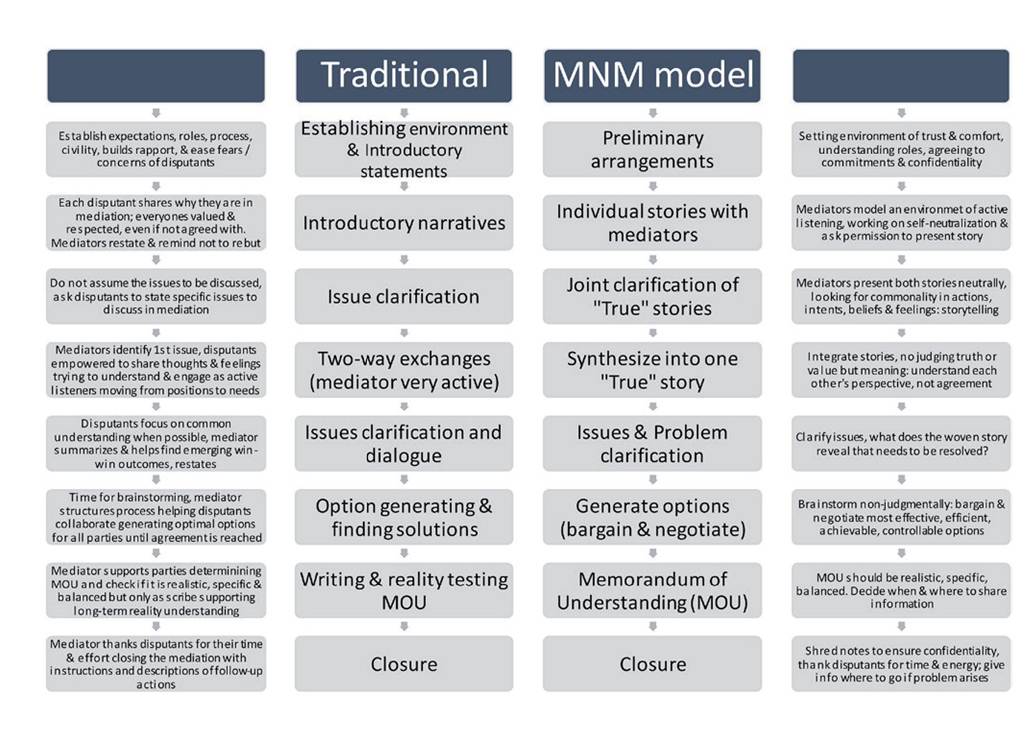
Establishing the Environment and Introductory Statements
■ Mediator establishes expectations by explaining the role of the mediator and the role of each party in conflict.
■ Mediator establishes and builds rapport with disputants and a functional level of willingness to engage between the disputants.
■ Parties are reminded they are not forced to reach an agreement but should have good faith commitment to one another.
■ Mediator starts by explaining the process and asking each disputant to share their perspective related to how come they are in mediation with one another.
■ Mediator works to ease fears and concerns of disputants, making sure the disputants understand the process, what is expected from them and what they can expect from one another related to civility.
■ Each party is asked to share their narrative (what brings them to mediation).
Initial Statements by Disputants
■ Everyone is to be valued and validated as a person whose values, needs, and beliefs are respected, even if not agreed with.
■ Each disputant shares their narrative (reason they are at mediation); typically 3-5 minutes.
■ Mediators restate or summarize what each disputant says.
■ Mediators remind Disputant 2 to share their narrative so that whoever goes second does not spend time in rebuttal to what the first disputant said, but rather simply shares their narrative.
Issue Clarification
This step of the mediation process is added by the people who are practicing the MNM Mediation Model (see The Multiparty Narrative Model (MNM) of Mediation).
Mediators state “you may have shared your issues in your previous narrative. However, we do not want to assume that we know the issues you want to discuss in mediation. Therefore, please state the specific issues you would like to discuss in mediation.”
The issues are listed so all parties can see the issues to be addressed in this mediation session.
Two-Way Exchange (Mediator Very Active)
■ The mediators identify the first issue for the parties to discuss.
■ Disputants share their additional thoughts and feelings related to the issue they are discussing.
■ Disputants share statements with other party that have not been heard before, particularly moving to understand other party’s reasoning and/or reactions, again even if remaining in disagreement.
■ Disputants empowered to operate in the process and control aspects of the process.
■ Ideally the disputants start summarizing and restating what they hear and learn from one another.
■ Disputants share perspectives that they believe drove them to their current positions.
■ They take turns.
■ They are asked to engage as active listeners.
■ Disputants begin moving from their positions to their underlying positions and needs.
■ Mediator notes and exposes patterns of behavior that lack cooperation.
Issues Clarification and Dialogue
■ Thoughts and feelings are shared in this part of the mediation process.
■ Avoidance in the form of spin-offs, dead ends, diversions may occur.
■ Competition in the form of blaming, hurting, or trying to pull the mediator to be on their side.
■ Disputants focus on common understanding when possible.
■ Mediator uses what he/she sees, hears, and feels in order to restate or summarize for other party.
■ Everyone hearing/looking for commonalities.
■ Disputants begin to focus on major or priority issues that need resolution.
■ Mediator notes and has disputants acknowledge differences between the two parties.
■ Mediator helps disputants find emerging win-win outcomes.
■ Mediator looks for ways to help parties save face.
■ Mediator begins to focus disputants on interests and needs rather than positions.
■ Disputants make issues specific and focused.
■ Mediator supports parties to focus on major issues, rather than every incident.
■ Mediator reinforces interdependence between the parties to help them understand and validate other’s perspectives through restating.
■ Mediator clarifies the differences that still cause unmet needs for the disputants.
Option Generating and Finding Solutions
■ Typically, disputants naturally move from sharing their thoughts and feelings to generating options.
■ Mediator structures the process, so options are generated; this is a time of brainstorming.
■ Disputants describe details of the options they propose.
■ Mediator formulates questions to pull option details out and cause more options to be generated.
■ Disputants collaborate to generate new options that allow optimal trade-offs for all parties.
■ Disputants compromise so that there is a balance of wins and losses for all parties.
■ Disputants negotiate and adapt on issues that have less of a priority for them than the issues have for the other.
■ Link new information with previously known information; make additions.
■ Seeing options in some new light by fractionalizing.
■ Disputants agree on options.
Mediators then ask the disputants to move to the next issue to work through and again support them in elaborating, sharing both their thoughts and feelings, and generating options.
Writing and Reality Testing of Memorandum of Understanding (MOU)
■ Mediator supports the parties in determining their MOU items.
■ Mediator checks with disputants to make sure the MOU is realistic, specific, and balanced.
■ Mediator supports disputants to test long-term reality of MOU by asking questions, “What if... or What is your understanding of...”
■ Mediator asks detailed questions related to the who, what, when, where, and how.
■ Mediator is the scribe for the disputants as they tell the mediator what they want in their MOU.
■ MOU is written in terms communicated by parties (each sentence ~7-15 words).
■ Mediator assures significant details of solution are captured in the MOU (dot I’s and cross T’s).
Closure
Mediator affirms good work regarding the MOU and the party’s commitment to their MOU.
Mediator closes the mediation with instructions and descriptions of follow-up actions.
Shred notes to ensure confidentiality.
The Multiparty Narrative Model of Mediation
Figure 8.2 is an illustration of sharing a combined narrative and a further elaboration on the MNM process of mediation, contrasted with the traditional mediation process.
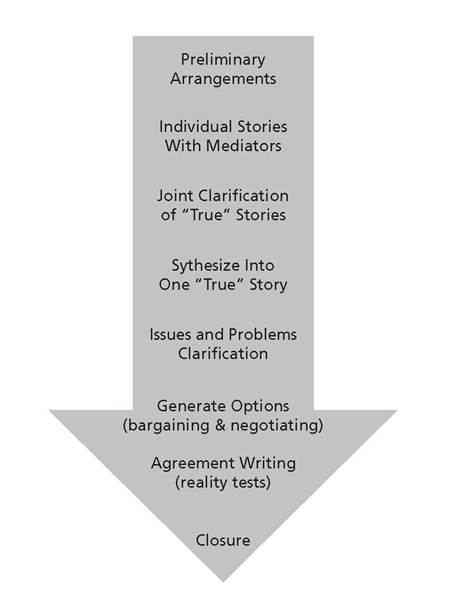
Figure 8.2 MNM mediation process framework.
The traditional mediation process was modified to further support addressing conflict in higher education. Primary components of the MNM of mediation (Figure 8.2) include:
1. The mediator, or one of the co-mediators, presents the combined narrative of the two parties (disputants).
Rationale:
- Research shows the person who shares their “narrative of the conflict first” frames the mediation.
- Disputant 2, in the traditional mediation model, spends about 50% of her/his time in rebuttal to Disputant 1 instead of sharing her/his narrative/ perspective on the conflict.
- Mediator models: sharing a narrative, active listening, sharing thoughts and feelings, introducing areas of common ground, clarity in issue identification, organizing the mediation in a chronological fashion.
- Disputants typically: learn of new information from the other disputant sooner, have decreased positionality and therefore less defensiveness, see both the strengths and the challenges in their relationship with one another, listen for new information instead of defensive posturing.
2. A shift in the mediation process moving issue clarification before the two-way exchange.
Rationale:
- The sooner the parties (disputants) can be clear on the actual issues (not their positional statements) that they want to discuss, there is increased likelihood that the parties can move to their underlying interests and needs related to the issue.
- Parties feel a greater sense of understanding of what issue they are discussing while sharing their feelings and thoughts. Increases movement to resolve issues more quickly.
Preliminary Arrangements
■ Setting an environment of trust and comfort with what will occur.
■ Understanding role of volunteers and commitments.
■ Agreeing to commitments and confidentiality.
Individual Stories With Mediators
■ Modeling an environment of active listening.
■ Establishing the appreciation and valuing of the story (Cloke & Goldsmith, 2011).
■ Mediators begin to work on self-neutralization and power neutralization for mediation.
■ Mediators must gain permission from disputants for any material from the individual stories to be presented.
Joint Clarification of “True” Stories
■ Mediators present aligned stories, looking for elements of commonality, neutral presentation, and exposure of actions, intents, beliefs, and feelings.
■ Set environment where disputants are not disempowered but are minimized in working hidden agendas (Kline, 1999). Let disputants correct errors of what was presented or what was omitted now that they see aligned stories.
■ See if the disputants can articulate what their story says about them—fundamental difference to traditional mediation model (storytelling, social justice literature, mental models, let disputants tell us what story means after they’ve heard our interpretation of stories). This may deepen the exposure of a disputant’s mental model.
Synthesize Into One “True” Story
■ Setting environment for understanding that we are weaving stories together not judging truth or value of stories.
■ Integrate (go beyond the meaning of my story to the meaning of the stories for both).
- Can Disputant 1 understand, not necessarily agree with, Disputant 2 perspective?
- What do other Disputants’ perspectives mean to me?
Issues and Problems Clarification
■ What does the woven story reveal that needs to be resolved? (What are the issues?)
■ Clarify issues so that we understand what is in conflict.
Generating Options
■ Brainstorm, nonjudgmentally, creative options to resolve or minimize conflicts.
■ Bargain and negotiate which options are the most likely to be effective, efficient, achievable, controllable, desirable.
Memorandum of Understanding (MOU)
■ Be realistic, specific, balanced.
■ Decide when and where to disseminate information.
Closure
■ Shred notes to ensure confidentiality.
■ Appreciate and affirm the disputants.
■ Give information to disputants on where to go next if a problem or concern arises.
Assumptions for Mediation
All models assume that we, as mediators, need to move the disputants higher on the cooperative axis from where they are initially presenting. Further, our goal is to keep all disputants assertive regarding their needs and interests so that one party is not accommodating on all issues. The assumption of all models is: (a) the disputants want to find a resolution and (b) their needs and interests can be met.
Traditional Mediation Model
Basic Assumptions
1. The mediator(s) can assume a neutral state.
2. History is allowed to gain understanding of the conflict issues that are the focus of the mediation.
3. Narrowing the focus will enhance the chance of success.
Process Assumptions
1. Taking equal turns and disallowing abuse assures fairness.
2. Focusing to narrow the information presented to the conflict issues that need and can be resolved.
3. Solution generation by the parties enhances buy in.
4. Reality, specificity, and balance will ensure fairness.
MNM—Mediation Model
Basic Assumptions
1. Since no one can be absolutely neutral, the mediators must be very conscious of their own mental models concerning the disputants, the conflict, and the process.
2. History must be used to help each disputant become more conscious of their mental models concerning the other party and the conflict.
3. A narrow focus may help get a resolution, but it may not be the best resolution especially considering the ongoing relationship of the disputants.
Process Assumptions
4. Statistically, the party that gets to go first is unintentionally advantaged over 80% of the time; MNM strives to negate this advantage.
5. Perspective taking, including awareness of the other person’s “reasonable” mental model, will enhance collaborative solution generation.
6. Rather than having one of the disputants take the first turn in the mediation, the mediators will first tell the history leading to the conflict based on the combined history of the conflict placed in a chronological format, including factors that have contributed to each disputant’s mental model. Each disputant will take turns to explain, correct, or elaborate the history presented until they believe an accurate history leading to the current status of the conflict is presented.
7. Focus should be on needs for resolution for the current conflict and on the ongoing relationship of the disputants.
8. Specificity, reality, and balance are important in regard to the conflict as it fits in the context of an ongoing relationship.
Example
Jess, a White female, professor, is in conflict with Stacy, an African American female, associate professor, concerning the use of resources, specifically who will have a teacher assistant (TA) and who will not. The senior faculty member makes these assignments and has not given Stacy a TA for the semester, while another faculty member, Mike, a White, male, associate professor, has received a TA for his course.
Stacy is certain that Jess has used personal biases in making the assignment because when Mike taught the course Stacy is scheduled to teach, he was assigned a TA. Furthermore, his current course assignment has never had a TA assigned to it before. The issue is simply that Jess does not like or respect Stacy and uses every opportunity to impede her work.
Jess is certain that her TA assignments are fair considering the current resources available and the departmental history. The issue is fundamentally based on algorithms for enrollment numbers and innovations proposed, as well as consideration of faculty needs to break algorithmic ties if resources are too scarce to give everyone a TA.
Traditional Model Beginning
A coin is flipped and either Jess or Stacy presents their version of the issue. If Stacy goes first then Jess may spend a significant part of her time addressing the fact that she does not dislike Stacy, and that she has never impeded Stacy’s work. If Jess goes first Stacy may spend a significant part of her time addressing the facts surrounding the algorithm for TA assignments and why it appears to be unfair.
MNM of Mediation Beginning
After 1-hour interviews with each disputant, the mediators begin the mediation with the following:
| Combine Narrative Using the MNM of Mediation | ||||
| Stacy | Jess | |||
| Feelings | Thoughts | Feelings | Thoughts | |
| 2003 | Excited to join the department, and nervous as the first woman | She was qualified but knew she had to make it like all the women had to be respected | ||
| 2012 | Excited to join the department because they made her feel valued and respected | Could contribute, make a difference, her passions aligned with institution’s espoused values | Angry that the faculty were ignored as the normal recruiting process was not engaged to hire the first African member of the department | Diversity, specifically ethnicity and race, overrode other very important issues in the hiring of Stacy |
| 2013 | Hurt and angered by hostilities, devaluing, and being ignored by Jess and others in curricula meetings | This is not much fun, may get better after tenure, why won’t others who agree with her speak up to counter Jess’s opinions | Sad and Angry because Mike almost did not get tenure because everyone compared him to Stacy | Stacy was given many more resources and opportunities than normal Asst. Profs because she is African American |
(continued)
| Combine Narrative Using the MNM of Mediation | ||||
| Stacy | Jess | |||
| Feelings | Thoughts | Feelings | Thoughts | |
| 2014 | Hurt and stressed by sharp criticisms about her work and teaching, it is like people are watching for every little mistake | I made it (tenure), maybe it gets better now—I can start doing other things to accomplish even more work in the field | Confused and disappointed that valued colleagues did not even analyze Stacy’s promotion package like they normally do | Stacy’s tenure is deserved but she certainly has not earned it like everyone else had to |
| 2016 | Current Conflict— ignored, devalued, punished, not given same chances to contribute to the field | May need to leave, does not know how to connect so they understand her and her research. TA assignment is an indication of whether they value the time you need for research | Tired of Stacy thinking she deserves special treatment, and concerned for the standards Jess and others have assured exist in the department. Sympathetic to Mike. | Stacy has been treated fairly, it is her turn to think about the department and make some sacrifices for others. It’s for her own good. |
It is important to note that both models, traditional and MNM, are strong conflict management models. It is the role of the mediator to determine which mediation model is ideal for the conflict situation they are facilitating.
The remainder of this chapter is comprised of two sections:
1. The Mediation Script—a script for beginning mediators to use in a mediation course to develop the process and skills to effectively facilitate conflicts.
2. The Mediation Skill Set—skills that are particularly important for mediators to be aware of and to hone in order to effectively support individuals in conflict.
The Mediation Toolkit
Below is the mediation script used to teach people to be effective conflict managers. This script can be used for all types of conflict interventions by adapting the formality or informality of the process dependent upon the intervention method being used. Similar scripts are widely used representing the traditional mediation model.
Getting Ready (Premediation):
(Meeting Separately With Disputants is Optional)
Use this step to begin the mediation when disputants:
■ have strong feelings,
■ when gathering information for a combined narrative,
■ to build rapport,
■ to explain the process, and
■ to explain specific protocols for your setting.
Purpose:
■ Mediators meet separately with the disputants when there is high emotion such as anger.
■ Mediators allow disputants to share emotions and/or anger about the situation.
■ Review the mediation process and make sure that parties understand what will be happening.
■ Review your role as the mediator.
■ Begin to develop rapport with parties and trust in mediators and process.
■ Review and get agreement to mediate and guidelines for behavior.
Procedures:
1. Mediators meet separately with each of the disputants for a short meeting (10-15 minutes for traditional model; 30-45 minutes for MNM of mediation).
2. Introduce yourselves and explain the role of the mediators.
M: My name is___________________________ and I am a mediator.
M: I am here to help support you two as you work to resolve your issues with.
~OR~
M: (name of other disputant) wants to solve her/his issues with you and would like to try and resolve it with you through the process of mediation.
M: Mediation is voluntary. We have no power to make a decision for you. We will not take sides or decide who is right or wrong.
Explain the mediation process.
M: Mediation is a process in which we help you talk about your is- sue/problem, look for possible solutions, and get a MOU that you both feel is fair.
M: Everything that is said here is confidential, except for a few things (homicide, suicide, and abuse, and any organizations limits to confidentiality).
3. Ask each disputant to tell her/his story.
M: Tell me what happened and how you are thinking and feeling about it. Repeat using your own words to summarize what was said and how they are feeling about it.
4. Get agreement to mediate.
M: Are you ready to work to solve your conflict in mediation?
If they say yes, they are ready, prepare for the mediation. If they say no, ask them what they need in order to begin. Below are suggestions for helping the disputants agree to mediation if they are hesitant about mediating.
M: What do you need in order to solve this conflict?
M: What would you like to get out of mediation?
Find out what alternatives they have if they do not want to mediate.
M: What will happen if you don’t solve the conflict in mediation?
Identify some of the advantages of mediation.
M: You will have a chance to express your feelings and point of view.
M: You will be able to talk about the conflict in a safe and neutral place.
M: You will be able to find a resolution to the conflict that is fair to both of you.
M: It’s a chance to improve the situation rather than making it worse.
Explain the guidelines for behavior (RULES).
M: In order for mediation to work, we need you to agree to some rules for behavior:
- No name calling or put-downs.
- No interrupting when someone is talking.
- Be as honest as you can.
- No physical fighting or threats.
- Agree to try to solve the problem.
Ask if there are any questions.
5. Explain when and where the mediation will take place.
Introductory Statements: Roles and Rules
Purpose:
■ Review mediation process and make sure that parties understand what will be happening.
■ Review your role as mediator.
■ Begin to develop rapport with parties and trust in mediators and process.
■ Review and get agreement to mediate and guidelines for behavior.
Procedures:
1. ROLES: Introduce yourselves and tell the role of the mediators.
M: Hi, my name is__________________________________, and this is
______________________________________, we are your co-mediators.
M: We are here to support you as you work to solve your problem.
M: Mediation is voluntary. We will not decide who is right or wrong, take sides, or make decisions for you.
M: Each of you will have a chance to discuss ways of solving your problem so each of you gets what you need.
M: A good faith commitment, called a Memorandum of Understanding (MOU), will be written and signed.
M: Everything that is said in here is confidential, except for a few things (homicide, suicide, and abuse, and any other organization limits to confidentiality).
2. RULES: Explain to get agreement to guidelines for behavior.
M: For mediation to work, we need you to agree to these rules:
- No name-calling or put-downs.
- No interrupting when someone is talking (here is some paper).
- Be as honest as you can.
- No physical fights or threats.
- Agree to try to solve the problem.
- Speak directly to us at first, if necessary.
- Clarify any time constraints.
- Comfortable with us as mediators?
- No recordings—this is not discovery.
3. Ask if there are any questions.
Initial Statements
Purpose:
■ FACTS and FEELINGS: To allow parties to describe their view of the situation (tell their story) and express feelings.
Procedures:
4. Decide who will talk first. Ask the first person to describe how they see the situation and how they are feeling about it. Get the FACTS and FEELINGS behind each issue.
M: (name), could you tell us about the events (what happened) and how you feel about it?
Restate the facts and feelings using your own words.
5. Ask the second person to tell how they see the situation and how they are feeling about it
M: (name), could you tell us about the events (what happened) and how you feel about it?
Restate the facts and feelings using your own words.
Two-Way Exchanges
Below are some guidelines during two-way exchanges between disputants.
1. Ask person #1 if he/she wants to respond to what the other side said.
M: (name), would you like to respond to what (name) said?
Restate each response using Active Listening.
2. Ask person #2 if he/she wants to respond to what the other side said.
M: (name), would you like to respond to what (name) said?
Restate each response using Active Listening.
3. OPTIONAL: Ask questions of each disputant to help clarify and to get more information. Possible questions:
M: Can you tell us more about (name)?
M: How long have you two known each other?
M: How long has this problem been going on?
M: Where or when did this happen?
Use good teamwork if there are co-mediators.
Issues and Problems Clarification
Purpose:
■ Mediators help parties to understand each other’s point of view. (Understanding does not mean agreement.)
Procedures:
1. Ask parties to summarize each other’s point of view and feelings about the problem (facts and feelings).
M: (name), would you tell us what you heard (name) say about this problem and how she/he is feeling about it?
2. Ask the other person if the summary was correct.
M: (name), is that correct?
If the person misunderstood or didn’t get all the facts and feelings, ask the other person to say it again.
3. Repeat Step 1 with the other party asked to speak.
4. Repeat Step 2 with the other person speaking.
Summarize all the facts and feelings as each person said them.
5. Find the things they have in common. For example:
M: (name), we heard you say that (name) used to be your friend, but it makes you angry when she/he talks with your boyfriend. Is that right?
M: (name), we heard you say that you don’t like it when (name) talks about you to your neighbor. You feel angry when (name) doesn’t say things directly to you. Is that right?
~OR~
M: We heard you both say that you used to be friends but now you are both angry and upset because of a problem about something that you both heard. Is that correct?
6. Identify ISSUES and look for COMMON GROUND.
7. Make sure that both persons have said everything that they need to say.
M: Is there anything else that either of you needs to say before we go on to the next part?
Generating Options and Finding a Solution
Purpose:
■ to generate ideas to find a reasonable solution to the problem,
■ to encourage the parties to cooperate in order to find a solution that is one to which they both can agree, and
■ to help the parties evaluate the possible solution in order to get a workable agreement.
Procedures:
1. Explain that you will support them in finding solutions to their problem.
M: You now can talk about a solution to the problem that you will both feel is fair and one that you can work with.
2. Ask the first person what he/she thinks is/are reasonable way(s) to address (solve or manage) their issues.
M: What do you think is a fair solution to the problem?
~OR~
M: What do you need in order to solve this problem?
Encourage them to come up with their own solutions. If they have difficulty thinking of something, you can say:
M: If this problem happened again, what would you do differently to prevent it?
If they still cannot think of a solution to the problem, remind them that they agreed to try and solve the problem. Only offer choices if necessary, for example,
M: In a similar situation, the people decided to... [You want to rarely do this, as you are “taking power” from the parties in conflict and decreasing the likelihood they will follow through with their MOU.]
M: If (name) were willing to... what would you be willing to do?
3. Restate what the person needs in order to solve the problem. Encourage each person to come up with multiple ideas. Do not allow the other party to judge the possible solutions.
4. Ask the second party what she/he thinks is a solution to the problem.
M: What do you think is a solution to the problem?
~OR~
M: What do you need in order to solve this problem?
Encourage them to come up with their own solutions. If they have difficulty thinking of something, you can say:
M: If this problem happened again, what would you do differently to prevent it?
If they still cannot think of a solution to the problem, remind them that they agreed to try and solve the problem. Only offer choices if necessary, for example,
M: In a similar situation, the people decided to... [You want to rarely do this, as you are “taking power” from the parties in conflict and decreasing the likelihood they will follow through with their MOU.]
M: If (name) were willing to... what would you be willing to do?
5. Support the parties in finding their solution they can both agree to.
6. Help the parties evaluate the solutions to make sure that they are:
- REALISTIC (it can be done).
- SPECIFIC (defines what, where, when, who, how).
- BALANCED (both parties are part of the agreement).
7. Summarize and restate all parts of the agreement. Check with the parties to make sure that it is accurate.
Writing the Agreement or Memorandum OfUnderstanding (MOU) Purpose:
■ to write a MOU that states, in their language, all the solutions to any of the issues the parties want incorporated in their MOU;
■ to determine if the MOU needs to be reviewed or evaluated after a trial period of time. May use this with younger (e.g., K-12) disputants; and
■ to clearly define how the MOU will be carried out.
Procedures:
1. Write the MOU on a mediation report form.
Read the MOU and allow the parties to make changes if necessary.
2. Have each party sign the MOU.
M: This MOU is a record for you two of what each of you agrees to.
Closure
1. Ask the parties if they need to meet again (e.g., K-12 settings) to review the MOU. Ask parties if they are going to work with others (e.g., attorney in civil mediation) on the MOU.
2. Ask the parties if they are willing to come back to mediation first if they have additional issues they need facilitated.
3. (If appropriate) remind the parties about rumors. Ask them to tell their friends, families, and neighbors that their conflict has been resolved.
M: When you go back in the workplace what will you tell your colleagues that have been aware you were previously in conflict with one another?
4. Congratulate them for their hard work and for reaching a MOU.
M: Congratulations on working hard for resolution of your conflict.
Go over the process as many times as needed. Be sure to ask “What if?” questions.
Restate! Restate! Restate!
Example of Co-Mediator Teamwork (abbreviated script)
Mediator #1—Opening: Roles
M: This is_________________________________ and my name is
____________________________. During the mediation you will both be given a chance to talk. We are not here to judge you or to take sides. We will not decide who is right or wrong or how you will solve your problem. When we finish you will come up with an agreement, Memorandum of Understanding (MOU) and everything is confidential (when to break confidentiality).
Mediator #2—Rules
M: You will both need to agree to some rules before we begin the mediation.
- No name-calling or put-downs.
- No interrupting when someone is talking.
- Be as honest as you can.
- No physical fighting or threats.
- Agree to try to solve the problem.
- Speak directly to us at first, if necessary.
- Questions?
- Comfortable with us as mediators?
- No recording of mediation.
- Time constraints.
Alternate inviting disputants to speak and restate what is heard. Continue alternating invitations to disputant to share and to clarify each other’s positions, interests, and needs. Continue alternating invitations for ideas and restatement of ideas during the generation of solutions.
Mediator #1—Agreement/MOU
Summarize solutions and get verbal agreement.
Mediator # 2—Agreement/MOU
Write solutions on agreement form.
Mediation Checklist
Introductory Statements and Items/Issues to be covered:
? 1. Introduction
? 2. Signing of any needed documentation
? 3. Explanation of complete process
? 4. Go over ground rules
? 5. Explanation of mediator’s role, confidentiality, and neutrality
? 6. Get acceptance of mediator
? 7. Agreement and Enforceability
? 8. Time Constraints
? 9. Modification if third party present
? 10. Any questions
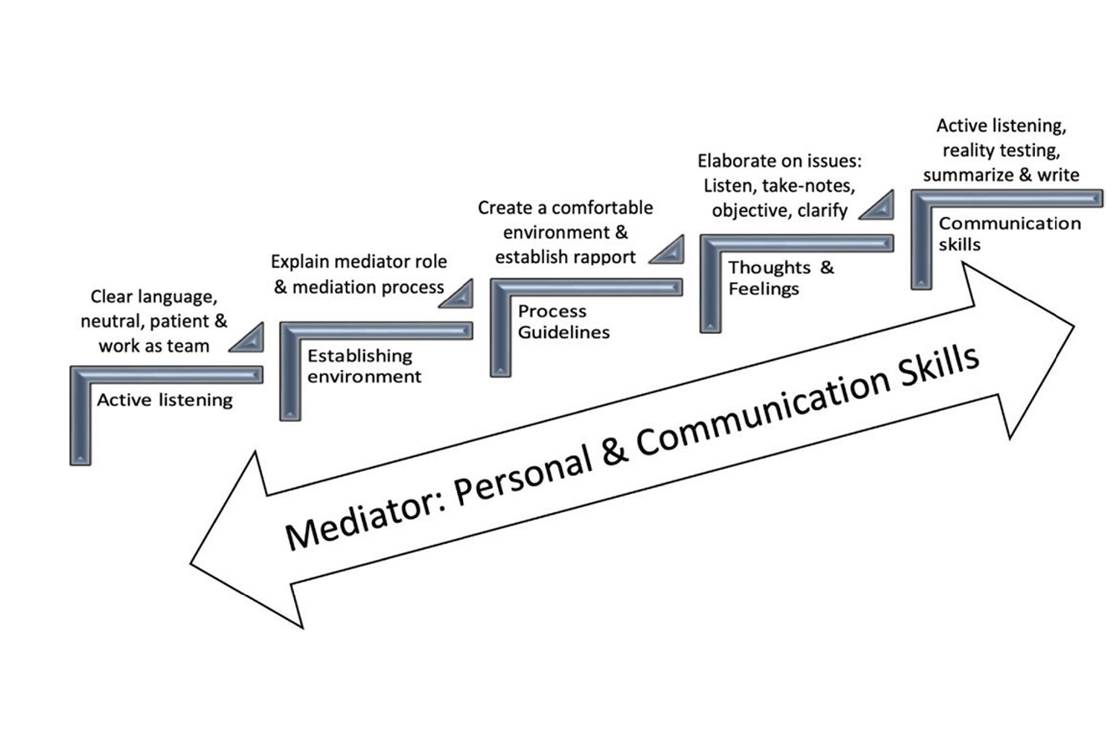
Mediator Skill Checklist
| Personal and Communication Skills | |||||
| Needs More Work | Mastered Skill | ||||
| Active Listening: Attention to Verbal and Nonverbal Cues | |||||
| 1. Using clear language | 1 | 2 | 3 | 4 | 5 |
| 2. Asking neutral questions | 1 | 2 | 3 | 4 | 5 |
| 3. Remaining patient | 1 | 2 | 3 | 4 | 5 |
| 4. Remaining neutral | 1 | 2 | 3 | 4 | 5 |
| 5. Working as a team | 1 | 2 | 3 | 4 | 5 |
| Roles and Rules: Establishing the Environment | |||||
| 1. Explaining the role of the mediator | 1 | 2 | 3 | 4 | 5 |
| 2. Explaining the mediation process | 1 | 2 | 3 | 4 | 5 |
| Roles and Rules: Process Guidelines | |||||
| 3. Creating a comfortable place for mediation to happen | 1 | 2 | 3 | 4 | 5 |
| 4. Establishing rapport | 1 | 2 | 3 | 4 | 5 |
| Facts and Feelings: Defining and Elaboration on the Issues | |||||
| 1. Listening/note-taking skills | 1 | 2 | 3 | 4 | 5 |
| 2. Ability to be objective and neutral | 1 | 2 | 3 | 4 | 5 |
| 1 | 2 | 3 | 4 | 5 | |
| 4. Clarifying issues | 1 | 2 | 3 | 4 | 5 |
| Personal and Communication Skills | |||||
| 1. Using active listening | 1 | 2 | 3 | 4 | 5 |
| 2. Getting ideas for resolution | 1 | 2 | 3 | 4 | 5 |
| 3. Using reality testing | 1 | 2 | 3 | 4 | 5 |
| 4. Ability to summarize and write an agreement | 1 | 2 | 3 | 4 | 5 |
| 5. Congratulating the disputants | 1 | 2 | 3 | 4 | 5 |
Characteristics of a Successful Mediation Program
Mediation programs have been implemented in schools, businesses, and communities. The purpose of these programs is to provide resources that will improve the environment for participants by actively addressing conflicts. Conflicts that are ignored often escalate into aggressive or even violent behavior. Therefore, the management of conflict for conscious, productive outcomes is at the core of a mediation program.
A well-designed program will benefit from the following characteristics:
■ a diverse team of conflict managers who can determine the nature of conflicts and determine the most appropriate dispute resolution strategy to use;
■ skilled mediators are available that will accommodate different disputants’ biases and needs;
■ people in the organization will have knowledge of the availability of the program;
■ widespread acceptance of the value of the program;
■ administrators, supervisors, and leaders who all support the program;
■ appropriate coordinators for the program are supported;
■ conflict managers and coordinators will participate in ongoing training;
■ the conflict management program will be considered a part of the organization’s climate, culture, diversity, and inclusion plans; and
■ external constituencies and supporters will be informed by the program and provide support as necessary.
References
Barrett,J. T., & Barrett,J. (2004). A history of alternative dispute resolution: The story of a political, social, and cultural movement. New York, NY: Wiley.
Charkoudian, L., Ritis, C. D., Buck, R., & Wilson, C. L. (2009). Mediation by any other name would smell as sweet—or would it? The struggle to define mediation and its various approaches. Conflict Resolution Quarterly, 26(3), 293-316.
Cloke, K., & Goldsmith,J. (2011). Resolving conflicts at work: Eight strategies for everyone on the job. Hoboken, NJ: Wiley.
Follett, M. P. (1996). Mary Parker Follett: Prophet of management. A celebration of writings from the 1920s. Boston, MA: Harvard Business School Press.
Kline, N. (1999). Time to think: Listening to ignite the human mind. London, England: Cassell.
Scholtes, P. R., Joiner, B. L., Streibel, B., Mann, D., & Streibel, B. J. (1998). The team handbook. Madison, WI: Associates.
Texas Mediator Credentialing Association. (n.d.). Standards of practice and code of ethics. Retrieved from https://txmca.org/index.php?page=10
Tuckman, B. W., & Jensen, M. A. C. (1977). Stages of small-group development revisited. Group & Organization Management, 2(4), 419-427.
Young, P. M. (2006). Rejoice-rejoice-rejoice, give thanks, and sing: ABA, ACR, and AAA adopt revised model standards of conduct for mediators. Appalachian JL, 5, 195.