Personal Skills Required to Be a Good Conflict Manager
Conflict simply is.
—Nance T Algert
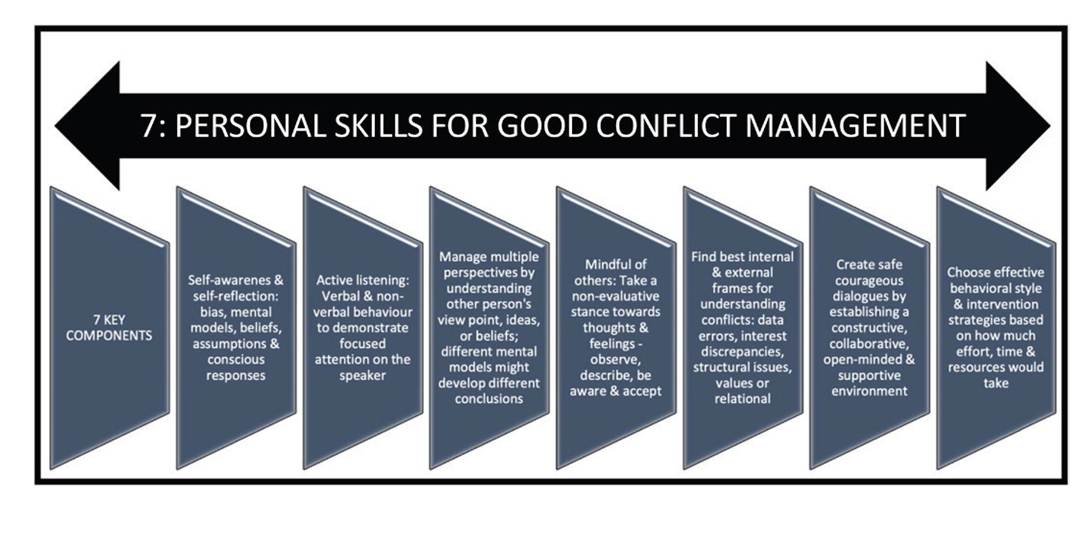
Regardless of the intensity of a conflict, nature of a conflict, or choice in how to manage a conflict, there are some fundamental skills, which everyone should hone to be more competent in managing individual, group, or organizational conflict.
While the list of valuable competencies is potentially vast, for the purposes of this book we will focus on seven key competencies:■ being self-aware of your position, attitudes, and reactions to the conflict,
■ being an active listener to everyone engaged in the conflict,
■ being able to manage multiple perspectives on the conflict,
■ being mindful of others,
■ being able to find the best frames for understanding the nature and intensity of the conflict,
Conflict Management and Dialogue in Higher Education, 3rd edition, pages 101-121
Copyright © 2021 by Information Age Publishing
All rights of reproduction in any form reserved.
■ being able to create safe courageous dialogues concerning the conflict, and
■ being able to decide if your chosen behavioral style and intervention strategies are likely to be effective.
Self-Awareness
Self-awareness and the willingness to engage in self-reflection concerning your responses and biases is a key component for effectively engaging in a conflict. Conflict exists, even if only one person perceives it. Therefore, whether you believe a conflict exists or not, when a person comes to you stating that they have a conflict, the conflict exists. When a conflict arises, you may need to be aware, because of your own personal history and experiences, of your own hyper vigilance toward certain people or specific situations that may cause you to overreact to some types of conflicts. If you lack the self-awareness to understand you or others, if you lack sensitivity to certain situations, and if you move to disbelief that a true conflict exists, you may jump in too vehemently.
When entering a conflict too forcefully, at an intensity not yet warranted, common reactions to the conflict are often to either dismiss or overdramatize the individuals who are in the conflict, about their beliefs, feelings, and thoughts. Too often, those who present a perceived conflict hear, “just ignore person X; he/she has behaved this way (e.g., being disrespectful to colleagues) for the past 20 years. You should just ignore her/him.” Often, just as unproductively, we may let our personal experiences or emotions inconsistently trigger reactions to eliminate a conflict so that we are perceived to have “favorites” in the organization, or even be susceptible to manipulation when others know our “hot buttons.”One effective strategy for strengthening your abilities to be more self- aware is to practice exposing your mental models (see Figure 1.1). Whenever you can, it is useful to engage in the following mental exercises:
■ Consider what others observed about a situation or event that you missed, and the things you focused on, where others seemed unconcerned. Are there patterns in the kinds of things you tend to ignore? When are those patterns good? Are there patterns
in the things you tend to focus on? How have your experiences shaped your ability to focus on those aspects of the situation?
■ Consider the beliefs that led you to assign meaning to certain data? Beliefs are deeply held perspectives that are true for yourself and others as well. For example, do you believe that good deeds are eventually rewarded, or do you believe that no good deed goes unpunished? Do you believe that there is always calmness right before the storm? These may be trivial examples to you personally, but they are meant to illustrate the need for you to understand how you focus your attention and interpretation of data based upon your beliefs.
■ Consider the assumptions you make about a situation or individuals that may seem valuable and true but might not have enough data present to substantiate them.
This is a useful way to check your stereotypes and biases.■ Consider what you conclude about the meaning of what you have observed and how you have integrated it into your beliefs and assumptions in order to draw a conclusion. Conclusions often include decisions based on what someone’s intentions are, even when only their behaviors are visible.
■ Consider whether your choice of actions was the only, or even the best choice, or did you rely on habits and conclusions substantiated by the data.
The purpose of these reflections is not to say your mental model is wrong. To the contrary, mental models are necessary for us to navigate the world. The purpose of the reflections is for you to be aware of your mental models so that they become more conscious and useful.
Active Listening
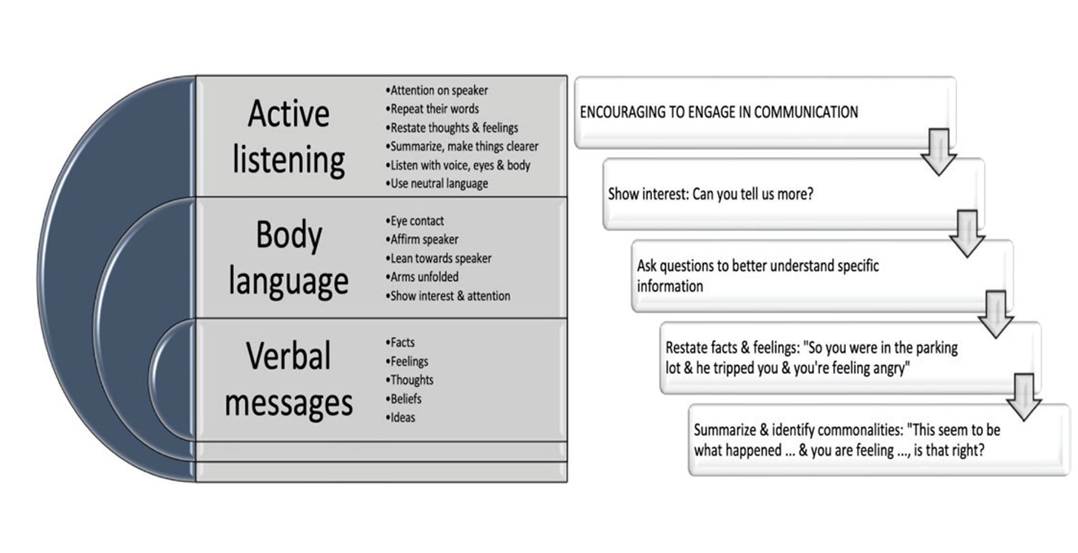
Active listening is a communication procedure wherein the listener uses nonverbal behavior, such as eye contact and gestures, as well as verbal behavior, including tone of voice, open-ended questions, restatements, and summaries, to demonstrate to the speaker that he or she is being heard (Fischer-Lokou, Lamy, Gu6guen, & Dubarry, 2016; Girard & Koch, 1996). Effective communication begins with effective or active listening! Practicing active listening skills in dialogue will enhance mutual understanding of the issues. Consider the do’s and don’ts in active listening as depicted in Table 7.1.
Body Language
People communicate in a variety of ways. They not only speak to get their messages across, but they also use their body to signal information. The body communicates a diverse vocabulary of gestures, postures, eye movements,
| TABLE 7.1 Do's and Don'ts—Active Listening Skills | |
| Do | Don’t |
| Focus attention on the one speaking. | Talk about yourself, be critical, or give advice. |
| Repeat back in their words. | Only say “mmm,” “ah hah,” etc. |
| Restate important thoughts and feelings. | Ignore the thoughts and facts. |
| Summarize so that they can hear themselves. | Pretend that you understand when you do not. |
| Ask questions to make things clearer or for elaboration. | Be a poor listener with your voice, eyes, and body. |
| Show listening with your voice, eyes, and body. | Fill every space with your talk. |
| Summarize feelings and thoughts. | Fix, change, or improve what they said. |
| Use neutral language. | Take sides. |
Source: From Watson and Watson (2011).
Reprinted with permission.
twitches, grimaces, and stares. Sometimes, body language communicates information that is actually closer to reality than what the voice indicates, which is why being able to recognize and interpret body language is a valuable communication skill.
This is often referred to as listening with a purpose. It takes effort to be a strong active listener and is essential for effective conflict management.
Body language can also communicate what we feel and think. As a participant or facilitator in a conflict, it is important not only to read other people’s body language, but to also be conscious of our own body language. With the right gestures or movements, an individual can control many situations with ease. According to Watson and Watson (2011) and Hall, Horgan, and Murphy (2019), body language can convey neutrality, focus, and empathy—important skills for effective communication.
■ Make eye contact.
■ Use nonverbal communication to affirm the speaker.
■ Lean slightly towards the speaker.
■ Keep arms unfolded.
■ Use appropriate facial expressions to show interest and attention.
Encouraging Others to Engage in Communication
The active listener works to encourage participants to stay engaged and share. Some strategies to help encourage effective communication are:
1. Encourage the other person to keep talking. Show that you are interested in what they are saying. Example: “Can you tell us more?”
2. Ask questions to get more information or to better understand the problem. Example: “Where did this happen?”; “How long have you known each other?”
3. Restate in your own words the basic ideas—facts and feelings. Example: “So, you were in the parking lot and he tripped you and you’re feeling angry.”
4. Summarize the important ideas and feelings as each person stated them. Identify the things they have in common. Example: “This seems to be what happened... and you’re feeling (or you’re both feeling).
Is that right?”Listen for Feelings Not Just Thoughts
Verbal messages in a conflict may convey facts, beliefs, thoughts, ideas, and feelings. Active listeners must be able to respond to both the content or facts and the feelings of the individuals in conflict. The following is a list of words that describe feelings. The list in Table 7.2 may also be helpful in identifying feelings and forming active listening responses.
Perspective Taking
Perspective taking involves working to understand another person’s viewpoint, idea, or belief. Importantly, perspective taking is not synonymous with agreement. Perspective taking includes awareness of the fact that another person’s reasonable mental model may create a completely different set of observations, trigger different beliefs and assumptions, and allow them to develop different conclusions.
Most people are good at considering the different perspectives involved in a conflict when they are not involved in the conflict or none of their hot buttons have been pushed. Perspective taking is a skill needed when your feelings and emotions, not to mention your beliefs and values
| TABLE 7.2 List of Words Describing Feelings | |||
| Fearful | Attacked | Surprised | Concerned |
| Ignored | Terrified | Confused | Frustrated |
| Blamed | Outraged | Embarrassed | Hateful |
| Jealous | Hurt | Delighted | Annoyed |
| Uncomfortable | Great | Judged | Used |
| Betrayed | Misunderstood | Disappointed | Irritated |
| Worried | Isolated | Special | Proud |
are being challenged.
The fundamental principle of perspective taking is to ASSUME, that all perspectives are rational given the information and history that is presented. Thus, the goal is to understand their perspectives and do the best detective work you can to understand why their perspective is important.Conflicts are managed and conversations are more successful when the parties:
■ have the ability to be self-aware (e.g., identify hidden assumptions),
■ are willing to engage in self-awareness and self-reflection,
■ frame the/their relationship,
■ frame the conflict and the issue(s),
■ practice mindfulness of one another,
■ choose to exercise perspective taking,
■ intentionally and strategically choose their conflict management mode(s),
■ look for areas of common ground,
■ move from positions to interests and needs,
■ articulate what you want to accomplish—desired end goal, and
■ use an effective communication skill set (Watson & Watson, 2011).
Being Mindful
Mindfulness is taking a nonevaluative stance toward thoughts and feelings of others and allowing those thoughts and feelings to come and go, without getting caught up in or carried away by them (Kabat-Zinn, 2003). Thus, according to Kabat-Zinn (2003) and Wells (2013), the components of mindfulness includes:
■ observing—notice,
■ describing—internal,
■ acting with awareness—versus rote response, and
■ accepting without judgment—not becoming consumed with thoughts/feelings.
For many people, the consequence of not keeping up with the flow of their everyday lives is a heightened sense of anxiety. They fear that if they do not keep up, they will drown in the buildup of work. Mindfulness tackles this by forcing you to stop and think about which pieces of information to engage with and which to ignore. According to an interview on ABC Radio National in 2014 with Rasmus Hougaard (2014) of The Potential Project, in 2009 we could “pay attention” an average of 13 seconds, and in 2013 it was 8 seconds—goldfish can focus for 9 seconds.
The benefits of mindfulness are noted as:
■ increase productivity and decrease stress;
■ helping decision-makers make clearer, better quality choices;
■ stronger ability to separate relevant from irrelevant information;
■ willingness to live with unwanted outcomes and refrain from doing physical damage to themselves;
■ practicing greater sense of self-regulation;
■ decrease obsessive circular thinking;
■ increased focus;
■ self-compassion;
■ increased perspective taking; and
■ increased self-reflection (Riskin, 2004).
Understanding the Frames Involved in Conflicts
This section deepens some of the ideas presented in Chapter 2 concerning realities about conflicts. It is very important for individuals in conflicts to understand and frame the conflict well. Oversimplifying a conflict can cause escalation and potentially shatter trust in an organization. However, engaging every nuance and complexity of a conflict may freeze people out of thinking that there is no hope in managing a conflict.
Most conflicts have one or more of the following root causes:
■ Data errors, that is, information is missing, misunderstood, or incomplete for some or all.
■ Interest discrepancies, that is, some people are not interested in the goals, missions, visions, or “causes” that others are interested in.
■ Structural issues, that is, when realities outside of the control of the parties in conflict generate conflicts, such as competition for resources or lack of resources, inaccessibility to support or access needed, or external units failing to prioritize the issues in conflict.
■ Values, that is, when belief systems or priorities are incompatible.
■ Relational, that is, when historical or psychological relationships are the source of the conflict.
How an individual frames what is going on in a conflict is always complex, but Figure 7.1 illustrates many of the components that are often engaged. It is important to understand that the individual may not be conscious of aspects of their own mental model or the external pressures that are influencing their perception that there is a conflict. The individual may not be readily cognizant of how they have framed all of the inputs tojustify the conflict; they may simply feel the conflict. An observer of the individual will not know all that is going on within the individual. Even if the observer witnesses the same situation, event or person as the individual in conflict, and even if they know what pressing issues are being felt by the individual in conflict, they have no way to observe how the individual is framing all of these factors and whether the perception of a conflict exists within the individual. The observer can see the behaviors, communication, and actions of the individual, and thus may begin to see that there is a conflict, but still have no information regarding how the conflict is framed for the individual.
As if the framing of one individual who perceives a conflict is not difficult enough, most organizational conflicts involve numerous people. Even
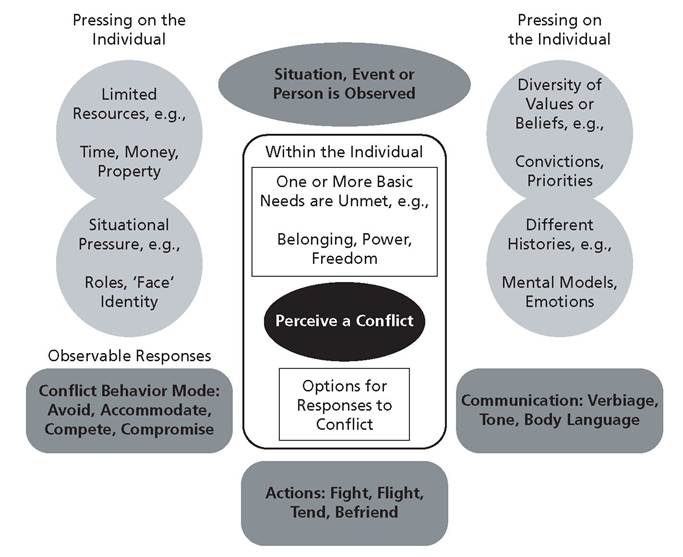
Figure 7.1 Influence on the individual that frame a conflict.
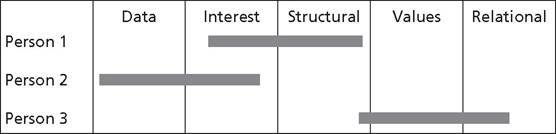
Figure 7.2 Example of differences in framing of the root elements of the same conflict.
though the same situations, events, or people are present, and they may experience many of the same pressures, different individuals may frame a conflict in entirely different ways. For example, as shown in Figure 7.2, individuals in the same conflict may perceive the root causes of the conflict to be very different.
To fully understand the framing of a conflict in an organization, whether it is a family unit, an academic department, or a corporation, it is not enough to simply understand how the individuals in a conflict may each frame the issues. It is also important to understand the influence the organizational culture has on framing of the conflict. Edgar Schein’s (1993) work on organizations helps in understanding the fundamental components of an organizational culture. He described an organizational culture that is formed by its artifacts (rules, procedures, compositions, outputs), espoused values and goals, and basic underlying assumptions. For example, a university may espouse to reflect a student population that is equivalent to the region’s diversity population; however, the artifacts may show great discrepancies when compared to reality. Thus, we would look for the underlying assumptions, such as “but they all must be able to pay the tuition,” or “they must all be nationally competitive in SAT scores,” or “this priority does not override the organization’s priority to compete for national merit finalists.” To really understand an organizational culture, people must have insights into the observable artifacts and espoused values, but even more importantly, they must determine the basic underlying assumptions that the employees within the organization hold, but that are rarely documented or discussed. Thus, when managing conflicts within an organization, people are experiencing multiple individual framings, and simultaneously, the organizational culture around framing conflicts as depicted in Figure 7.3.
The skill required to piece together all the individual and organizational elements, mental models, decisions, histories, cultural artifacts, and goals to frame the conflict is detective work at its best.
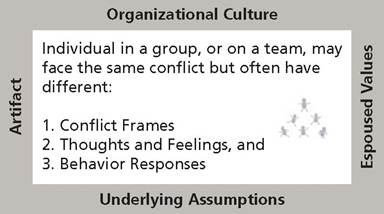
Figure 7.3 Framing of the same conflict by multiple individuals and the organization’s culture.
Creating Dialogue
In creating dialogue, a form of communication is needed where people are asked to suspend judgment and feel reasonably safe in exposing their thoughts and feelings. Dialogue is not merely a conversation. A conversation is casual talk between two or more people during which thoughts, feelings, and ideas are expressed, questions are asked and answered, or news and information are exchanged. In a conversation, there is rarely a deliberate effort made to ensure mutual understanding. Nor is a dialogue an argument or debate. In organizations and in academia, debate is often the mode of communication used first. Winning, when one person convinces another that her/his ideas are right or the best, is often the goal. In debate, you listen to the other side in order to find flaws and to counter the arguments. Debate participants then affirm their point of view, defend assumptions as truth, and critique other positions. The assumption in a debate is that there is a right answer, and someone has it(Gergen, Gergen, & Barrett, 2004). Our definition of dialogue follows::
Dialogue (Latin: Dia: shared; Logos: meaning) involves two or more sides working toward shared meaning or common understanding. Common understanding is not synonymous with agreement. Individuals work to suspend judgment in order to listen and learn new information from others.
Figure 7.4 shows attributes for dialogue and perspective taking; if all participants commit to these elements, then a courageous place for dialogue will be created. Absent this feeling of safety, people will hold back, protect their positions, and at their worst, judge who is right and who is
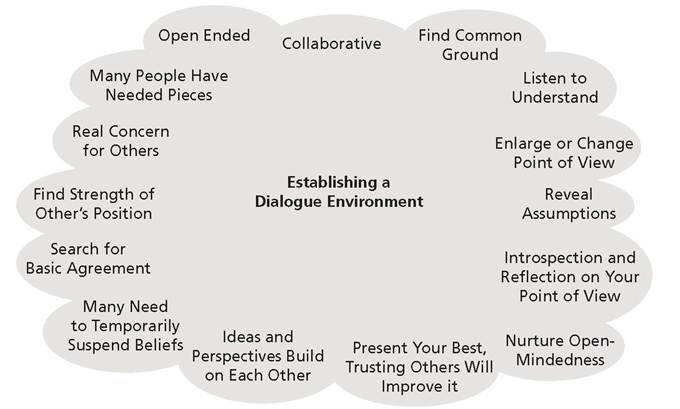
Figure 7.4 Attributes for dialogue and perspective taking.
wrong. As illustrated in Figure 7.4, from its fuzzy design, dialogue and conflict engagement are nonlinear. There are no specific steps to creating a courageous place for dialogue. However, attributes shared in Figure 7.4 increase the likelihood that constructive dialogue will occur.
Intervention Decision
When a conflict exists between parties, individuals in the position to intervene must first decide whether intervention is advisable, whether they should be the ones to intervene, and the intervention style that is needed. This consideration must take into account not only the current conflict, but also the long-term relationships and interactions of the parties with each other and with the intervening party. The major factors of concern are determining the process and resolution to the current conflict, and how much influence the intervening party has on the process and resolution. Deciding if an intervention is desirable can be a difficult task, because often until you are fully immersed, you have little information on the true framing of the conflict. We offer Figure 7.5 as a guide to aid in deciding if intervention is desirable.
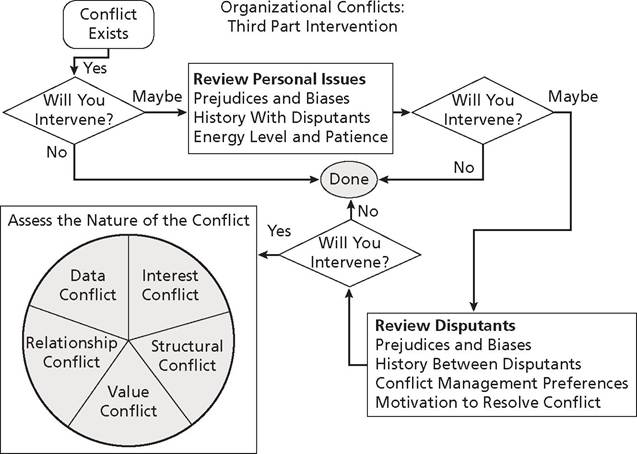
Figure 7.5 Guide to personal intervention decision.
Other considerations in choosing an approach are how much effort, time, and resources the approach will take. To summarize, considerations when choosing an approach are:
■ What are the long-term relations and interactions of the disputants with each other and with the intervening party?
■ How much influence do the disputants have in determining the process and resolution to the current conflict?
■ How much influence does the intervening party have on the process and resolution?
■ How much effort, time, and resources will the approach take?
■ Identify the sources of the conflict, the nature of the conflict, and determine its impact on you.
■ Become more aware of your own reactions and engage strategically in planning for direct and contingent actions as the conflict evolves.
■ Observe how others are responding to the conflict and to your approaches for managing the conflict (be aware that managing conflict is a complex dance, where one leads, and all others follow).
■ Evaluate and consciously weigh the value of all approaches to the conflict and to the management styles being demonstrated by all.
■ Choose a conflict management style based upon your best awareness of the entire situation.
■ Determine if your intervention is wise and whether presenting it can manage rather than create another attribute of the conflict.
Style of Intervention Management
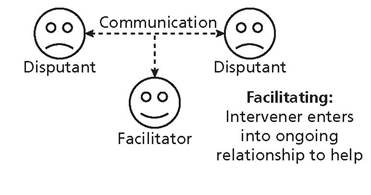
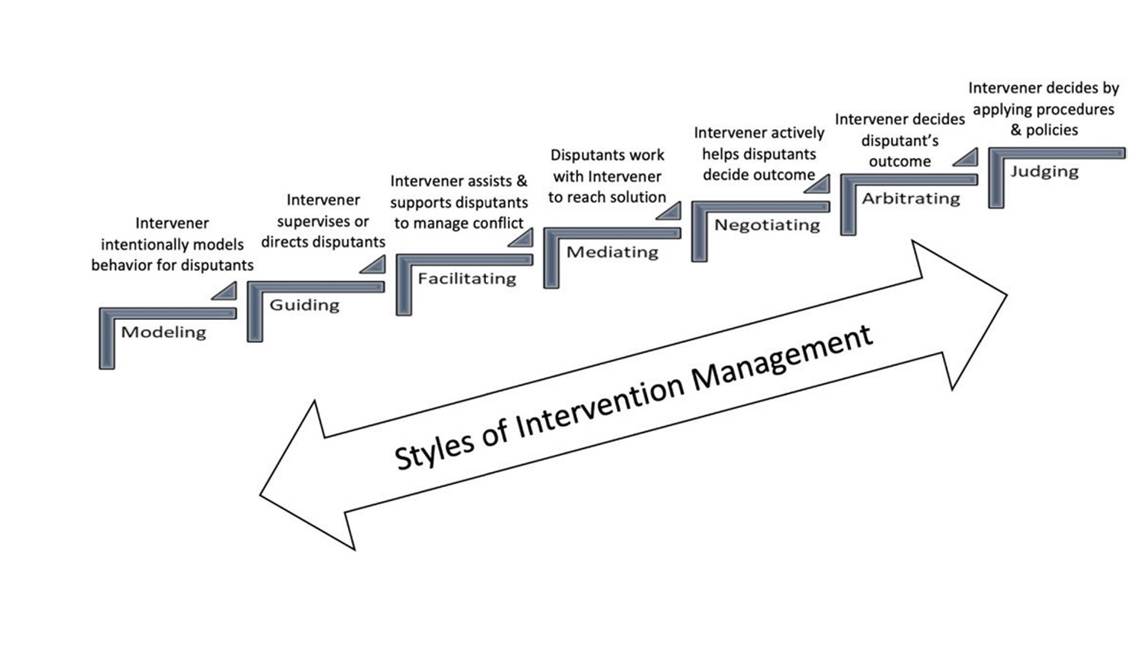
If intervention is desired, there are numerous styles of intervention, as illustrated in Figure 7.6. And all of the intervention strategies require the ability to engage in difficult dialogues and the skill sets for facilitating critical dialogues.
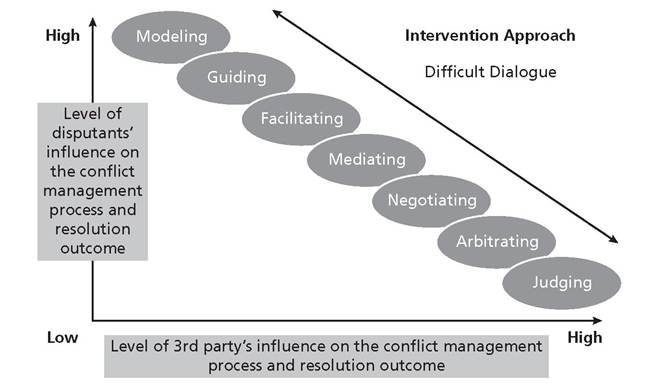
Figure 7.6 Styles of intervention management. Source: Watson and Watson (2011). Reprinted with permission.
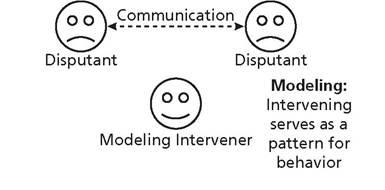
To thoughtfully and intentionally model workplace behavior requires skills in
■ self-awareness of behavior and
■ managing one’s emotions to demonstrate consistency.
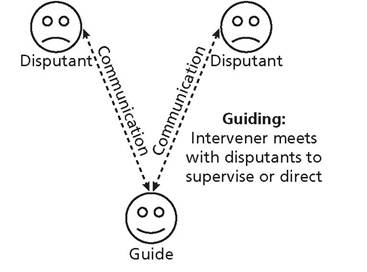
Effective guidance requires skills in
■ active listening,
■ perspective taking (seeing other’s position), and
■ a sense of timing so guidance is seen as supportive.
Facilitation brings disputants together to assist and support them in managing their conflict, and requires skills in
■ active listening and
■ impartiality to support all disputants.
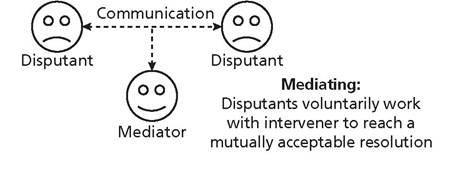
Using a formal mediation process to generate agreement requires skills in
■ neutrality,
■ nonthreatening confrontation, and
■ skills in managing people through a formal process.
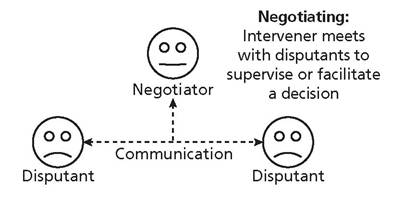
Negotiators actively help the disputants decide the outcome of a dispute based on bringing the disputants together. It requires skills in
■ consequence analysis and
■ decision-making.
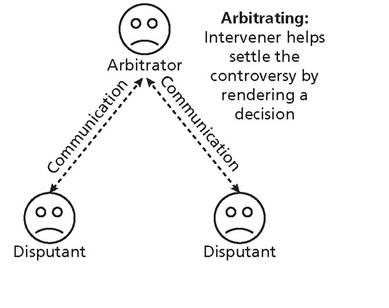
Arbitrators will make a decision about the outcome of the dispute if the disputants do not, and requires skills in
■ information gathering,
■ consequence analysis, and
■ decision-making.
Judging requires skills in
■ understanding and applying procedures and policies,
■ clear communication, and
■ control of processes.
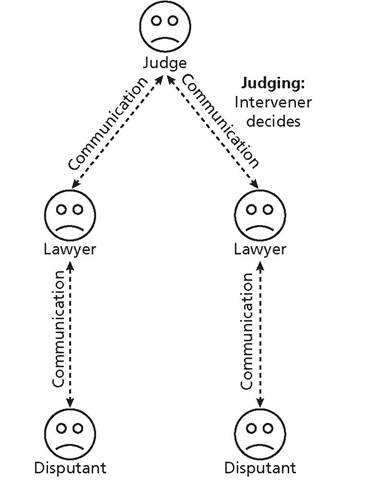
The following is extracted from public information provided by the
U.S. government when describing recognized alternative dispute resolution methods in judicial practices.
Alternative Dispute Resolution
The term alternative dispute resolution or “ADR” is often used to describe a wide variety of dispute resolution mechanisms that are short of, or alternatives to, full-scale court processes. The term can refer to everything from facilitated settlement negotiations in which disputants are encouraged to negotiate directly with each other prior to some other legal process, to arbitration systems or mini trials that look and feel very much like a courtroom process. Processes designed to manage community tension or facilitate community development issues can also be included within the rubric of ADR. ADR systems may be categorized generally as negotiation, conciliation, mediation, or arbitration systems.
Negotiation systems create a structure to encourage and facilitate direct negotiation between parties to a dispute without the intervention of a third party. Mediation and conciliation systems are very similar in that they interject a third party between the disputants, either to mediate a specific dispute or to reconcile their relationship. Mediators and conciliators may simply facilitate communication, or may help direct and structure a settlement, but they do not have the authority to decide or rule on a settlement. Arbitration systems authorize a third party to decide how a dispute should be resolved. It is important to distinguish between binding and nonbinding forms of ADR. Negotiation, mediation, and conciliation programs are nonbinding and depend on the willingness of the parties to reach a voluntary agreement. Arbitration programs may be either binding or nonbinding. Binding arbitration produces a third-party decision that the disputants must follow even if they disagree with the result, much like a judicial decision. Nonbinding arbitration produces a third-party decision that parties may reject. It is also important to distinguish between mandatory processes and voluntary processes. Some judicial systems require litigants to negotiate, conciliate, mediate, or arbitrate prior to court action. ADR processes may also be required as part of a prior contractual agreement between parties. In voluntary processes, submission of a dispute to an ADR process depends entirely on the will of the parties (Office of Special Counsel, U.S. Government, 2015).
Once an informed decision is made on when and how to intervene, then you can execute your decisions, evaluate new information or situations, and persevere, but not infinitely in the same mode (be prepared for contingencies and alternate approaches as the situation evolves). A conflict management plan can be an invaluable tool to effectively manage individual and organizational conflict. A Conflict Management Plan is essentially the utilization of your mental models, unless you have prepared yourself to make more conscious choices about how you want to behave in the face of a conflict. By creating awareness of different conflict management plans, prior to being involved in a conflict, a person can: (a) create an entire toolbox for productive intervention plans and (b) implement a conscious choice of which plan to use when in conflict. When an organization has robustly and explicitly discussed how it wants to operate in the face of conflict, and even more importantly, facilitated the skills of all personnel to practice and implement the plan, then the organization can truly thrive in managing conflict.
References
Fischer-Lokou, J., Lamy, L., Gueguen, N., & Dubarry, A. (2016). Effects of active listening, reformulation, and imitation on mediator success: Preliminary results. Psychological Rep∣rrl.s. 118(3), 994-1010.
Gergen, K. J., Gergen, M. M., & Barrett, F. J. (2004). Dialogue: Life and death of the organization. In The SAGE handbook of organizational discourse (pp. 3959). Thousand Oaks, CA: SAGE.
Girard, K., & Koch, S.J. (1996). Conflict resolution in the schools: A manual for educators. San Francisco, CA: Jossey-Bass.
Hall, J. A., Horgan, T. G., & Murphy, N. A. (2019). Nonverbal communication. Annual Review of Psychology, 70, 271-294.
Hougaard, R. (2014). Corporate mindfulness. Saturday extra. ABC Radio National. Retrieved from https://www.abc.net.au/radionational/programs/ saturdayextra/corporate-mindfulness/5533108
Kabat-Zinn, J. (2003). Mindfulness-based interventions in context: Past, present, and future. Clinical Psychology: Science and Practice, 10(2), 144-156.
Office of Special Counsel, U.S. Government. (2015). Alternative dispute resolution. Retrieved from https://osc.gov/Services/Pages/ADR.aspx
Riskin, L. L. (2004). Mindfulness: Foundational training for dispute resolution. Journal of Legal Education, 54(1), 79-90.
Schein, E. H. (1993). On dialogue, culture, and organizational learning. Orga- nizationalDynamics, 22(2), 40-51.
Watson, N., & Watson, K. (2011). Conflict management: An introduction for individuals and organizations (2nd ed.). Bryan, TX: The Center for Change and Conflict Resolution.
Wells, C. M. (2013). Mindfulness in academia: Considerations for administrative preparation. Education Leadership Review, 14(3), 1-11.