Conflict Management in Higher Education
A Review of Selected Literature
Courage is what it takes to stand up and speak;
courage is also what it takes to sit down and listen.
—Winston Churchill
Our review of literature on conflict and conflict management revealed studies that have been focused primarily on conceptual models and their effect on team performance and organizational behavior and efficiency (Alper, Tjosvold, & Law, 2000; Amason, Thompson, Hochwarter, & Harrison, 1995; Bienstock, 2019; Likert & Likert, 1976; Marques Santos, Uitdewilligen, & Passos, 2015; Thomas, 1992).
While these researchers provided a useful and conceptual foundation for understanding conflict and conflict management, there are a few selected researchers who have addressed the experiences with conflict of individuals who work and reside in public research institutions of higher education. In particular, there is a growing body of literature from researchers related to universityConflict Management and Dialogue in Higher Education, 3rd edition, pages 87-98
Copyright © 2021 by Information Age Publishing
All rights of reproduction in any form reserved.
88 ■ Conflict Management and Dialogue in Higher Education, 3rd edition departmental leadership (Armstrong & Woloshyn, 2017; Comer, Haden, Taylor, & Thomas, 2002; Findlen, 2000; Gmelch, 1991; Hickson & McCro- skey, 1991; Lumpkin, 2004; Trombly, Comer, & Villamil, 2002; Stanley & Algert, 2007; Stevens, Williamson, & Tiger, 2013), and fewer who have focused at the level of faculty (Harrison, 2007; Olsen & Near, 1994; Reybold, 2005). Reybold (2005) engaged in a longitudinal investigation of nine faculty participants. The participants shared disillusionment with their academic career and considered leaving higher education; Reybold analyzed conflict narratives from multiple interviews.
Findings indicated that personal experiences with professional conflict correspond to an individual’s motivating force (source of meaningfulness) and disrupting force (interruption to meaningfulness), and the disillusioning process evolves along a continuum of expectation and disposition, resulting in differential thresholds of faculty dissatisfaction.In a study of research university faculty in first and third years of appointment, Olsen and Near (1994) investigated the relationships among work and nonwork satisfaction, interdomain conflict, and life satisfaction. Their findings indicated that balance and conflict explained variance in life satisfaction beyond that explained by job and nonwork satisfaction. Harrison (2007) reported findings from a survey of 308 students, which revealed that student-faculty conflict is widespread, with approximately one-third of all students reporting a conflict that they have pursued. These findings should come as no surprise to us, given the nature of academia and higher education institutions as discussed throughout this book. So, while we clearly see the need for more research to understand the nature of conflict that occurs at the faculty level, it might be more useful to review what we know from the literature about those who work with and lead faculty and administrative initiatives at the department level—the department chair or department head. In a 1990 survey (Gmelch, 1991) of approximately 800 department chairs from 100 research institutions, they reported a primary source of stress was confrontation with colleagues. Included in their description was conducting annual performance evaluation, making decisions that affect the lives of faculty colleagues, and resolving differences between faculty colleagues (Higgerson, 1996). Conflict is possible, if not probable, in many of the duties and responsibilities assigned to department chairs and the opportunity for conflict increases when department chairs must manage with declining human and fiscal resources, but conflict can erupt even in instances when there is (or should be) no real disagreement (American Council on Education, n.d).
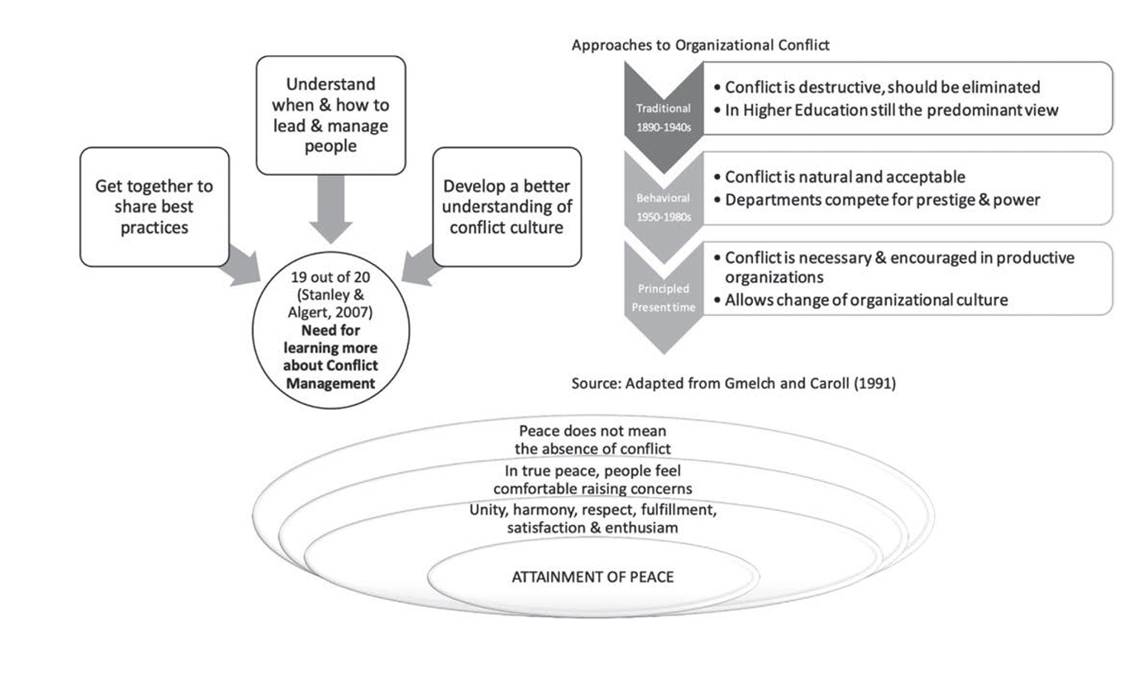
Sometimes department chairs must manage conflict that exists among others, including disagreements between faculty members or between faculty and students. At other times,department chairs must manage conflict between themselves and others, such as disagreements with faculty, students, or central administration. The fact that confrontation with colleagues surfaced as the second most often mentioned source of stress in a survey of some 800 chairs may be indicative of both the discomfort of managing conflict and the frequency with which department chairs encounter conflict. Department chairs need to know how to manage conflict effectively (American Council on Education, n.d). Researchers have further elucidated departmental leaders’ frequent encounters with on the job stress. Tracie Miller, a former graduate student at Texas A&M University, hopes to be a department chair and eventually become a dean. In a research paper for her graduate course on conflict management and dialogue, she uncovered that Aggarwal, Rochford, and Vaidyanathan (2009) surveyed marketing department chairs from Association to Advance Collegiate Schools of Business (AACSB) accredited schools of business on the sources of department chair stress. Listed among the top 20 were handling student concerns and conflicts (ranked number 15) and resolving differences with their dean/supervisor (ranked number 16). Ag- garwal et al. suggested a department chair’s ability to handle conflict with peers, supervisors, and students as a way for department chairs to manage stress. Crookston (2014) discussed one of the many benefits of conflict, as a department chair, is the attainment of peace. However, peace does not mean the absence of conflict. True peace is a situation where faculty, staff, and administrators feel comfortable raising the issues that concern them. They used words such as “unity, harmony, respect, fulfillment, satisfaction, and enthusiasm” (p. 24) to describe their work environments.
False peace, on the other hand, is a situation where conflicts are ignored. During false peace, faculty and staff bring issues up to their administrators and the issues are ignored, downplayed, or simply not addressed (Miller, 2015). Gmelch and Carroll (1991) argued that approaches to conflict can be organized around three time periods—the 1890-1940s, 1950-1980s. At the time of the writing of their article, in the 1990s, they further characterized these time periods as noted in Table 6.1.Gmelch and Carroll (1991) described the traditionalist approach to conflict from the late 19th century through the middle 1940s as “destructive and
| TABLE 6.1 Approaches to Organizational Conflict | |||
| Period | Philosophy | Nature | Prescription Strategy |
| 1890-1940s | Traditional | Destructive | Eliminate |
| 1950-1980s | Behavioral | Natural | Accept |
| Present Time | Principled | Necessary | Encourage |
therefore should be eliminated. The role of the manager was to purge conflict from the organization. In higher education, this remains the predominant view” (pp. 108-109). The behavioral approach that was characteristic of the 1950s is attributed to Freud’s belief that aggression is natural, independent, and instinctual. Therefore, conflict was seen as something that is natural and acceptable, and organizations by their very nature are conflict laden (Gmelch & Carroll, 1991). Departments compete for prestige...All compete for power” (Robbins, 1974, p. 13). The principled approach, according to Gmelch and Carroll (1991), views conflict as “something necessary and to be encouraged in a productive organization.
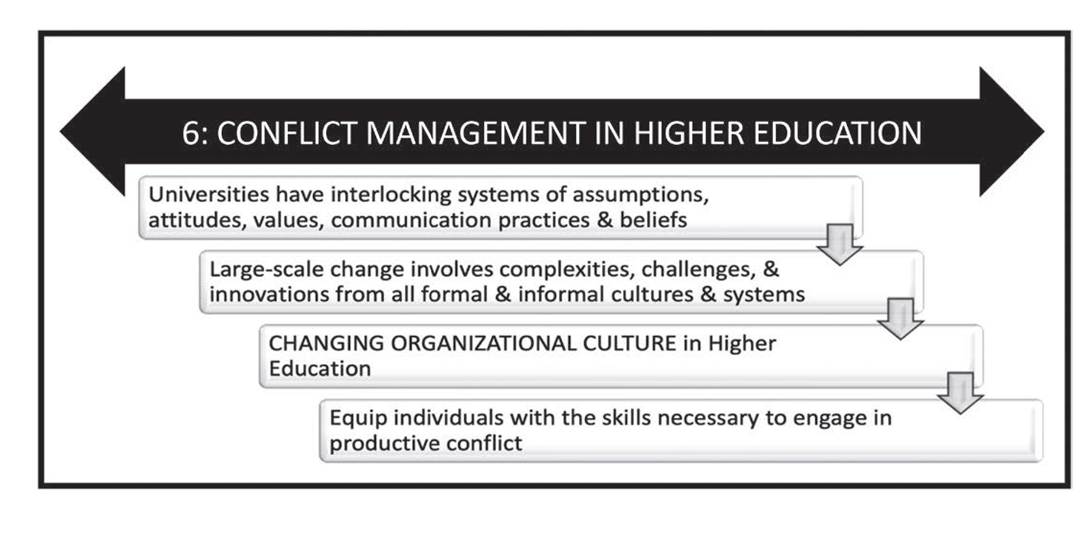
With this style of management, the needs of both the individual and the organization are met” (p. 109). However, our review of the current literature did not reveal any descriptors for approaches to organizational conflict since the 1990s. So, we argue, based on experience and the emerging literature that the prescription strategy that seems most prudent now in higher education that fits within the principled philosophy is to “change the organizational culture.” For it is only through changing the organizational culture, that we equip individuals with the skills necessary to engage in productive conflict. For universities that have interlocking systems of assumptions, attitudes, values, communication practices, and beliefs that govern how people behave within the organization, the organizational culture is the very place, with all its innovations, challenges, and complexities to engage in large-scale change. As Barbara Sporn (1996) stated, “Universities are complex social organizations with distinctive cultures. On the one hand, academic freedom and autonomy are inviolable values and, on the other hand, changing environmental conditions exert strong influence on the primary functions of universities” (p. 41). Di Virgilio and Di Pietro (2012) found that the role of organizational culture on informal conflict management illustrates that there is a relationship between culture and behavioral norms. In addition, leaders’ own conflict management behaviors are associated with distinct unit conflict cultures (Gelfand, Leslie, Keller, & de Dreu, 2012). Interestingly enough, Gmelch and Carroll (1991) stated, “conflict in most complex organizations such as universities and colleges is sewn into the fabric of the institution” (p. 110). This is even more evident at institutions that are being challenged to increase enrollment and are expected to do so with declining state resources. “As the size of an organization increases, goals become less clear, interpersonal relationships become more formal, departments become more specialized and the potential for conflict intensifies” (Gmelch & Carroll, p. 110).In 2004, we conducted a qualitative research study of 20 department heads who represented 10 academic colleges at a major public research university (Stanley & Algert, 2007). Specifically, we wanted to learn how they described their conflict management style and how this style enabled them to manage all types of conflict—faculty-faculty, faculty-staff, facultystudent, and staff-staff and whether their experiences were consistent with the existing literature. The data consisted of interview transcripts and field notes taken during the interviews. The interviews were then transcribed. After carefully analyzing the transcripts, and as discussed in previous chapters, we relied on the Thomas-Kilmann conflict mode instrument (TKI) to determine the conflict management styles of the department heads. We decided not to give them the TKI because we wanted them to describe the types of conflicts they encountered at the departmental level and their perceptions of how they handled each conflict situation. Further, we wanted to pay attention to the participants’ voices and feelings to the open-ended questions we asked of them as they described how they managed conflict.
Eleven of the department heads self-reported using the compromising mode to manage conflict in their departments (Stanley & Algert, 2007). The modes least used were “avoiding” and “accommodating,” on the cooperation axis. All department heads described situations where they thought they had to “negotiate” or make concessions in order to resolve the conflict. Their management style was dependent on the nature of the conflict and the individuals involved. For example, one department head, in response to the question, “How would you describe your conflict management style?’ attempted to describe the compromising mode of conflict management in the following manner,
Basically, what I try to do is to first recognize that a legitimate issue exists and make sure that we have as much clarity about the issue as possible. This is what I call “discussing the un-discussible.” It was so contentious between the two different faculty members who teach in this program that they would blow up from time to time and we would end up attacking each other instead of attacking the issue. Ultimately, we created a shared position. I think that is what conflict management is all about. It is creating compromising solutions where all interests are recognized and dealt with. You may only get 60%, 70%, 80% satisfaction of all parties. Nobody gets 100% of what they want, but they get 80% and you serve the net best interest of the department. (Stanley & Algert, 2007, p. 56)
In comparison, the department heads who used the collaborative mode seemed to express a high level of confidence in recognizing and managing conflict. For example, one described these skills rather poignantly.
I try to get people to actually come to an agreement or resolution that they can both live with. Sometimes, I will propose an agreement and it just depends on what it is. If someone is really stepping out of bounds and if they really want a third person, I am more collaborating. I try to get each person to air their concerns and needs. I did a survey at midpoint of my term. It was like a five-page survey. Most people filled it out because I told them that it was not going to go to the Dean, it’s to be used by me but I didn't want to wait because the Dean does a survey of the faculty at the end of your term after four years... You know if something is festering I don’t want to wait... I gave them areas for comments and things like that so it [the feedback] was really good. (Stanley & Algert, 2007, p. 57)
The common conflicts that department heads described were “data conflicts (e.g., limited resources), inadequate personnel, [and] space issues” (Stanley & Algert, 2007, p. 58). For example, when describing a hiring decision that created conflict among faculty members, the department heads talked about other issues that impacted the conflict such as the hiring history of other faculty, belief systems held by faculty, resources, faculty retention, and diversity issues. In addition, the primary individuals involved in the majority of the conflicts seem to be faculty-faculty (Stanley & Algert, 2007). The results of the Stanley and Algert (2007) study were not unlike the work of Gmelch and Carroll (1991) where their review of the research on organizational conflicts revealed:
10 structural conflicts which actually can create conflict among faculty and administrators, regardless of any interpersonal animosities or personality differences: (1) levels in the hierarchy; (2) rules and regulations; (3) degree of specialization; (4) staff composition; (5) nature of supervision; (6) participation in decision making; (7) sources of power; (8) rewards and recognition; (9) staff interdependence; and (10) roles and responsibilities. (p. 110)
We posed this question to the department heads. “Do you think department heads need training in conflict management? Why or why not?” Ten of the 20 department heads in the Stanley and Algert (2007) study indicated a need for more professional development opportunities for department heads and deans in the area of conflict management, and specifically to address how the university culture impacts the management of conflict. Here are two representative comments from the department heads:
Provide professional development on a regular basis. Conflict management is a daily activity. When you go from a faculty member to a department head, even though you may have done things with the organization [department], it is not the same because now the scale of conflict is different and escalates. (Stanley & Algert, 2007, p. 61)
I never had any training in conflict management. I have been at this university for a long time..., but every day is a new event; and so you wrestle with it to make sure that you do all the things that I am talking about. That you are fair, that you are listening, that you make sure that to the extent you can, that parties walk away with a win-win situation. I would think that there would be a lot of value in giving somebody an opportunity to have to go through some training where conflict management issues would be sorted out, you know, maybe in terms of some scenario development situations that you would find yourself in so that it's a little less sort of learning on the job while you are doing it. (Stanley & Algert, 2007, p. 58)
In the Stanley and Algert (2007) study, several of the department heads readily admitted that they were not particularly effective at handling conflict. In fact, 19 out of 20 department heads in that study expressed a need for learning more about conflict management. When asked, “What could the university do to further enhance departmental leadership skills in conflict management?” their responses were grouped along three very distinct themes:
1. getting together to share best practices,
2. understanding when and how to lead and manage people, and
3. developing a better understanding of the university’s conflict culture.
Eighteen of the 20 department heads wanted more opportunities to get together to share best practices. Specifically, some suggested that conflict management training and workshops include, but not be limited to, case study scenarios through which they could learn how to identify conflict and develop appropriate strategies for managing the conflict.
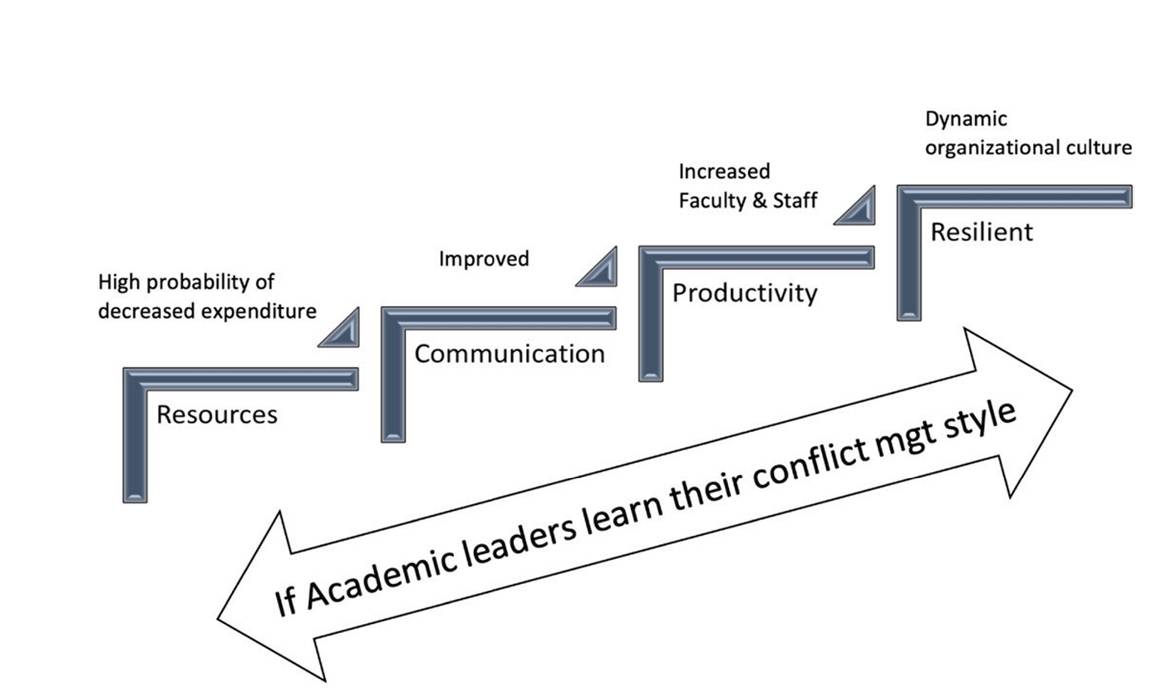
When academic leaders, such as department chairs and deans, work to learn more about their conflict management styles, there is a high probability of decreased resource expenditure, improved communication, increased faculty and staff productivity, and a dynamic and resilient organizational culture. Furthermore, departmental and college communities will have a clear understanding of the university conflict culture and colleges and universities will be better equipped at responding to social and cultural change.
In Section IV: Skills for Managing Conflict, we begin to lay out skills needed to better manage conflicts in higher education. Specifically, in Chapter 7, we discuss personal skills required to be a good conflict manager and ideas for choosing conflict intervention strategies. In Chapter 8, we focus on one specific area of conflict intervention—mediation. In Chapter 9, we discuss skills that help address difficult dialogues, both personally and organizationally. Finally, in Chapter 10, we conclude with a brief summary and discuss the “way forward.”
References
Aggarwal, P., Rochford, L., & Vaidyanathan, R. (2009). The hot seat: Profiling the marketing department chair. Journal of Marketing Education, 31(1), 40-51. https://doi.org/10.1177/0273475308324089
Alper, S., Tjosvold, D., & Law, K. S. (2000). Conflict management, efficacy, and performance in organizational teams. Personnel Psychology, 53(3), 625-642.
Amason, A. C., Thompson, K. R., Hochwater, W. A., & Harrison, A. W. (1995). Conflict: An important dimension in successful management teams. Organizational Dynamics, 24(2), 20-35.
American Council on Education. (n.d). Department leadership project. Department chair online resource center managing conflict. Retrieved from http://www2.acenet.edu/resources/chairs/docs/higgerson_conflict.pdf
Armstrong, D. E., & Woloshyn, V. E. (2017). Exploring the tensions and ambiguities of university department chairs. Canadian Journal of Higher Education, 47(1), 97-113.
Bienstock, J. E. (2019). Campus conflict resolution: The time has come for mandatory mediation. Journal of Business and Behavioral Sciences, 31(1), 36-47.
Churchill, W. (2007). Winston Churchill quotes. Retrieved from http://www.brainyquote.com/quotes/quotes/w/winstonchu161628.html
Comer, R. W., Haden, N. K., Taylor, R. L., & Thomas, D. D. (2002, April). Leadership strategies for department chairs and program directors: A case study approach. Journal of Dental Education, 66(4), 514-519.
Crookston, R. K. (2014). Using conflict to achieve true peace. The Department Chair, 25(2), 22-25. https://doi.org/10.1002/dch.20069
Di Virgilio, F., & Di Pietro, L. (2012). The role of organizational culture on informal conflict management. Retrieved from http://ssrn.com/ abstract=1978428
Findlen, G. L. (2000). Conflict: The skeleton in academe’s closet. In D. Robillard, Jr. (Ed.), Dimensions of managing academic affairs in the community college. New directions for community colleges (pp. 41-49). San Francisco, CA: Jossey-Bass.
Gelfand, M. J., Leslie, L. M., Keller, K., & de Dreu, C. (2012, November). Conflict cultures in organizations: How leaders shape conflict cultures and their organizational-level consequences. Journal of Applied Psychology, 97(6), 1131-1147.
Gmelch, W. H. (1991, October). The creation of constructive conflict within educational administration departments. Paper presented at the Annual Meeting of the University Council for Educational Administration, Baltimore, MD.
Gmelch, W. H., & Carroll, J. B. (1991, Winter). The three Rs of conflict management for department chairs and faculty. Innovative Higher Education, 16(2), 107-123.
Harrison, T. R. (2007, March). My professor is so unfair: Student attitudes and experiences of conflict with faculty. Conflict Resolution Quarterly, 24(3), 349-368.
Hickson, M., & McCroskey, J. C. (1991, October). Diagnosing communication problems of academic chairs: Applied communication in context. ACA Bulletin, 78, 8-13.
Higgerson, M. L. (1996). Communication skills for department chairs. Bolton, MA: Anke.
Likert, R., & Likert, J. G. (1976). New ways of managing conflict. New York, NY: McGraw-Hill.
Lumpkin, A. (2004). Enhancing the effectiveness of department chairs. Journal of Physical Education, Recreation & Dance, 75(9), 44-48.
Marques Santos, C., Uitdewilligen, S., & Passos, A. M. (2015). Why is your team more creative than mine? The influence of shared mental models on intragroup conflict, team creativity, and effectiveness. Creativity & Innovation Management, 24(4), 645-658.
Miller, T. (2015, November). Conflict management for department chairs. A paper presented for a conflict management course on conflict management and dialogue. College Station: Texas A&M University.
Olsen, D., & Near, J. P. (1994). Role conflict and faculty life satisfaction. Review of Higher Education, 17(2), 179-195.
Reybold, L. E. (2005, December). Surrendering the dream. Early career conflict and faculty dissatisfaction thresholds. Journal of Career Development, 32(2), 107-121.
Robbins, S. P. (1974). Managing organizational conflict. Englewood Cliffs, NJ: Prentice-Hall.
Sporn, B. (1996). Managing university culture: An analysis of the relationship between institutional culture and management approaches. Higher Education, 32, 41-61.
Stanley, C. A., & Algert, N. E. (2007). An exploratory study of the conflict management styles of department heads in a university setting. Innovative Higher Education, 32, 49-65.
Stevens, R. E., Williamson, S., & Tiger, A. (2013). Conflict resolution strategies in an academic setting. Feature Edition, 2013(4), 10-21.
Thomas, K. W. (1992). Conflict and conflict management. Journal of Organizational Behavior, 13(3), 265-274.
Trombly, R. M., Comer, R. W., & Villamil, J. E. (2002, April). Case III: Managing conflict—The case of the faculty stuck in the middle. Journal of Dental Education, 66(4), 533-540.