Unique Attributes Around Conflict in Higher Education
Change is possible!
—Virgina Satir (1983)
We can often measure our progress by watching the nature of our conflicts. Ifa man should tell you that his chief daily conflict within himself is “shall I steal or not steal?” you would know what to think of his development in the same way, one test of your [organization] is not how many conflicts do you have, for conflicts are the essence of life, but what are your conflicts, and how do you deal with them?
—Mary Parker Follett, 1940, p.
45The Focus on Conflict in Higher Education
In most higher education institutions, conflicts exist at all levels. Successful academic leaders, or anyone in titled leadership, such as chancellors, presidents, provosts, deans, department chairs, department heads, or program chairs must be able to discern and effectively manage the multitude of conflicts that come their way. Conflict is a natural state of existence
Conflict Managem-ent and Dialogue in Higher Education, 3rd edition, pages 69-83 Copyright © 2021 by Information Age Publishing
All rights of reproduction in any form reserved.
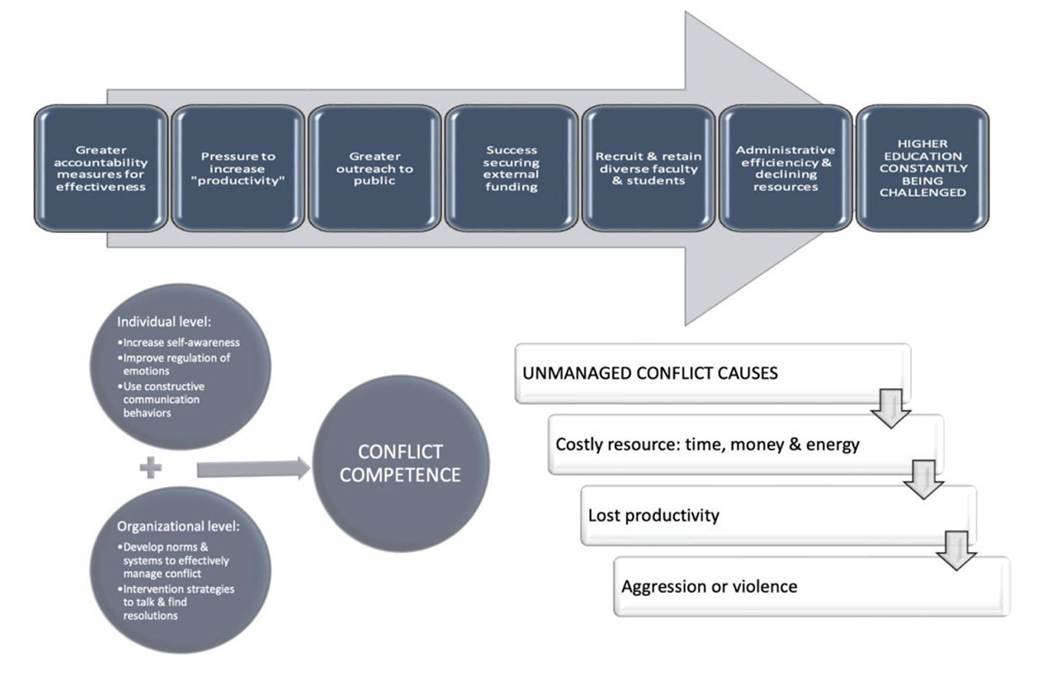
and the academic setting is no exception. Like many other organizations, higher education is constantly being challenged with greater accountability measures for effectiveness, pressure to increase “productivity” through increased student enrollment, greater outreach activities to the public and to the business sector, greater success in securing external funding, and the expectation to recruit and retain a more diverse faculty and student body, all with administrative efficiency amid declining resources. These pressures have ensured that the probability that an academic leader will engage in or have to resolve conflicts is similar to that of their corporate counterparts. If these causes and effects are not particularly unique for higher education, then why single out such enterprises? Our contention is that there is no singular attribute of higher education that makes it unique with respect to conflict management, but rather it is a combination of several attributes.
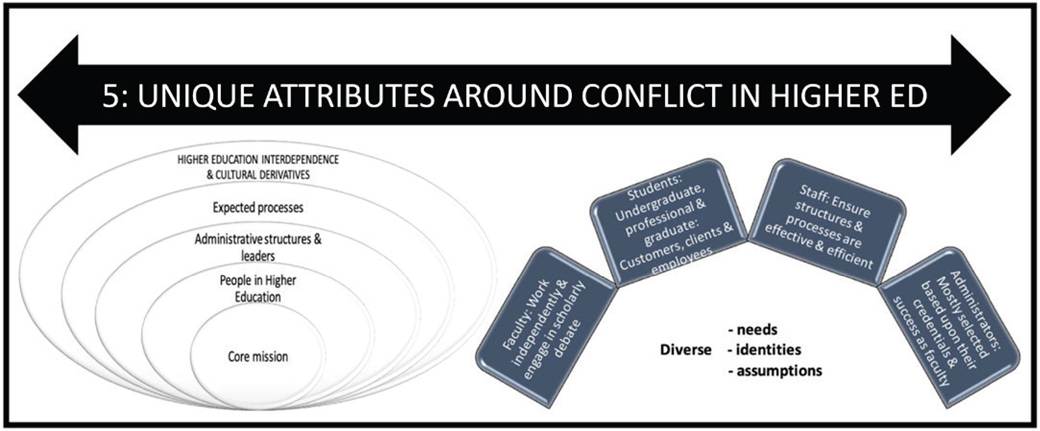
The main attributes to consider are the interdependence and cultural derivatives of: (a) the core missions of higher education, (b) the people engaged in higher education, (c) the administrative structures in higher education, and leaders chosen for filling those structures, and (d) the expected processes in higher education. These attributes come together in higher education and demand skills in conflict management, similar to that of other organizations. However, there are unique requirements for the strength and distribution of these skills throughout the organization.Core Missions of Higher Education
In academia, the core missions of teaching, research/scholarship, and service, are anchored on maintaining individual creativity, innovation, pace, and approaches for the interactions between experts and novices. A vibrant university or college must constantly be in flux, even though it must also ferociously stick to tenets that stabilize the core missions to resist pop fads that have negative long-term effects. The core missions are meant to serve students and society for the long term, not just a 4-year period of study or the lifetime career of a graduated student. Everyone in the organization must be fluid during periods of change, and ideally receptiveness to change becomes natural as it is occurring. For example, instructors may be required to teach true novices century old fundamental knowledge in the same way they challenge more senior students and colleagues to push the boundaries of knowledge in a specific field. Students may be required to question and then deepen their commitment to certain core values and beliefs, and embrace change at the same time, because all learning is a change process. Scholars are required to ground discoveries in tried and tested techniques while they innovate approaches and experiments to develop
Unique Attributes Around Conflict in Higher Education ■ 71 new understanding. New technologies and procedures must be seamlessly integrated into activities, without wasted experiments on new fads that actually harm student learning.
All of this is not to say that higher education does not experience its fair share of resistance to change and innovation. However, subtleties of change that occur in higher education must be acknowledged because the fundamental missions and tenets influence immediate and long-term impacts.The Higher Education Community—Faculty, Students, Staff, and Administrators
The college and university environment are microcosms of society and the world. The primary constituent groups of a campus community—faculty, staff, and students—are as diverse in their needs, identities, and assumptions as are the various constituency groups in our society and world. In addition, there is diversity within and across groups, offering opportunities for growth, awareness, understanding, and of course, conflict. Conflict is essential for universities to thrive. Faculty often work independently and engage in scholarly debate and conflict as they perform their research. They look for consistencies and differences, to gauge whether their innovations, ideas, and scholarly endeavors support or conflict with existing research. Disagreements and opposing beliefs and values are hallmarks of a thriving university campus. University staff also engage in conflict to ensure that structures and processes are effective and efficient in the workplace. One unique attribute of any educational organization is the focus on the interaction between and among two sets of people, the faculty and students, and the third set of people, staff, who are committed to ensuring that the core interaction of faculty and students is optimized. While stereotypes of any of these groups are unproductive, we present some common attributes that are often shared within each of these three constituent groups.
Faculty
In general, particularly in the United States, faculty in higher education institutions represent a group of people committed to a shared value of education and the need to discover new knowledge, create new procedures and representations of current understanding, and innovate procedures and design mechanisms.
While not altruistic, many faculties have chosen this path and commitment over monetary status, political influence, or business or industry development. Faculty in higher education tend to have a high level of degree attainment, making them experts in specificareas more often than others with broader and multidisciplinary experiences. While some have difficulty understanding why the pure joy of learning is not a natural motivator for everyone, most are dedicated to the idea of finding the spark that ignites students’ imagination and motivation to learn. While some may appear impatient, especially to novices in the field, they are incredibly patient, considering that they work to achieve broad and long-term impact on the development of individuals and their fields of study. In general, faculty have a choice with respect to where and how they want to use their education and career. In general, faculty are amongst the most satisfied professionals, in large part because of their ability to work autonomously to achieve the university’s core mission.
Students
Students, whether they identify as undergraduate, professional, or graduate students, have opted to be in the position as novices or apprentices, learning from experts. Some may be just emerging from adolescence, while others may have more life experience than the experts who are there to instruct and guide them. While a few may simply be “killing time” because seeking a degree or taking a course is required by someone, most are truly committed to learning for a lifetime, which requires change. They may not think of learning as a change process, but if they were never challenged with what they know, how they learn, or what will be required of them beyond graduation, then they do not understand the learning process. This is not to say that all students have the same depth of commitment to learning, or the same patience within self or around others, or the same sense of urgency and motivation for change.
A highly motivated and committed student in one particular learning environment may be unengaged in other circumstances. Students in higher education have opted to be there, even if highly pressured by sources of influence such as parents, guardians, significant others, family members, or role models. There is no law that requires them to remain in college.Another unique aspect about students and their contributions to the higher education organizational culture is that they are customers (consuming our services), clients (being advised and mentored by college personnel and services), and employees (while not necessarily paid, they must engage in the work of learning if we are to achieve our mission). The only descriptive word for this combination is student. They are essential to the organization in multiple dimensions, and they are often key drivers as the source of some conflicts and the culture around how conflicts should be managed.
Staff
Staff and administrators represent a wide range of academic and service professionals. Some are committed to a career, and for others, it is a job that affords them with a suitable standard of living. Some are deeply committed to the organization and its mission, and for others, it is about receiving a paycheck. Most have options and choose to work in higher education organizations because they value the mission. Many value interactions with students. Some interact with faculty, donors, and sponsors of the university or college. Their support of the core missions of the university or college is essential for it to function and they enable the institution to achieve excellence. However, most universities and colleges can do more to support the professional development of staff and administrators.
While faculty are somewhat destined to remain in a unit at the institution, staff often move from unit to unit to attain professional development and advancement. With few to no formal developmental rotation opportunities, a staff member must design and execute this effort on their own.
Administrators
Many administrators are selected for their position based upon their credentials and prior success as a faculty member. This is especially important for trustworthiness and credibility, while at the same time, they may have little to no experience for the actual challenges of their administrative responsibilities. Thus, support staff are often placed in the role of mentoring their supervisors in the actual demands of the administrative position. Successful administrators are often servant leaders, not control and execution leaders. They lead by serving their units and the university or college. While they can dictate very little in ensuring or changing how well the core missions are being achieved, they are essential in creating a collaborative, consensus-oriented culture while allowing for autonomy in faculty and student work plans and schedules. Approaches to management often require looser and more adaptive administrative strategies in order to accomplish the institution’s core mission.
Structures and Leaders in Higher Education
Generally, higher education is structured around academic fields to achieve the core mission of teaching, service and research, and around functional services to support and run the institution. Like many other complex and large organizations, various units interact and understand their interdependencies, or they may rarely interact at all. It may make sense on a certain level that the research scholar in an academic unit may never have to deal with the utilities that support their workplaces. A faculty member in geosciences may rarely interact with a faculty member in the liberal arts. Even managers, up to the very highest administrative levels of the institution, may have little to no knowledge of other units. That is, until a conflict arises. Conflicts are the most common reasons for units to interact within an institution. Remember, these conflicts may not be negative; however, they present an opportunity for all units to improve, and are often approached by unit leaders, with a lack of understanding or experience with the other units, in a manner that is sometimes derogatory, adversarial, and territorial. The approaches to such conflicts are primarily due to a lack of leadership development in understanding the interdependence between and among the units of the institution. While structural and leadership issues exist in many organizations, the culture in higher education that fosters autonomy and specialization often exacerbates the type, frequency, and response to structural conflicts on college and university campuses.
Processes in Higher Education
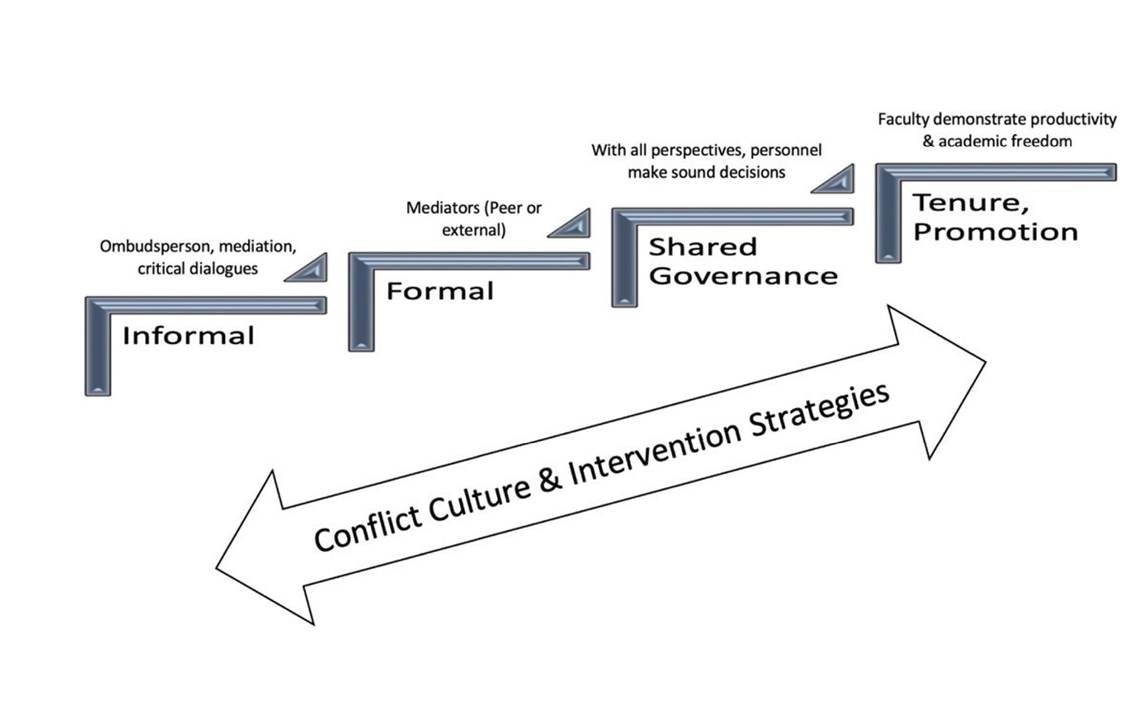
When conflicts arise, many universities have formal grievance processes to handle these events, with many of the processes managed through human resources, student affairs, and designated administrators such as a dean of faculties. Several universities have created programs to informally resolve conflicts (Katz, Sosa, & Kovack, 2018; Klingel & Maffie, 2011; Shiroma, 2018). Informal conflict management programs include ombudsperson services, mediation programs, and critical dialogue programs. Formal mediation programs range from having an employee mediator, to faculty, students, and staff trained peer mediators, to hiring someone external to the university for mediation. Cases deemed appropriate for mediation differ across campuses as well as the level and content of mediation services.
It can be valuable for universities, colleges, departments, and other units to think about their conflict culture and the conflict intervention strategies that help them accomplish their goals for faculty, staff, and students. Two relatively unique values that affect procedures in higher education are shared governance and tenure.
Shared governance is faculty and staff sharing perspectives, disseminating ideas, and providing inputs into institutional practices. Because universities and colleges have a unique culture, shared governance is an important principle and practice.
For example, academic tenure protects the status, academic freedom, and independent voice of scholars and teachers. Shared governance, in turn, arose out of a recognition that:
■ academic decision-making should be largely independent of short-term managerial and political considerations;
■ faculty and professional staff are in the best position to shape and implement curriculum and research policy, to select academic colleagues and judge their work; and
■ the perspective of all front-line personnel is invaluable in making sound decisions about allocating resources, setting goals, choosing top officers and guiding student life.
While a commitment to shared governance is often perceived by outsiders as slowing down decision-making, and indeed, it can slow down initial decisions, shared governance is crucial for achieving decisions concerning change, including ones that have the potential to significantly move the organization forward. In some instances, an institution’s procedures to ensure shared governance can interfere with a manager’s abilities or perceptions of their abilities to manage personnel and conflict issues in a responsible and timely manner.
In addition, universities and colleges have formal tenure guidelines. In theory, and overwhelmingly in practice, tenure is awarded to faculty who have demonstrated productivity and the ability to meet academic freedom obligations of the institution, including academic integrity. However, there are some faculty who abuse tenure, as if they have no responsibilities to the institution or others.
This complexity alone calls for higher education institutions to pay special attention to the competencies and skills needed to manage conflict. When leading or managing very bright people, who are often trained to dissect and find every difference and nuance of a situation or issue, it is very important that leaders or managers do not escalate conflicts by triggering outrage over process instead of dialogue over goals and long-term organizational outcomes.
Common Problems for Conflict Management in Higher Education
Given the complexities around mission, personnel, structures, procedures, and leadership development in higher education, the goal for those
76 ■ Conflict Management and Dialogue in Higher Education, 3rd edition responsible for the management of conflict is to develop adaptive conflict competencies. The concept of conflict competence has gained visibility in recent years (Morrison, 2008). Conflict competence is the ability to effectively manage the inevitable conflicts that arise between people. At the individual level, conflict competence involves increasing our self-awareness about reactions to conflict, improving our capacity to regulate emotions, and using constructive communication behaviors to resolve issues. At an organizational level, conflict competence involves developing norms and systems for effectively managing conflict. When conflict goes awry and the retaliatory cycle causes tensions to mount, it is essential to address matters before they escalate. While some elements of conflict competency are aimed at dealing with conflict effectively, there will be times when things may not go as planned. In such cases, the ability to use workplace conflict intervention strategies to reach out to the parties in conflict, ensure they are talking, and finding resolutions becomes another critical element of effective conflict competency skills.
Conflict management and conflict competencies are overlooked areas of faculty, staff, and administrative leadership development efforts in higher education. Typically, higher education institutions work to avoid or ignore conflict hoping it will go away, and most leaders hope their unit will have no conflict. Neither of these behaviors is effective. Most people only engage in conflict when it is unavoidable. This is not strategic. When striving to avoid a conflict, most units work to “get the conflict over with” as quickly as possible, which is typically a problematic strategy for the unit. Ideally, individuals and organizations that are “well practiced” in strategic conflict engagement work to address conflicts systematically and strategically at all levels. Ideally, a unit communicates the expectation that all individuals engage in conflicts as they arise. Practicing conflict engagement, particularly with the easier and simpler conflicts, makes an individual nimble and more effective to address the larger conflicts successfully when they occur. An effective conflict manager should understand basic and common conflict management vocabulary. This vocabulary should be understood by all, taught to new employees, used in written conflict protocols, and become part of a unit’s organizational culture. In particular, a culture of conflict management and competencies should be a distributed and broadly shared set of competencies and skills, not just something that a few administrators or special employees manage.
It is important to recognize that unmanaged conflict has the potential of costing the organization (see Figure 5.1) in time, resources, energy expended, lost productivity, aggression, and violence. The reason an unmanaged conflict becomes costlier is not only because of the potential for wasted
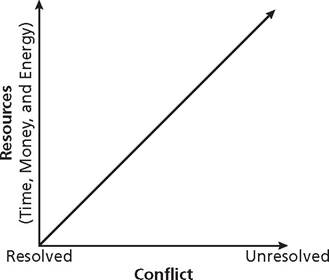
Figure 5.1 Impact of unmanaged conflict.
resources in the midst of the conflict, but also the volume of resources required for resolution typically increases as a conflict persists. This is often attributed to the escalation of the conflict. As a conflict is not managed or resolved, the range of options for engaging in the particular conflict also diminish.
The time, money, and energy that it costs to maintain unresolved conflict are tremendous for both individuals and organizations. Unresolved conflicts for individuals can lead to distraction from work particularly in the areas of creativity and productivity. Unresolved organizational conflicts can lead to a climate of distrust and an overall decline in the unit’s productivity. In addition, the longer a conflict is left unattended, the greater the time and cost, both financial and in energy, to the organization. It is clear that if individuals improve their abilities to resolve conflicts, they will save resources and can expect to see improved understanding (even when parties remain in disagreement), improved communication, and improved productivity due to better utilization of resources and relationships. Recognizing how conflicts escalate will help someone understand how a conflict may be de-escalated.
Higher education organizations must discuss how procedures and leaders think about and address conflict. However, the conflict skills that are needed to do our work are not always effective in our working relationships with one another. The culture of higher education is such that it does not easily make for a cooperative win-win mode (Holton, 1995; Kelso, 2005). Many on a college or university campus often think the following, “if we can just make it two more years when person Y is gone, then everything will be okay” (implying all conflict will cease in the unit). However, even if person Y appears to be the source of the conflict, conflicts are often bigger than one person or one event.
As we have discussed, conflicts can be similar and different for administrators, faculty, staff, and students in the university setting. Below are examples of common conflicts reported across these four constituent groups that comprise higher education.
Faculty Conflicts
■ role within their department or unit,
■ faculty-student conflicts,
■ faculty-staff conflicts,
■ tenure/tenure track faculty across different ranks,
■ tenure/tenure track-nontenure track faculty,
■ perception that conflict engagement is the responsibility of someone else to manage,
■ perception of or actual inequities in the system, and
■ social and cultural identity conflicts.
Student Conflicts
■ transition to college adjustments,
■ student-student conflicts,
■ student-faculty conflicts,
■ academic—nonacademic activities,
■ cognitive growth and development conflicts,
■ perception that conflicts are “bad” to have on campus or in relationships, and
■ social and cultural identity conflicts.
Administrator Conflicts
■ perception of or actual limited resources,
■ administrator-administrator,
■ administrator-faculty,
■ administrator-staff,
■ perception that conflicts are “bad” for the organization, and
■ social and cultural identity conflicts.
StaffConflicts
■ staff-faculty conflicts,
■ staff-staff conflicts,
■ perception of being a “second class” citizen at a university (faculty being first),
■ responding to change, and
■ social and cultural identity conflicts.
Conflict Management and Dialogue in Higher Education, 3rd edition
Unique Attributes Around Conflict in Higher Education
00
References
Follett, M. P. (1940). The psychology of consent and participation. Dynamic administration: The collected papers of Mary Parker Follett. New York, NY: Harper & Brothers.
Holton, S. (1995). Conflict 101. New Directions in Higher Education, 92, 5-10.
Katz, N. H., Sosa, K. J., & Kovack, L. N. (2018). Ombuds and conflict resolution specialists: Navigating workplace challenges in higher education. Journal of the International Ombudsman Association, 1-41.
Kelso, M. (2005). Nonviolent communication and ombuds work. Conflict Management in Higher Education Report, 6(1). Retrieved from https://www.creducation.net/resources/cmher_vol_6_1_kelso.pdf
Klingel, S., & Maffie, M. (2011). Conflict management systems in higher education: A look at mediation in public universities. Dispute Resolution Journal, 66(3), 12-17.
Morrison, J. (2008). The relationship between emotional intelligence competencies and preferred conflict-handling styles. Journal of Nursing Management, 16(8), 974-983.
Satir, V. (1983). Satir step by step: A guide to creating change in families. Mountain View, CA: Science & Behavior Books.
Shiroma, K. (2018). How higher education ombudsman systems can benefit by implementing modified restorative justice practices. Pepperdine Dispute Resolution Law Journal, 18(2), 241-261.
This page intentionally left blank.
More on the topic Unique Attributes Around Conflict in Higher Education:
- Contents
- Algert Nance, Rogers Kenita S.. Conflict Management and Dialogue in Higher Education. Information Age Publishing,2020. — 227 p., 2020
- Prelude and Book Organization
- Unit Leaders’ Responsibilities With Conflict
- Dialogue as a Conflict Management Strategy
- Why Focus on Managing Conflict?
- Personal Skills Required to Be a Good Conflict Manager
- Foreword
- Canary Daniel J., Lakey Sandra. Strategic Conflict. Routledge,2012. — 272 p., 2012
- Oetzel John, Ting-Toomey Stella. The SAGE Handbook of Conflict Communication: Integrating Theory, Research and Practice. SAGE Publications,2013. — 912 p., 2013