Unit Leaders’ Responsibilities With Conflict
Instead of suppressing conflicts, specific channels could be created to make this conflict explicit, and specific methods could be set up by which the conflict is resolved.
—Albert Low (2008)
“ onflict is a natural and inevitable part of life.
It is both the constant companion and frequent trigger of change” (Aschenbrenner & Sid- ers, 1999, p. 32). It is inherent to social interaction and common to organizational life (De Dreu & Van De Vliert, 1997). Yet many work to ignore or avoid it in our personal and professional lives. The word conflict itself is an elastic and elusive term (Gudykunst, 2005). As stated earlier, it is defined as “a struggle or contest between people with opposing needs, ideas, values, goals, or beliefs. It arises when one’s interests or needs are perceived as being denied to them by another. Conflict, exists, even if only one person perceives it” (Watson & Watson, 2002/2012, p. 2).In this chapter, we discuss managing conflict in the university setting from a leadership perspective. There are unique issues related to addressing
Conflict Management and Dialogue in Higher Education, 3rd edition, pages 51-67
Copyright © 2021 by Information Age Publishing
All rights of reproduction in any form reserved.
faculty conflict in the university setting, particularly when one considers that there is not a person in charge of faculty. There are department heads or department chairs who may evaluate faculty; however, they do not dictate the day-to-day work of faculty. Effective conflict engagement and strategies in college and university differ from business and industry. Faculty and administrators rarely assume their positions knowing how to manage conflict. However, Putnam (1988) suggested that university leaders spend over 40% of their workday engaged in conflicts. Conflict is also an overlooked area in the professional development of our faculty and administrators.
The word, conflict, conjures up a variety of images for many people. Some of us think of it as something to avoid while others think it can be healthy if managed well. Regardless of the image, management of conflict is complex (Algert & Watson, 2002). This complexity is heightened even more so in a university setting where tenure, priority of discipline, and lack of clear accountability measures limit conflict management tools available to leaders and managers. Further, unprecedented pressures such as declining public funding for higher education, increasing student enrollments, increasing external demands for accountability, and rising expectations for increased external funding require superior leadership to shape constructive responses to conflict. University leadership is critically important. Furthermore, the leadership position that often requires interaction with faculty is the department head or chair. Given the current challenges, the leadership provided by a department head to transform the faculty and the department is critical to an institution’s future and mission. Furthermore, the department head, the individual in titled leadership at the center of this transformation, is often the one trying to manage all of the various sources of conflict (Stanley, Watson, & Algert, 2005).
Department leadership and management on a university or college campus are usually classified as a department chair or head. Although these titles are often used synonymously in practice, there are some clear distinctions with respect to the origin and etiology of the titles. For example, the title, “department chair” is used most often in academic settings and has a connotation of collegiality, while the title, “department head” is used most often in military and governmental settings and has a connotation of a hierarchy. For the purposes of this book and from our collective experiences, we use the term department head (Stanley & Algert, 2007).
The role of the department head is often characterized as “ambiguous” because of the differing roles and responsibilities inherent in the position.
For example, McLaughlin, Montgomery, and Malpass (1975) described three roles that department heads play in colleges and universities: academic, administrative, and leadership. Academic duties include teaching,advising, facilitating research, and developing the curriculum. Administrative duties include managing the budget, managing faculty and staff, keeping records, and advocating and representing the department in the college and the institution as a whole. Leadership duties include supporting, motivating, and developing the faculty (Wilson, 1999). Bowman (2002) argued,
In the broadest sense, are they expected to function as managers or leaders, or both? In a narrower sense, are they expected to serve in roles as diverse as resource manager, instant problem solver, spokesperson, deep listener, motivator, enabler, meaning maker, systems designer, and cultural rainmaker? (p. 158)
After a brainstorming session with faculty in a department of education at Winona State University, Bowman (2002) noted, “Faculty members identified more than fifty discrete roles and leadership demands central to key aspects of the department’s daily operations” (p. 158). Given these daunting and comprehensive expectations, it seems safe to presume that department heads not only play a critical leadership role within the academic setting, they are also expected to fulfill a variety of responsibilities that may or may not be realistic.
Some researchers have maintained that the department head role is perhaps one of, if not the most, challenging position in higher education (Bennett & Figuli, 1993). Lumpkin (2004) emphasized that the position almost demands that department heads come prepared with skills necessary to manage, assist, and mediate intrapersonal as well as interpersonal conflicts. Therefore, conflict management is an important skill for a department head to have. However, most department heads are neither equipped with these skills nor aware of their conflict management style.
Faculty become university and college leaders for a variety of reasons. Some department heads for example, assume this position because no one else in the department wants it; some are encouraged by their colleagues to do so because of admired accomplishments as a scholar; and others seek this leadership opportunity to learn more about administration with the hope of assuming even higher administrative responsibilities in the future (Lumpkin, 2004). Regardless of the motivation or reason for becoming a department head, it can be a lonely place to reside (Stanley & Algert, 2007).The body of literature discussing department heads leadership skills in managing conflict in a university setting (Coffman, 2009; Comer, Haden, Taylor, & Thomas, 2002; Findlen, 2000; Gmelch, 1991a, 1995; Gmelch & Carroll, 1991; Hickson & McCroskey, 1991; Lumpkin, 2004; Trombly, Comer, & Villamil, 2002) pointed to a common thread, which suggests that the ability to recognize and manage conflict is a skill that most heads lack and one that is needed to enhance their effectiveness as leaders (Gmelch, 1991a; Hickson & McCroskey, 1991; Lumpkin, 2004). Furthermore, we find in the literature that department heads are practicing conflict resolution styles learned in childhood (Algert & Watson, 2002), whether adaptive or maladaptive, unless they have made a conscious decision to reflect and evaluate their conflict management styles. It is assumed that department heads know all there is to know about being effective leaders. Yet high on the list of responsibilities of the department head is constructively resolving conflict in the department. The literature is replete with information and studies on how to recognize and resolve conflict in a variety of settings (Carmichael & Malague, 1996; Gmelch, 1995; Gmelch & Carroll, 1991). However, there are very few publications on how conflict is managed at the departmental level (Findlen, 2000; Gmelch, 1991a, 1995; Gmelch & Carroll, 1991; Hickson & McCroskey, 1991; Trombly et al., 2002), and few of these include reported data from the individual most often managing conflict in this domain—the department head (Gmelch, 1991b; Hickson & McCroskey, 1991).
Academic departments are not unlike many other organizations. Many claim to be a “community.” However, a challenge that department heads face is how to create a climate where individuals who have different viewpoints can agree to disagree with each other and still feel that they are a part of the community. This is not easy. Bowman (2002) argued that the real work of the department head is learning how to “invite and orchestrate the very penetrating, perceptive, probing questions that can often give rise to the tension, dissent, and constructive stress that are absolutely essential to both defining reality and creating positive organizational change” (p. 160). For certain, “Colleges and universities are highly political institutions, but that is a statement of fact, not an indictment. The challenge for campus leadership is to understand and leverage the political realities that are present in every situation” (Bolman & Gallos, 2011, p. 72). Many faculty members assume that conflict is a negative force and has no place in a department. Despite the negative forces that are often assumed to exist around conflict, many scholars concur that, if managed properly, it can enhance working relationships and build a positive departmental climate (Bowman, 2002; Crookston, 2014; Gmelch, 1995; Gmelch & Carroll, 1991; Trombly et al., 2002). Conflict, if not managed properly, “can also increase faculty antagonism, lead to interdepartmental tension, disrupt normal channels of communication, and divert faculty’s attention from a department’s goals and mission” (Gmelch, 1995, p. 35). Furthermore, if departments believe and model the concept of community, then conflict can be a positive factor.
We should then come to welcome discussions, expect arguments, and tolerate challenges (Trombly et al., 2002).
Gmelch (1995) asserted that one of the first steps that a department head must take toward a positive and constructive conflict style is “to recognize the nature and causes of conflict in the department and university setting” (p.
35). However, ultimately it is the department head’s responsibility to identify the conflict culture for that department and to equip all employees with an understanding of the conflict culture, expectations for resolutions, and provide the necessary conflict management skills. There are several models that are useful to our understanding of how the institutional culture influences departmental conflict, and ultimately, the department head’s ability or inability to manage it (Baldridge, 1971; Birnbaum, 1988). First, the bureaucratic model assumes that conflict occurs but can be managed through bureaucratic roles and procedures. Second, the political model states that conflict is inevitable and is normal between and among individuals who have different needs and interests. Third, the collegial model views the academy as a “community of scholars” where conflict is “abnormal” and when it is identified, steps should be taken to eliminate it. The fourth and final model, anarchical is present in institutions that succeed in conditions of abundant resources and enter into decline when resources are limited. The latter then forces administrators to make difficult decisions, which can then lead to conflict (Gmelch, 1995, p. 36).Gmelch (1991a), in his survey of 800 department heads at 101 research and doctoral-granting universities, found that the development of conflict management skills can lead to a deeper self-awareness of not only one’s conflict management style, but also a healthier and more productive work life for faculty, staff, and students. Gmelch (1995) argued,
No matter what the answer or reaction, one of the head’s main functions is to adjudicate these conflicting situations by creating a healthy web of tension... Heads need to realize that regardless of the causes, it is their personal responsibility to respond to these conflict situations. (p. 40)
We believe differently. This may be one role that the department head can play. More importantly, it is the department head’s responsibility to discuss the department’s conflict culture and to provide the skills faculty and staff need to effectively manage conflict. Department heads are tensely placed between the demands of the administration and the faculty. Many feel trapped between the pressures to perform as a faculty member and as an administrator.
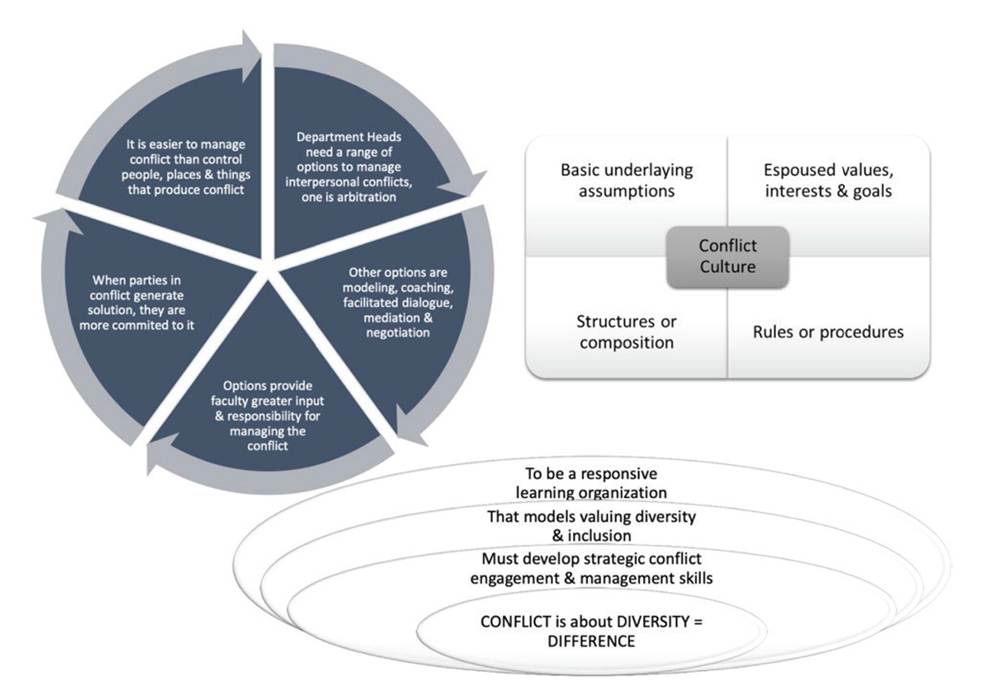
Trombly et al. (2002) stated, “Managing conflict is an arduous but necessary task” (p. 533). Conflict calls for the resolution of conflict, and also the management of unresolvable conflict. It is easier to manage conflict than it is to control the people, places, and things that produce conflict (Algert & Watson, 2002). Within the context of the university setting we prefer to use the term, “conflict management.” This term recognizes the complexity of the nature of conflict situations and allows that some of these may result in “progressive achievements, while others do not have an ideal win-win situation” (Algert & Watson, 2002).
Scholars have argued that communication is at the heart of conflict management (Hickson & McCroskey, 1991; Trombly et al., 2002). In a survey of 47 department chairs in the Southeast and Midwest used to identify communication problems, the results indicated that conflict management was one of their communication concerns (Hickson & McCroskey, 1991). Highlights from the findings of this study included the following: (a) most chairs do not like being an arbiter between faculty members, (b) most chairs do not like being an arbiter between faculty and staff, (c) most chairs find assessing faculty against one another quite difficult, (d) most chairs do not know what to do with “dead wood faculty,” and (e) it is hard for most chairs to tell a faculty member, “No.” We believe that department chairs need a range of options for managing interpersonal conflicts, of which one is arbitration. However, there are other options available such as modeling, coaching, facilitated dialogue, mediation, and negotiation. Tidd, McIntyre, and Friedman (2004) suggested four strategies that managers can use to deal with conflict: (a) manage perceptions and attend to context, (b) create a team environment based on trust, (c) attempt to reframe conflicts in context and address them at an appropriate time with employees, and (d) be skilled at framing the conflict by providing a social account whereby uncertainty can be addressed and understood in the work environment.
These options, more than arbitration and judging, provide faculty members greater input and responsibility for managing the conflict while directly reducing the pressure placed upon the department head. This is counter to the traditional myth that faculty have to be against one another while in conflict. Further, when the parties in conflict generate a solution to their conflict, versus being told by their department head what to do, the parties are more likely (over 90% of the time) to follow through on their commitment to one another.
Conflict and Diversity
When conflict is used in concert with the word diversity, a commonly held assumption and image are that these two concepts are mutually negative forces. Universities, like many organizations, rarely consider the “culture” for managing conflicts until the conflict overwhelms the individual or the institution. Further, we know, as stated in Chapter 1, that conflict responses are learned, led by people with the greatest longevity in the organization and driven by people in titled leadership. Also, conflict engagement styles can be changed if desired or deemed necessary (Algert & Watson, 2002; De Dreu & Van De Vliert, 1997). Conflict is productive, and even strategic, if framed and managed well.
Conflict is an overlooked area in the professional development of academic leaders, faculty, staff, and students. Engaging in meaningful conflict can enhance cultural understanding, foster creativity, and improve cross- cultural communication. A philosophy that undergirds our approach to effective conflict engagement is that conflict, if examined critically, is almost always about diversity, using its simplest definition—difference. In addition, if universities aspire to be (a) responsive learning organizations and (b) models for valuing diversity and inclusion, then they must engage and develop faculty, administrators, and staff skills in strategic conflict engagement and conflict management.
Furthermore, if universities are preparing college graduates to work and live in an increasingly diverse and global society, then it is imperative that they are equipped with the necessary cultural competency skills to engage and learn from and about differences. If conflict management is examined in a variety of cultural and international settings, much can be learned from these experiences and used as models in the university setting.
With the increased attention given by many institutions in higher education to create a more diverse and global academic environment that reflects an educated citizenry—and as we work to develop and value individuals and groups who have different needs, values, beliefs, interests, or goals—conflicts are inevitable. Race relations theory (George, 1984; Lo, McCallum, Hughes, Smith, & McKnight, 2017; Merelman, 1995) relates that as the representation of people of color increases in an organization or community, the opportunity for conflict arises. As many universities strive to reflect the student, faculty, and staff demographics of their States or the nation, very little attention is being given to how conflict can assist or work against organizational change. Even more importantly, there is little to no discussion about the relationship between conflict and diversity. A wrong assumption is often in place; it is a belief that people naturally know how to resolve conflicts effectively. Developing effective conflict management skills to work within the context of increasingly diverse organizations such as universities, colleges, departments, and other work units will lead to stronger long-term organizational health.
The impact of conflict on an organization’s diversity culture calls for greater attention by scholars and practitioners on how culture influences the way individuals approach and manage instances of conflict (Ting- Toomey et al., 1991). Every organization has a conflict culture. Within this culture, there are (a) basic underlying assumptions; (b) espoused values, interests, and goals; (c) structures or composition of the organization; and (d) rules or procedures for the organization. If the university is viewed as an organization that has a conflict culture of its own, especially in the area of diversity and globalization, we can begin to see that conflicts which confront faculty, administrators, and staff are “more complex, multifaceted, and intense” (Lan, 1997, p. 29). The often-assumed state of complacency on the part of well-intentioned institutions to recruit for faculty and student diversity without thinking carefully about how diversity impacts an organizational culture, including the behavior and attitudes of the people within the organization is no longer acceptable. Closer attention needs to be paid to examining the relationship between conflict and diversity and how it impacts the organizational culture. Donnellon and Kolb (1997) stated “as new social groups enter into the workplace and move up in organizations, conflict rooted in class, gender, race, and ethnicity” (p. 162), along with many other dimensions have become more prominent.
Most colleges and universities are striving to model the diversity that is representative of our society and/or state as a whole. In their work on racism and White privilege curriculum design, Bell, Love, and Roberts (2007) made some comments that apply equally well to campus dialogues involving issues of race:
Participants bring to a course on racism a wide range of feelings and experiences, and often misinformation, and confusion, and bias. White participants may sincerely want to learn about racism and figure out how to play a role in making their communities, schools, and workplaces welcoming places for all, but fail to see the role white skin privilege and accumulated white advantage play in perpetuating racial inequality.
Participants of color may want to figure out how to break through the silence about racism as a historic and contemporary force that differently shapes their lives, but fear having their concerns dismissed, being viewed as too sensitive or as troublemakers, or being misunderstood by white peers and teachers. Participants from all racial groups may be reluctant to explore racism, especially in mixed groups, given the complex and often painful web of emotions that discussions about racism inevitably raise. (p. 123)
In Chapter 3, we discussed some realities and guidelines for addressing racial conflicts.
Positively Engaging in Conflict
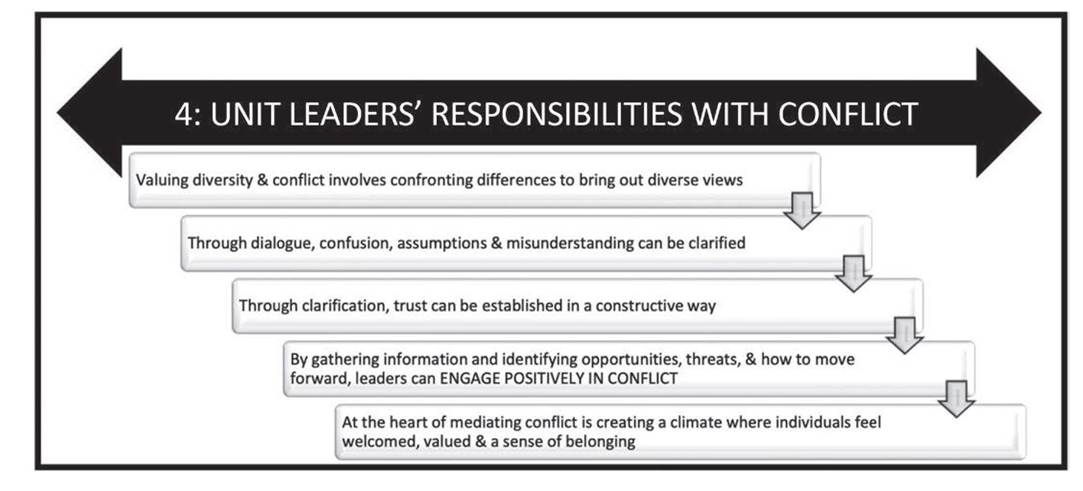
Tjosvold (1991) argued, in his conflict-positive model, that the goal of any organization should be “not how to avoid differences but how to use them to accomplish common aspirations as effectively as possible” (p. 27). Valuing diversity and conflict involves confronting differences because these confrontations can bring out diverse views about issues that are critical for positive conflict and for the organization. Furthermore, through dialogue, employees and students can clarify the confusions and assumptions that make them suspicious. People who confront the issues develop an understanding of each other, which is one of the tenets for effective conflict management. Through dialogue, colleagues clarify assumptions, confusions, and misunderstandings; clarification moves towards trust and away from suspicion. People who confront issues, in a constructive way, gather information, identify opportunities, determine if threats are present, and determine how to move forward in their working relationship.
Deeper dialogues are always important and necessary in the university environment, and particularly with increased diversity. Faculty and administrators will often argue convincingly that there are benefits to recruitment and retention of diversity. However, as Sonnenschein (1997) stated, “Diversity’s benefits are not automatic. Diversity also means challenge” (p. 4) and conflict. “Racism, sexism, ageism... homophobia,” and other diversity issues “can be disruptive to the workplace, preventing the unit from accomplishing its goals” (p. 4). Without engagement in meaningful conflict and a willingness to discuss these complex issues of diversity and identity, an organization can create organizational distress. Diversity, respecting identity, and social justice all require hard work. This work can bring conflicts and when addressed through dialogue, can also bring great success to a unit.
Implications for Faculty and Organizational Development
Managing conflict, particularly diversity conflicts in the university setting, is clearly complex. Differences in opinions, ideas, life experiences, and social and cultural attributes present formidable challenges as well as opportunities for growth, understanding, and learning. The multiparty narrative model (MNM) of mediation in conflict engagement, which is discussed in Chapter 8, is a model that has been used constructively and productively in academic environments to address such conflicts.
Sustaining a highly successful department, college, or university is critical, particularly during times of more accountability to ensure that the demographics of the faculty, staff, and student body reflect society. In addition, an integral part of sustaining the unit is to have effective strategies, protocols, and ways to address conflict. A university is dependent upon the fact that faculty are one of the keys to organizational success and that the management of conflict is critical to successful strategic planning and the success of faculty and student learning in academic settings. At the heart of mediating conflicts in the university setting is creating a climate where individuals feel welcomed and valued for not only their contributions to the academic discourse but also for who they are as human beings. The MNM of mediation, is ideal for use in mediating diversity conflicts by having positive implications for organizational and individual development around diversity and social justice. Below is some feedback gained from academic administrators (department heads and deans) and conflict managers who participated in conflict management skill set development.
Faculty Development
Faculty professional development activities such as mediation short courses and conflict management seminars can serve as catalysts to enhance faculty and administrator dialogues in understanding diversity and social justice.
1. The skills developed in the mediation short course can be used in a variety of management settings such as faculty meetings, staff training, and community meetings.
2. The use of real, problem-based case studies in conflict management and the mediation short course allow for ownership of and a willingness by participants to engage in deeper dialogues around diversity and social justice.
3. Faculty professional development activities such as the mediation short course, conflict management seminars, and critical dialogues modules can enhance cross-cultural communication skills and address differences. Ultimately, the goal is improved working and collegial relationships in the academic environment.
Organizational Development
Senior academic leaders are essential to impacting the organization’s climate and culture related to conflict management. Leaders can impact the development of the organization as illustrated with a few examples below.
1. Senior academic leaders such as deans, provosts, presidents, and chancellors can help create a conflict-positive organizational culture by providing resources to support the professional development needs of administrators such as department heads and deans in the area of conflict management and critical dialogues.
2. Senior academic leaders and administrators can help create a conflict-positive organizational culture by establishing norms stating conflict will occur with increased faculty and staff diversity and can be useful in problem-solving, creativity, visioning, recruitment, retention, and valuing difference.
3. Teaching and learning centers can play a critical role in leading the effort to enhance the professional development of faculty and administrators by sponsoring seminars and workshops on conflict management and difficult dialogues. Faculty professional development professionals can form collaborative relationships with deans and department heads to develop the content of such programs to ensure positive learning outcomes.
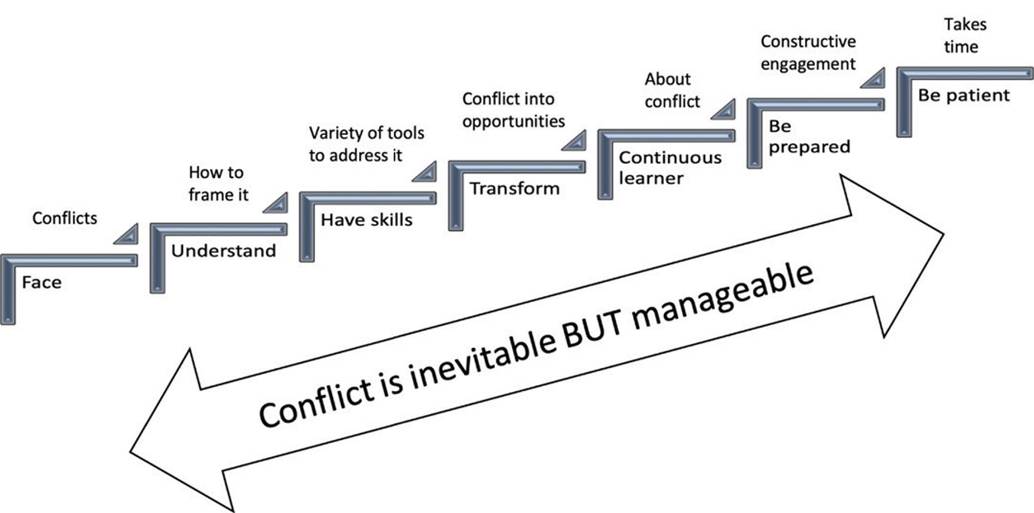
Conflict is inevitable and unavoidable, but it is manageable. Leaders must:
■ Face that conflicts exist in organizations.
■ Understand how conflicts work and be able to frame conflicts.
■ Have the skill sets and a variety of tools to address conflicts as they arise.
■ Transform destructive conflicts into opportunities.
■ Be a continuous learner about conflict.
■ Be prepared. Leaders can address conflicts if they are prepared and well-practiced at constructively engaging in conflict.
■ Be patient—working through some conflicts takes time.
In Chapter 5, we focus on the unique attributes around conflict in higher education. We discuss the core missions of higher education, including its constituencies. Further, we share structures, processes, and leadership in higher education and some common problems for conflict management, specifically in the higher education setting.
Conflict Management and Dialogue in Higher Education, 3rd editk
Unit Leaders' Responsibilities With Conflict
Conflict Management and Dialogue in Higher Education, 3rd edition
References
Algert, N. E., & Watson, K. L. (2002). Conflict management: Introductions for individuals and organizations. Bryan, TX: Center for Change and Conflict Resolution.
Aschenbrenner, C. A., & Siders, C. (1999). Managing low-mid intensity conflict in the health care setting. Retrieved from http://www.freepatentsonline.com/ artide/Physician-Executive/102286870.html
Baldridge, J. V. (1971). Power and conflict in the university. New York, NY: Wiley.
Bell, L., Love, B. J., & Roberts, R. A. (2007). Racism and white privilege curriculum design. In M. Adams, L. Bell, & P. Griffin (Eds.), Teachingfor diversity and social justice (pp. 125-144). New York, NY: Routledge.
Birnbaum, R. (1988). How colleges work: The cybernetics of academic organization and leadership. San Francisco, CA: Jossey-Bass.
Bolman, L. G., & Gallos, J. V. (2011). Reframing academic leadership. San Francisco, CA: Jossey-Bass.
Bennett, J. B., & Figuli, D. J. (1993). Enhancing departmental leadership: The roles of the chairperson. Phoenix, AZ: The Oryx Press.
Bowman, R. F. (2002, January/February). The real work of department chair. The Clearing House, 75(3), 158-162.
Carmichael, G., & Malague, M. (1996, February). How to resolve conflicts effectively. Paper presented at the Fifth Annual International Conference for Community & Technical College Chairs, Deans, and Other Organizational Leaders. Phoenix, Arizona. Retrieved from ERIC database. (ED 394 572)
Coffman, J. R. (2009). Conflict management for chairs. Department Chair, 20(1), 18-21.
Comer, R. W., Haden, N. K., Taylor, R. L., & Thomas, D. D. (2002, April). Leadership strategies for department chairs and program directors: A case study approach. Journal of Dental Education, 66(4), 514-519.
Crookston, R. K. (2014). Using conflict to achieve true peace. The Department Chair, 25(2), 22-25. https://doi.org/10.1002/dch.20069
De Dreu, C. K., & Van de Vliert, E. (Eds.). (1997). Using conflict in organizations. Thousand Oak, CA: SAGE.
Donnellon, A., & Kolb, D. M. (1997). Constructive for whom? The fate of diversity disputes in organizations. In C. De Dreu & E. Van De Vliert (Eds.), Using conflict in organizations (pp. 161-176). Thousand Oaks, CA: SAGE.
Findlen, G. L. (2000). The skeleton in academe’s closet. In D. Robillard, Jr. (Eds.), Dimensions of managing academic affairs in the community college: New Directions for Community Colleges (pp. 41-49). San Francisco, CA: Jossey-Bass.
George, H. (1984). American race relations theory: A review of four models. University Lantham, MD: Press of America.
Gmelch, W. H. (1991a, October). The creation of constructive conflict within educational administration departments. Paper presented at the Annual Meeting of the University Council for Educational Administration, Baltimore, Maryland.
Gmelch, W. W. (1991b). Paying the price for academic leadership: Department chair tradeoffs. Educational Record, 72(3), 45-48.
Gmelch, W. H. (1995). Department chairs under siege: Resolving the web of conflict. In S. Holton (Ed.), Conflict management in higher education: New directions for higher education (pp. 35-42). San Francisco, CA: Jossey-Bass.
Gmelch, W. H., & Carroll, J. B. (1991). The three Rs of conflict management for department chairs and faculty. Innovative Higher Education, 16, 107-123.
Gudykunst, W. B. (2005). The matrix of face: An updated face-negotiation theory. In S. Ting-Toomey (Ed.), Theorizing about intercultural communication (pp. 71-92).
Hickson, M., & McCroskey, J. C. (1991, October). Diagnosing communication problems of academic chairs: Applied communication in context. ACA Bulletin, 78, 8-13.
Lan, Z. (1997). A conflict resolution approach to public administration. Public Administration Review, 57(1), 27-35.
Lo, C. C., McCallum, D. M., Hughes, M., Smith, G. P., & McKnight, U. (2017). Racial differences in college students’ assessments of campus race relations. Journal of college student development, 58(2), 247-263.
Low, A. (2008). Conflict and creativity at work: Human roots of corporate life. Long Island City, NY: Apollo Books.
Lumpkin, A. (2004). Enhancing the effectiveness of department chairs. Journal of Physical Education, Recreation & Dance, 75(9), 44-48.
McLaughlin, G. W., Montgomery, J. R., & Malpass, L. F. (1975). Selected characteristics, roles, goals, and satisfactions of department chairmen in state and land-grant institutions. Research in Higher Education, 3, 243-259.
Merelman, R. M. (1995). Representing black culture. Racial conflict and cultural politics in the United States. New York, NY: Routledge.
Putnam, L. L. (1988). Communication and interpersonal conflict in organizations. Management Communication Quarterly, 1, 293-301.
Sonnenschein, W. (1997). Defining diversity. In W. Sonnenschein (Ed.), The diversity toolkit: Howyou can build and benefit from a diverse workforce (pp. 1-12). Chicago, IL: Contemporary Books.
Stanley, C. A., & Algert, N. E. (2007). An exploratory study of the conflict management styles of department heads in a research university setting. Innovative Higher Education, 32(1), 49-66.
Stanley, C. A., Watson, K. L., & Algert, N. E. (2005, November). A faculty development model for mediating diversity conflicts in the university setting. TheJournal of Faculty Development, 20, 129-142.
Tidd, S. T., McIntyre, H. H., & Friedman, R. A. (2004). The importance of role ambiguity and trust in conflict perception: Unpacking the task conflict to relationship conflict linkage. The International Journal of Conflict Management, 15(4), 364-380.
Ting-Toomey, S., Gao, G., Trubisky, P., Yang, Z., Soo Kim, H., Lin, S. L., & Nishi- da, T. (1991). Culture, face maintenance, and styles of handling interpersonal conflict: A study in five cultures. International Journal of Conflict Management, 2(4), 275-296.
Tjosvold, D. (1991). Positive conflict: Theory and research. In D. Tjosvold (Ed.), The conflict-positive Digaiuzation.: Stimulate diversity and create unity (pp. 37-58). New York, NY: Addison-Wesley.
Trombly, R. M., Comer, R. W., & Villamil, J. E. (2002, April). Case III: Managing conflict—The case of the faculty stuck in the middle. Journal of Dental Education, 66(4), 533-540.
Watson, N. T., & Watson, K. (2012). Basic mediation training book. Bryan, TX: The Center for Change and Conflict Resolution. (Originally published 2002)
Wilson, V. (1999). The department chair: Between a rock and a hard place. (ERIC Document Reproduction Service No. ED 430 458).
This page intentionally left blank.