Conflict Management From a Practitioner Perspective
Ifyou believe the voice in your head, you will find yourself in an isolated world, far away from reality
—Nissim Amon
Learning to manage conflict is integral to achieving a high-performing department, college, or university.
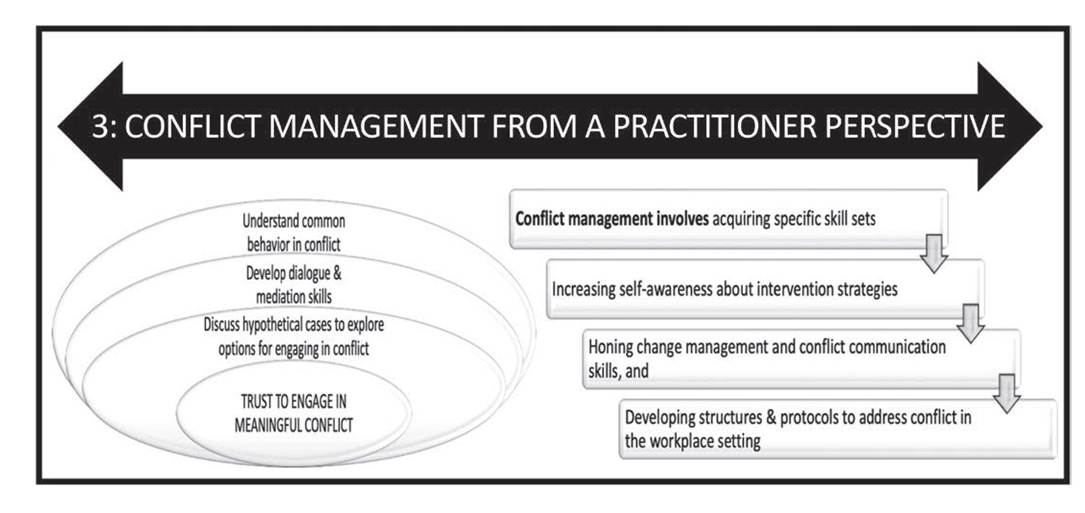
Very few people in academia, or any organization, seek conflict; however, with any vibrant organization there will always be conflicts. More often than not, conflicts are due to inappropriate or ineffective communication among the members of an organization regarding their needs, ideas, beliefs, goals, or values. The idea that we underscore in the proper management of conflict is that not all conflicts can be resolved but learning to manage conflicts will significantly decrease the odds of destructive escalation. Conflict management involves acquiring a specific skill set, increasing self-awareness about intervention strategies, honing change management and conflictConflict Management and Dialogue in Higher Education, 3rd edition, pages 35-49 Copyright © 2021 by Information Age Publishing
All rights of reproduction in any form reserved.
36 ■ Conflict Management and Dialogue in Higher Education, 3rd edition communication skills, and developing structures and protocols to address conflict in the workplace setting.
Preparing for Constructive Conflict Engagement
The more you work to hone your skill set to engage in productive conflict engagement, the greater are your chances of creating a high-performing work environment where all individuals in your colleges and universities have the opportunity to thrive. The goal is to turn conflict into strategic, productive, and positive outcomes for the individuals and the unit. Here we are proposing activities so organizations are better prepared for conflict engagement.
Build Trust
As discussed in Chapter 2, individuals and organizations cannot engage in meaningful conflicts if there is a lack of trust.
Trust is essential for people to be willing to engage in meaningful conflict. Cruise O’Brien (2001) talked about trust as “an expectation about the positive actions of other people, without being able to influence or monitor the outcome” (p. 10). Trust involves releasing control and believing in our colleagues. Some important points Cruise O’Brien shared include:■ People award trust on the basis of fair treatment, respect, and recognition for their contributions.
■ People at the bottom of an organization are continuous and careful “intuitive auditors.”
■ Deference to authority has been found to be based more on trust than on competence.
■ The durability of trust is based on integrity and consistency.
■ Trust builds incrementally; however, distrust can develop from one event and can be catastrophic for a working relationship.
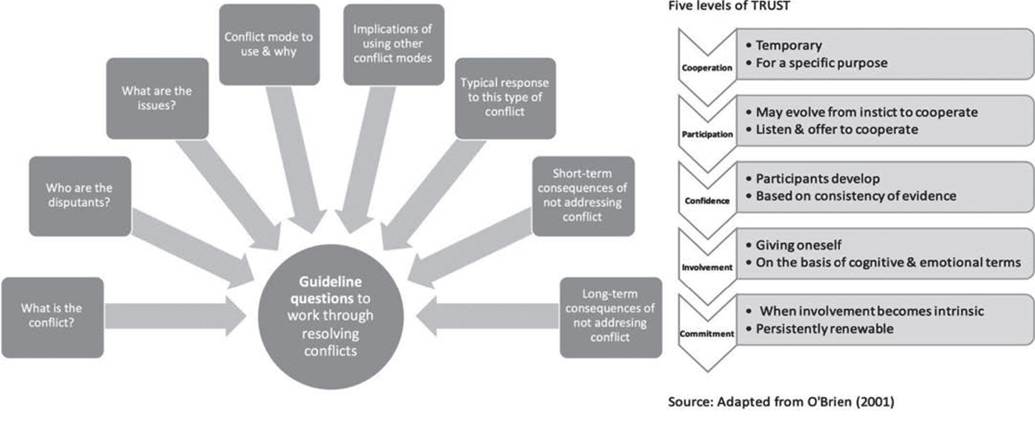
Some leaders say, “just trust me,” without realizing trust is far more complex than a simple declaration. Further, trust occurs at varying levels of occurrence. As seen from Cruise O’Brien (2001), there are five distinct levels of trust:
■ Cooperation—temporary, for a specific purpose.
■ Participation—may evolve from instinct to cooperate, listen, and offer to cooperate.
■ Confidence—participants develop based on consistency of evidence.
■ Involvement—giving oneself on the basis of cognitive and emotional terms.
■ Commitment—when involvement becomes intrinsic or persistently renewable.
Trust within workplace units is necessary for employees to have effective communication, including engaging in meaningful conflict, with both employees and supervisors. To build trust, especially when an organization is in conflict, the organization should explicitly train people to:
1. Understand common behaviors, including their own, when in conflict.
2. Develop dialogue and mediation skills.
3. Discuss cases of hypothetical conflicts, as tabletop exercises, for participants to explore options in engaging in the conflict posed.
An Example Conflict Case Study
Consider the following case study. Try to read it from the perspective of each of the participants involved and respond to the guiding questions that follow.
You are in your first year as chair of a department with 14 full-time faculty members. You have already heard some concerns about three faculty members who spend a lot of time consulting and are rarely seen on campus. You engage with one of them, Dr. Bucks, to learn about his consulting activities. He is somewhat evasive about the extent of his consulting activities but emphatically stresses the importance of his professional activities to the department.
Dr. Brightlight has a national reputation. Students in her courses complain that guest speakers and videos are often used to conduct the class while she is out consulting. The department needs her, probably more than she needs it. Her luminary reputation is helpful to the department’s status and research activities.
Dr. Dolittle is a full professor who has been with the university for 23 years. He recently invested in a business and is spending increasing amounts of time analyzing and supervising its operations. He is frequently unavailable to students. You drop by during his office hours on three occasions; however, he is absent. When you finally get an opportunity to talk with him
38 ■ Conflict Management and Dialogue in Higher Education, 3rd edition about his off-campus activities, he responds that the new business is really a form of consulting, that it improves his teaching, and that his business operations are similar to other faculty members’ activities.
Your executive committee suggested that absent faculty members are derailing the department’s programmatic progress. Classes are not being taught or are not of the quality that they should be. These faculty members’ research efforts seem to support their consultation work rather than departmental priorities. Their service to the department is nonexistent.
Their attitude is having a negative impact on both faculty morale and recruitment efforts, as evidenced by students’ comments to prospective students. You understand the executive committee’s concerns, but you are also aware of what the impact will be on the department’s reputation if all three of these faculty members explore leaving the department because of any action that you take.Here are some guiding questions to ask, as you work through how to resolve this conflict:
1. What is the conflict?
2. Who are the disputants?
3. What are the issues?
4. Which of the conflict modes would you use and why?
5. What are the implications of using other conflict modes?
6. What is the typical response to this type of conflict?
7. What are the short-term consequences of not addressing the conflict?
8. What are the long-term consequences of not addressing the conflict?
Deepen Commitments to Diversity and SocialJustice
The goal of socialjustice education is full and equal participation of all groups in a society that is mutually shaped to meet their needs (Adams, Bell, & Griffin, 1997). The higher education setting, which is a microcosm of our society, is no different. Faculty, staff, and administrators who are underrepresented or marginalized because of social and cultural identity characteristics such as class, race, ethnicity, gender, age, sexual orientation, political ideologies, culture, religion, nationality, and physical and learning ability bring experiences, values, and beliefs that often run counter the master narrative. These counter-narratives can trigger conflict. We have learned from conflict theory and mediation practice that diversity and social justice issues are important to consider when managing conflict. A basic tenet of social justice is inclusiveness. You cannot effectively manage
conflict without ensuring that all parties involved have a voice at the table and are provided with an opportunity to tell their narrative from their seat of identity or multiple identities.
Parties whose voices may not be heard or heeded in conventional forums must be given the opportunity to be heard in the conflict resolution process.More importantly, the views, needs, and interests of the participants in a dispute must be given full consideration, and the “power” differences among the participants must be equalized in reaching a fair resolution of the conflict. For example, we have worked with an administrative office at a major research university that provides mediation services. Faculty members are trained to be mediators and are called on to mediate faculty conflicts when they arise. The mediators receive 40 hours of extensive training (a requirement of the state bar where the university is located), and a large part of that training is learning about the relationship between conflict and socialjustice. Issues such as racial identity development, the cycle of socialization, the dynamics of oppression, and responding to triggers that can lead to conflict are important topics of discussion during the training. The mediation service is voluntary and available to all faculty members. One of the attributes of this service is that the associate provost works to assign co-mediators to cases to ensure that the power relations are reasonably equal, especially when it is perceived that the nature of the conflict might involve a social justice issue such as racism. For example, if there is a perceived racial conflict, the office works to find a biracial team of co-mediators. Mediators are never from the parties’ department and college, and when more than one mediator is involved representing each of the parties, every effort is made to ensure that co-mediators are equally matched regarding academic rank.
Most of our colleges and universities are striving to model the diversity that is representative of our society and/or state as a whole. Regarding the goals and achievements of a diverse campus, Lee Bollinger (2007), president of Columbia University, stated,
The experience of arriving on a campus to live and study with classmates from a diverse range of backgrounds is essential to students’ training for this new world, nurturing in them an instinct to reach out instead of clinging to the comforts of what seems natural or familiar.
We know that connecting with people very or even slightly different from ourselves stimulates the imagination; and when we learn to see the world through a multiplicity of eyes, we only make ourselves more nimble in mastering and integrating— the diverse fields of knowledge awaiting us. (p. B20)However, the learning experience that Bollinger rightly applauds when people with diverse backgrounds interact can also lead to misunderstanding
40 ■ Conflict Management and Dialogue in Higher Education, 3rd edition and conflict. As a result, universities and academic leaders find themselves responding to and managing racial incidents or hate crimes on their campuses. Individuals on campus are also often uncertain as to how to respond to these incidents. Still too often, we will serve on a committee or attend a meeting only to hear someone make a disparaging comment that is perceived as sexist, racist, homophobic, anti-Semitic, or Islam-phobic, and it is met with silence. We often observe and critique the conflict management skills of individuals who work to resolve these difficult encounters.
Learning how to discern and manage racial conflicts on a college or university campus is an intellectually, emotionally, and politically challenging exercise (Bell, Love, & Roberts, 2007; Gorski, 2019). For those who have engaged in discussions regarding racial conflict, they relive comments such as, “Is this really happening?”; “Why is this a race issue?”; “You people are so sensitive”; and “They just don’t get it!” Comments like these are more likely when faculty, staff, administrators, and students are not provided with opportunities to dialogue about potentially divisive racial issues in safe and supportive spaces.
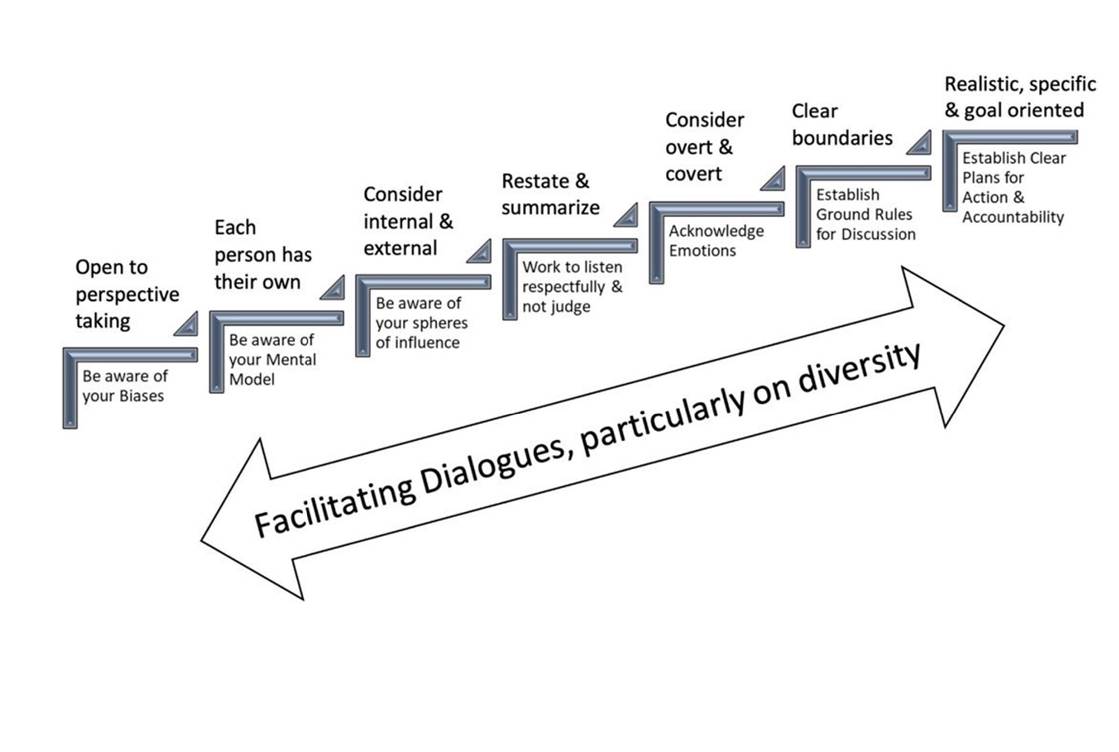
Racial conflicts do not go away on their own; they usually escalate if they are not managed well. All faculty members and college administrators can become better models of diversity by learning how to facilitate difficult dialogues when racial conflicts occur. Below are some general guidelines to follow when facilitating such dialogues, particularly with conflicts related to diversity.
Guideline 1: Be Aware of Your Biases
Each individual holds prejudices. Prejudices may involve taking a particular point of view or perspective or reinforcing stereotypes about a group of people before facts are gathered and weighed. These prejudicial behaviors can be observed before and during conflicts. However, biases become problematic when we facilitate discussions involving racial conflicts from a subjective rather than an objective point of view. You should be open to perspective taking, including learning and unlearning information about self and others.
Guideline 2: Be Aware of Your Mental Model
Mental models are explanations in our mind of how something works in the real world. They drive our choices, actions, and behaviors. Be cognizant of the fact not everyone shares the same mental model. Each person, of course, has different life experiences, values, and beliefs that shape us
as human beings. Individuals who historically have been marginalized or have been made to feel marginalized in our society might bring a different mental model to a given situation. Conflicts are opportunities to uncover mental models so that there is growth and learning.
Guideline 3: Be Aware of Your Spheres of Influence
You can influence meaningful conflict dialogues by examining and understanding the mindset and assumptions of the various people or cultures that might collide to create areas of conflict. The first sphere is that of self (including our own attitudes, beliefs, values, knowledge, and behavior in terms of socialization experiences and our interactions with others). The second sphere is that of the campus itself. Does it have high expectations for behavior for all students and faculty? Does it provide a welcoming environment and support students and faculty when obstacles occur? Other spheres whose assumptions and procedures should be examined and understood, as they may influence behavior and attitudes resulting in conflicts, include those of the department, college, or school (including faculty governance and climate); community (including interactions between the campus or individual faculty members with schools, religious organizations, business and industry, and health-care agencies); and professional organizations and the assumptions and attitudes that might inform faculty scholarship and work at the local, national, and international levels.
Guideline 4: Work to Listen Respectfully and NotJudge
One of the key ingredients to facilitating discussions about conflict or any difficult dialogue is learning how to listen mindfully, be aware of one’s own narrative and mental model, and to exercise perspective taking. Many are skilled speakers and far less proficient listeners. Additionally, the ability to suspend judgment is equally difficult for some of us. To achieve clear communication and to clarify misinformation, it is always helpful to restate and summarize what you think you heard during a conversation.
Guideline 5: Acknowledge Emotions
Difficult dialogues are difficult because human beings come to the discussion table laden with a variety of emotions—fear, disappointment, frustration, anger, confidence, courage, hate, pain, pride, vulnerability, worry, and so forth. These emotions often come from direct experiences with overt and covert discrimination. Emotions that ensue as a result of these
42 ■ Conflict Management and Dialogue in Higher Education, 3rd edition experiences are natural and sustained. Avoiding dialogues under the guise of waiting until individuals appear to be “calmer” is never the best solution.
Guideline 6: Establish Ground Rules for Discussion
Ground rules are helpful in setting clear boundaries for difficult dialogues so that everyone feels reasonably safe to participate and contribute in a respectful manner. We have found that when participants in a dialogue work together to establish ground rules, there is more ownership in working to ensure that the conversation remains productive.
Examples of useful ground rules are as follows:
■ Commit to active listening.
■ Agree to use “I” statements to avoid generalizations.
■ Do not judge others or question their motives.
■ Do not interrupt when someone is telling his or her story.
■ Agree to confidentiality.
■ Be respectful in your contributions.
Guideline 7: Establish Clear Plans for Action and Accountability
One of the questions often posed to academic leaders before and during the facilitation of discussion regarding conflicts is, “What is going to be done as a result of this conversation?” Effective facilitation of such discussion includes the development of clear plans of action that are realistic, specific, and goal oriented. In addition, academic leaders who are often in the best position to ensure that plans of action are developed, implemented, and assessed should be held accountable for monitoring appropriate outcomes.
Conflicts Involving Bullying
There is a growing body of literature (Gravois, 2006; Jefferson, 2007; Keas- hly & Neuman, 2010; Levine, 2006; Namie & Namie, 2000; Powers, 2007; Pyke, 2018, Twale & De Luca, 2008) on bullying in academia. A majority of the authors of this literature have agreed that bullying behaviors seem to take hold when there is an imbalance of power. Keashly and Neuman (2010) underlined that related to higher education in a statement, “While the values and norms of academic freedom, collegiality, and autonomy are the foundation of the academy, the understanding and interpretation of these may vary. Such variability can lead to misunderstandings and
potentially perceived or actual mistreatment” (pp. 62-63). Additionally, Houghton (2003) stated, “Bullying thrives in situations where the perpetrators are both powerful and frightening, and those around them [are] too scared to challenge” (p. 126). In addition, these behaviors are directed at members of targeted groups in academia such as women; faculty of color; international faculty, gay, lesbian, bisexual, and transgender faculty; Muslim faculty; and Jewish faculty. Bullying can impact an individual in three ways: physiologically (illness), psychologically (anxiety, depression, fear), and be- haviorally (obsession, aggression, withdrawal; Namie & Namie, 2000).
Academic bullies are often “older, tenured professors who are unwilling to take direction and create what many describe as a ‘toxic environment’ in the department” (Powers, 2007, p. 1). While bullying is often characterized in the academic setting as powerful professors who take advantage of less powerful ones, including graduate students becoming victims, bullying can occur in any workplace. The Canadian Center for Occupational Health and Safety (2005) offered the following examples of workforce bullying:
■ Spreading malicious rumors, gossip, or innuendo that is not true.
■ Excluding or isolating someone socially.
■ Intimidating a person.
■ Undermining or deliberately impeding a person’s work.
■ Physically abusing or threatening abuse.
■ Removing areas of responsibilities without cause.
■ Constantly changing work guidelines.
■ Establishing impossible deadlines that will set the individual up to fail.
■ Withholding necessary information or purposefully giving the wrong information.
■ Making jokes that are “obviously offensive” by spoken word or e-mail.
■ Intruding on a person’s privacy by pestering, spying, or stalking.
■ Assigning unreasonable duties or workload which are unfavorable to one person (in a way that creates unnecessary pressure).
■ Underwork—creating a feeling of uselessness.
■ Yelling or using profanity.
■ Criticizing a person persistently or constantly.
■ Belittling a person’s opinions.
■ Unwarranted (or undeserved) punishment.
■ Blocking applications for training, leave or promotion.
■ Tampering with a person’s personal belongings or work equipment.
Academic leaders must challenge and support victims of bullying behavior. Staff, faculty, students, and administrators can bully and can be bullied. With the increase in use of social media, an increase in cyberbullying has occurred. Anonymity has increased the number of people who bully and practice inappropriate behaviors towards peers, supervisors, and subordinates. These behaviors are on the rise and occurring at increasing levels of sophistication in the academy. Recognizing and responding appropriately to bullying behaviors is inherent to effective conflict management. Academic bullying is a clear example of behaviors that create conflicts, which have escalated and are not effectively addressed. Denice Denton, late chancellor of the University of California, Santa Cruz, had this to say about confronting bullying behavior, conflict, and bias in her closing address at the National Academies Committee on Maximizing the Potential of Women in Academic Science and Engineering:
I’m going to offer you a set of recommendations that will cost you nothing but courage. They can also be used more broadly well beyond the hallowed halls, and thus impact the “cross-institutional interlock,” or as I would say as an electrical engineer, “the system.” First of all, we should have zero tolerance for bullying behavior. It should not be acceptable in the workplace or anywhere else. If you are an academic leader, you should confront faculty and others who are abusive to students, staff and other faculty, particularly senior faculty. Tenure is not a license to kill. There are limits to acceptable behavior in the academy. How many of you have seen on an academic campus, senior people with tenure over and over abuse people who are lower than them in the power structure, and nobody ever does anything? Why does that happen? Why do we let that happen? It’s unacceptable. If you have issues with dealing with conflict and you are an academic leader, take a class. Get help. Seek support. People don’t want to confront each other. But we have to. It’s our job. It’s in the position description. We can learn from conflict. We do learn from conflict. Confront people’s biases. When biases come out if you’re an academic leader or anything else, confront people’s bias. And here is another one, and this is not a popular one, but I’m just throwing it in there. Support your local senior feminist colleagues, male and female. It’s lonely at the top. (Rosser, 2006, p. 23)
Within six months of delivering this address to the National Academies, Chancellor Denton committed suicide. Even though Chancellor Denton knew the importance of engaging in conflict and had conflict management skills, she became saturated by the bullying behavior directed towards her. All of us have a threshold related to the abuse and bullying we can have aimed at us.
Conflict Management From a Practitioner Perspective ■ 45
■Р» σ>
Conflict Management and Dialogue in Higher Education, 3rd edition
Conflict Management From a Practitioner Perspective ■ 47
Author Note
For additional support in using Chapter 3 as part of a Mediation Course, contact:
Nance T Algert, PhD, LPC, FAPA
The Center for Change and Conflict Resolution
1511 Texas Avenue South # 134
College Station, TX 77840-3303
T: 979.224.3638 F: 888.819.0495
email: cccrtx@gmail.com
Web: http://www.cccrtx.us
References
Adams, M., Bell, L., & Griffin, P. (1997). Teaching for diversity and social justice. (1st ed.). New York, NY: Routledge.
Bell, L., Love, B. J., & Roberts, R. A. (2007). Racism and white privilege curriculum design. In M. Adams, L. Bell, & P. Griffin (Eds.), Teachingfor diversity and social justice (pp. 125-144). New York, NY: Routledge.
Bollinger, L. (2007). Why diversity matters. Chronicle of Higher Education, 53(39), B20.
Canadian Center for Occupational Health and Safety. (2005). OSH Answers. Bullying in the workplace. Retrieved from https://www.ccohs.ca/oshanswers/ psychosocial/bullying.html
Cruise O’Brien, R. (2001). Trust: Releasing the energy to succeed. Chichester, England: Wiley.
Gorski, P. C. (2019). Racial battle fatigue and activist burnout in racial justice activists of color at predominately White colleges and universities. Race ethnicity and education, 22(1), 1-20.
Gravois, J. (2006). Mob rule: In departmental disputes, professors can act just like animals. Chronicle of Higher Education, 52(92), 92.
Houghton, A. (2003). Bullying in medicine. British MedicalJournal, 326(7393), S125.
Jefferson, A. I. (2006). The bullying boss. Academic Leadership Journal, 4(4), 14-16.
Keashly, L., & Neuman, J. H. (2010). Faculty experiences with bullying in higher education. Administrative Theory & Praxis, 32(1), 48-70.
Levine, I. S. (2006, September 22). Bosses who bully. Science Careers Forum. Retrieved from https://www.sciencemag.org/careers/2006/09/bosses-who -bully
Namie, G., & Namie, R. (2000). Workplace bullying: The silent epidemic. Employee Rights Quarterly, 1(2), 1-12.
Powers, E. (2007, July). Handling the “bad apples.” News, views and careers for all of higher education. Inside Higher Education. Retrieved from http:// www.insidehighered.com/news/2007/07/13/advance
Pyke, K. D. (2018). Institutional betrayal: Inequity, discrimination, bullying, and retaliation in academia. Sociological Perspectives, 61(1), 5-13.
Rosser, S. V. (2006). Using the lenses of feminist theories to focus on women and technology. Champaign: University of Illinois Press.
Twale, D.J., & De Luca, B. M. (2008). Faculty incivility: The rise of the academic bully culture and what to do about it (Vol. 128). New York, NY: Jossey-Bass.
This page intentionally left blank.