Realities About Conflict
Every conflict we face in life is rich with positive and negative potential. It can be a source of inspiration, enlightenment, learning, transformation, and growth—or rage, fear, shame, entrapment, and resistance.
The choice is not up to our opponents, but to us, and our willingness to face and work through them.—Kenneth Cloke and Joan Goldsmith (2001)
Conflict Is Normally Perceived to Be Bad
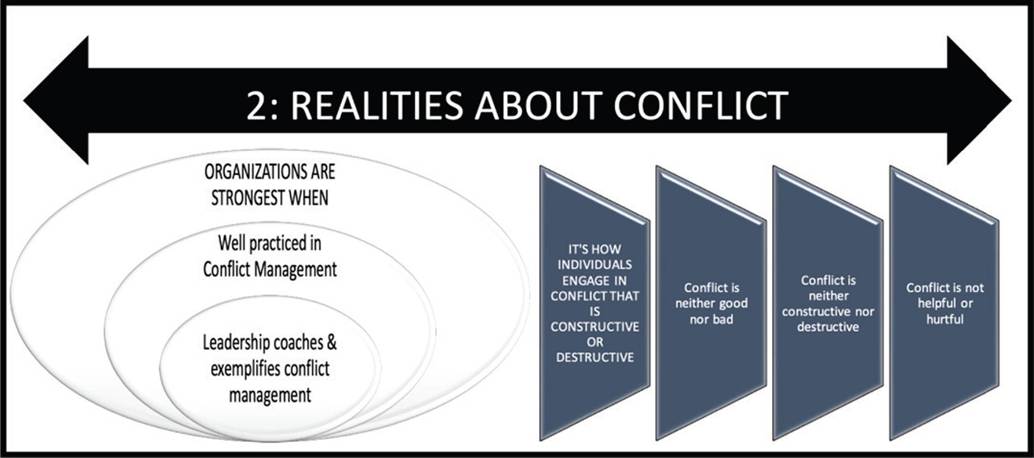
Conflict is neither good nor bad. It is neither constructive nor destructive, not helpful or hurtful. It is how individuals engage in conflicts as they arise that is either constructive or destructive for the individual, other people in the conflict, or an organization.
When people think about engaging in conflict, the words and phrases most often used to describe their thoughts and feelings associated with conflict include fight, flight, anger, destructive, divisive, illness, bad change, spawn new problems, and distress. It is therefore easy to understand why people often behave as if any conflict must be viewed through this lens. Many individuals and organizations tend to avoid conflict at all cost, and
Conflict Management and Dialogue in Higher Education, 3rd edition, pages 19-31 Copyright © 2021 by Information Age Publishing
All rights of reproduction in any form reserved.
think that conflict should be avoided if possible or squashed quickly. Conflict is viewed as dangerous, worrisome, and a burden. It is assumed that an organization in conflict is broken or weak. If this is the perception, then it is no wonder that many leaders of organizations do not want their unit to be known as having conflict. Therefore, to deny that conflicts exist is common. It is important to understand some of the reasons behind the commonly held perception that conflict is negative.
First, we find that many people are socialized or have role models who foster a mental model that the correct perspective is that conflict is negative.
Often this is because individuals have not been taught how to manage conflicts. Unmanaged or unresolved conflict can lead to aggression, which in turn can lead to violence, making experiences with conflict negative. Most people are not taught to frame a conflict differently from the internal responses that they have to the conflict. Furthermore, people may have learned that conflict means change, and it is very normal to resist change, even if that change is intellectually perceived to be desirable. One powerful form of resistance is to brand the change that is occurring as negative. A third reason why conflict is perceived as negative is the intuitive as well as cognitive signals our body sends when we, or a unit, is under stress. We want relief from the sometimes overwhelming feeling of stress. We will address physiological responses to conflict later; however, it is sufficient to say here that stress may lead to labeling an experience as negative.The Positive Aspects of Conflict
Once we are mindful that conflict is simply defined as differences with regard to values, needs, ideas, beliefs, or goals between people, we can then understand that being aware of such differences is actually a positive step toward understanding conflict. In the same way, it would be insensitive to lack awareness about social justice, or reflect on one’s privilege, and assume that everyone else’s perspective or experience is the same as yours. So, one positive aspect of conflict, not necessarily the outcome of how the conflict is managed, is that it increases one’s awareness and openness to diverse perspectives. Researchers have shown that diverse teams, particularly in their approaches to thinking about, framing, and engaging in a problem, are stronger teams than those who are not as diverse (Garcia Martinez, Zouaghi, & Garcia Marco, 2017; Milem, 2003; Watson, Johnson, & Merritt, 1998).
Conflict can also provide positive signals to individuals about the need for, or impending initiation of, change.
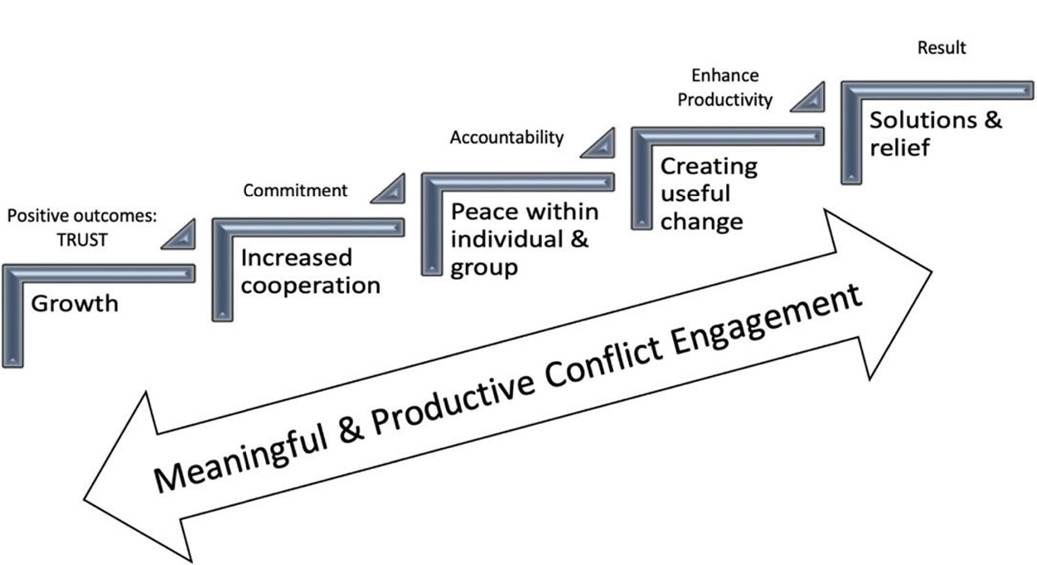
This awareness, although likely to trigger resistance at first, will often help people muster the proper energy for a needed change.Conflict also helps teams tune themselves to be high performing teams. Consider a sports analogy where the team really shines when the competition is truly challenging. The team has to depend on each other to do their part to ensure overall performance is at its peak. Additionally, Tuckman and Jensen (1977), from their early research which remains relevant today, identified four stages that commonly occur when a team is engaged in teamwork: forming, storming, norming, and performing. These stages have clear implications for thinking about how conflict can lead to positive outcomes and enhance productivity. Tuckman and Jensen found that when a team storms, it engages differences and conflicts within the team, then it can norm, or calibrate itself on what the team is truly able to accomplish. Further, Lencioni (2002), in his book The Five Dysfunctions of a Team, addressed the importance of effective teams and organizations. As shown in Figure 2.1, which is an adaptation of his work, an organization is only successful in accomplishing its goals and results if individuals and the organization are willing to engage in meaningful conflicts. The figure shows that positive results are possible when people or a team are accountable to one another because they are committed to the team. They are committed to the team because they are willing to engage in constructive and meaningful conflicts; this occurs because the individuals on the team build trust.
Meaningful and productive conflict engagement can yield positive outcomes such as growth, increased cooperation, peace within the individual and unit, creative and useful change, solutions and resolution to issues that had been ongoing, and finally, relief. The primary reason why adults decide to engage in conflict is to experience relief; relief that the conflict is resolved, relief that they will spend less energy at work in interpersonal conflicts, and relief that there is no longer a lingering unresolved issue.
Therefore, we contend that conflict is similar to that of the canary in the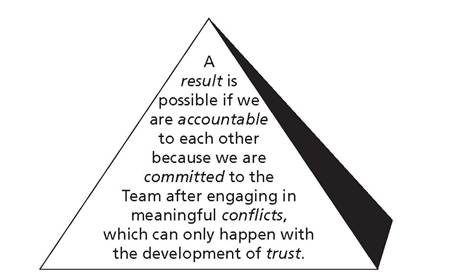
Figure 2.1 The five dysfunctions of teams. Source: The five dysfunctions of teams.
coalmine, which sends needed signals to individuals about their own beliefs, interests, needs, and values in relation to those around them. The consequence of receiving such signals is entirely dependent on how the signaling of the conflict is received and subsequently managed.
Conflict Frequency
Conflict is a high probability event. Over twenty years ago, it was reported that managers spent at least 40% of their day engaged in conflict (Putnam, 1995) and 30 years ago, it was reported that adults average five conflicts per day, and adolescents, such as undergraduate college students, average nine conflicts per day (Opotow, 1990). According to Acuna (2013), more recent overall statistics indicate that between 10 to 26% of a manager’s time is spent handling conflict.
A foundational tenet for this book is that organizations are strongest when (a) they are well practiced in conflict management and (b) coaching this practice becomes one of the most important leadership responsibilities in the organization. Because conflict is a high probability event, addressing conflict early on is important, because there is typically a greater range of resolu- tion/management options as well as the likelihood of diminished escalation.
Conflict Intensity (Escalation)
Conflict and change go hand in hand. The intensity of resistance to change can serve as a proxy for an individual’s perception about the intensity of a conflict. Rick Maurer described the following three levels of resistance and motivations that occur during conflict:
Level I—I don’t get it (confusion about the idea)—motivation is an intellectual lack of information or disagreement about the information.
Level II—I don’t like it (an emotional reaction to the change)—motivation is a concern that some personal belief or value is being challenged or changed.
Level III—so maybe they like you, and I don’t like you—motivation is rooted in historical experiences and hard to disentangle from the current situation or conflict (Maurer, n.d.).
With regard to Level III, Maurer said, “So maybe they like you, but they don’t trust you—or don’t have confidence in your leadership. That’s a hard pill to swallow, I know. But lack of attention to Level III is a major reason why resistance flourishes and changes fail” (Maurer, n.d.).
Jordon (2000) translated and summarized Glasl’s model of how conflicts escalate. When conflicts are ignored and not addressed, the conflict typically escalates. Further, the people involved in the conflict typically become more positional in nature. Table 2.1 was created to summarize Glasl’s steps. Unresolved and unaddressed conflict can eventually lead to the death of a partnership and an organization.
Glasl’s model is useful to review in its entirety as it discusses (a) each conflict stage, (b) what the specific conflict issues are, (c) what the observable behaviors are at each stage, and (d) what is the threshold trigger to move the conflict to the next level.
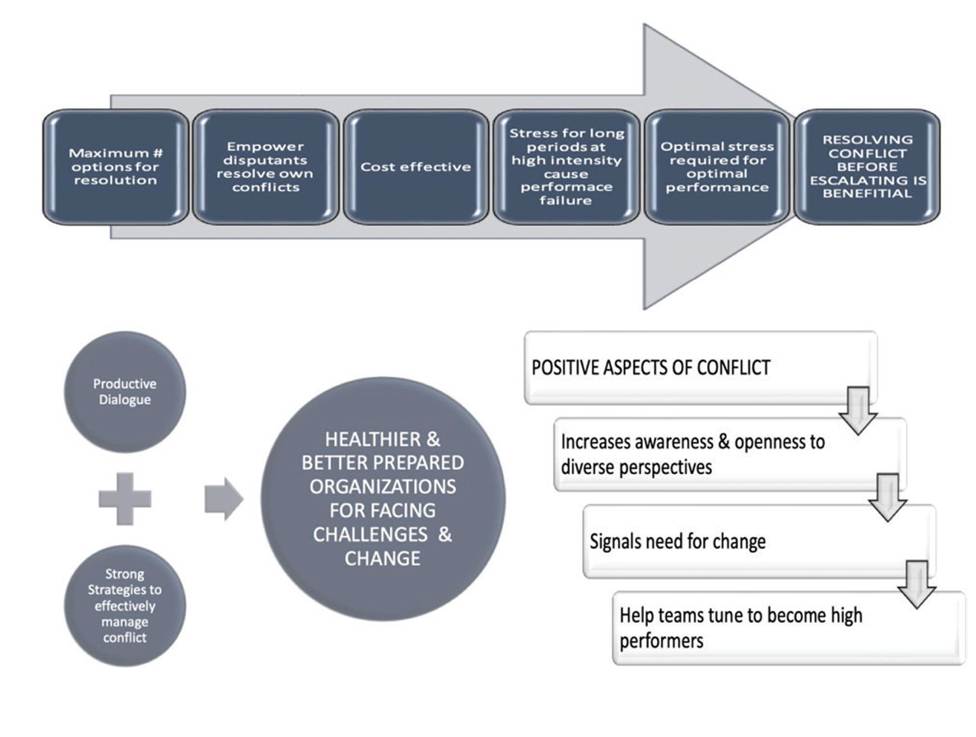
Resolving conflict at its lowest point of escalation is obviously beneficial. First, when a conflict is addressed between the initial disputants’ parties, the maximum number of options for resolution exists. As a conflict is passed up through the ranks, the range of options for resolution diminishes and the options often become more punitive in nature. Second, it is empowering for the disputants to resolve their own conflicts versus having a hierarchical third party mandate the resolution. Through this empowerment, individuals are more likely to follow through on their resolution. Third, it is cost effective for conflicts to be resolved at the lowest level of escalation possible. As more parties become involved in resolving or managing
| TABLE 2.1 Conflict Escalation | |
| Stage 1: | People attempt to get along with one another and find themselves in a conflict. |
| Stage 2: | People may debate and become more positional as they perceive the “other” as unreasonable. |
| Stage 3: | People start adhering to their mental model to confirm they are right and the “other” is wrong and share their discontent about the other person. |
| Stage 4: | The conflict is neither about the actual issues any longer, nor even positions, but about defeating the other. |
| Stage 5: | The conflict moves beyond defeating a person to a newly held belief of having to “beat an enemy” or to publicly shame another. |
| Stage 6: | The conflict issue(s) are no longer clear and the parties in conflict move to threats and ultimatums about what must happen or what the other has to do. |
| Stage 7: | The situation (formally seen as a resolvable conflict back in Stage 1) is now viewed as self-preservation; thinking can be “how do I limit the negative impact of the “other” (the person, their comments, their behaviors). |
| Stage 8: | The belief is “I need to attack the enemy.” |
| Stage 9: | The belief is “the enemy must be annihilated and if I have to be annihilated as an outcome that is okay.” |
24 ■ Conflict Management and Dialogue in Higher Education, 3rd edition conflict, each of these individuals must spend more time away from their work responsibilities.
■ A common mistake in managing a conflict is to ignore the intensity or escalation level of a conflict.
An example would be treating a historically based mistrust of each other as a lack of information.■ Treating a simple lack of information as a fundamental difference in beliefs.
■ Treating a debate as a war.
■ Treating teams working to annihilate one another as a simple position on a new issue or change.
Therefore, it is clear that regardless of our mental models, whether a conflict is perceived as positive or negative, anyone wanting to manage or resolve a conflict will not likely succeed if they do not understand the nature and intensity of the conflict being considered. Glasl (1982) explained that once a conflict is escalated to a certain stage, the effort to resolve a conflict must involve de-escalating it one stage at a time, rather than immediately trying to jump back to Stage 1. Doing otherwise will trigger additional conflict.
Personal Health and Stress Related to Conflict
Feelings accompany conflict even though people often state their conflict has nothing to do with feelings or emotions. Individuals in conflict often exhibit anger, resentment, fear, guilt, and hopelessness. Their thoughts often take the form of “they are doing it again,” “they are trying to win,” “they are trying to take credit for my work,” “I will not tolerate this,” “someone has to have standards here,” “they entered my turf,” “they are discriminating against me,” or “they are wrong” (Algert & Watson, 2005). The behavioral response to conflict may be “fight or flight,” or as Taylor et al. (2000) indicated, women may have a different response to conflict, and that is to “tend and befriend” (p. 411). These behavioral responses relate well to the conflict behavioral modes described by Thomas-Kilmann in Chapter 1. Stress always accompanies change or conflict and for some people, change creates distress. When a person experiences distress with change, it is harder for the person to reason constructively and engage meaningfully in the conflict.
Figure 2.2 illustrates that under distress or eustress, individuals do not perform at an optimal level, yet another reason why conflict engagement can be good. However, operating under stress for long time periods at high intensity can ultimately wear people out. When this occurs, individuals may
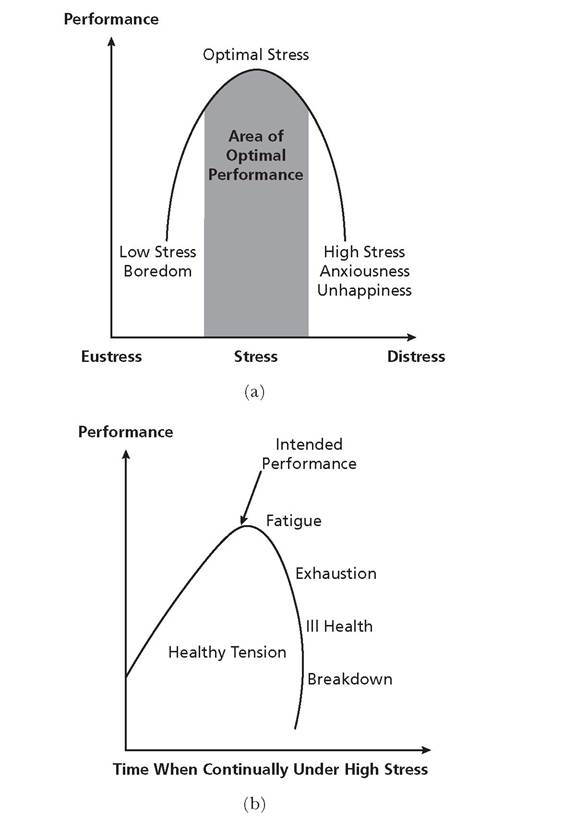
Figure 2.2 Two important aspects of stress: (a) stress is required for optimal performance, and (b) long durations under high stress eventually cause performance failure.
not only have diminished abilities to help an organization, they may suffer temporary or permanent health issues.
Regardless of the stress levels, performance, or behavioral instincts, an individual in conflict exhibits certain physiological responses. For example, physiological responses to conflict for many are associated with anxiety or fear, and include sweaty palms, a shortness of breath or rapid breathing, stomach queasiness, headache, rapid eye movement, neck and shoulder tension, tingling sensation, lower back pain, and/or tightness in the jaw. On the other hand, others may feel a need to repress these feelings and work toward a heightened acuteness and are prepared to fight. All physiological responses can ultimately influence one’s stress levels and health. Therefore, managing the causes of these reactions, through self-awareness, practice, and processes that bring relief, can aid individual health and performance.
Organizational Health and Effectiveness Related to Conflict
Our fundamental philosophy is that effective conflict management practices are key for organizational effectiveness. Conflict management is having the ability to notice and address, versus solve, conflict in a constructive manner (Algert & Gill, 2020; Watson & Watson, 2011). Developing and refining individual conflict management skills are also key for institutional integrity and prosperity. It is easier to learn to manage conflicts constructively than try to control all people, places, events, and things that create conflict. If individuals in an organization attempt to control all potential conflict situations, the person is first, unsuccessful and, second, creates an environment that lacks reflection, creativity, rich dialogue, and trust.
Conflict resolution means engaging in a process to resolve or solve a dispute or disagreement whereas conflict management implies the presenting conflict issue (e.g., insufficient resources) is still present and, through productive dialogue, strong strategies are employed to effectively manage the conflict (Algert & Gill, 2020; Watson & Watson, 2011). A unit well practiced and skilled in conflict management is healthier and better prepared for facing challenges and change.
RealitiesAboutConfIict ■ 27
NJ OO
Conflict Management and Dialogue in Higher Education, 3rd edition
RealitiesAboutConfIict ■ 29
References
Acuna, A. (2013). How much time do managers spend on conflict? Learningfl-Managers. Retrieved from https://learning4managers.com/dir/conflict _management
Algert, N. T., & Gill, C. A. (2020). Critical diailogues in higher education. Charlotte, NC: Information Age.
Algert, N. E., & Watson, K. (2005, April). Systemic change in engineering education: The role of effective change agents for women in engineering. Paper presented at the Women in Engineering Advocates Network (WEPAN)/National Association of Minority Engineering Professionals Advocates (NAMEPA) Joint Conference, Las Vegas, Nevada. Retrieved from https://journals. psu.edu/wepan/article/ viewFile/58417/58105
Cloke, K., & Goldsmith, J. (2001). Resolving conflicts at work: A complete guide for everyone on the job. San Francisco, CA: Jossey-Bass.
Garcia Martinez, M., Zouaghi, F., & Garcia Marco, T. (2017). Diversity is strategy: The effect of R&D team diversity on innovative performance. R&D Management, 47(2), 311-329.
Glasl, F. (1982). KonfilktmanagementE in Handbuch furFuhrunfskafte, Berterinnen underater, 5, Erweiterte Auflage [Conflict management: a guide for leadership and consultants]. Bern, Germany: Verlag Paul Haupte.
Jordon, T. (2000). Glasl’s nine-stage model of conflict escalation. Mediate.com.
Retrieved from http://www.mediate.com/articles/jordan.cfm
Lencioni, P. (2006). The five dysfunctions of a team. San Francisco, CA: Wiley.
Maurer, R. (n.d.). Resistance to change—why it matters and what to do about it. Retrieved from http://www.rickmaurer.com/wrm/
Milem, J. F. (2003). The educational benefits of diversity: Evidence from multiple sectors. In Compelling interest: Examining the evidence on racial dynamics in higher education (pp. 126-169). Stanford, CA: Stanford University Press.
Opotow, S. (1990). Moral exclusion and injustice: An introduction. Journal of Social Issues, 46(1), 1-20.
Putnam, L. L. (1995). Formal negotiations: The productive side of organizational conflict. In A. M. Nicoreta (Ed.), Conflict and organizations: Communicative processes (pp. 183-200). Albany: State University of New York Press.
Taylor, S. E., Klein, L. C., Lewis, B. P., Gruenewald, T. L., Gurung, R. A., & Updegraff, J. A. (2000). Biobehavioral responses to stress in females: Tend-and- befriend, not fight-or-flight. Psychological R,eview, 107(3), 411-429.
Tuckman, B. W., & Jensen, M. A. C. (1977). Stages of small-group development revisited. Group & Organization Management, 2(4), 419-427.
Watson, W. E., Johnson, L., & Merritt, D. (1998). Team orientation, self-orientation, and diversity in task groups their connection to team performance over time. Group & Organization Management, 23(2), 161-188.
Watson, N., & Watson, K. (2011). Conflict management: An introduction for individuals and organizations (2nd ed.). Bryan, TX: The Center for Change and Conflict Resolution.
This page intentionally left blank.