Why Focus on Managing Conflict?
It is possible to conceive conflict as not necessarily a wasteful outbreak of incompatibilities, but a normal process by which socially valuable differences register themselves for the enrichment of all concerned.
—Mary Parker Follett
In this book, we address the important topics of conflict, conflict management, and dialogue in higher education. Conflicts are a part of everyday life. Conflict for many people is defined as a fight, and therefore, it is often something that from an early age we learn to avoid until it is the last resort. However, as individuals who live and work in an increasingly diverse and global society, we must learn to manage conflict. When one person perceives another is denying her/his needs or interests, conflict rises, even if no one else recognizes that a conflict exists. Considering this definition, many people assume that all conflicts are negative and, therefore, should be avoided; however, conflict itself is truly neutral. Importantly, how one chooses to engage in the conflict can produce either constructive or destructive outcomes. Consistently managing and engaging in conflict in a constructive manner yields many positive outcomes. We hope that you find the contents of this book to be useful as a constructive conflict management guide in your personal and professional lives.
Conflict Management and Dialogue in Higher Education, 3rd edition, pages 3-17
Copyright © 2021 by Information Age Publishing
All rights of reproduction in any form reserved.
Useful Definitions
It is important to have a common vocabulary when discussing, engaging in, and strategically addressing conflict. Terms that we will discuss in this book are defined below.
■ Conflict is a struggle or contest between people with opposing values, needs, ideas, beliefs, or goals (Watson & Watson, 2011) or a social interaction of two or more interdependent parties who perceive incompatible goals (Kolb & Putnam, 1992).
■ Dialogue is two or more sides working toward understanding, suspending judgment, and listening for new information.
■ Difficult Dialogue is any conversation between two or more people where at least one person experiences “dis-ease” or discomfort in engaging in the topic or issue with others.
■ Facilitation is a structured conversation between two or more parties involved in a conflict.
■ A Facilitator is a third party who makes it easier for people to understand one another.
Foundation of Individual Conflict Responses
Individuals develop a mental model of how to deal with a conflict early in childhood; it happens at an unconscious level. Most continue to use strategies that were modeled by primary caregivers or significant role models while growing up. Some had excellent adult role models who taught them how to effectively manage conflict. Others had adult role models who taught us that conflict is bad and should be avoided at all cost. Some were even taught to “get others before they get us.” Individuals carry these mental models of what they believe to be appropriate behavior and are often unconscious of the reasons for making a particular choice of behavior when faced with a conflict. It is critical that individuals become aware of their individual mental models at a conscious level.
Unless individuals make a conscious choice to look at the relationship between their mental models and how they engage in conflict, they generally just react to conflict with their old unconscious, coping behaviors. They continue to engage or ignore conflict consistent with how they were taught as children. Those who were taught to fight continue to do so. Those who were taught to avoid and “pretend there is no conflict” continue to ignore and avoid the conflict. Individuals practice what they unconsciously learned and then are often dissatisfied with the outcome of their conflict engagement. There is nothing inherently wrong with acknowledging the mental model for conflict management developed in childhood.
However, it is often an ineffective strategy for specific conflicts. If we have a framework for understanding our unconscious behavior choices when facing a conflict, as well as other modes of behavior, then we can make our choices more consciously, while recognizing other possible choices and outcomes.What Are Mental Models?
According to Peter Senge (1990),
Mental models are deeply held internal images of how the world works, images that limit us to familiar ways of thinking and acting. Very often, we are not consciously aware of our mental models or the effects they have on our behavior. (pp. 232, 262)
Because these thoughts and feelings are internal to the individual, other people cannot know the individual’s thoughts and feelings. They can only see the actions. Individuals’ mental models determine how they navigate the world. This is one of the fundamental reasons conflict occurs. When a person focuses on something in a different way than another person, assumptions are usually made about who is right and who is wrong. “Who is right” is typically related to the idea that my mental model is the true mental model, and if you deviate from it, you might be trying to undermine me.
Figure 1.1 demonstrates how much of what occurs prior to our making a decision on an action is internal, known only to us.
Observable Data → Choice of Action
∖ Observable data
∖ People select the data they will use and ignore the rest.
∖ People use their personal and cultural beliefs to construct meaning of the data.
People make assumptions using the added meaning.
∖ People draw conclusions from the assumptions and selected data.
People use the conclusions to adopt personal beliefs to use in the future.
∖ Finally, people select an action based on their beliefs.
Figure 1.1 Ladder of inference. Source: Model adapted from Senge (1990) by K. Watson. Reprinted with permission.
A Framework for Understanding the Modes of Behavior in Conflict
Blake and Mouton (1975) created a framework which illustrates five different conflict modes or types.
The modes lie on a grid that compares the response to conflict by noting the levels of cooperation and assertiveness. The Thomas-Kilmann Conflict Mode Instrument (TKI) is based upon Blake and Mouton’s conflict framework. This self-report instrument reflects the propensity of individuals to respond to conflict using one of five modes as shown in Figure 1.2.This framework illustrates that individuals respond to conflict by consciously or unconsciously using one of the following five modes (Thomas & Kilmann, 1974): (a) avoiding, (b) competing, (c) compromising, (d) accommodating, and (e) collaborating. Each of these modes can be depicted along two scales: assertiveness and cooperation. None of these modes are wrong to use when responding to conflict; however, there are times when the use of a particular mode is constructive or destructive (see Figure 1.3).
The TKI is designed to show which style(s) an individual has the greatest tendency to use in a conflict. However, different conflicts and their associated factors warrant different styles. The more that individuals understand the strengths and weaknesses of each style, the more likely they are to be able to choose the style most conducive for managing particular types of conflict.
Individuals will choose a conflict style depending upon personal and organizational norms, as well as the current escalation level of the conflict. In order to skillfully manage a conflict, individuals must choose a style that will lead to de-escalation of the conflict, and ultimately, a level of resolution
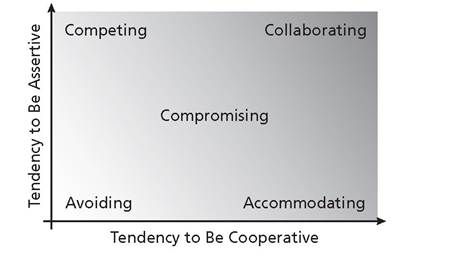
Figure 1.2 Conflict modes grid. Source: Consulting Psychologist Press (1999). Reprinted with permission.
The avoiding conflict mode is characterized by low assertiveness and low cooperation. The avoiding mode is appropriate to use when there are issues of low importance. It is also used when we want to reduce tensions, buy some time, or when we are in a position that has little to no power.
Avoiding skills include the• ability to withdraw
• ability to sidestep issues
• ability to leave things unresolved
• ability to discern a sense of timing
The competing conflict mode is characterized by high assertiveness and low cooperation. The competing mode is appropriate to use when quick action needs to be taken, unpopular decisions need to be made, vital issues must be handled, or one is protecting self-interests. Competing skills include:
• arguing or debating
• using rank or influence
• standing your ground
• asserting your opinions, thoughts, and feelings
• stating your position clearly
The compromising conflict mode is characterized by moderate assertiveness and moderate cooperation. Some people define compromise as "giving up more than you want,” while others see compromise as winning for both parties. The compromising mode is appropriate to use when there are issues of moderate importance, equal power status, or parties have a strong commitment for resolution. The compromising mode can also be used as a temporary solution when there are time constraints. Compromising skills include:
• negotiating
• finding a middle ground
• assessing value
• making concessions
The accommodating conflict mode is characterized by low assertiveness and high cooperation. The accommodating mode is appropriate to use to show reasonableness, develop performance, create good will, or keep peace. Some people use the accommodating mode when the issue or outcome is of low importance to them. Accommodating skills include:
• forgetting your desires
• selflessness
• ability to yield
• obeying orders
The collaborating conflict mode is characterized by high assertiveness and high cooperation. The collaborative mode has been described as "putting an idea on top of an idea, in order to achieve the best solution to a conflict” (S. Luera, personal communication, 1998). Collaborating can take a great deal of time and energy.
Therefore, the collaborating mode should be used when the conflict warrants the time and energy. The collaborative mode is appropriate to use when conflict is important to people who are working to construct an integrative solution. Collaboration skills include:• active listening
• identifying needs and concerns
• nonthreatening confrontation
• analyzing input
Figure 1.3 Utilization of TKI conflict behavioral modes.
that minimizes the resources and energy surrounding the issues in the conflict (Algert & Froyd, 2002). Once a person determines what conflict mode he/she will use for a given conflict situation, the next step involves reflecting on what conflict modes are being used by the other parties in conflict. This process is known as framing a conflict and will be discussed in Chapter 7.
Conflict Responses in Organizations
Windle and Warren (2009) shared three common responses from people within organizations when conflicts arise. Organizational conflicts are typically addressed in the following ways:
■ Pave over the conflict with superficial gestures.
■ Blaming, talking, or complaining about the situation with friends or third parties (while failing to talk directly to the other party with whom we are in disagreement).
■ Trying to get hired guns to deal with the problem (they should be able to intimidate the other party).
Paving over the conflict involves the parties discussing everything except the conflict. The individuals may discuss the weather, the search for a new college dean, or even the school’s athletic programs; however, the parties never discuss the conflict. When the conflict is not discussed, there is a grain of sand of divisiveness between the two parties. This one-grain may not create a large problem. However, the cumulative effect of multiple unresolved conflicts, or multiple grains of sand, leads to distrust between the parties. On the other hand, if the organization’s style of managing conflict is to blame others, it may quickly become a very unwelcoming environment. And finally, if an organization’s primary response is to passively wait for someone else to fix the conflicts, it may get stuck, with no internal skills to progress.
In addition, the researchers have shown that an organization will normally develop a dominant behavioral mode for dealing with conflict (Algert & Watson, 2002; Gelfand, Leslie, Keller, & de Dreu, 2012). Furthermore, responses to conflict are learned and people who stay in the organization usually adapt their personal styles to the environment over time. Researchers have demonstrated that conflict behavior modes are often driven by the majority, especially over time when people in titled leadership and managerial positions, as well as the people who choose to stay with the organization and thus with the greatest longevity are setting the culture of the organization (Algert & Watson, 2002; Watson, Xie, & Etchells, 2018).
Change Creates Conflicts
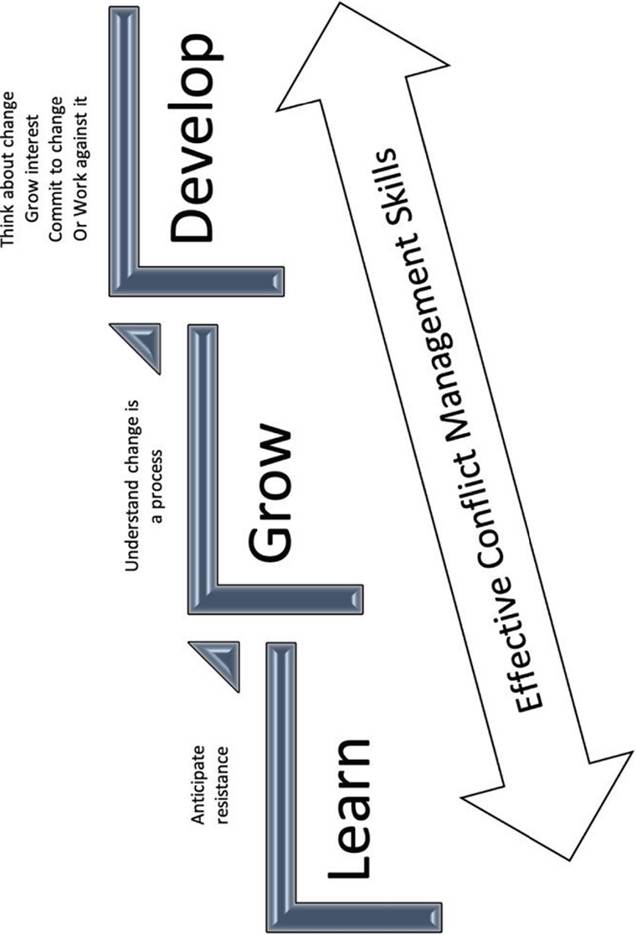
Change will often cause conflicts to occur in an organization, whether it is a college or university, department, or a particular program. Figure 1.4 illustrates a change process model, which explains how an individual transitions through various stages of change in an organization. When an organization is experiencing change, it is common for an individual to believe others are simultaneously in the same stage related to the change process; this is typically not accurate. People in the organization will move through the change steps at different rates of speed. Even though the individuals are all moving through the process, some will be leading the change initiative and expending a lot of energy, while others will spend a lot of energy resisting the change. Individuals within a group or team will experience different
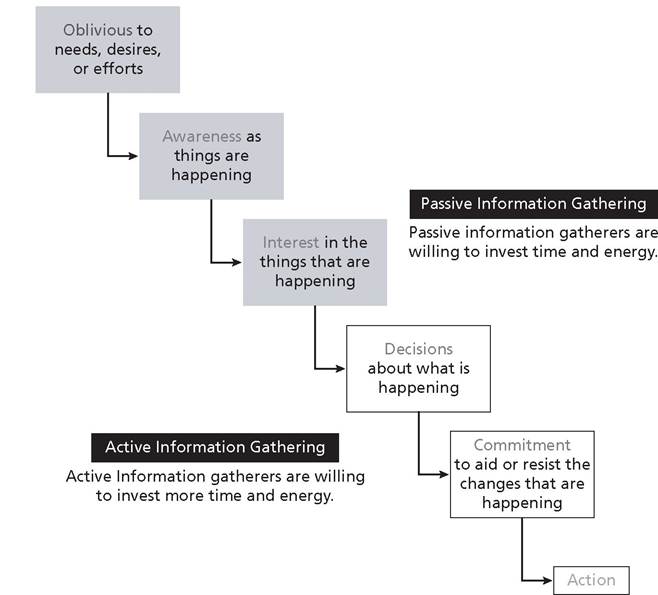
Figure 1.4 Staged change model. Source: Synthesized by K. L. Watson from Foundation Coalition (2000). Reprinted with permission.
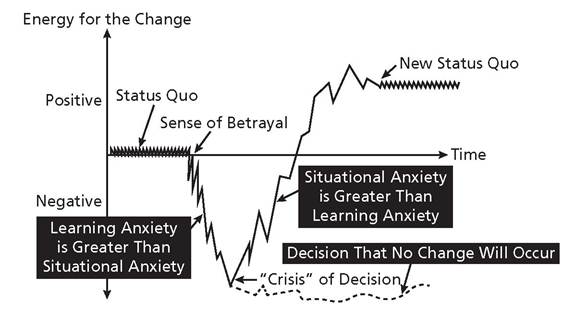
Figure 1.5 Satir’s model for individuals and organizations. Source: Adapted from Satir, Banmen, Gerber, and Gomori (1991) by Algert and Watson (2005). Reprinted with permission.
levels of resistance to change, so we are all at different stages of the internal change process.
Colleges and universities are prime examples of organizations where change is a constant. When leaders plan for change, they often engage their leadership team about the process and outcomes over a considerable time period. As a group, they have progressed through the change process and are therefore committed to the decision to change. However, when the change is announced, levels of resistance that accompany change often shock leaders. Leaders should always anticipate resistance and understand that other people in the organization might not yet have had the opportunity to work through the change process. Individuals need sufficient time to think about the change, grow interest in the change, commit to the change, or even to work against the change. Satir and Banmen’s (1991) change model, Figure 1.5, depicts the normal shift over time that occurs as individuals (as well as groups and organizations) are confronted with a change. The time scales for individuals and for a particular change may vary tremendously within an organization. Part of managing change involves handling the complexity of people being in different stages of resisting or accepting the change.
Diversity Creates Conflict
Colleges and universities are becoming increasingly socially and culturally diverse. In many ways, college campuses are microcosms of society, the workforce, and the world. The diversity that enriches an organization or a campus environment will often lead to conflict.
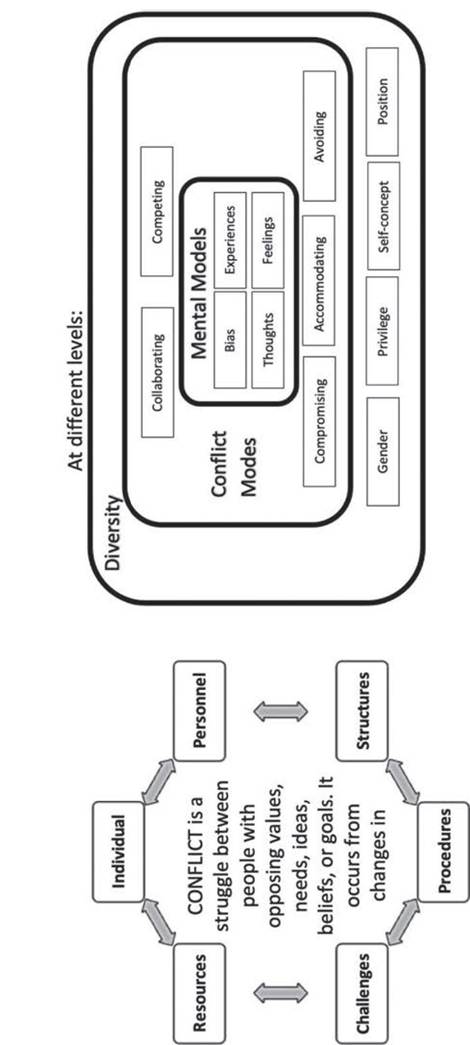
As we noted, how individuals choose to engage in the conflict can either be constructive or destructive. We firmly believe that diversity creates an opportunity for productive dialogue that raises awareness, enhances communication, leads to perspective taking, and increases knowledge and understanding about self and others. Consequently, when there is a diversity of mental models operating, there is increased likelihood that they are going to open the door for conflicts to arise. In addition, when we consider the diversity of an individual’s preferred conflict behavioral modes and where individuals are in the change process, conflicts will likely occur.
Individuals who have been historically marginalized or underrepresented in society represent an intersection of social and cultural identity factors, such as age, cultural identity, gender identity or expression, nationality, physical or mental ability, political and ideological perspectives, racial and ethnic identity, religious and spiritual identity, sexual orientation, and social and economic status. One cannot expect to espouse diversity and not value what all members of an organization or campus community bring to the educational enterprise. Similarly, one should fully expect that diversity of identity, thought, opinion, and life experiences will challenge ways of thinking and doing in an organization. These attributes are likely to create differences in how conflict is perceived and managed, and also the behaviors associated with the conflict.
A few specific examples include:
■ Gender: Individuals are often socialized to use particular conflict modes because of their gender. For example, in some cultures, males are taught to “always stand up to someone, and, if you have to fight, then fight.” A person socialized this way would be more likely to use assertive conflict modes versus cooperative modes. Similarly, some females are socialized to accommodate when a conflict arises, especially if the conflict is with a male.
■ Privilege: In their work on racism and White privilege curriculum design, Adams, Bell, and Griffin (2007) shared the following comments:
Participants bring to a course on racism a wide range of feelings and experiences, and often misinformation, confusion, and bias. White participants may sincerely want to learn about racism and figure out how to play a role in making their communities, schools, and workplaces welcoming places for all, but fail to see the role white skin privilege and accumulated white advantage play in perpetuating racial inequality. Participants of color may want to figure out how to break through the silence about racism as a historic and contemporary force that differentially shapes their lives, but fear having their concerns dismissed, being viewed as too sensitive or as troublemakers, or being misunderstood by white peers and teachers.
Participants from all racial groups may be reluctant to explore racism, especially in mixed groups, given the complex and often painful web of emotions that discussions about racism inevitably raise. (p. 123)
■ Self-concept: How people think and feel about themselves affects how they approach conflict. For example, do they think their thoughts, feelings, and opinions are valuable in the current situation.
■ Position (Power): What is an individual’s power status (i.e., equal to, more than, or less than) in relation to the person with whom we are in conflict?
Vibrant Organizations Change and Have Conflicts
An organization that is not experiencing change is a dying organization. In any vibrant organization, conflict occurs when: individuals change, personnel change, structures change, procedures change, competition and challenges change, or resources change. One of the most important reasons for management, rather than avoidance of conflicts is that some level of conflict drives most change that occurs in organizations. In order to manage change, we must learn, grow, and develop effective conflict management skills. The conflicts we engage in our personal lives and in the workplace are essential to personal, professional, and organizational development. However, when managed poorly, conflicts can escalate to the point where they can harm the health and vitality of individuals and organizations.
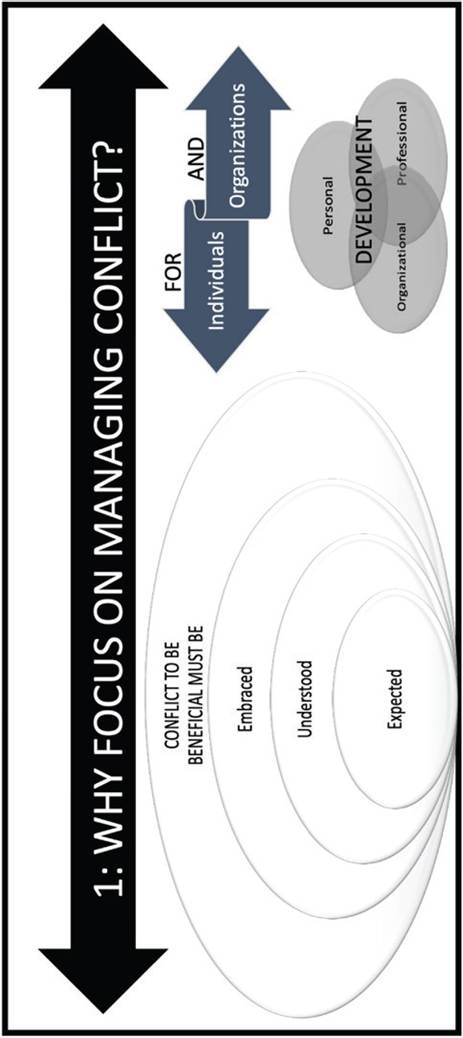
The key to managing conflict is to expect, understand, and embrace conflict in a manner that allows it to be beneficial to individuals and the organization. The alternative to well managed conflict is not the absence of conflict, but typically the costly loss of talented members of an organization or campus community, an unhealthy campus climate, or even formal grievance or unresolved issues leading to lawsuits. In this book, we provide approaches for one of the most recognized and useful alternative methods of managing conflicts—mediation. Further, we share important communication tools for addressing conflict and the value of using dialogue to address social and cultural differences. We challenge readers to reflect upon personal biases and beliefs that may negatively impact conflict and the mediation process. In Chapter 2, we consider the realities about conflict and what is known about conflict. We discuss the perception most people have, which is that conflict is bad and something to be avoided and challenge the reader to reflect on the positive aspects of conflict. Further, we discuss how prevalent and frequent conflict is, and the potentially destructive and catastrophic consequences of escalating unmanaged conflict. Finally, we share information about conflict in relationship to an individual’s and an organization’s overall health and stress.
References
Adams, M., Bell, L. A., & Griffin, P. (Eds.). (2007). Teachingfordiversity and social justice. Abington, England: Routledge.
Algert, N. E., & Froyd, J. (2002). Understanding conflict and conflict management. The Foundation Coalition. Retrieved from https://drive.google.com/ file/d/11eWkcHks_RKAUVSn5sNiMc9W9TpPXOs6/view
Algert, N. E., & Watson, K. (2005, April). Systemic change in engineering education: The role of effective change agents for women in engineering. Proceedings: Women in Engineering Advocates Network (WEPAN)/National Association of Minority Engineering Professionals Advocates (NAMEPA), Las Vegas, Nevada.
Algert, N. E., & Watson, K. L. (2002). Conflict management: Introductions for individuals and organizations. Bryan, TX: Center for Change and Conflict Resolution.
Blake, R. R., & Mouton, J. S. (1975). An overview of the grid. Training and Development Journal, 29(5), 29-37.
Gelfand, M. J., Leslie, L. M., Keller, K., & de Dreu, C. (2012). Conflict cultures in organizations: How leaders shape conflict cultures and their organizational-level consequences. Journal of Applied Psychology, 97(6), 1131-1147. https://doi.org/10.1037/a0029993
Kolb, D. M., & Putnam, L. L. (1992). The multiple faces of conflict in organizations. Journal of Organizational Behavior, 13(3), 311-324.
Satir, V., & Banmen,J. (1991). The Satir model: Family therapy and beyond. Palo Alto, CA: Science & Behavior Books.
Satir, V., Banmen, J., Gerber, J., & Gomori, M. (1991). The Satir model. Mountain View, CA: Science & Behavior Books.
Senge, P. M. (1990). Thefifth discipline: The art and practice ofthe learning organization. New York, NY: Currency Doubleday.
Thomas, K. W., & Kilmann, R. H. (1974). Thomas-Kilmann conflict mode instrument. Mountain View, CA: Xicom.
Watson, N., & Watson, K. (2011). Conflict management: An introduction for individuals and organizations (2nd ed.). Bryan, TX: The Center for Change and Conflict Resolution.
Watson, N. T., Xie, L., & Etchells, M. J. (2018). Cultural impact on conflict management in higher education. International higher education. Charlotte, NC: Information Age.
Windle, R., & Warren, S. (2009). Communication skills. Retrieved from https:// www.cadreworks.org/resources/communication-skills
This page intentionally left blank.
More on the topic Why Focus on Managing Conflict?:
- Why Focus on Managing Conflict?
- Algert Nance, Rogers Kenita S.. Conflict Management and Dialogue in Higher Education. Information Age Publishing,2020. — 227 p., 2020
- Oetzel John, Ting-Toomey Stella. The SAGE Handbook of Conflict Communication: Integrating Theory, Research and Practice. SAGE Publications,2013. — 912 p., 2013
- Differences Due to Self-construal
- ASSESSING CONFLICT MANAGEMENT OUTCOMES
- Boundaries to Our Model of Strategic Conflict
- Focus on Microlevel Practices
- Narrative
- Conflict is ubiquitous in human affairs.
- References