Conflict and Relationship Stability
Many studies have found that the manner in which couples manage conflict affects relational quality and stability. This section reviews that research, emphasizing the work ofJohn Gottman.
Gottman’s work is emphasized because his is the most comprehensive in demonstrating how conflict tactics predict relational termination.Gottman's Cascade Model of Divorce
Gottman’s (1994) model delineates different processes that lead to satisfaction and stability, or dissatisfaction and instability. Gottman refers to his model as a “cascade model,“ where first one observes a “decline in marital satisfaction, which leads to consideration of separation or divorce, which leads to separation, which leads to divorce” (p. 88). Gottman’s model is presented in Figure 14.1. As the
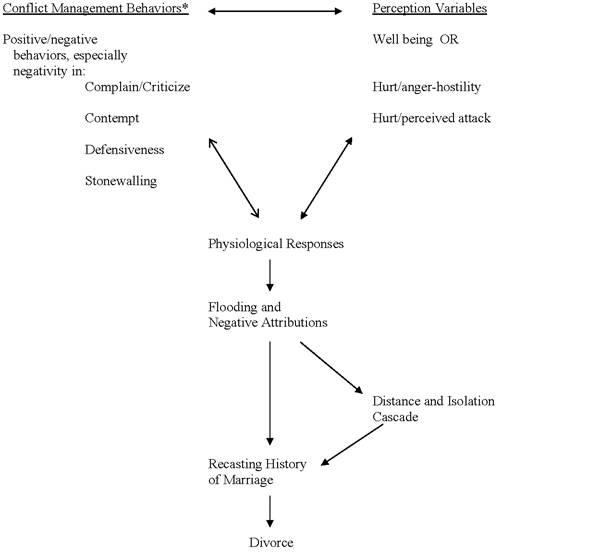
FIGURE 14.1 Gottman’s Model of Dissolution
Note: From Gottman, 1994, p. 370. *Gottman also references these as “Flow” variables.
reader will see, this model focuses on how partners communicate with each other during conflict—and the way they communicate sets the stage for marital bliss or marital hell.
The initiating factor in Gottman’s (1994) model concerns how married partners engage in positive or negative conflict strategies. The use of negative conflict tactics leads to initial reactions of feeling hurt and defensiveness or feeling hurt and angry. But the use ofpositive behaviors leads the partner to experience a sense of well-being, contentment, and safety.
According to Gottman, the ratio ofpositive/negative behaviors represents how the couple “balances” their relationship. Dissatisfied couples engage in a ratio of 1:1 positive-to-negative tactics. In laboratory studies, unstable and unhappy couples begin their problem-solving discussions using polite behavior, with 5:1 ratio of positive-to-negative tactics (the data actually show a 4.58 to 1 ratio; rather picky we know).
After only a few minutes, however, partners in very unhappy relationships revert to fewer positive messages and greater negativity. Then their messages stabilize at one positive message for every negative message. In this manner, unhappy couples “balance” (as Gottman labels this phenomenon) a negative message with a positive message. Dissatisfied partners cannot act as positively as they did at the start because they cannot re-invent themselves to create different characters that communicate with strategic conflict. In other words, couples’ conflict communication will largely remain the same across situations given the chance to argue.On the other hand, highly stable and satisfied couples engage in a ratio of almost 5:1 positive-to-negative messages. Accordingly, highly satisfied partners largely approach incompatibilities by counter-balancing negative messages with a preponderance of positive ones. Satisfied couples begin their problem-solving conversations in a polite manner and they continue to be positive throughout the discussion. In that way, satisfied couples maintain their balance.
We should note, however, that the comparisons of highly stable and satisfied couples to very unstable and dissatisfied couples represent drastic contrasts. In a paper that compared highly satisfied to moderately satisfied couples (with no couple scoring below the mid-point on a standard satisfaction measure [Norton, 1983]), Canary, Mikesell, and Gustafson (2003) found that highly satisfied couples had an average of 4.5:1 positive to negative conflict tactics, and moderately satisfied couples had an average of 3:1 positive to negative tactics. The impact is that the 5:1 ratio that Gottman (1994) reports does not represent a critical threshold at which positive versus negative messages makes a difference. Instead, positive- to-negative conflict tactic ratios are incremental—so infusing more positivity can improve conflict tactic impacts on relational quality.
Four conflict behaviors appear to be especially corrosive to marital stability and quality.
Gottman calls these the “Four Horsemen of the Apocalypse.” As with the four horsemen of the Apocalypse who announce the end of the world (Revelation), four behaviors announce the end of the marriage. And these behaviors occur in order: complaining/criticizing the partner is followed by contempt, which is followed by defensiveness, which is followed by stonewalling (Gottman, 1994, p. 415). Stonewalling—or refusing to talk—is particularly corrosive as it signals one’s complete disinterest in resolving a conflict or interacting with your partner.However, Gottman, Coan, Carrere, and Swanson (1998) replicated some elements of Gottman’s (1994) “Horsemen.” Gottman et al. (1998) revised their “horsemen” to defensiveness, contempt, and belligerence, as well and milder forms of negativity, which among only wives predicted separation and divorce. Contrary to Gottman’s and other research, reciprocity and complementarity were unrelated to relationship stability and satisfaction.
At this point, we wish to reflect the view (presented in Chapter 3) that the most recent literature on relationship quality often explores how conflict behaviors combine with some other form of positive interaction (e.g., sharing leisure time together). And we argued that relational maintenance behaviors—especially sharing time, positivity, and supportive messages—increase a nurturing relational environment that counteracts potential negative effects due to conflict. A nurturing relational environment must occur before the next stage of Gottman’s model, as it represents the point of no return.