Law-Based CMS
Law-based CMS take a fundamentally adversarial approach to rights-based conflicts. Early law-based strategies originated in an era where unions took on a third-party role to remedy the power imbalance between workers and management (Bendersky, 2003).
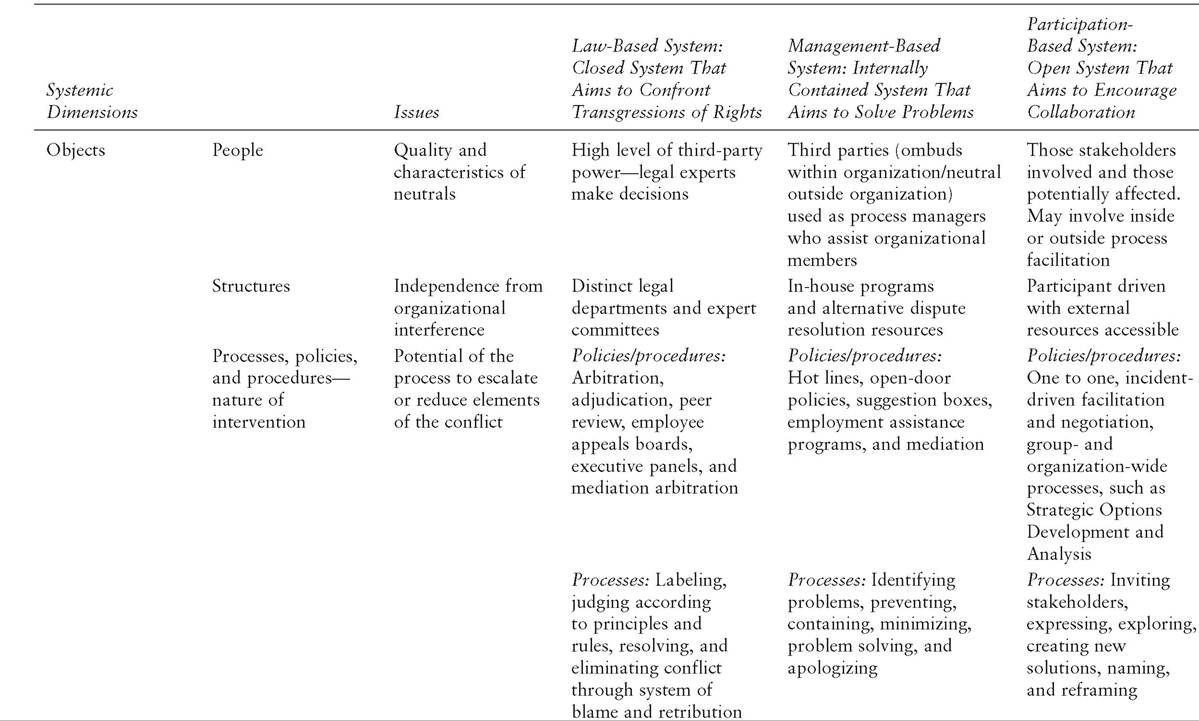
In the contemporary industrial relations environment, these strategies can ensure that organizations recognize and implement workplace rights. Bingham (2004a) noted that well- designed law-based CMS within the U.S. diamond and cotton industries have developed rules in an adaptive way. However, evidence also shows that third parties who are not organizationally neutral have co-opted these strategies and systems, threatening employee protections in nonunionized workplaces in the United States (Lipsky & Seeber, 2006) and in Australia (Van Gramberg, 2006). We examine why organizations can abuse law-based CMS processes and suggest three design areas that merit particular attention if law-based systems are to achieve their intended purpose.The first key process involves labeling an action or an omission as a transgression of rights, which gives rise to a specific and identifiable dispute. From this perspective, laws, principles, and the terms of employment contracts specify appropriate organizational behaviors. Only when policies or practices explicitly violate rights set out in relevant documents (e.g., harassment, discrimination, or poor working conditions) are organizational members legitimized to take their “case” to the relevant conflict management body. Identifying rights becomes problematic when policy documents offer vague or inadequate guidelines. Clair’s (1993) analysis of institutional discourses of sexual harassment concluded that framing terms in a strategically ambiguous way discouraged victims from using policies.
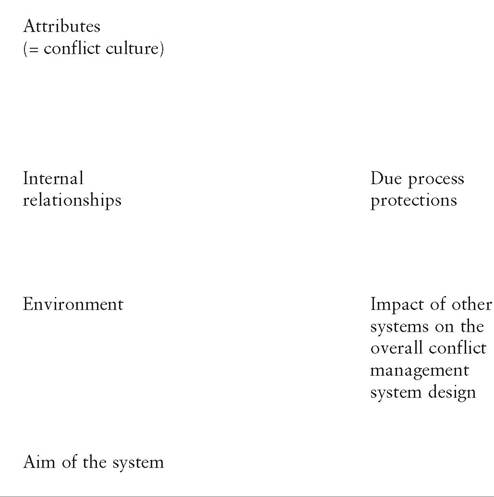
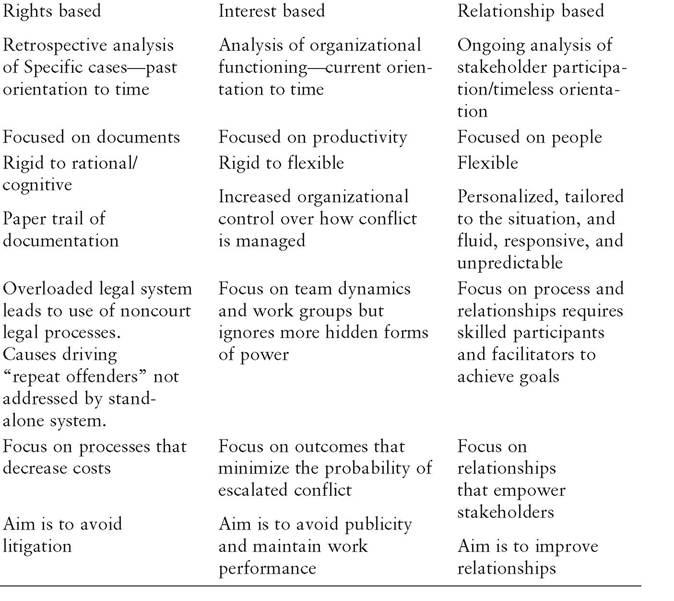
Table 17.1 Key Features of Law-Based, Management-Based, and Participation-Based Conflict Management Systems
Definitional issues are also significant in so-called ethical conflicts and when differences of opinions emerge among professionals who are experts in the field (Fox, Myers, & Pearlman, 2007).
Additionally, those called on to judge the facts of the case must delineate the object of their inquiry and, by doing so, create clear beginning and end points to the conflict. The frames that are imposed specify whether evidence will include immediate or longer-term effects, direct or indirect costs, or the impact of the conflict on financial viability, organizational image, staff morale, and future standards of ethical behavior (Nelson, Weeks, & Campfield, 2008).The second process requires an expert third party, rather than the stakeholders involved, to judge the facts of the case. Through law-based CMS strategies, such as arbitration, adjudication, peer review, employee appeals boards, executive panels, and mediation arbitration, third-party “neutrals” attempt to eliminate the conflict by assigning blame and responsibility to one of the parties and ensuring that the “loser” makes appropriate reparation to the wronged “winner.” Empirical evidence suggests that employees seldom win, either because third parties are not organizationally neutral (Meltzer, 1998), or because larger organizations benefit from the repeat player effect or learning by experience how to manage the system to best advantage (Bingham, 1997). In response to criticisms that law-based CMS strategies compromise procedural justice and fairness (e.g., Feuille & Chachere, 1995), the United States has implemented the Due Process Protocol to protect organizational members during arbitration of statutory disputes (Zack, 1999). Representatives from labor associations, arbitration providers, and civil liberties organizations signed the protocol, which provides guidelines about the right to representation, cost sharing, access to information, and the training and selection of arbitrators. Significantly, the parties did not reach an agreement about whether employers have the right to insist on mandatory arbitration as a precondition to employment (American Arbitration Association, 2006).
Irrespective of improvements in practice, CMS designers and users need to critically examine three guiding principles at the systemic level: (1) the assumption of rational decision making, (2) the exclusively retrospective focus, and (3) the confront/avoid dynamic inherent in law-based CMS design. First, the complexity of conflict situations suggests that the rigid application of rationally determined categories and procedures to evaluate and settle rights-based cases is insufficient or inappropriate. In many cases, outcomes and procedures do not fit a neat right-wrong binary, and multiple paths are possible. For this reason, Fox et al. (2007) pointed out that the conflicts within ethics committees are frequently resolved by voting rather than by applying standardized procedures. In contrast to legal proceedings, which are public documents, law-based strategies such as arbitration and mini trials that operate in parallel to the legal system are frequently private and confidential, creating an institutional conspiracy of silence (Conrad & Taylor, 1994). Organizational interests are cloaked by an external guise of rationality and due process. Chew (2011), for example, found that employees who experience racial harassment fare far worse in arbitration cases than in court proceedings.
Second, present conflict situations are analyzed solely from a retrospective analysis of facts in light of particular rules, policies, and procedures. In some settings, relying on experts to interpret how current cases fit organizational policies is particularly problematic. For example, the head of emergency medicine at Canada’s Queen Elizabeth II Health Sciences Centre pointed out that policies to resolve emergency room conflicts between doctors and patients’ families already exist but that “the process usually takes a few days and the necessary personnel aren’t available after hours” (Sibbald, 2001, p. 74). Critics have argued that lack of analysis of root causes underlying conflicts means that similar types of conflicts are likely to recur (Nelson et al., 2008) and “repeat offenders” are less likely to be identified.
More proactive approaches to conflict management are needed for systemic change of organizational processes.Third, although law-based CMS seem to foster confrontation about rights, organizations can also avoid challenges (van de Vliert, 1997) through strategic system design. When claims to rights threaten highly institutionalized policies and practices, more powerful parties may structure the CMS in such a way that the weaker party cannot initiate a case. In New Zealand, employer federations successfully lobbied the government to implement 90-day trial periods for new employees that deny them their right to file a personal grievance (Lansbury, Wailes, & Yazbeck, 2007). Bingham (2004a) pointed out that mandatory arbitration designed solely by one party can result in the deliberate creation of transaction costs that are so excessive that the other party decides not to pursue the claim. Some national sports organizations in Canada, for example, refer arbitration cases involving athletes to the independent Court of Arbitration for Sport, located not in Ottawa but in Lausanne, Switzerland (Haslip, 2001).