Lessons Learned and Challenges Remaining
As we look back at this three-decade project, we realize that we have learned a great deal about the discourse of conflict and transformation. From our case studies, we were able to uncover important dynamics of moral conflict.
This in turn enabled us to identify some of the factors that lead to frustration and a degraded discourse. We also found in those early case studies that civil discourse is possible in the face of moral conflict, and we learned some of the things that can make discourse more constructive and less destructive. Figure 22.1 outlines the lessons we have learned from our own work and that of others within this realm.Despite all of our work on moral conflict, we are less clear today about identifying any particular conflict strictly as “moral.” Although many public disagreements possess elements of moral clash, persistent conflicts can have other elements that propel them. Coleman (2003, 2011), for example, found more than 50 factors in the literature associated with intractable conflicts. In an impressive interview study of current practitioners, Coleman, Hacking, Stover, Fishker-Yoshida, and Howak (2008) reinforced the idea of complexity in intractable conflicts. They found many stakeholder, personal, political, and cultural constraints that can feed intractability. From our own
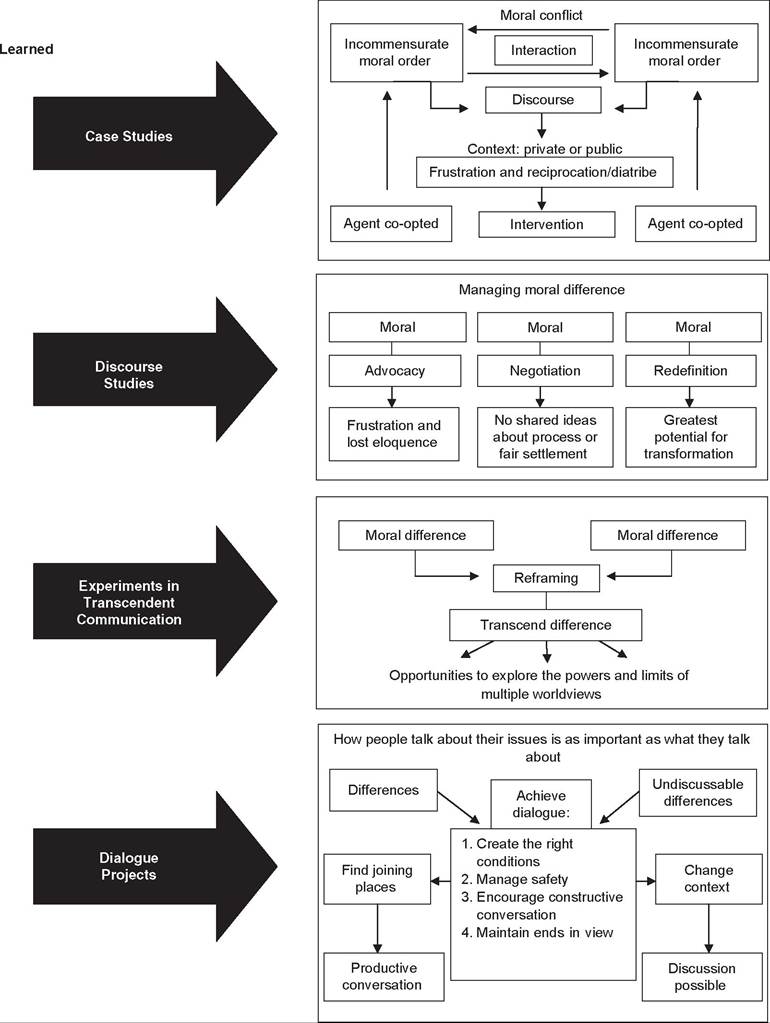
Figure 22.1
Lessons Learned
experience, three factors seem especially important, and these are (1) interests, (2) self-identification, and (3) power. In terms of the theory of CMM, when any of these three becomes a very high level of context for meaning and action—driving all other considerations—conflicts will become intractable.
We used to distinguish between a moral conflict and an interest-based conflict. We now believe that certain interests are so strong that they can lead to intractable conflicts with the same consequences, whether moral difference is there or not.
Here, the problem is not so much that the parties fail to find a common set of premises but that the struggle to prevail in order to meet desired goals has become so entrenched that a solution is all but impossible. The interest assumes tremendous logical force on meaning and action, it defines the self, and it defines the relationship. All actions are understood within the context of the interests, and one cannot imagine responding to one’s opponent outside of the struggle to prevail.Personal identity sometimes assumes the same status in a conflict. In working with many local groups and numerous conflicts over the years—both public and private—we have come to see the importance of self-identity in persistent conflicts. After a period of time in which the struggle has come to dominate the lives of the participants, they come to identify with the conflict itself. The self gets wrapped up in resistance—in being an opponent. Here, “self as combatant” becomes a very high level of context that drives his or her logic of meaning and action within the situation.
Finally, contemporary politics remind us how power can propel conflict. Power matters most, and both sides struggle to gain it, to maintain it, or to regain it. Substantive issues are understood through rules of meaning that define them in terms of power gained or power lost. Rules of action dictate responses aimed solely at gaining, maintaining, or regaining power, regardless of the issues or the stakes.
We do not think it matters much in our work whether conflicts are driven by moral difference or something else. Although we focused initially on moral conflict, we now know that good dialogue is a goal whenever difference becomes an obstacle. We are not optimistic about well-meaning mediators injecting preestablished processes into an ongoing conflict with the hope of transformation. Indeed, our experience leads me to the opposite conclusion, that uninvited outside intervention rarely works.
Coleman et al. (2008) concluded that the factors affecting intractability and readiness for new forms of discourse form a complex and durable system with a strong tendency for homeostasis. Indeed, attempts to achieve peace can simply lead to a rebound in which the system pulls itself back into alignment with continuing intractability.The community must be ready, and there must be a willingness of the parties to give dialogue a good-faith try. We believe that transformative discourse is most likely to succeed when you have the experience of mutual adversity (everyone is suffering), powerful models and leaders are behind the search for new forms of communication, lessons have been learned from previous failures to communicate, and community members have come to value their common humanity over their moral differences. All of this may be necessary to shift the system’s balance from one of conflict to one of peace, and as Coleman et al. (2008) remind us, this is not an easy task.
One of our most useful insights from system theory has been that processes cannot be imported from outside the system but must connect to the community. An intervention must first engage the system, meaning that it must connect with the ways of thinking and working and must engage the vocabulary of the community. This is why a local design team is critical in developing processes. Next, the intervention must challenge the system, not in a confrontational manner but by asking participants to think in new ways, to stretch their system in a direction that may permit transcendent discourse. This is reframing writ large. Finally, interventions can then, and only then, invite participants to imagine a future that works for everyone (Littlejohn & Domenici, 2001).
An Agenda