Role of Culture, Communication, and Conflict
Each person and group of people have their own social realities. There are different criteria to determine what constitutes importance, success, relevance, goodness, and so on. To live in the same environment, same social world, and have some semblance of order, we need to share these worlds or at least acknowledge and understand the differences in criteria that created them.
Not all of these social realities have the same principles and values; and to live in harmony, we need to have empathy, which is a human connection to understand why people do what they do even if we do not behave the same way or agree with their choices.Conflict may result when the real or perceived notion that another person or group of people is blocking us from being able to perform activities that we feel we need and deserve (Deutsch, 1973). The intercultural aspects of conflict are when the involved parties experience these differences and incompatibilities across cultures in that they represent different sets of cultural values and norms (Ting-Toomey & Oetzel, 2001).
Our experiences create our worldviews, and these socially constructed patterns are our unquestioned schemes of reference. There are different terms used to frame this concept. Vayrynen (2001) refers to these as our stocks of knowledge, and how we determine what is relevant to us and for us is based on these stocks of knowledge. Mezirow (2009) refers to this as frames of reference “which are structures of assumptions and expectations on which our thoughts, feelings, and habits are based” (p. 22). Our experiences guide how we act and react, so the more we know about ourselves and the outcomes we desire, the more mindful and deliberate we can be in our interactions with others. Every action, every message has a consequence. If we more consciously choose our communication to more directly correspond to the outcomes for which we strive, we can achieve more rewarding results.
Another component to this equation is to know and understand the other with whom we are engaged. It serves us well to be aware that we all have different stocks of knowledge and frames of reference, because we all have our own unique sets of experiences and influences that shape our worldviews. These experiences create filters from which new encounters pass through in the process of interpretation and meaning making, which is an iterative process. Figure 30.1 depicts this interaction which is embedded in the influence of culture.
We make meaning in our lives as a way to understand our worlds, and this takes place in the intersection of self, other, and context. As humans, we are constantly looking to understand our situations, perhaps stemming from an instinctive need to survive. Our points of view and understanding are shaped by and open to the cultural influences we have had or currently have, and this is why self, other, and context are embedded in culture.
Worldviews that have compatible definitions of relevance and sets of values result in more effective communication (Schutz, 1967, as cited in Vayrynen, 2001). Opposing or seemingly opposing sets of values and systems of relevance can result in conflict. This can also mean the way in which conflict is framed and the format of how it should be handled including c onflict scripts, which refer to who attends to the conflict, who speaks, the order and manner in which they speak, and other defining procedures (Ting-Toomey & Oetzel, 2001).
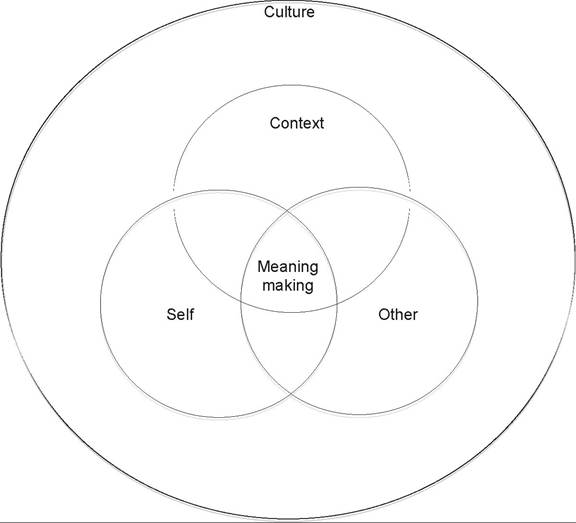
Figure 30.1 Intersection of Self, Other, and Context, Embedded in Culture in Meaning Making
In any conflict situation, there are sets of emotions that occur. Much of the emotional reactions we experience in these settings are not in our conscious minds, but we feel the impact of our emotions, and this brings them to consciousness. Damasio (1999) identifies two biological functions for emotions: One is to induce in us a reaction to a specific stimulus, such as running from danger; the second is to physically prepare our body to engage in this reaction, such as pumping more blood to our legs to enable us to run from danger. Siegel (2007) mentions that emotions can be defined as “a dynamic and central function that integrates behavior, meaning, thinking, perceiving, feeling, relating and remembering” (p.
211). Emotions have an impact on our communication from how we frame and express ourselves to how we interpret and understand others.In the conflict resolution literature, there is mention of people seeking to satisfy their needs, both tangible and psychological, and when these needs are not met, conflict may result. There are different ways of conceptualizing these needs and their origins. Some believe that needs are sociobiological and that they are universal and all humans have them (Burton, 1990, as cited in Vayrynen, 2001). Others contend that needs are not universal and that they are socially constructed (Vayrynen, 2001). There are implications with how needs are framed because that influences how they are understood and satisfied and how they relate to creating and resolving conflict.
For those holding the nontotalist view that needs are socially constructed, their actions to satisfy these needs will be in ways that are culturally sanctified and morally acceptable (Vayrynen, 2001). Others follow the belief that needs are universal, and all people have the same basic needs to fulfill regardless of cultural differences or considerations (Burton, 1990, as cited in Vayrynen, 2001). This framing is important to how we attempt to resolve conflict.
Goals are established directly relating to the types of needs being addressed. There is a focus on the content of the conflict when the substantive issues are of concern; on the relational aspects when concern is about the relationship; and on needs addressing issues of validation, rejection, and so on when identity is of concern (Ting-Toomey & Oetzel, 2001). In addition to cultures having an influence on the values, norms, and needs of the people of that culture, it also has an influence on how conflict resolution should be handled. Giving or saving face is a society’s way of showing respect and maintaining dignity. Ting-Toomey and Takai (2006) discuss Ting-Toomey’s conflict face negotiation theory and that there are different ways of addressing concerns of face depending on the orientation of face of the involved parties.
There can be self-face in which people try to protect their own image, other-face when people try to protect the image of the other party, and mutual-face in which both sides are concerned about protecting the image of the relationship.Concerns about face are built on a set of assumptions: all communication in one way or another addresses issues of face; identitybased conflicts are especially sensitive to face concerns; and that all of this is culturally influenced (Ting-Toomey & Takai, 2006). Identities are culturally and socially constructed, and conflict happens when aspects of our identity are denied, which could emerge when we are not in a shared reality with others.
Two cultural dimensions facework pays particular attention to are individualism/ collectivism and power distance continuums because these orientations influence the nature of the facework concerns and how they are addressed (Ting-Toomey & Takai, 2006). These dimensions can be thought of as running along a continuum with degrees of variation influenced by the context (Ting- Toomey, 2010). The flexibility the continuum provides without forcing absolutes, allows for more possibilities in understanding and resolving conflict across cultures. What we pay attention to is culturally induced. Interpretations differ because our own unique worldviews developed from our social worlds create filters from which we perceive, interpret, and make meaning of our experiences.
We pay attention to certain aspects of conversations and interactions, which may be culturally induced. This means that the focal points that are heightened for us, that may lead us to frame our understanding differently than another, could lead to conflict situations. The following section elaborates on how we frame communication.