The Relationship Between Family Conflict and Mental Health
Regardless of culture, numerous people suffer from depression, anxiety, substance abuse, and schizophrenia. While we do not know the exact causes for many mental disorders, we do know that certain factors play a role in all health—both mental and physical.
These factors typically do not operate in isolation. Rather, causes of disorders usually result from an interaction between one’s biological, psychological, and social/cultural functioning (U.S. DHHS, 2001).Family is of fundamental importance to the social development and future adjustment of children (Schrodt & Ledbetter, 2007). Family influences are greatest on individual behaviors when it comes to communication behaviors (Koerner, this volume; Koerner & Fitzpatrick, 2002b). Seminal work from the late 1970s put forth the notion that mental health and illness comes from a Biopsychosocial Model of Disease (BMD; Engel, 1977), which posits that mental illness is the result of contributing factors such as genes, parenting, culture, and stressful events as opposed to any one individual factor (i.e., biological factor). Familial communication patterns, level of conflict, stressful events such as marital discord, familial violence, and antagonistic divorce are well established environmental factors in the development of mental health issues in youth and teenagers (Gavazzi, 2006; Kazdin, 1995). Importantly, Kendler, Aggen, Prescott, Jacobsen, and Neale (2004) reported on additional studies that, in fact, have observed numerous aspects of the family environment that actually modify the effects of genetics in many mental health outcomes, including alcoholism, schizophrenia, conduct disorder, and antisocial personality disorder. At the same time, when family members have mental health issues, these issues often create conflicts about the illness, how to treat it, the effects on the family, and other related topics.
The BMD is a well-founded and recognized framework used to understand and conceptualize the complexities of mental health. Because there is no one reason or explanation for the onset of mental illness, I use the BMD to illustrate the connections of substance abuse, depression, and family communication patterns that contribute to poor mental health outcomes. Figure 9.1 illustrates the (noncausal) relationship among family conflict, mental health, and substance abuse as consistent with the BMD. The figure demonstrates an overlap among all of these constructs in that the presence of serious family conflict co-occurs with depression and substance abuse in a number of individuals. However, the model also illustrates that there are unique experiences to each construct. For example, presence of serious family conflict does not always co-occur with depression or substance abuse even though it can be a contributing factor for some individuals. This literature review explores the research that explains the connections among the constructs. The next section discusses the alarming evidence of how family conflict, parenting, violence, and poor patterns of attachment lead to poor mental health and substance abuse and dependence outcomes. It begins with a discussion of family conflict and communication.
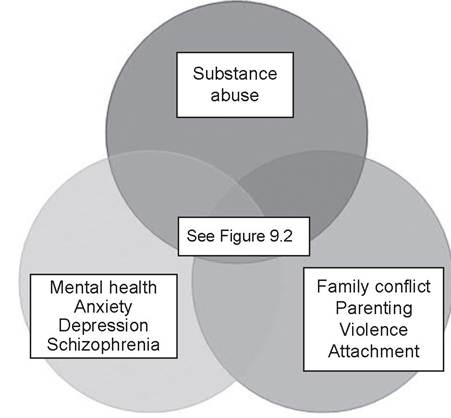
Figure 9.1 Intersection of Mental Health, Substance Abuse, and Family Conflict