What Causes Particular Strategy Patterns to Dominate Negotiations?
In addition to trust, negotiators’ social motives appear to affect their predispositions to use integrative versus distributive negotiation strategy (De Dreu, Weingart, & Kwon, 2000; Deutsch, 1973) and to adjust their strategy to the social motive and strategy of the counterpart (Weingart et al., 2007).
Social motives reflect the relative importance people place on their own versus joint outcomes in social interaction. People primarily concerned about their own outcomes are individualists, whereas those concerned both with their own and the other party’s outcomes are cooperators (Messick & McClintock, 1968). Given that cooperatively motivated negotiators attempt to maximize joint gain, while individualisti- cally motivated negotiators attempt to maximize their own gain, it is not surprising that two cooperative negotiators tend to rely on integrative strategies, while two individualistic negotiators tend to rely on distributive strategies (see De Dreu et al., 2000, for a metaanalysis supporting this conclusion).Dyads with heterogeneous social motives use an entirely different set of negotiation strategies. Theory and evidence from the experimental game literature suggests that cooperatively motivated players are likely to shift from cooperation to competition (defection) when confronted with an opponent making individualistic choices. In comparison, individualistic players are less likely to shift from competition to cooperation when confronted with a cooperative opponent (Kelley & Stahelski, 1970a, 1970b; McClintock & Liebrand, 1988; Schlenker & Goldman, 1978). However, research on heterogeneous social motive dyads in integrative negotiations does not identify a consistent pattern of negotiation strategy (Olekalns & Smith, 1999, 2003; Schei & Rognes, 2003, 2005; Ten Velden, Beersma, & De Dreu, 2007).
In some studies, it is the cooperator who changes strategy, while in others, it is the individualist or both (see discussion in Weingart et al., 2007).Research on multiparty negotiations with heterogeneous social motives indicates that context matters. Cooperators report using distributive strategy less in groups dominated by cooperators than they do when groups are dominated by individualists (Schei, 2004). Weingart et al. (2007) found that cooperators reduced their use of integrative strategy and increased their use of distributive strategy in groups dominated by individualists, but individualists did not make similar, strategic adjustments in groups dominated by cooperators. Further analyses of strategy sequences showed that cooperators were more responsive than individualists to protect themselves, much like the cooperators in the experimental game studies. However, cooperators also used integrative moves strategically to redirect their groups toward cooperation (Weingart et al., 2007). The authors argued that these results contradicted the stereotype of cooperators as “suckers.” Instead, cooperators intentionally and strategically used distributive and integrative behaviors to counterbalance their group’s dominant strategy and maximize its outcomes. Therefore, it appears that negotiators’ predispositions toward goals and trust can shape their strategies. However, strategies are not just static, predetermined attributes of negotiators and features of negotiation situations, but dynamic and evolving.
In sum, the deployment of negotiation strategy is a dynamic process that involves blending of distributive and integrative sequences and phases across different stages of the negotiation. Negotiators’ predispositions concerning goals and trust affect but do not fully determine negotiators’ use of strategy. Strategy shifts dynamically as negotiators reinforce, complement, or transition away from the strategic direction signaled by their counterpart’s most recent behavior, or necessitated by unexpected external events.
Reconciling the Gaps in the Negotiation Strategy Literature: Opportunities for Research
Considered separately, each lens of the negotiation strategy literature provides a coherent account. However, as we pointed out while moving from one lens to another, these four research streams do not tell a completely consistent story when considered together. We identify three inconsistencies among the lenses and discuss them below. Given the broad, birds-eye view required to identify these inconsistencies, we regard them as opportunities for future research, as opposed to critiques of prior research. Table 11.3 summarizes the gaps and inconsistencies among the lenses.
The first inconsistency arises when contrasting the outcome and process lenses against the cultural lens. The outcome and process literatures identified Q&A behaviors as integrative strategy and S&O behaviors as distributive strategy because negotiators using the former could typically realize higher joint gains than negotiators using the latter. However, the cultural lens clearly shows that S&O is not necessarily distributive when used by negotiators from high-context cultures. Thus, a direct and unambiguous mapping of Q&A and S&O negotiation behaviors onto integrative and distributive strategies is not possible.
Table 11.3 Inconsistencies Among the Lenses of Negotiation Research
| Lenses | Inconsistencies |
| Outcome versus process and culture | The outcome literature assumes that integrative and distributive strategies lead to integrative and distributive outcomes, respectively. However, the process and culture literatures suggest that the intentions underlying strategies need not correspond to the outcomes that negotiators attain. Thus, the outcome lens rather confounds the intention underlying the negotiation behavior with the outcome of that behavior. |
| Outcome and process versus culture | The outcome and process lenses identified Q&A behaviors as integrative strategy and S&O behaviors as distributive strategy. Yet the cultural lens shows that S&O does not necessarily lead to distributive outcomes when used by negotiators from high-context cultures. |
| Time versus process and outcome | Negotiation strategy is more complex according to the time lens than the way it is represented by the process and outcome lenses. The time lens illustrates the dynamic interplay between negotiators’ use of strategy over time. In contrast, the process and outcome lenses tend to focus on the strategy that dominates the negotiations overall. In sum, the time lens shows that negotiators switch strategies on and off throughout a negotiation rather than maintain a constant use of a single strategy. |
NOTE: Q&A = questions and answers; S&O = substantiation and offers.
This conclusion highlights another inconsistency (pitting the outcome lens against the other lenses): Strategic behavior is, by definition, goal-directed behavior. However, labeling negotiation strategy as integrative and distributive confounds the intention with the outcome. For example, integrative outcomes do not necessarily reflect intentionally integrative behavior. Conversely, explicit or implicit intentions to be integrative may not produce integrative outcomes (e.g., if the other negotiator fails to reciprocate). The same is true of distributive behaviors and outcomes. For example, negotiators may use behaviors that research would label “integrative” (e.g., questions) to achieve an information advantage leading to distributive outcomes. Finally, the negotiation dynamics literature revealed that a cooperatively oriented negotiator may still resort to S&O when the counterpart does. Hence equating intentions and outcomes, as the terms integrative strategy and distributive strategy do, oversimplifies what we know about negotiation strategy.
A third inconsistency stems from the very nature of the negotiation dynamics literature, which suggests that negotiation strategy is significantly more complex than the integrative versus distributive stance of one side.
The alternative views, which we have reviewed, suggest that negotiation behavior is determined by static factors that influence the individual negotiators—like the situation, negotiators’ strategic orientations, cultures, or individual differences. However, the dynamics literature suggests that the behaviors of the other party or parties at the table are at least as important. Thus, the dynamics literature points toward a dyadic- or group-level conceptualization of strategy.The negotiation dynamics literature also, obviously, points toward the importance of time and change. Negotiators can and do switch off strategies to further their interests as negotiations develop. The phase and stage research shows this decisively: Negotiators move from what has previously been called distributive strategy to integrative strategy and back again. Thus, they build toward integrative agreement in rather elegant waves, incorporating more and more information about differing interests into multi-issue offers. Alternatively, they spiral toward a distributive contest or impasse in waves foaming over with positions, offers, and substantiation.
These inconsistencies among the negotiation strategy lenses lead us to four theoretical conclusions. First, negotiation strategy is both predetermined (by cultural and individual differences) and emergent from the strategic choices that negotiators make. Second, negotiation outcomes are the end result of an intricate and dynamic interplay between negotiators’ goal-directed behaviors. Third, the frequency and sequence of these behaviors depend to some extent on culture, negotiation context, negotiators’ social orientations, and counterparties’ moves. Finally, future research on negotiation strategy should define terms and operationalize concepts in behavioral terms—what the negotiators are doing—as opposed to what they intend. Negotiators’ use of strategy is certainly goal directed, but as we saw in the culture section, equating the intention with the outcome can be misleading.
It is for this reason that we encourage future researchers to label behaviors as behaviors (e.g., Q&A or S&O), as opposed to “distributive” or “integrative.”Conclusion and Opportunities for Studying Negotiation Strategy
In this chapter, we reviewed negotiation strategy research through four lenses: (1) outcome, (2) process, (3) culture, and (4) time. We have presented the lenses historically, discussing them in the approximate order that they emerged from the literature. We opened by explaining the importance of joint gains and defining negotiation strategy. We then reviewed the theoretical origins of negotiation strategy research and described the two overarching strategies—distributive and integrative—identified by those looking at strategy through an outcome lens. Next, we summarized the behavioral studies using a process lens and described the resulting model that links negotiation strategy to insight and joint gains. We then identified the implications of culturally based communication style and trust for negotiation strategy. We showed that Q&A and S&O serve different strategic functions in negotiations with the potential for joint gains, and, at least for S&O, that this function seems to depend on culture. We then reviewed research that has examined negotiation strategy dynamically, showing how and why negotiation strategy develops through time. Finally, we identified and suggested ways to reconcile some inconsistencies that appear across the four lenses.
Although we have presented the lenses historically, as they emerged from the literature, it is also possible to present them causally. As a means of synthesizing and summarizing the content of this chapter, Figure 11.2 does just that. As shown, negotiators’ cultural experience predates any particular negotiation that they enter into;
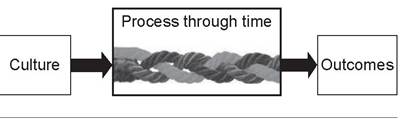
Figure 11.2
A Causal Model of the Four
Negotiation Lenses
thus, culture causally precedes the use of negotiation strategy (i.e., the process lens). Within a particular negotiation, culture can be conceptualized as one factor influencing the strategies that play out through time. To capture the dynamic and sequential nature of negotiation strategy, described under the time lens, we have portrayed these strategies as a rope. Each strand of the rope represents a different strategy. Over the course of a negotiation, each strand comes to dominate at various points in time (i.e., appears “on top” of the others). The strategies that unfold during a negotiation naturally affect the negotiation’s outcomes. Thus, outcomes form the final link in the causal chain in Figure 11.2. In sum, through a circuitous historical path, the negotiation literature has afforded a rather comprehensive view of the causal relationships between culture, negotiation strategy, time, and outcomes.
Although our review has been theoretically focused, negotiation theory has natural implications for practicing negotiators. Based on the research reviewed in this chapter, we draw several implications for the practice of negotiations. Table 11.4 organizes these implications according to the four negotiation research lenses.
Despite the growing body of research on negotiation strategy and outcomes, many important questions remain to be studied. For example, we identified substantial inconsistencies when looking at negotiation strategy using the outcome, process, culture, and time lenses. While we suggested a theoretical integration to address these inconsistencies, our suggestions are but a small subset of the many avenues that researchers might follow to reconcile them. Overall, we believe that the greatest opportunity for future research lies in studies that integrate across the four lenses, helping to create and define the lenses of the future.
Table 11.4 Implications of Research for Becoming a Better Global Negotiator
Outcome • Approach negotiations knowing that opportunities for integrative as well as distributive outcomes will generally arise.
• Remember that giving counterparts more of what they want does not necessarily mean that you will get less of what you want.
• Negotiations often present opportunities to create value by trading off low-priority issues for high-priority issues or by understanding both parties’ interests and creatively bridging differences.
Process • Practice using both Q&A and S&O and know when to use them.
• At least in a Western cultural context
• Use the Q&A strategy to create value by generating and integrating information about underlying interests and priorities.
• Use the S&O strategy to claim value and defend against competitive negotiators.
Culture • Recognize that negotiators in some cultures are more comfortable using Q&A, and negotiators in other cultures are more comfortable using S&O. This difference appears to be related to the level of trust in a culture. Educate yourself about negotiators’ likely trust levels in your own and your counterpart’s cultures.
• Understand how to
• Infer information about interests and priorities from patterns of offers and substantiation, as high-context culture negotiators do.
• Infer information about interests and priorities from patterns of questions and answers, as low-context culture negotiators do.
• If negotiating in high-context/low-interpersonal trust cultures
• Use the Q&A strategy more sparingly than in a low-context/high-trust culture.
• Use the S&O strategy both to create value and to claim value and defend against competitive negotiators.
• Realize that in some cultures, good economic outcomes are expected to follow from relationship building, not precede it.
Time • Accept that negotiations naturally cycle through stages as negotiators work toward
agreement or impasse. Know where you are in the cycle, and deploy strategy accordingly.
• Know that, although negotiation dynamics and cycles vary across cultures, most negotiators start by stating and justifying positions.
• Know that, despite this tendency to focus on positions, generating an outcome that creates value requires that negotiators begin to share information in a culturally normative way early in the negotiation.
NOTE: Q&A = questions and answers; S&O = substantiation and offers.
Notes
1. Of ourse, not all value can or should be quantified. For a review of subjective value in negotiations see Curhan, Elfenbein, and Xu (2006).
2. Note that some negotiators reach joint gains inadvertently out of random trial and error. We do not consider such outcome a result of a strategy.
3. For an insightful retrospective on the theory, see McKersie and Walton (1992).
4. For a discussion on satisficing, see the work of Simon (1957, 1978).
5. See Cartoon negotiation simulation at DRRC’s website: http ://www.kellogg.northwestern. edu/drrc/teaching/index.htm
6. “American” refers to U.S. nationals.
7. For a discussion of the anchoring effect, see Ku, Galinsky, and Murnighan (2006) and Galinsky, Ku, and Mussweiler (2009).
8. See the papers in the symposium presented at the MICON conference in 2009: http://www.cs.cmu.edu/~softagents/papers/ IJCAI-09-MICON-Proceedings-final.pdf
9. Note that there are some differences between deal making and dispute resolution negotiations (e.g., linked versus independent BATNAS, a priori and true versus a posteriori and possibly faked negative emotions, negotiating to minimize costs versus maximize gains; Brett, 2007).