What is Culture's Relationship to Global Workplace Conflict?
But what do scholars mean by culture and cultural variability, and how are these related to macrolevel issues? By 1950, Kluckhohn (1951) had already collected more than 300 definitions of culture, ranging from “the total way of life,” to a cognitive map.
Today, most scholars agree that culture embodies the societal patterns of beliefs, values, and practices that distinguish one group from another.Without question, the most dominant approach to organizational and national culture research has been that of Geert Hofstede. Culture, he argues, is “the collective programming of the mind that distinguishes one group or category of people from another” (Hofstede, 1984, p. 89). Hofstede stresses shared cultural values as key differentiators among national groups, a view that is largely echoed by proponents of another popular approach—Global Leadership and Organizational Behavior Effectiveness (GLOBE). According to House and his GLOBE colleagues, culture consists of shared motives, values, beliefs, identities, and interpretations or meanings of significant events that result from common experiences of members of collectives that are transmitted across generations (House, Hanges, Javidan, Dorfman, & Gupta, 2004, p. 15). Typically, nation-state is used as a proxy for culture, although national variation exists across geographic regions.
Cultural variability affects organizational conflict through multilevel mechanisms, including (a) differential political/legal prescriptions and prohibitions, legal requirements, and regulations; (b) variable constraints and opportunities of the institutional environment;
(c) diverse preferences (values) and premises about what organizations can and should be;
(d) unique rites, rituals, and other communicative practices; (e) varying ways in which individuals perform their roles and relate to one another; (f) different mind-sets of occupational communities; (g) various approaches to problem solving; and (h) multiple instantiations of spatio/temporal boundaries.
The effects of cultural differences in the global workplace are far ranging. Studies that utilize experimental designs (Weber & Camerer, 2003), survey methodologies (Ardichvili & Kuchinke, 2002), comparative case studies (Winkler, Dibbern, & Heinzl, 2008), and ethnographies (Moore, 2011) all find that conflict is manifest in emotional stress, behavioral disruptions, negative attitudes, and task interference. For example, Moore’s (2011) ethnographic study of a car assembly work group in a joint venture between German car manufacturer BMW and the British Morris Mini found that culturally divergent interpretations of specific tasks influenced processes of integration and the ability to work together. Importantly, Moore’s “holistic ethnography” did not isolate any particular cultural trait. Rather, Moore argued that national culture was less relevant as the embodiment of any specific inherent traits, but its importance was “as a set of ‘native categories’ through which the problems and successes of the integration were filtered and understood, and which colored the interactions of the two national groups of managers with each other” (p. 667). The Moore study stands out as an important contrast to more traditional studies of cultural differences in which researchers utilize “classic” dimensions of cultural differences to illustrate how variations may cause conflict. For example, a study by Hofstede, Pedersen, and Hofstede (2002) reports that members of low power distance cultures are often frustrated by the lack of participation by members of high power distance, and workers from collectivist cultures are often offended by the perceived selfishness and rudeness of those from individualist cultures.
Table 27.1 provides brief descriptions of the most commonly studied dimensions of cultural variability associated with conflict in the global workplace. A comprehensive review of leading management journals (Tsui, Nifadkar, & Ou, 2007) found Hofstede’s power distance and individualism collectivism dimensions to be the most commonly studied.
Given that issues of control, leadership, and group identity are central to virtually all theories of organization, this is not surprising.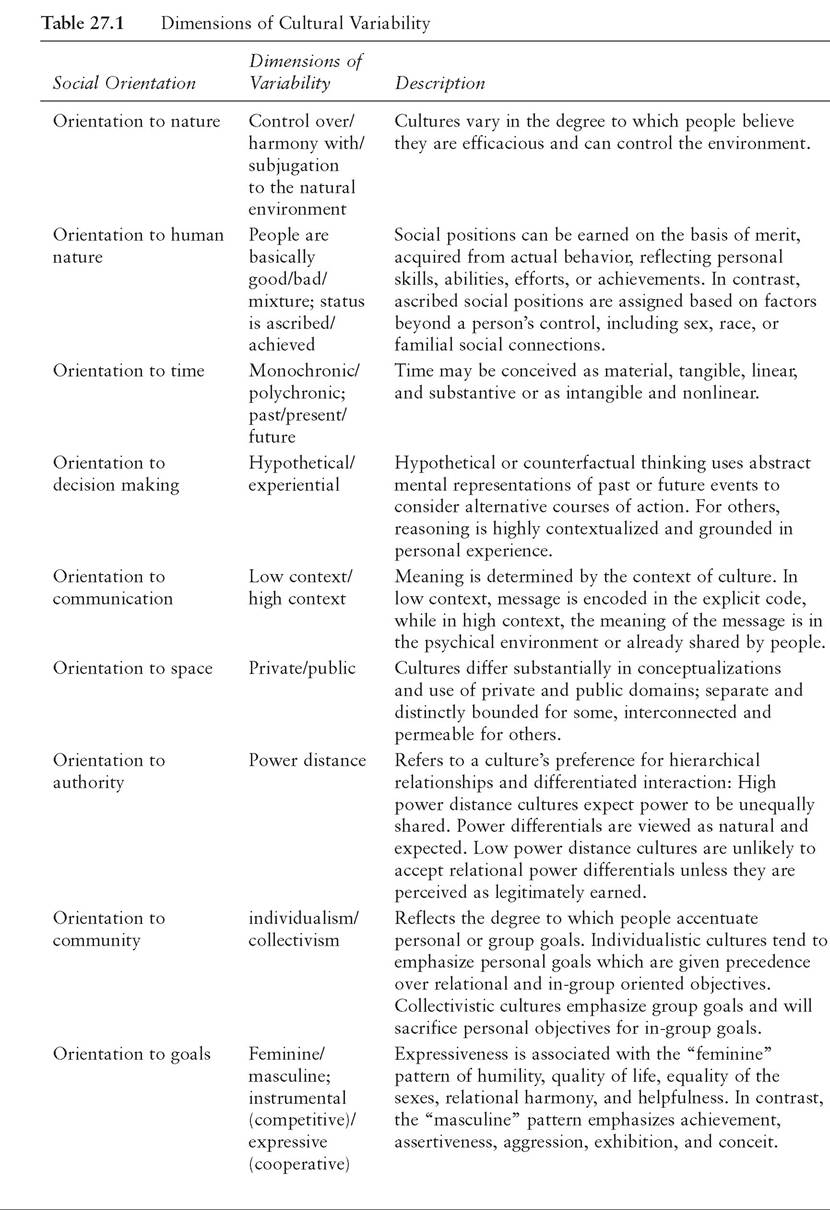
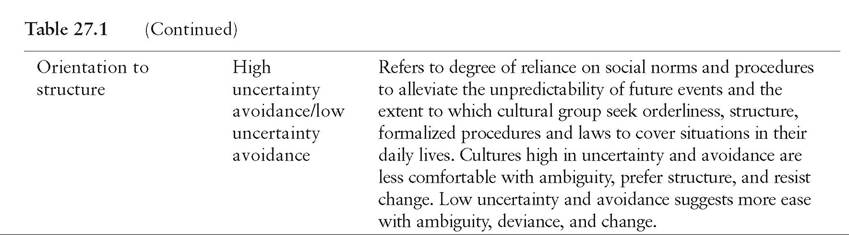
NOTE: This list was derived from the excellent overviews of the cultural constructs and conflict examined in cross-cultural organizational behavior research (see Gelfand, Erez, & Aycan, 2007; Leung, Bhagat, Buchan, Erez, & Gibson, 2005; and frameworks by authors such as Earley, Singelis, Triandis, House, Hall, Schwartz, and others [Hall, 1976; House et al., 2004; Schwartz, 1994; Singelis & Brown, 1995; Triandis, 1995]).
But other variables become especially important in the uncertain, rapidly changing global context. For example, orientation to structure captures the degree to which individuals and groups respond to ambiguous and unstructured contexts with a high level of stress and a need to adopt and maintain rigid rules and strict codes of behavior. When one of our authors worked with a global engineering team in a time of international economic crisis, the unpredictable situation was exacerbated by a conflict between engineers from high uncertainty avoidance cultures, who wanted to develop a rigid set of responses and rules to cope with the volatility, and those with lower levels of uncertainty avoidance, who felt that the team should “go with the flow” and enjoy the freedom that the crisis engendered. The former group thought the latter were being reckless, and the latter thought the former were far too timid to cope with the crisis.
But just looking at one cultural dimension individually does not give us the full picture. Gomes, Cohen, and Mellahi’s (2011) study of conflict between South African and Congolese managers illustrates the importance of considering both context and cultural variability for understanding conflict.
In a strategic alliance between Vodacom and Congolese Wireless Networks, the legacy of the apartheid era magnified cross-cultural differences as well as differential perceptions of procedural and interactional justice. The context also exacerbated interpersonal conflicts among the managers based on cultural differences (e.g., South Africans tend to be far more individualistic in their approach to task issues than natives of Central Africa). The case study shows how the effectiveness of structural actions taken to address conflicts rooted in procedural injustices (i.e., the creation of new management policies and procedures to reduce disparities between South African and Congolese managers in order to enable equal access to key managerial positions for all managers) was circumscribed “by the continued presence of perceived interactional injustice (the feeling of not being treated with respect and dignity during interactions with managers from the other partner in the alliance)” (Gomes et al., 2011, p. 5). Resolving the conflicts required multiple, iterative, and radical structural, personnel, and interactive changes that transcended traditional internal and microlevel solutions.Overall, globalization creates a work context in which social identities, normative expectations, and societal institutions must continually be negotiated as they can no longer remain spatially or communicatively distinct. Creating new opportunities and unheralded cooperation between different types of organizations and groups of people, also means greater potential for conflict.
In the remainder of this chapter, we see how bringing people with diverse cultural experiences together in face-to-face and/or cyber settings to solve problems, make decisions, and complete interdependent tasks often magnifies the importance of differences in laws, norms, personality, values, beliefs, attitudes, sense of responsibility, perceptions, and languages. We limit our focus to conflict in transnational teams and global alliances, two constitutive domains of the global workplace. Given the importance, however, of understanding the macrocontext for understanding microconflict dynamics, the next section further unpacks the context in which transnational teams and global alliances exist, a context of emergent paradox.