Criticizing Rawls II: Why maximin?
Rawls claims that his principles would be chosen in the bargaining game because the players will find that they are preferable to the various alternative theories of justice he considers, provided they apply the maximin criterion.
But there is no reason to suppose, as Rawls requires, that all reasonable people will adopt maximin as their rule in this game.Let me try to explain why. I said earlier, in 6.4, that there were reasons for choosing a maximin strategy in two-person zero-sum games. The basic reason was that in a zero-sum game you can assume that your opponent is out to get you; thus, you should act in such a way as to make you least vulnerable to your opponent's choices. But in non-zero-sum games, especially those involving more than one person, it is not at all clear why we should use the maximin rule. There is no reason to suppose your fellow players are out to get you, since
a) they are not envious, and
b) because the game is not constant-sum, getting you won't necessarily do them any good anyway.
Now, I also argued earlier that the idea of a constant-sum game couldn't be made to apply in cases where the payoffs are, as Rawls requires, in utilities. But the point remains that in the sort of bargaining game we are considering, there is generally no reason to think that you will prefer outcomes in which I have less utility to outcomes in which I have more.
Thus, suppose that we cannot make interpersonal comparisons of utility, so that we cannot compare Fay's utilities with Ray's. We can represent this state of affairs by using different units for each of us: call Fay's utilities f's and Ray's r's.
If we cannot make interpersonal comparisons of utility, we cannot say how many f's are worth one r. Fay and Ray might be involved in a situation where the payoffs are like this: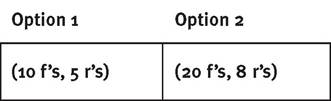
In this case, even though we cannot compare the utilities of the two players, we can see that Fay has no reason to think that Ray will prefer outcomes where she has less to outcomes where she has more. To put it another way, if we had any way of measuring how many units of Fay's utility were worth one unit of Ray's, whatever the ratio of f to r, this would not be a zero-sum game. It is hard to see why, in circumstances where this sort of noncompetitive outcome is possible, reasonable people should adopt the maximin rule. And if the people in the original position would not adopt the maximin rule, it is not at all obvious that they would prefer Rawls' principles to other ways of deciding whether a state is just; for example, utilitarianism. Self-interested people if they are applying maximin, will accept rules, such as Rawls' two principles, that protect the worst-off people, because they want to make sure that if they turn out to be the worst-off, their lives will be as good as they can be. But if they are not applying maximin—instead gambling, for example, that they will not be the worst off—they might very well opt for a system of social justice that is less concerned for the poorest. And unless Rawls can show that any reasonable person in the original position will adopt maximin principles, there is no reason to suppose that they will all agree on his two principles.
There is, indeed, a reason for thinking that reasonable people in the original position might well do a different sort of calculation, a reason why someone might indeed be willing to gamble on an outcome different from Rawls'.
In the original position, you are provided with a very great deal of general knowledge about people, so that though you do not know how any particular person will act— because you are ignorant of everybody's goals and relative posi- tions—you can make statistical predictions about the sorts of ways in which people will behave.Suppose, in particular, your general knowledge told you that very few people would be really badly off if your society was run not according to Rawls' principles, but according to the utilitarian principle that we should maximize average utility. (To do this, we should have to continue to assume, with Rawls, that interpersonal comparisons of utility were possible.) And suppose it also told you that if you adopted Rawls' principles, the worst-off would be better off, but everybody else would be worse off. Why should a self-interested person who knows this seek to protect the interests of the worst-off when he or she is very unlikely to be one of them? To adopt maximin in this case would be to assign a very great deal of weight to an extremely unlikely outcome.
To make this question vivid, suppose, that one of the rules being considered in the original position would set up a compulsory lottery that made a few people who had the bad luck to get the wrong ticket into slaves who had to do some nasty but necessary jobs. Suppose, too, that the economists told us that this would produce a massive increase in the goods available to everybody else, and nobody would volunteer to do these jobs for the sorts of pay that our society could afford. If there were enough people, the chances of any particular person getting caught by the lottery could be very small indeed, and everyone might accept the lottery. (Rational people often take small risks for large benefits; nobody would think it irrational to take the small risk of dying in a car accident to drive to fetch a million-dollar lottery prize.) Since no moral considerations prohibit the players in the original position from adopting this rule—and remember, the only requirement on them is that they mustn't be envious—there would, apparently, be no reason in these circumstances for Rawls to reject this option.
The general point is this: maximin may save you from the worst that can happen, but—especially in conditions of scarcity—it may also reduce your chances for a really worthwhile life once the veil of ignorance is lifted.
6.9