International Trade and Consumer Theory
Haberler's course was important for Samuelson for it provided problems to which he could apply the economic theory and the mathematics he was learning elsewhere. In particular, he was making connections between the mathematical economic theory he had learned from Wilson and problems that were raised by material he covered with Haberler.
Early in 1937, he wrote a paper on one of the topics covered in Haberler's international trade course— the transfer problem, or the problem of how a payment from one country to another gets translated into flows of goods and services; the topical example of this was the reparations imposed on Germany after the First World War. Entitled “The Effects of a Unilateral Payment on the Terms of International Trade,” it was completed in April 1937.The classical theory, represented by Harvard's Frank Taussig, held that balance of payments adjustments came about through price changes. This was an important problem, and in the early 1920s, several of his students, including two of Samuelson's teachers, Jacob Viner and John Williams, had written dissertations on how such adjustments had taken place under the nineteenth-century gold standard. According to the quantity theory, under
which prices depend on the quantity of money in circulation, a transfer of money from one country (call it Germany) to another (call it France) would lower German prices and raise French prices. This would have two effects. The first is that these price changes would worsen the terms of trade, for Germany would have to export more goods to pay for the same quantity of imports. The second effect is that, because German goods would now be cheaper—more competitive—German exports should rise and imports fall. The size of these changes would depend on elasticities of demand—on the responsiveness of exports and imports to changes in relative prices.
This was crucial because, as Keynes had argued in his highly influential book The Economic Consequences of the Peace (1919), if elasticities of demand were low (as he believed they were), Germany would be unable to generate the export surplus it needed to reduce its foreign debts. This was a major reason for his argument that the Versailles settlement was unworkable: Germany could not pay, even if it wanted to. Bertil Ohlin challenged Keynes, arguing that this analysis neglected something important: demand for imports depended not only on prices but also on income: the transfer payment would reduce German income and raise French income.40 Thus, even if elasticities of demand were zero, Ohlin claimed, German imports would fall and French imports would rise, producing the necessary adjustment.In his paper, Samuelson challenged the claim that such income effects undermined the traditional (classical or neoclassical) theory of trade.41 He aimed to show that even if economists had reached incorrect conclusions, this did not show that the theory itself was faulty: the conclusions were incorrect because theorists had been insufficiently rigorous in their reasoning. To provide the rigor necessary to settle the dispute, it was necessary to turn to algebra, because the complexity of the problem meant that “intuition fails, as do the usual graphical devices.”42 He solved the problem by seeing the similarity with the problem of barter between two individuals that he had encountered in Bowley's Mathematical Groundwork of Economics (1924), the textbook used by Wilson. Samuelson simplified the problem by assuming that there were two countries, each producing a fixed quantity of a single good (say, tea and coffee), which they then traded—assumptions that would have made sense to any trade theorist. He set the price of one good (say, coffee) equal to ι, so that the only remaining price measured the price of tea in terms of coffee. Assuming that the proportions of tea and coffee consumed in the two countries depended on this price, he was able to show that the five variables in his model (consumption of tea and coffee in each country, and the price of tea) would all depend on the transfer being made from one country to the other.
Using differential calculus, “elementary theorems on linear equations,” and assumptions about consumer preferences, he was able to show that the effect of a change in transfer payments would depend on how consumption of tea and coffee responded to changes in income in each of the two countries—something on which economic theory had nothing to say. Thus, although he believed the conventional theory associated with Taussig and Viner was right, critics such as Ohlin were right to claim that adjustment to a transfer payment could take place even without any change in the terms of trade.r
Samuelson submitted the paper to Chicago's Journal of Political Economy, edited by Viner. It would appear that Viner was the paper's first reader and that Samuelson did not get it checked by his Harvard teachers first.43 Perhaps he thought that Wilson, who would understand the mathematics, would not understand the trade theory, and that Haberler would not appreciate the mathematics or the use of indifference curves. Leontief would, however, have been an ideal reader, but there is no evidence that he saw it at this stage. Samuelson's sending the paper to Viner presumably indicates his selfconfidence. However, Viner rejected the paper on the grounds that “no one would today seriously dispute the conclusions you draw, given your assumptions, and your article therefore does not really touch the issues which are still in controversy.”44 He did not consider Samuelson's claim that, though Leontief had proved a similar result, he had not done so in the context of a barter economy, sufficient to justify publication. Samuelson needed to be much clearer about the mistakes he claimed to be correcting. However, Viner's reaction was not entirely negative, for he said that he would consider publication if Samuelson could, without “an excessively elaborate array of mathematical and graphical material,” prove that his results would hold even in the presence of domestic commodities (not entering into international trade) and where producers' and consumers' indifference curves do not have abnormal properties.
This unpublished paper shows the stage Samuelson had reached by the spring of 1937. He understood consumer theory well, and could apply it to the field of international trade. His problem was that, though he understood the transfer problem, he was not on top of the latest developments in the field. This is consistent with the complete absence of references (other than to Bowley) in the paper. Trade theorists such as Viner might not be studying the subject as rigorously as Samuelson thought they should be, but they attached
r. This account is a simplification in that it ignores the distinction between net and gross barter terms of trade, which Samuelson discussed in detail. importance to issues that Samuelson had brushed aside when he simplified the problem so that he could solve it rigorously.
Samuelson’s method in this paper was to take a literature that he believed was confused and apply to it mathematical techniques, including the linear algebra he had learned the previous summer in Wisconsin, that were not usually used. The topic he chose in this paper was one in which Harvard economists (Haberler, Leontief, Williams, and Taussig in retirement) were actively involved, and where his teachers were introducing him to the most advanced techniques being used. However, this advantage could not compensate for his not knowing the literature sufficiently well. Viner’s marginal notes on the paper show that he completely understood Samuelson’s mathematics, but despite understanding this, he was not persuaded that the paper was worth publishing.s Viner was also able to point out important limitations in Samuelson’s economic analysis. Samuelson explained that he was engaged in a comparison of two different systems, with different transfer payments (what was later called “comparative statics”), whereas Viner argued that he should also consider how one got from one system to the other (dynamics). It was not simply conservatism and hostility to mathematics that caused Viner to find Samuelson’s paper unconvincing.45
The unsuccessful paper on the transfer problem was not the only fruit of his attendance at Haberler’s course, for a remark made by Haberler proved important in stimulating the theory of consumer behavior to which his name was soon to become firmly attached.
Haberler’s substitution curve (figure 9.1) depicted the supply side of an economy, showing the combinations of two goods that could be produced given available resources. To become a complete theory identifying a single point on the substitution curve, it was necessary to have a theory of demand, for which some economists, including his colleague Leontief, had turned to the device of indifference curves. That is, consumers will choose the point on the substitution curve that enables them to reach the highest possible indifference curve,s. Samuelson differentiated a set of equations with respect to the transfer payment to obtain another set of equations that he described as linear. Viner queried this, but then crossed out his query, presumably realizing that, though had not said so, Samuelson was taking a linear approximation in the neighborhood of the equilibrium. When Samuelson observed, toward the end of the paper, that his results, which held strictly only in the neighborhood of the equilibrium, could easily be generalized by integration along a specified path, Viner noted that this was misleading. Even though Samuelson may have been the better mathematician, Viner could still follow the technical details of his mathematical arguments.
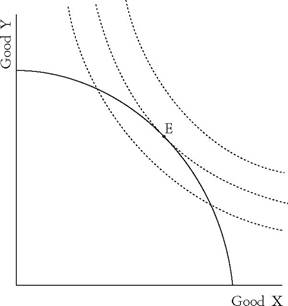
Figure 9.2 Equilibrium between consumption and production.
Note: Indifference curves are utility contour lines. If consumers prefer more of everything, contours farther from the origin are preferred to ones nearer the origin. The crucial assumption is that they have the curvature shown here.
denoted point E in figure 9.2. Because he could not accept that indifference curves had the shape shown in figure 9.2, Haberler had refused to take this last step, meaning he had no explanation of which point on the substitution curve would be chosen.
The problem with this approach is that, even if individuals’ indifference curves are well behaved, there is no reason why a country—a collection of heterogeneous individuals—will have indifference curves with the required properties.
There is no theoretically rigorous basis for treating a country as if it were an individual. Haberler not only shared such doubts but was a skeptic about the use of indifference curves in general, for he was doubtful that they had the properties needed to ensure an equilibrium.Samuelson claimed that it was Haberler’s skepticism that prompted him to work out a way to simplify the theory of the consumer by seeing the connection with index-number theory, on which Haberler had written his doctoral thesis. He wrote,
My own work in this direction grew out of a remark made to me by Professor Haberler in his 1936 international trade seminar at Harvard. “How do you know indifference curves are concave?” My quick retort was “Well, if they’re not, your whole theory of index numbers is worthless.” Later I got to thinking about the implications of this answer (disregarding the fact that it is not worded quite accurately). Being then full of Professor Leontief’s analysis of indifference curves, I suddenly realized that we could dispense with almost all notions
of utility: starting from a few logical axioms of demand consistency,
I could derive the whole of the valid utility analysis as corollaries.46
Haberler's theory of index numbers was concerned with measuring the change in the cost of living when the prices of different goods change by different amounts.47 The now standard solution is to use an average of all price changes weighted by the quantities of different goods purchased. However, if people respond to price changes by changing the quantities they consume (they will presumably be inclined to buy less of goods that have become more expensive in relation to other goods, and to buy more of goods that have become cheaper), the choice of weights is not clear: Is it better to use the quantities purchased before the price change (the Laspeyres price index), or the quantities purchased after the price change (the Paasche price index), or some other index altogether? Haberler's solution, taken from the British economist Francis Edgeworth, was to argue that if prices change, the “true” rise in the cost of living was the amount by which someone's income had to rise if he or she were to be indifferent about the situations with the old and new prices. He argued that the Laspeyres and Paasche price indices provided limits to the “true” cost of living. His results quickly became part of a large literature involving many leading economists.48 Haberler's double condition required that the Laspeyres index be larger than the Paasche index. Haberler argued that, though this would not necessarily be true, it was likely to be true because, if the prices of certain goods fell relative to prices of other goods, consumption of those goods was likely to fall.49 He was one of several economists deriving this result, though different economists derived it in different ways. For example, Roy Allen at the London School of Economics derived it using the assumption of convex indifference curves, the assumption to which Haberler took exception.50
This remark is important because it makes clear that, even though Samuelson was studying the theory of the consumer most rigorously with Wilson, he associated indifference curve analysis with Leontief. He was thinking actively about consumer theory, having already written one paper that was on its way to publication; Haberler's remark, made by a teacher whom Samuelson associated with his thesis on index numbers, made him realize that he could go further than others had gone in showing that the theory of the consumer could be derived simply from observations of consumer choices.t As with his work on international trade, Samuelson was making connections between material covered in different courses. However, even though he wrote, much later, that the theory of revealed
t. Samuelson's first paper, discussed in the first section of this chapter, was published in preference was born in his exchange with Haberler, it was to be two years, during which much was to happen, before his articles on the subject came to fruition.51