The First Draft, 1945
Samuelson's starting point was the book produced by various members of the MIT department, put together by Ralph Freeman, known as The Economic Process, a revised edition of a book originally written in 1934.21 Like Taussig's textbook used at Harvard, it comprised two substantial volumes of nearly 500 pages each.
Chapters had been drafted by nine members of the department, but so Freeman wrote, “[t]here has been... so much interchange of ideas, and the editor has so freely used his power of amendment, that it would be difficult to trace to particular individuals the various errors and imperfections which may appear.”22 It was this book, used by all instructors, that was the starting point for the debates over the curriculum that led Clemence and Doody to write their article.Though the organizing principle of the book may have been that proposed by his former colleagues, and though he started from the text Freeman had edited, the opening gambit in Samuelson's book appears to be entirely his own. He began by citing an unnamed professor at the Harvard Law School who used to address the entering class, “Take a good look at the man on your right, and the man at your left; because next year one of you won't be here.”23 Samuelson used this story, which any student in that first class would understand, not to make a point about the need for hard work but to argue that unemployment could strike anyone; it was not something that people brought on themselves but something that affected companies and even whole industries. According to Samuelson, the rise of the dictators, and hence the Second World War, stemmed from the failure to maintain high employment. Economics could hardly be more important. It explained the existence of poverty within a society in which goods were plentiful.
From here Samuelson tried to persuade his student readers that economics was an intellectually challenging activity—that it was not simply a matter of expressing personal opinions about what should happen—and that economic analysis involved more than mere description.
Using analogies from science, he explained why economists had to distinguish between understanding the world as it is and what they wanted to happen.At every point of our analysis we shall be seeking to shed light on these policy problems [controlling the business cycle, furthering economic progress, and achieving an equitable distribution of income]. But to succeed in this, the student of economics must first cultivate an objective and detached ability to see things as they are, regardless of his likes or dislikes. The fact must be faced that economic subjects are close to everybody emotionally. Blood pressures rise and voices become shrill whenever deep-seated beliefs and prejudices are involved. A doctor passionately interested in stamping out disease must train himself to observe things as they are. His bacteriology is not a different one from that of a mad scientist out to destroy the human race by plague. Wishful thinking is bad thinking and leads to little wish-fulfillment.24
There was, Samuelson claimed, not one economics for Democrats and another for Republicans. People might have different ethical positions, yet agree on economic analysis. Economics might not be obviously difficult, like mathematics, and it deals with things that everyone knows about, but this simplicity could be deceptive. Words could be treacherous because they elicited emotional reactions. Like any science, economics involves simplification, idealization, and abstraction. What is most noticeable about this passage is how Samuelson refrained from using terms such as “positive” and “normative” economics, even though these had been well established in the literature since the nineteenth century. He was avoiding jargon, however simple it might appear to economists. Philosophical jargon was not completely absent, but it was confined to terms he could be sure his students would already understand, as when he wrote about theory.
Properly understood, therefore, theory and observation, deduction and induction cannot be in conflict.
Like eggs, there are only two kinds of theories: good ones and bad ones. And the test of a theory's goodness is its usefulness in illuminating observational reality. Its logical elegance and fine-spun beauty are irrelevant. Consequently, when a student says, “That's all right in theory but not in practice,” he really means, “That's not all right in theory” or else he is talking nonsense.25Here, as earlier on, he was trying to persuade students that economics was saying something substantial—that it was not simply a matter of opinion.
Samuelson's introductory chapter closed with a section “The Whole and the Part,” driving home the point that what was true for an individual was not necessarily true for society as a whole. He was thus clearing the ground for analysis that would go counter to the conclusions students would draw from their own experiences. Individual behavior might be unpredictable, but it might be possible to predict how large groups would behave. After all, he explained, the planets did not understand that they were following elliptical paths. Behavior that benefited one person (such as standing on tip-toe to see a parade) might not be of any value if everyone did the same. This led Samuelson to explain that when there was unemployment, “we move into a topsy-turvy wonderland where right seems left and left is right; up seems down, and black white.”26 Picking up the analogy used by Keynes almost a decade earlier, he continued in terms his students, all of whom were trained in mathematics and physics, would understand:
Mathematicians tell us that in addition to Euclidian geometry there exist non-Euclidian geometries. In these non-Euclidian worlds, two parallel lines may meet—thus on the spherical surface of the earth two “parallel” lines perpendicular to the equator meet at the pole. What is true of one kind of world may be false of another. Similarly, for the modern world of unemployment, the conclusions of the old classical or Euclidian economics may not be at all applicable.
He pointed out that the benefits derived from moving gold from mines into Fort Knox, of exporting more goods, and of saving more all depend on whether there is unemployment or full employment. This was why it was important to start with the analysis of national income and unemployment. However, again following Keynes, he argued that if unemployment could be banished, then traditional economics would come into its own.
Samuelson then gave his view of what economics was about. He argued that any society had to solve three economic problems: (ι) What is produced? (2) How is it produced? (3) For whom is it produced? These questions helped define the subject matter of economics, but they did not do so completely. What was produced would depend on individual tastes—the province of the psychologist, the anthropologist, or even the biologist. Explaining institutions was for the sociologist or anthropologist, and technology was the realm of the physicist and engineer. Economists, he argued, should take the results reached by other scientists as a starting point: “The institutional framework of society, the tastes of individuals, the ends for which the strive—all these must be taken as being given. These and more. For the character and quantity of resources and the technological facts about their combinations and productive transformations must also be taken as given.”27
This somewhat abstract definition of the subject matter of economics was then made more concrete with a simple example, of a society facing a tradeoff between guns and butter. A numerical example was presented not just using a table and a graph but also with a pictogram of stylized artillery pieces and packets of butter—a pictogram such as Bliven had wanted for his article in The New Republic—shown as figure 25.1.f Technical concepts such as the “production-possibility curve” and “substitution” could explain the different wartime experiences of the United States, Germany, and Russia.
In the United States, “the arsenal of democracy,” eliminating unemployment made it possible to have more guns and more butter, and living standards rose. In Germany, the slack created by unemployment all went into military production, while Russia, already on its production possibility frontier, increased its military production only at the expense of hardship for the civilian population. This could hardly have been more relevant to students coming to the subject in 1945.gAs his discussion of the wartime experiences makes clear, Samuelson saw the problem of unemployment as central to economics. However, a further influence was that of his Chicago teacher, Frank Knight. In the second edition of the textbook, he added a footnote to his exposition of the three questions faced by society, saying that “This viewpoint, with minor adaptations,
f. Though this choice is believed to date back to press reporting of the National Defense Act of 1916, the most notorious use of it was by Joseph Goebbels in 1936, when he argued that guns would make Germans powerful whereas butter would make them fat. The use of illustrations such as this was a novelty of his textbook.
g. This can be seen as a compromise between traditional definitions of economics that sought to identify the subject matter of economics (for example, as the study of the business system) and the analytical definition made famous by Lionel Robbins (1932), which defined economics as analyzing the implications of the fact of scarcity, an aspect of all behavior. Samuelson accepted the fact of scarcity, even writing about “the law of scarcity,” but his definition defined a specific subject matter. See Backhouse and Medema 2009.
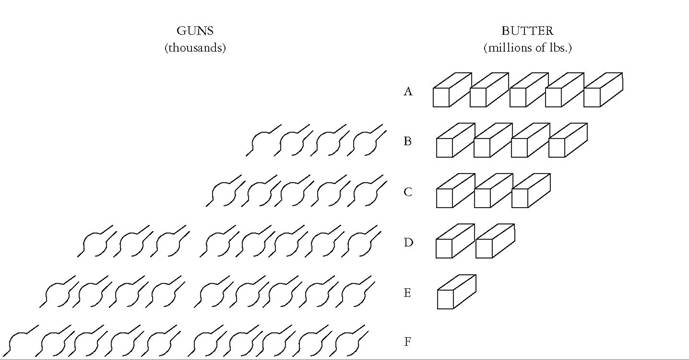
Figure 25.1 Guns or butter?
Source: P. A. Samuelson, 1945, Modern Economics: An Introductory Analysis of National
Income and Policy, PASP 91, p. II-6.
corresponds to that worked out by Frank Knight...
[in his] Social Economic Organization,” which he had used as an undergraduate.28,h Like Knight, Samuelson objected to very broad definitions of economics that made it synonymous with rational behavior, and he wrote in terms of the different functions of an economic system. However, Samuelson conceded too much to Knight when he described the modifications to Knight's perspective as only minor. Knight's five functions were reduced to three, and they did not correspond exactly to Samuelson's. Knight wrote of “fixing standards” and “efficiency”—terms that Samuelson did not use, presumably because he wanted to keep clear of ethical issues—and Knight's functions of “economic maintenance and progress” and “adjusting consumption to production within very short periods” have no counterpart in Samuelson's list. Samuelson's functions for an economic system were both simpler—easier for beginning students to remember—and less nuanced, shorn of many of the philosophical points that Knight wove into his discussion.However, although Samuelson acknowledged a debt to Knight, it is not difficult to see a similarity between Samuelson's three opening chapters and
h. It is not clear why this acknowledgment was added in the second edition. Around the time that the second edition was being prepared, Knight had had a somewhat acrimonious exchange with Samuelson, and perhaps Samuelson was trying to make amends. Possibly he had written the first edition without thinking fully about the source of his ideas (he had started by revising the department's textbook) and the parallel with Knight's text was drawn to his attention later.
the equivalent chapter in the department’s textbook from which he had started. That talked not of economic organization but of the economic process, making the point that production involved more than engineering. Economic problems arose from scarcity, which implied the need for choice and economizing.
Samuelson’s most obvious innovation was his writing style, beginning with his opening sentence. Whereas the text of Freeman and his colleagues had been dry and analytical, Samuelson’s opening chapter abounded in paradoxes—poverty amid plenty, differences between the whole and the part—and imagery involving money and spending. In place of an abstract discussion of choice, Samuelson posed three much more concrete problems that societies had to solve. Samuelson described a concrete choice between guns and butter, using a diagram to help students visualize it, as previously mentioned. Where the earlier book had written in abstract terms about social institutions—practices, laws, methods, and customs—that molded individual behavior, Samuelson dispensed with such general discussion to cover in detail those institutions about which students needed to know: families, businesses, and government.