National Income and Its Uses
The first draft of the textbook was circulated to students in 1945 with the title Modern Economics: An Introductory Analysis of National Income and Policy. As Clemence and Doody had recommended, national income provided the unifying theme.
Not only did the subtitle come close to equating modern economics with the study of national income, but the first section, comprising eight chapters, culminated in an explanation of national income. The idea of income was introduced in two chapters on “Individual and Family Incomes,” grounding the idea of income in a context that would be familiar to students.These chapters centered on statistics compiled by the National Resources Committee, which had been the data on which his wartime work on forecasting consumer spending for the National Resources Planning Board was based. He included tables displaying the number of families receiving different levels of income, and showed how the degree of inequality could be represented on a diagram.[lxiv] There was an extensive discussion of income distribution, including differences between male and female earnings and between earnings of black and white households. He discussed poverty and the industrial revolution, and Marx's views about class struggle, noting that the Soviet Union appeared to have similar levels of inequality to the United States. His second chapter on individual incomes focused on occupational differences, both within and between occupations. These two chapters, exploring issues of social mobility and the question “Is college worthwhile?” clearly covered issues to which the students could relate. A diagram showing starting salaries for chemical engineering graduates could hardly have been more directly aimed at MIT student concerns. They will have seen very clearly that engineering graduates prospered during the war, this being due, Samuelson explained, to “our rather short-sighted national policy of drafting scientific, medical and engineering students into the armed forces."[lxv]9,j It was a simple and very clear lesson in supply and demand before Samuelson turned to a more formal discussion later on.
He then went on to “Business Organization and Income," a chapter that was very different in tone, comprising sections taken directly from the text Freeman had written previously? It was far more taxonomic in its coverage, focusing on institutional forms—individuals, partnerships, corporations— and methods whereby businesses raised funds. The last topic took him into a discussion of financial assets, the stock market, and speculation. He explained how to read balance sheets and analyze corporate income streams. In the course of this, he included a diagram, out of Freeman's book, showing how funds flowed in and out of businesses (figure 25.2). Supporting this emphasis on the interpretation of company accounts. Samuelson included the 1941 earnings report of the International Harvester Company, replete with balance sheets, different sets of income and expenditure accounts, and overseas transactions, from which were derived a series of questions for students to answer.
Corporate financial accounting led straight into the national accounts; the table of contents specified a chapter on government, but this was not present in the first draft. There was a clear link between the discussion of individual and household incomes and the breakdown of national income by type of income. The difference between real and nominal incomes led into a discussion of national product (the sum of the different types of goods and services produced) and the relationship between saving and capital accumulation. The
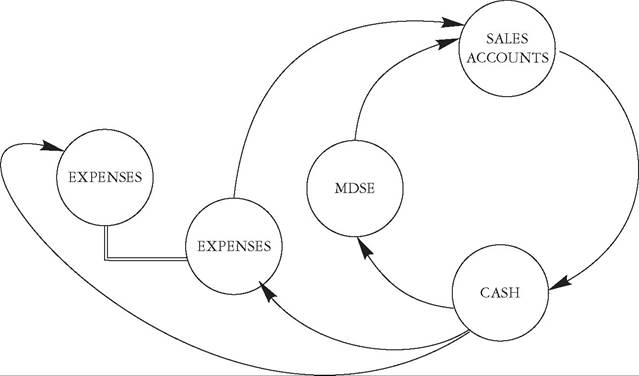
Figure 25.2 Financial statements.
Source: P. A. Samuelson, 1945, Modern Economics: An Introductory Analysis of National
Income and Policy, PASP 91, p. V-15.
chapter on national income culminated in two graphs. The first depicted the course of national income during the Great Depression, showing the waste arising from actual national income being below its full employment level.
The second showed that, despite inflation, real national income had risen enormously during wartime. The challenge Samuelson posed to his readers was understanding how the economic situation could have been so different in the early 1930s and the early 1940s.Focusing on income was one of the ways in which Samuelson made economic ideas seem more concrete, for household income was something to which students could relate, especially when it was laced with up-to-date statistics on the distribution of income across households. The chapter that stood out as not following this pattern was the one on business income, with its more comprehensive, almost taxonomic approach. The reason for this difference is clearly that Samuelson had not had time to rewrite this the way he wanted, and although he had shortened and rearranged the material, the chapter was a series of sections from Freeman's book. The concrete but fictitious example of the “Santa Claus Manufacturing Company” used to present company accounts was taken directly from Freeman's text. However, Samuelson's addition of a genuine company report, presumably in facsimile, served to persuade students to take this fictitious example seriously. Closing part I of the text with a chapter on national income not only integrated the previous chapters but rendered the discussion of the economic system as a whole more concrete in the same way as he had done in the chapter on individuals and families. The changes Clemence and Doody had advocated were useful, not just for making the material more dynamic and for linking it to history, but also for making it less abstract.
In part II of the first draft, to which he gave no title, the tone was completely different. Using simple numerical examples, Samuelson explained supply and demand curves in a way that did not presume prior understanding of graphic representations of data. His tables and the graphs derived from them involved artificial examples illustrating assumptions that were based on pure theory—diminishing rates of substitution, linear demand curves, U-shaped average cost curves.
He explained not just the economics but also how one should read a graph, the meaning of optimum conditions, and how to justify using continuous functions when some products (e.g., eggs) were indivisible.Equilibrium under perfect competition was illustrated using a supply and demand diagram, but when Samuelson turned to monopolistic competition, he used no diagrams or numbers and instead invited his readers to place themselves in the position of a company president having to take advice from his accountants and sales managers (all of whom could be presumed to be male in 1947) before deciding what prices to set. “ ‘Boys,’ you will say, ‘what will our volume of output approximately be if we stay on our toes and keep our share of the market?’ ”30 The manager’s decision was then to decide what markup to apply to the costs these accountants came up with. This might not conform with the theory of profit maximization, but Samuelson believed it was realistic.
Many investigators of actual business pricing policies have testified that corporations often do follow the above described practice of quoting prices on a “cost and mark-up” basis, hoping thereby not only to recover their full costs, but also to make a return on their investments. This theory is therefore realistic.31
Though realistic, this statement was not very informative because it did not explain the markup. To take the analysis further, Samuelson turned not to theory but to empirical work, arguing, “There seems to be nothing to do about this unsatisfactory situation but to try to specify a number of different competitive and monopolistic patterns characteristic of various important industrial situations.” These included chronically overcrowded sick industries, few sellers of identical products (oligopoly), monopolies maintained by research and advertising, and publicly regulated monopolies. He was adopting Chamberlin’s strategy of classifying market structures, but the examples he used were more reminiscent of the institutionalist studies of pricing found in the reports of the Temporary National Economic Committee.
Theory, again illustrated with numerical examples, and with graphs in an appendix, returned when Samuelson moved on to the problem of “Production Equilibrium and the Problem of Distribution.” The point that he emphasized was that the marginal productivity theory explained how much of each factor a company would hire given the prices it faced: it did not explain factor prices. He was very critical of the economists who had developed what he repeatedly called the “so-called marginal productivity theory of distribution.”32 The search for a marginal productivity theory of distribution, in which each factor was paid according to the amount produced by the last unit employed, was a “will-o-the-wisp” and “ill-conceived.”33 The theory could say little about the problems that were of concern to society.
Unfortunately, there is little that can be said about this general supply and demand problem which is very useful in understanding the distribution of income between rich and poor, between labor and property owner, between one kind of property owner and another. This is unfortunate, and admittedly a deficiency in our economic knowledge. But in any case, the problem of “distributing social product” is a false one, and the difficulties which [a]rise in its solution are irrelevant ones.34
There were also technical problems with marginal productivity theory, of which the main one was joint production. If capital and labor had to be used together, withdrawing one factor would mean losing the whole output. Marginal productivity theory could do no more than establish the limits within which factor prices must lie (and in extreme cases, it might say no more than that a factor get between 0 and 100 percent of total product). Given this, there was scope for bargaining to influence factor payments, which led Samuelson to ask whether trade unions could raise wages. His answer was that they could change wages, though only within certain limits.
These limits might be very hard to define, but they were real. However, Samuelson was not wholly on the side of unions, for wage rises could have harmful effects, and there was the danger that worker demands would be insatiable.In its coverage, part II was the most traditional part of the book. Here, he did not seek concreteness by discussing real-world data but, rather, through simplifying the theory, explaining concepts by reducing them to essentials that could be explained using the easiest possible mathematics. This was much more what one might expect from the author of Foundations. Where Freeman, like Taussig and others before him, had enunciated a set of economic principles, whether on consumer behavior, the distribution of income, or the process of saving and investment, Samuelson was much more clearly providing students with a set of analytical techniques they could use to solve economic problems. His chapters on supply and demand, consumers, and firms were exercises in economic theory, clearly separated from discussions of real-world markets.
From the theory of production, Samuelson moved to international trade, using similar diagrammatic techniques to illustrate the theory of comparative advantage. His main expository tool was a numerical example, in which the United States and Europe traded food and clothing. The lesson was on the importance of specialization and hence of international trade. One diagram showed “a very advantageous triangular trade” in which America exported autos to England, England exported clothing to the East Indies, and the East Indies exported rubber to America. The system of multilateral trade in 1938 was illustrated with a more complex diagram, showing trade flows between the United States, the tropics, regions of recent settlement, continental Europe, and non-continental Europe. The point of this diagram was to show how tragic bilateralism (trade deals negotiated between countries two at a time)—a policy he associated with continental fascist countries—would be. He reminded his readers about the United Nations' having set up the International Bank for Reconstruction and Development (now the World Bank) and the International Monetary Fund to create conditions in which multilateral trade could flourish, and that Franklin Roosevelt's policy of pressing for tariff reductions remained U.S. national policy. This discussion, which exposed his student readers to the internationalist position he had taken in The New Republic, provides a clear illustration of how his wartime experiences were informing his writing.
This internationalist position was supported by a chapter, devoid of technical theory (though theoretical ideas lay beneath many of his arguments), on tariff protection and free trade. His starting point was the fact that “unhampered free trade promotes mutually profitable international division of labor, greatly enhances the potential real national product of all countries, and makes possible higher standards of living all over the globe.”35 This was presented as “a fact,” not an abstract theoretical conclusion. He then discussed various arguments for protection, but even here he challenged common arguments. Non-economic goals, such as national defense, might be important, as in the case of fostering domestic rubber production. However, in this instance, subsidizing industry would be better than imposing a tariff. Other arguments for tariffs, such as keeping money in the country, raising money wages, or serving special interests, were completely fallacious. Even tariffs to raise revenue or to protect home markets or domestic labor were misconceived. “Infant industry” and “young economy” arguments had more validity, but they applied more to “backward nations” than to the twentieth-century United States. Samuelson’s commitment to free trade was clear.
More on the topic National Income and Its Uses:
- Conclusion
- Learning Objectives
- Solow Model and Regression Analyses
- MichalKalecki
- NUMERICAL PROBLEMS
- ANALYTICAL PROBLEMS
- An Alternative Approach to Labor-Augmenting Technological Change *
- Abel A.B., Bernanke B., Croushore D.. Macroeconomics. 10th Edition, Global Edition. — Pearson,2021. — 690 pp., 2021
- References and Literature
- The IS-LM Model for an Open Economy