11.3 The basic theory-element
By means of the previous conceptual framework, it is possible to introduce the concept of a Sraffian economy.
11.3.1 Definition 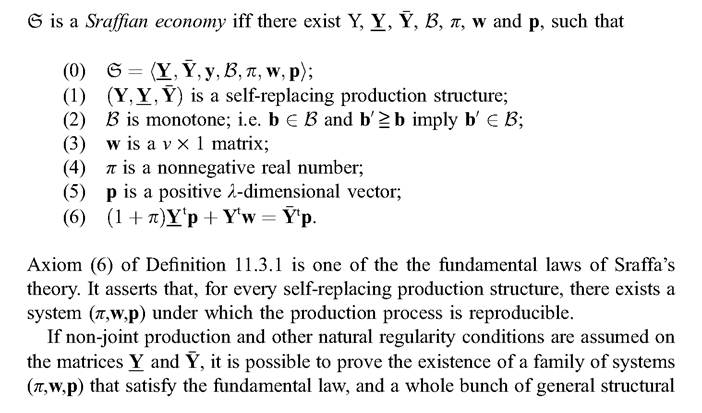
theorems follow from the definition of Sraffian economy (cf.
Ballesteros, Beato, Jerison, and Oliu 1976).But there are no analogous general conditions in the case of joint production. All known conditions, like the system’s being all-engaging, are too strong and hold only exceptionally (cf. Schefold 2005: 545). This is typical of T-theoretical terms: the existence of the corresponding magnitudes must be established in every case, depending on the empirical conditions presented by the case, and they cannot be determined without presupposing the validity of the fundamental law. Clearly, terms w, π and p are Sraffian-theoretical and, so, finding a general sufficient condition implying the existence of the corresponding required magnitudes, satisfied by all intended applications, is out of the question.
As I have pointed out elsewhere (Garcia de la Sienra 2009), in spite of the use of familiar economic terms (in the present case, terms like ‘commodity input’ or ‘subsistence’), the structural axioms of an economic theory, and even the laws, do not make or imply any empirical claim.
In order to produce an empirical claim by means of them, you need to stipulate a particular empirical interpretation of the terms and not only that, but also apply somehow the axioms to a real agent [or structure].
(Garcia de la Sienra 2009: 357)
The application of the conceptual framework of an economic theory T to a real phenomenon, agent or structure requires the fleshing out of the terms, by means of empirical information. There is hardly a better generic description of the domain of intended applications of the Sraffian theory than that given by the astronaut arriving from the moon:
The significance of the equations is simply this: that if a man fell from the moon on the earth, and noted the amount of things consumed in each factory and the amount produced by each factory during a year, he could deduce at which values the commodities must be sold, if the rate of interest must be uniform and the process of production repeated. In short, the equations show that the conditions of exchange are entirely determined by the conditions of production.
(D3/ 12/ 7: 87; quoted by Kurz and Salvadori 2004: 1546)1
Yet, in the first place, it is not clear whether the description of the production structure should include each factory on planet Earth, in the European Union, or in a single country like the United States. Or centrally planned economies as well as capitalist: the specification of the domain of intended applications of the theory requires an empirical, appropriate description of the real production structures to which the members of the school intend to apply the theory. Once this is done, in relation to any of these structures, the phrase “he could deduce..is too optimistic. Even aliens with extraordinary powers might have trouble figuring out what are the values at which “commodities must be sold, if the rate of interest must be uniform and the process of production repeated”. The determination of these values is the substance of the Sraffian “normal science”, which of course does not consist of proposing abstract assumptions in order to mathematically derive existence theorems.
Perhaps something like this is what Schefold has in mind when he asks whether joint production leads to a triumph of economic over mathematical logic. But there is no such a triumph. A correct logical reconstruction of a scientific theory must show the form that the normal science problems adopt in the discipline. In the present case, the conditions leading to the system of prices must be determined empirically. Whether the system under scrutiny is all-engaging, or satisfies other condition out of which prices can be computed, is an entirely empirical matter.
11.3