The conceptual framework
Two outstanding concepts of PCC are those of method of production and standard commodity. Roughly, a method of production is a system of interconnected production processes operating during a whole year.
The simplest example Sraffa provides is that of a couple of processes producing wheat and iron for subsistence:280 qtr. wheat + 12 t. iron → 400 qtr. wheat
120 qtr. wheat + 8 t. iron → 20 t. iron
The concepts of reproduction, private property and social wealth (not the words) suggest themselves immediately: At the beginning of the cycle (the year), “the society” has an endowment ω = (400, 20) consisting of 400 qtr. of wheat and 20 t. of iron. The farmer has at his disposal (owns) 280 qtr. of wheat and 12 t. of iron, ω1 = (280, 12); the ironmaker has (owns) 120 qtr. of wheat and 8 t. of iron to start his production process, ω2 = (120, 8). There is
The logical structure of Sraffian economic theory 175 no hint of rational choice (profit maximizing) or alternative production processes here: the producers just replicate the cycle as if they were doomed to do so. At the end of the cycle “the society” returns to the original state, but the wheat and the iron are allocated in a different way. This time, the farmer has all the wheat, ω'1 = (0, 20), and the ironmaker all the iron, ω'2 = (400, 0). Thus, the cycle cannot be repeated if the producers do not find a way of reallocating the commodities in order to replicate the situation at the beginning of the cycle. Sraffa never says that they will coordinate, or how a coordination can be reached. He only points out that the cycle cannot be replicated unless trade takes place among the producers according to certain proportions.
Actually, in the example the exchange-value required is 10 qtr. of wheat for 11. of iron.
These values can be represented by means of a price vector (1, 10), where wheat is clearly performing as a numeraire. The wealth of the farmer at these values (relative prices) is (1, 10)-(400, 0) = 400, and that of the ironmaker is (1, 10)-(0, 200) = 2000. In order to start over the process, the farmer demands 12 t. of iron with a cost of (1, 10) ■ (0, 12) = 120; the ironmaker demands 120 qtr. of wheat with a cost of (1, 10) ■ (120, 0) = 120. Thus, at these prices, the required trade is balanced and the process can be reproduced.In general terms, the method of production and exchange-values under conditions of simple reproduction can be represented by means of a set of equations like
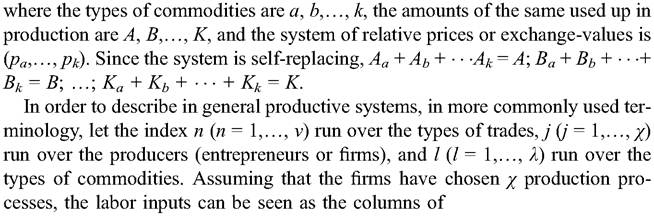
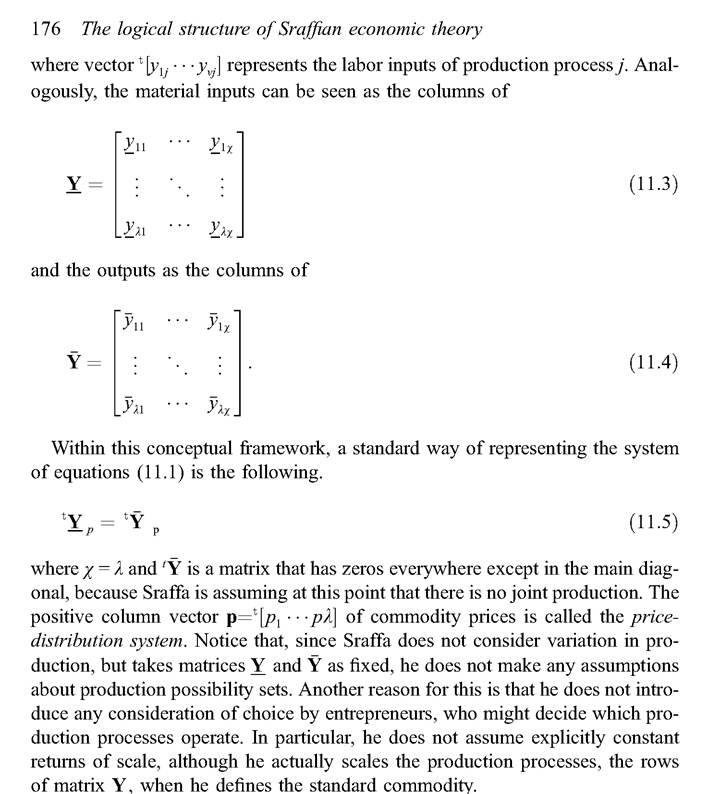
Since Sraffa considers the commodities required to maintain the labor-power as inputs in the production process, and system (11.1) represents the case of mere subsistence without any surplus, it is not necessary to consider matrix Y of labor inputs. In this case it is sufficient the introduction of the set B of all possible aggregate consumption bundles (“baskets”) that allow laborers to provide one unit of labor. B is a subset of the nonnegative orthant of Rn.
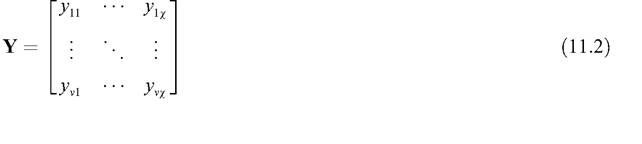
In order to account for production with surplus and joint production, it is necessary to consider the matrix of labor inputs. Sraffa introduces the concept of labor input vector, represented by a χ ? 1 positive matrix y, since he assumes that labor is homogeneous. Nevertheless, since the restriction of homogeneous labor is not necessary in the general case (it is in order to determine the standard commodity for non-joint production systems), it is more convenient to use matrix Y as defined above. At any rate, in the case of homogeneous labor, all entries are 0, excepting those in the first column. With such proviso, in the case of
The logical structure of Sraffian economic theory 177 homogeneous labor (the only case considered by Sraffa), Y is assumed normalized, so that the sum of the entries in the first column is 1 (i.e. total labor, which is supposed homogeneous, is made equal to 1).