Abstract labor
In a capitalist economy, the equalization of labors is not carried out by a conscious accounting, but takes place through the exchange process. The exchange process equates the profiles of labor inputs through the equating of their respective products.
A profile of labor inputs is a vector associated to a classification of tasks. Each position of the vector represents a certain amount of labor applied to a specific task. The convention is that entry n of labor input profile y, real number yn, represents a certain amount of time applied to a certain task. For instance, yn may represent yn hours of a mechanic applied to install the brakes of a certain model of car, or yn hours of a mechanic applied to assemble the engine. We shall convene that, even though both tasks are performed by a mechanic, they are different types of tasks. Hence, a mechanic applied to install brakes will be represented by an entry yn different from the entry yn representing the mechanic assembling engines (n ¼ n').The time required to perform a task is socially necessary labor-time. According to Marx, this has various consequences, one of them being that
all wasteful consumption of raw material or instruments of labor is strictly forbidden, because what is wasted in this way represents a superfluous expenditure of quantities of objectified labour, labour that does not count in the product or enter into its value.
(Marx 1976: 303)
Another consequence is that
the labour-power itself must be of normal effectiveness. In the trade in which it is being employed, it must possess the average skill, dexterity and speed prevalent in that trade...[and]...it must be expended with the average amount of exertion and the usual degree of intensity.
(Ibid.)
Normal labor-power expends prime materials, and employs tools and machines, in an efficient way.
Therefore, the use of more labor-power in a process of the same type (a scaling of the former) should increase proportionally the use of the means of production, as well as the amount of final products. This means not only that more means of production are employed, but also that to small increases in the amount of labor-power there correspond small increases in the amount of the production means and the corresponding products. It is only natural to formulate this as a continuity condition: to an infinitesimal increase in labor-power there corresponds an infinitesimal increase in the net product. This narrative motivates the following definition.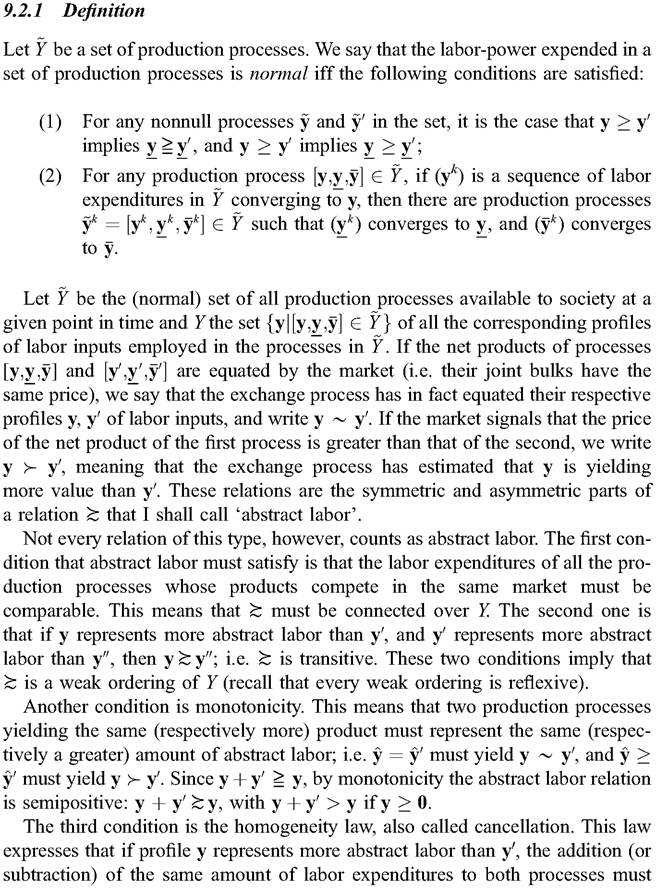
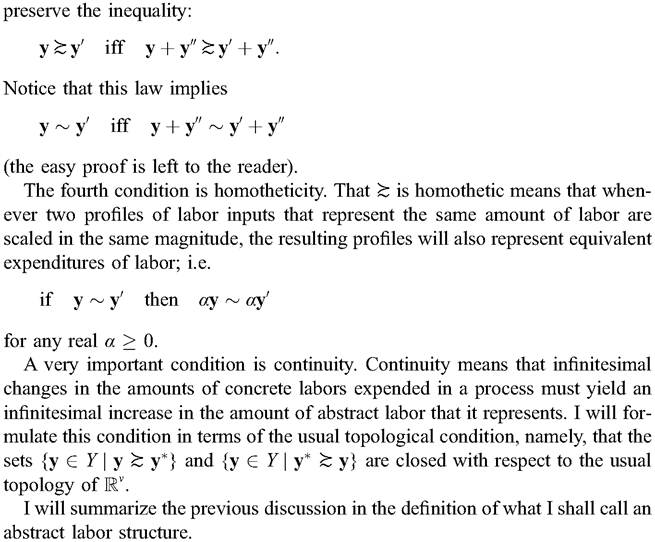
9.2.2 Definition
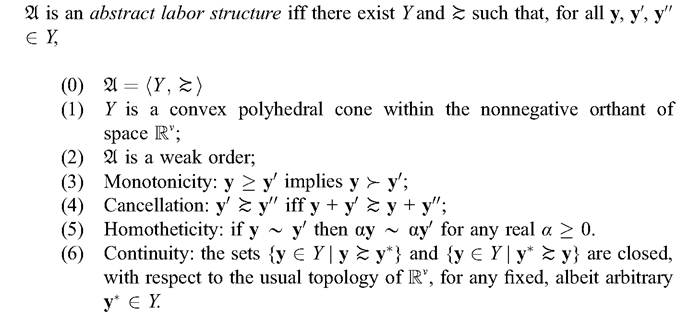
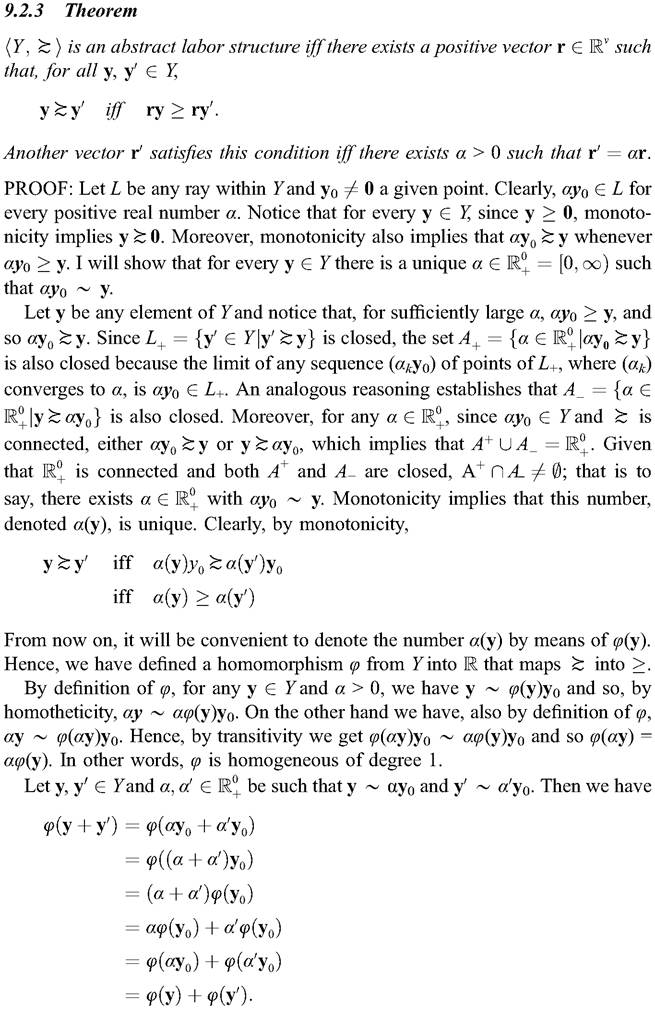
Axioms (1)-(6) are enough to prove the existence of the desired representation. This is the content of the following theorem.
9.3