Market-determination of abstract labor
The typical narrative in volume 1 of Das Kapital (dk) is that labor in a capitalist economy (or in any economy, for that matter) is homogeneous, and so the value of the goods it produces can be measured in terms of the mean or minimal labortime employed in their production.
This presupposes that value is the result of a process that takes place entirely within the pure sphere of production, “independently of its form of manifestation” in the sphere of exchange:It becomes plain that it is not the exchange of commodities which regulates the magnitude of their values, but rather the reverse, the magnitude of the value of commodities which regulates the proportion in which they exchange.
(Marx 1976: 156)
This same narrative seems to be reinforced at the beginning of his Contribution to a Critique of Political Economy where he appears defending the marketindependent view of value:
As exchange-values of different magnitudes they [i.e. commodities of different types] represent larger or smaller portions, larger or smaller amounts of simple, homogeneous, abstract general labour, which is the substance of exchange value.
(Marx 1970: 29)
Nevertheless, seemingly contradicting the typical narrative, also in DK Marx intimated that market-exchange, a social process “that goes behind the back of the producers”, is the one that actually reduces the heterogeneous labors to a common unit. And in Contribution he ends up asserting this same view:
the labor of different persons is equated and treated as universal labour only by bringing one use-value into relation with another one in the guise of exchange-value.
(Ibid.: 34)
This is the view that in the exchange process universal
social labor is... not a ready-made prerequisite but an emerging result. (Ibid.: 45; emphasis added)
Naturally, putting together these quotations a perplexity cannot but arise:
...
a new difficulty arises: on the one hand, commodities must enter the exchange process as materialised universal labour-time, on the other hand, the labour-time of individuals becomes materialised universal labour-time only as the result of the exchange process.(Ibid.)
It is pretty clear to me that the content of this last quotation is the manifestation of an ambiguity which is present both in DK and in Contribution. In both works Marx starts by describing the “substance” of value as homogeneous labor, which in addition he seems to identify with abstract labor and simple or unskilled labor. The impression that one gets reading the first sections of such books is that the “substance” of value can be defined almost in purely technological terms that can be applied to any type of economy. Nevertheless, this view is actually incorrect, since it does not take into account that labor is not homogenous but rather quite diversified.
In contradistinction to the simplistic view just described, my aim in the present section is to develop the view that
it is only the expression of equivalence between different sorts of commodities which brings to view the specific character of value creating labour, by actually reducing the different kinds of labour embedded in the different kinds of commodity to their common quality of being human labour in general.
(Marx 1973: 142; emphasis added)
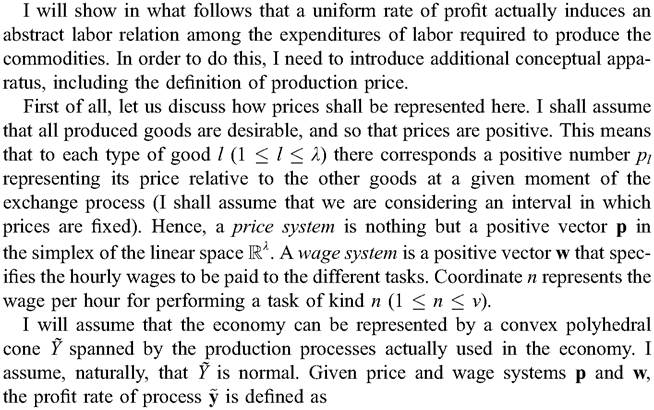
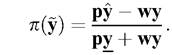
System p is called a system of production prices whenever π(y) is uniform; that is to say, it is the same for every process in Y Production prices reflect the expenditures of labor assigning a higher price to those processes that employ more labor. This assertion is made more precise in the following lemma.
9.3.1 Lemma 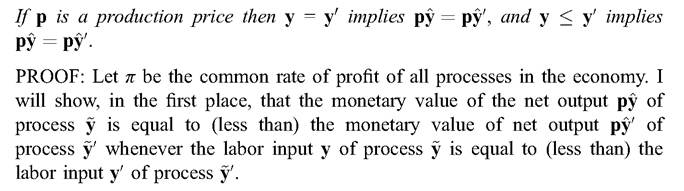
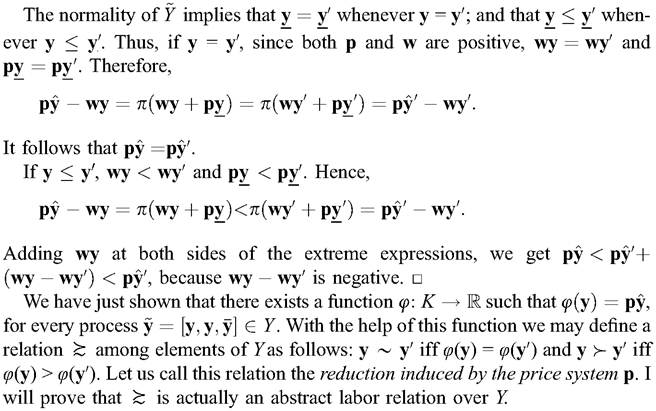
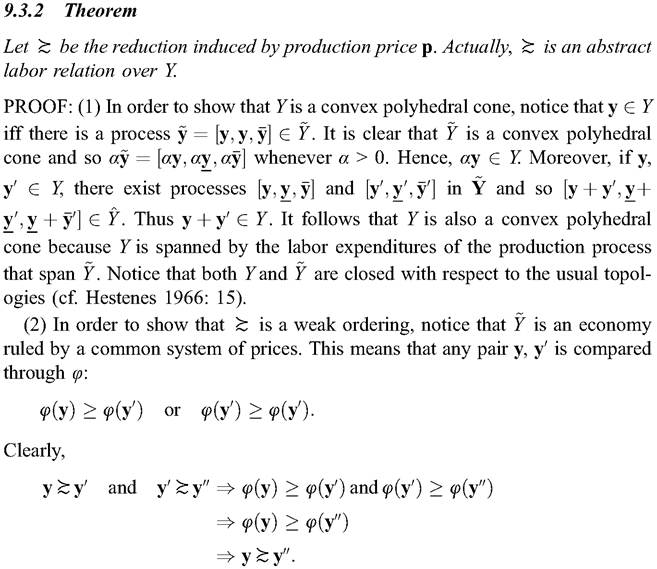
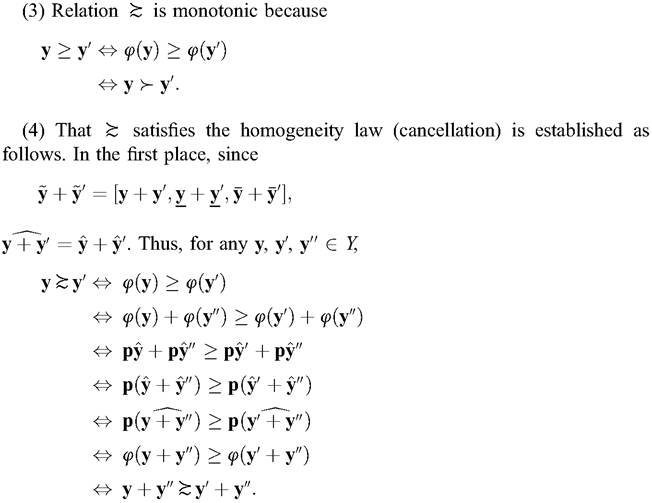
(5) The homotheticity of £ is established as follows:
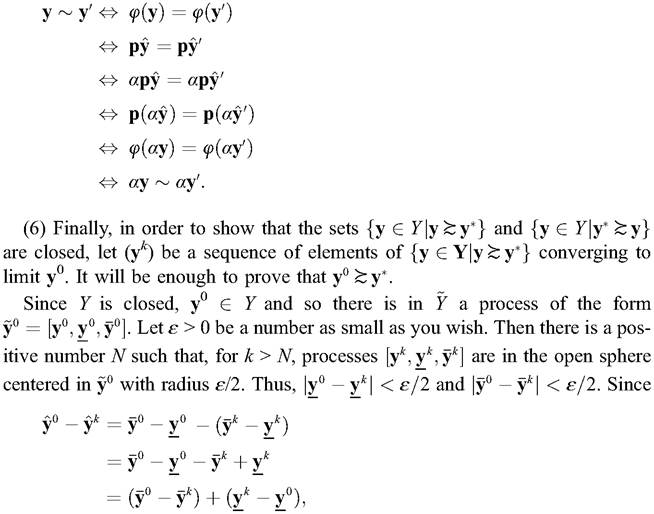
it follows that
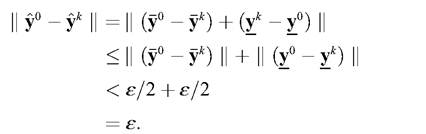

The former theorem means that a tendency toward a uniform rate of profit involves a tendency toward a specific reduction of the expenditures of heterogeneous labors to a common unit - it leads to abstract labor. Reductions induced by production prices are called standard reductions.
9.4
More on the topic Market-determination of abstract labor:
- Market-determination of abstract labor
- The meaning and relevance of abstract labor
- Labor-value
- Freeing the Labor Market from its Distortions
- Technical progress as a source of change in labor market institutions
- Technological change in frictional labor markets
- Adolfo Garcia de la Sienra. A Structuralist Theory of Economics. New York, USA: Routledge,2019. — 235 p., 2019
- BOX 6-2 Guidelines for Determination of Specific Food Allergies
- Self-Determination and Joint Action
- While recognizing the right of national self-determination, we take care to explain to the masses its limited historic significance and we never put it above the interests of the proletarian revolution.