Labor-value
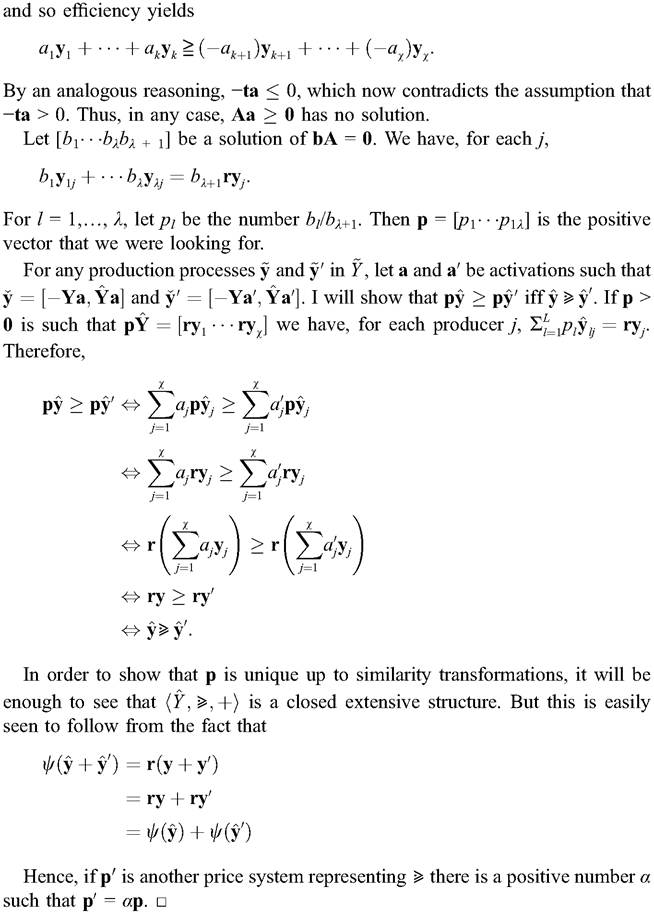
Closing the circle, just as the production price induces a reduction of concrete heterogeneous labors to abstract labor, abstract labor induces a system of prices for the produced goods.
In order to prove this proposition, we need to define the concept of a productive structure, and prove a more general version of the substitution theorem. Let us start with a precise definition of efficiency. Intuitively, an efficient process is characterized by producing the same or more amount of net product using less or the same amount of labor than other processes.9.4.1 Definition
Let y, y' be elements of the set of production processes Y. Process y is more efficient than process y' iff y ≥ y'. It is strictly more efficient iff y ≥ y'. Process y 2 Y is efficient iff there is no process in Y strictly more efficient than yy.
It is usual in economic theory to represent the technological possibilities of a given producer as a certain set of production processes, and the choice of the producer as a point in that set. I shall assume that there are χ producers but producers with the same technology will be treated as the same producer. I admit the possibility of alternative techniques, and so the same kind of output can be produced by different technologies. This implies that there may be more types of production processes operating than kinds of outputs; i.e. λ < χ. I shall assume also that the positive net outputs of producer j are ocassionally more than one, which means that there is joint production (like leather together with beef in the cattle industry). Nevertheless, it seems that joint production is not enough to revert the inequality λ < χ. Also, since the same tasks repeat in different production processes, I shall assume that there are more producers than tasks, so that ν ≤ χ.
Finally, I will take for granted that no process in Yj can be obtained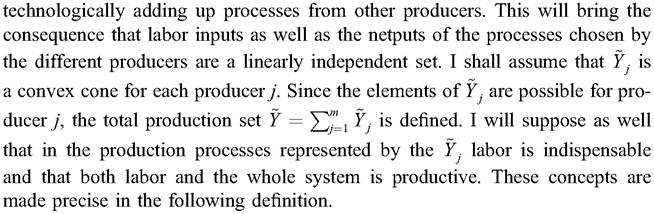
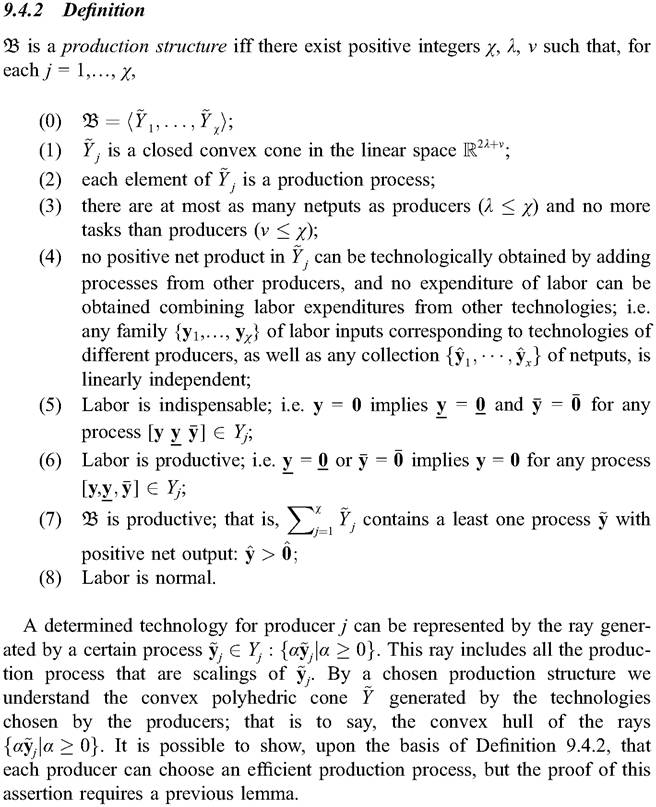
9.4.3 Lemma
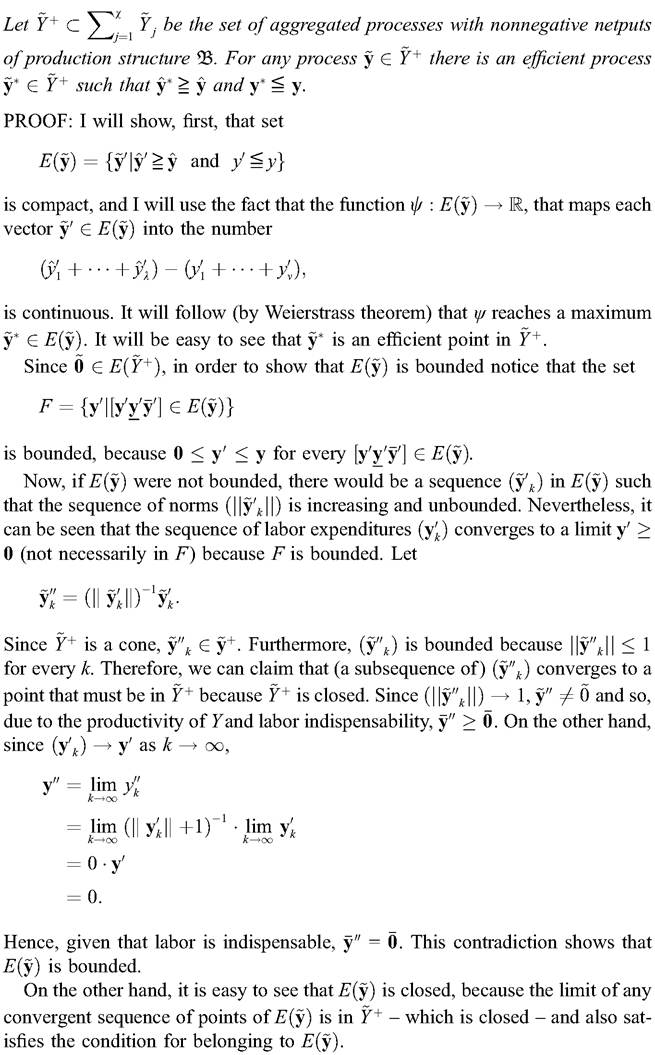
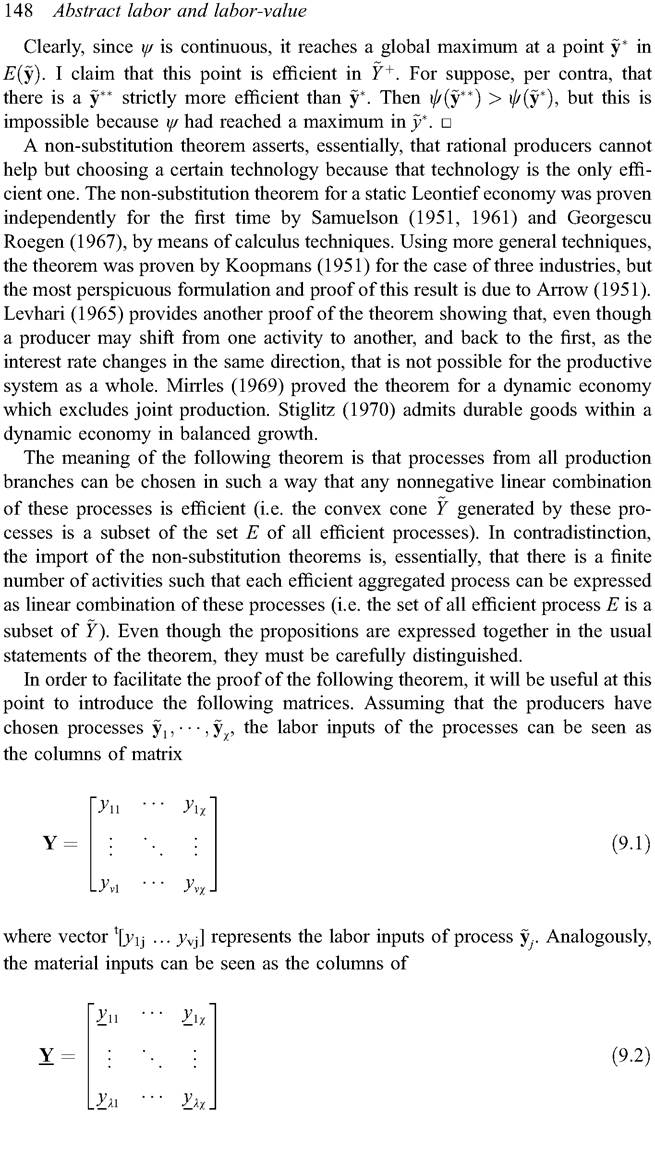
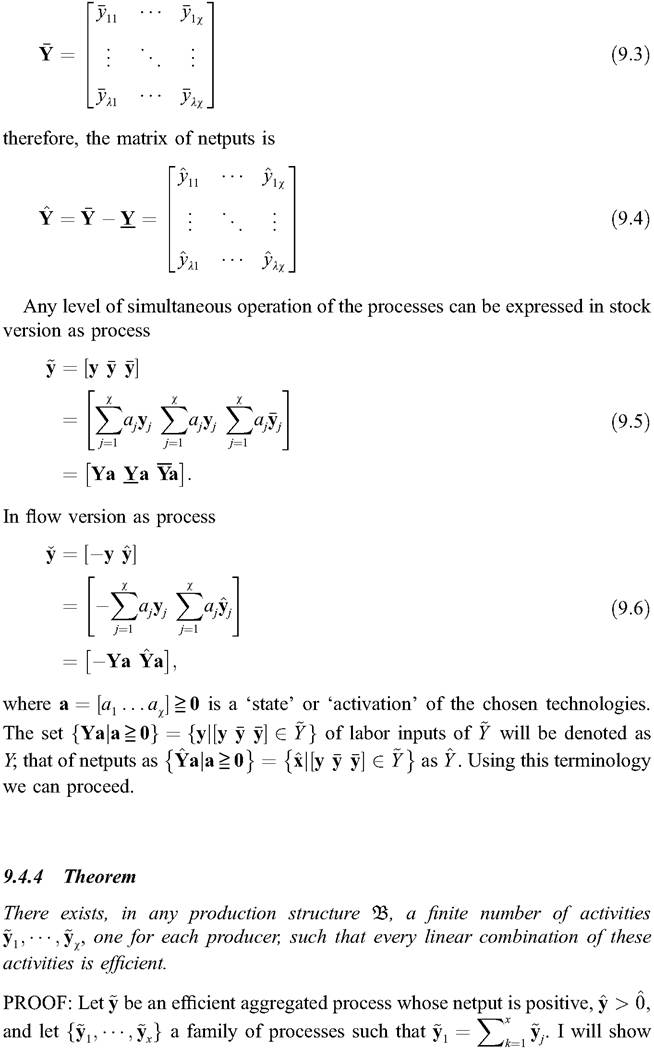
and the outputs as the columns of
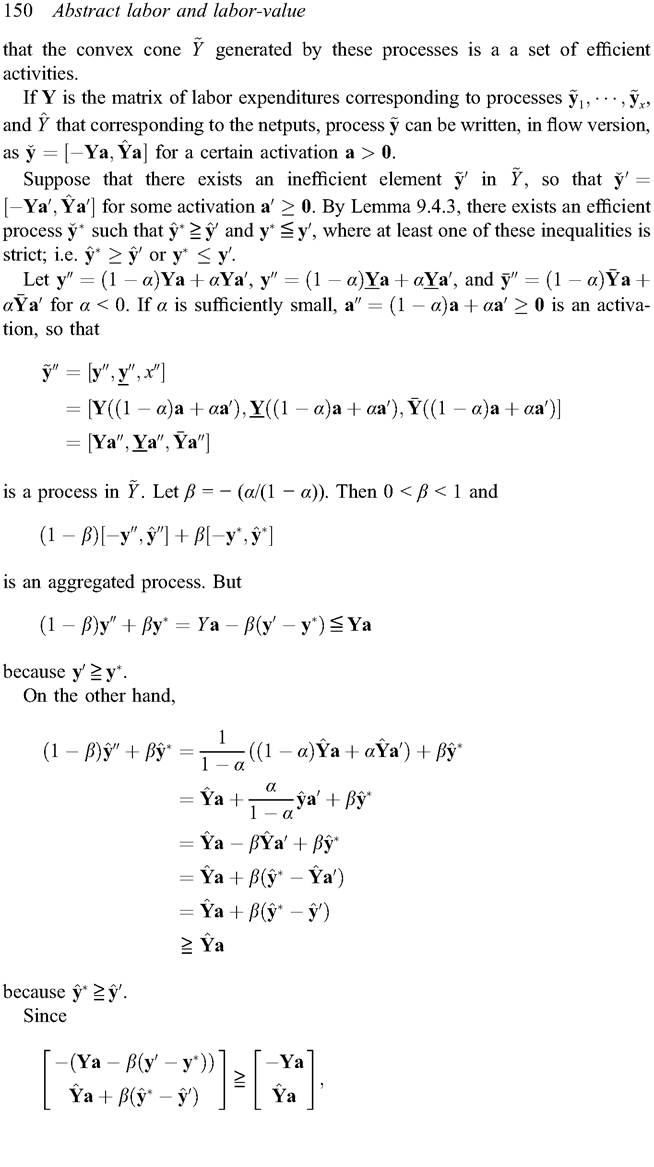
the assumption that y' is strictly less efficient than y* implies that

But this contradicts the assumption that y is efficient. ?
Hence, we can assume that the producers choose to operate a family of efficient processes whose aggregated netput y is positive. Notice that this does not require to assume that the entrepreneurs are ‘competitive’ (price-takers).
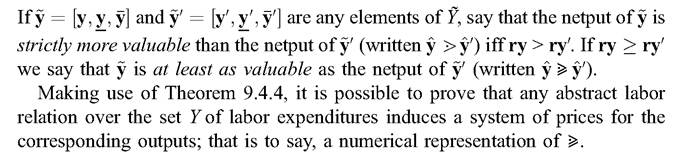
Notice that, just as production prices induce an abstract labor relation among labor expenditures, reductions induce a value relation among netputs, in the sense of the following definition.
9.4.5 Definition
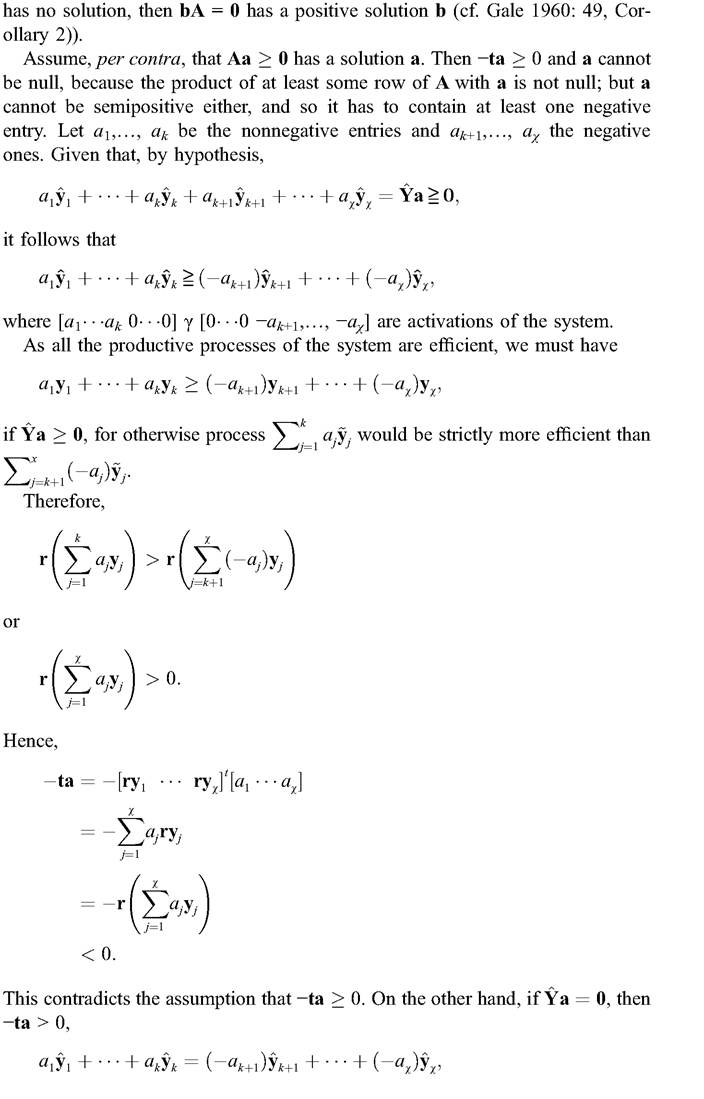
9.4.6 Theorem 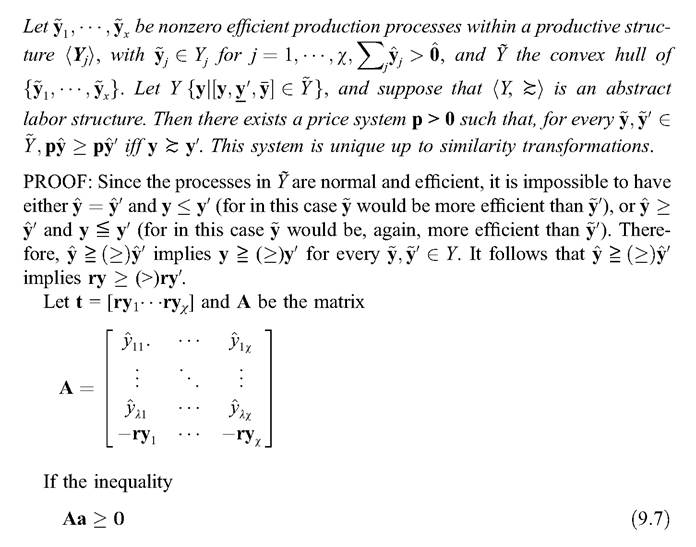
9.5