Directed technical change
So far, technical progress has been modeled as an increase in total factor productivity (A) that is neutral towards different factors and sectors. For many applications, however, this assumption is not realistic.
For example, there is evidence that technical progress has been skill-biased during the last century and that this bias accelerated during the 1980s. Similarly, the fact that the output shares of labor and capital have been roughly constant in the US while the capital-labor ratio has been steadily increasing19 Relative demand for intermediates is:
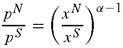

suggests that technical change has mainly been labor-augmenting.[48] Further, industry studies show R&D intensity to vary substantially across sectors. In order to build a theory for the direction of technical change, a first step is to introduce more sectors into the model. Then, studying the economic incentives to develop technologies complementing a specific factor or sector can help understand what determines the shape of technology.
An important contribution of this new theory will be to shed light on the determinants of wage inequality [Acemoglu (1998, 2003a)]. Another application studies under which circumstances technologies developed by profit-motivated firms are appropriate for the economic conditions of the countries where they are used. The analysis will demonstrate that, since IPRs are weakly protected in developing countries, new technologies tend to be designed for the markets and needs of advanced countries. As a result, these technologies yield a low level of productivity when adopted by developing countries [Acemoglu and Zilibotti (2001)].
Trade can reinforce this problem and create interesting general equilibrium effects.Although most of the results discussed in this section can be derived using models of vertical innovation, the expanding variety approach has proved to be particularly suited for addressing these issues because of its analytical tractability and simple dynamics. For instance, creative destruction, a fundamental feature of quality-ladder models, is not a crucial element for the problems at hand, and abstracting from it substantially simplifies the analysis.
4.1. Factor-biased innovation and wage inequality
Directed technical change was formalized by Acemoglu (1998), and then integrated by Acemoglu and Zilibotti (2001) into a model of growth with expanding variety, to explain the degree of skill-complementarity of technology.[49] In this section, we discuss the expanding variety version [following the synthesis of Acemoglu (2002)] by extending the “lab-equipment” model to two sectors employing skilled and unskilled labor, respectively. Consider the following aggregate production function:

where Yl and Yh are goods produced with unskilled labor, L, and skilled labor, H, respectively. Y represents aggregate output, used for both consumption and investment, as a combination of the two goods produced in the economy, with an elasticity of substitution equal to ε. Maximizing Y under a resource constraint gives constant elasticity demand functions, implying a negative relationship between relative prices and relative quantities:
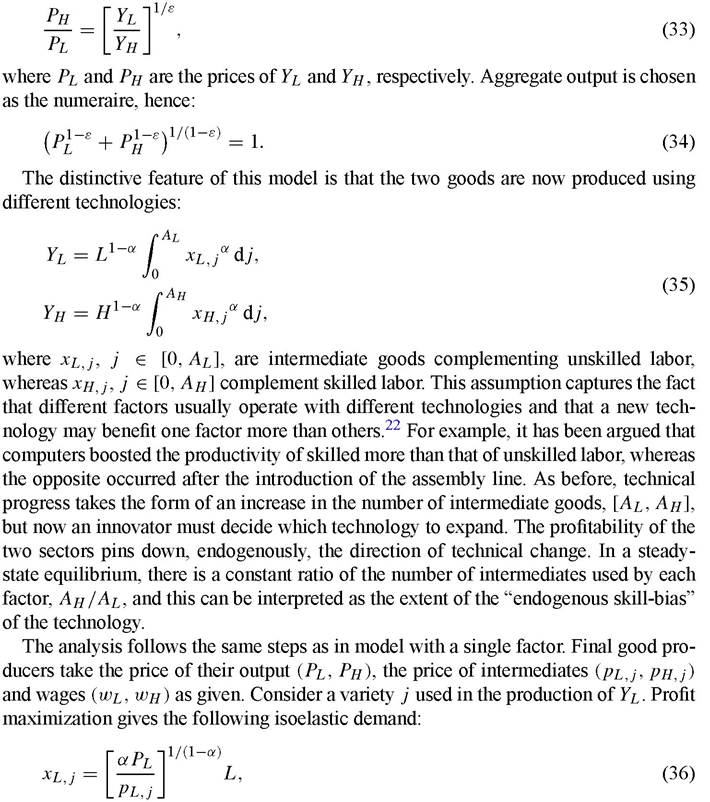
and an equivalent expression for xHj.
The intermediate good sector is monopolistic, with each producer owning the patent for a single variety. The cost of producing one unit of any intermediate good is one 22 The analysis can be generalized to specifications where, in the spirit of Heckscher-Ohlin models, each sector uses all productive factors, but factor intensities differ across sectors.
The model can also be generalized to more than two factors and sectors.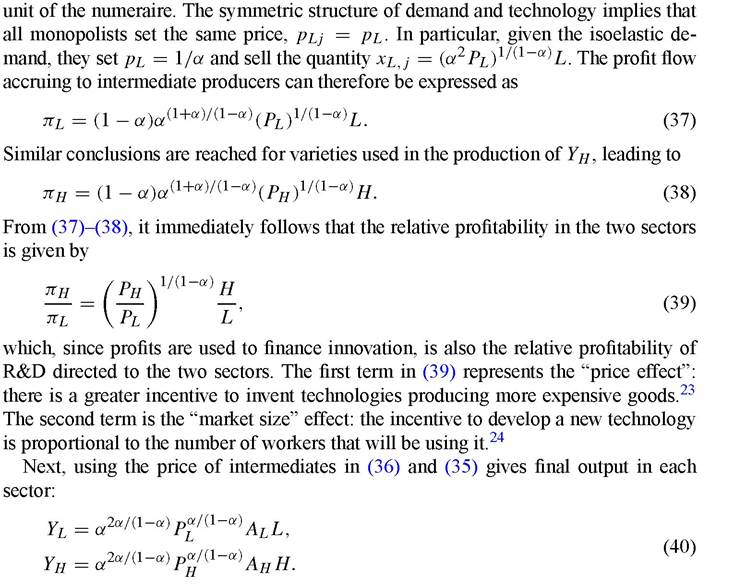
Note the similarity with (16). As in the benchmark model, output - in each sector - is a linear function of technology and labor. But sectoral output now also depends on sectoral prices, Pl and Ph, since a higher price of output increases the value of productivity of intermediates, but not their costs, and therefore encourages firms to use more of them, thereby raising labor productivity. Note that this is not the case in the one-sector model since there, the price of output is proportional to the price of intermediates.
We can now solve for prices and wages as functions of the state of technology and endowments. Using (40) into (33) and noting that the wage bill is a constant fraction of sectoral output, yields:

[1] The price effect, restated in terms of factor prices, was emphasized by Hicks (1932) and Habakkuk (1962).
[1] Market size, although in the context of industry- and firm-level innovation, was emphasized as a determinant of technical progress by Griliches and Schmookler (1963), Schmookler (1966) and Schumpeter (1942).
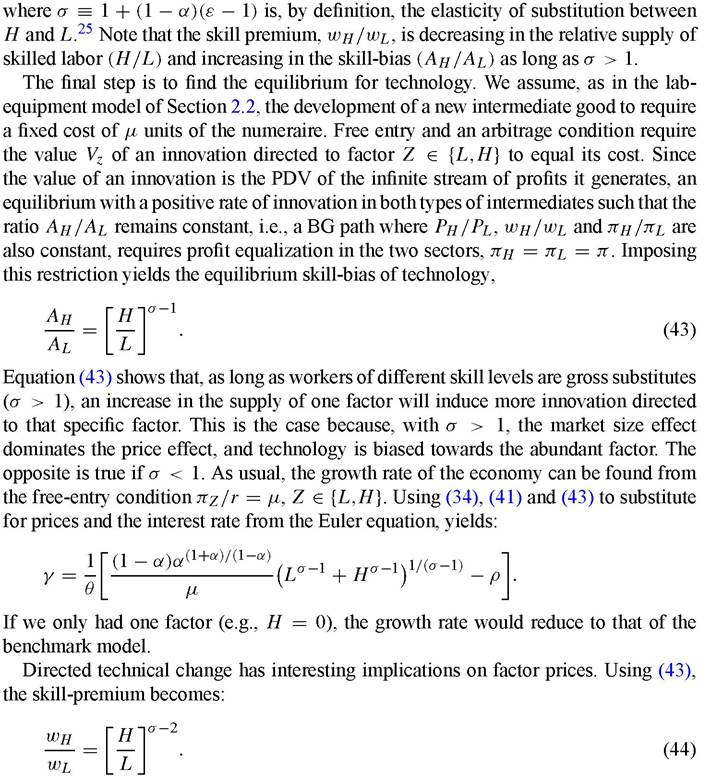
Equation (44) shows that the slope of the labor demand curve, i.e., the relationship between relative wages and relative labor supply, canbe either positive or negative and is the result of two opposite forces. Onthe one hand, a large supply of one factor depresses the price of its product while, on the other hand, it induces a technology bias in its favor, thereby raising its productivity. A high substitutability between H and L implies a weak price effect of an increase in relative supply, which makes a positive relationship more likely.
In particular, if σ > 2, the market size effect is sufficiently strong to not This is the short-run elasticity of substitution between L and H, for a given technology Al and Ah ∙ only dominate the price effect on technical change (see Equation (43)), but also the substitution effect between skilled and unskilled workers at a given technology.25
This result can help rationalize several facts. First, it suggests that technical change has been skill biased during the past 60 years, because of the steady growth in the supply of skilled labor. Second, the case σ > 2 offers an explanation for the fall and rise in the US skill premium during the 1970s and 1980s. In the 1970s, there was a large increase in the supply of skilled labor (H/L). Assumingthis shock to be unexpected, the model predicts an initial fall in the skill premium (recall that Ah/Al is a state variable that does not immediately adjust), followed by its rise due to the induced skill biased technical change, a pattern broadly consistent with the evidence.
In Acemoglu (2003b), this set-up is used to study the direction of technical progress when the two factors of production are capital and labor. Beyond the change of notation, the resulting model has an important qualitative difference, as capital can be accumulated. The main finding is that, when both capital and labor augmenting innovations are allowed, a balanced growth path still exists and features labor-augmenting technical progress only. The intuition is that, while there are two ways of increasing the production of capital-intensive goods (capital-augmenting technical change and accumulation), there is only one way of increasing the production of labor-intensive goods (laboraugmenting technical progress). Therefore, in the presence of capital accumulation, technical progress must be more labor-augmenting than capital-augmenting. Further, Acemoglu shows that, if capital and labor are gross complements (i.e., the elasticity of substitution between the two is less than one), which seems to be the empirically relevant case [see, for example, Antras (2004)], the economy converges to the balanced growth path.
Finally, the theory of directed technical change can be used to study which industries attract more innovation and why R&D intensity differs across sectors. In this exercise, following a modified version of Klenow (1996), we abstract from factor endowments as determinants of technology, by assuming there to be a single primary input, which we call labor. Instead, other characteristics can make one sector more profitable than others. Major explanations put forward in the literature on innovation are industry differences in technological opportunities, market size and appropriability of rents, all factors that can easily be embedded in the basic model with two sectors. In particular, to capture the market size hypothesis, we introduce a parameter η defining the relative importance of industry i in aggregate consumption:

Differences in technological opportunities can be incorporated by allowing the cost of an innovation, μi, to vary across sectors. Finally, we assume that an inventor in industry i can only extract a fraction λi of the profits generated by his innovation. The previous analysis carries over almost unchanged, with the main difference that we now need to solve for the allocation of labor across industries. This can be done requiring all
industries to pay the same wage, i.e., setting (42) equal to one:
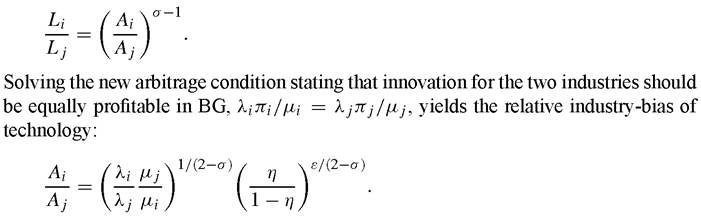
As expected, industries with a larger market size, better technological opportunities and higher appropriability attract more innovations.26 Empirical estimates surveyed by Cohen and Levin (1989) suggest that about one half of the industry differences in research intensity can be attributed to the available measures of these three factors.
4.2. Appropriate technology and development
Directed technical change has interesting implications for the analysis of some development issues.
Acemoglu and Zilibotti (2001) show that technologies resulting from directed technical change are optimal for the economic conditions of the markets where they are sold. They analyze the implications of this finding in a two-country world where technological innovation takes place in the North, and the South does not enforce (or imperfectly enforce) IPRs. In this environment, innovators in the North can only extract rents from selling technologies (embodied in new varieties of intermediate goods) in the Northern market, since new technologies can be copied and locally produced in the South. Thus, innovation does not respond to the factor endowment of the South: the equilibrium skill-bias of technical change (see Equation (43) in the previous section) is determined by the factor endowment of the North only. In this sense, technological development tends to be “inappropriate” for the South: there is too much investment in inventing new technologies augmenting the productivity of skilled workers, and too little in inventing new technologies augmenting the productivity of unskilled workers. Such excessive skill-bias prevents the South from fully profiting from technological improvements. The theory can explain North-South productivity differences, even when the technology is identical and there are no significant barriers to technology adop- tion[50] [51]We start by studying the set of advanced countries, called North. A continuum of measure one of final goods is produced by competitive firms. Final goods, indexed by i ∈ [0,1], are aggregated to give a composite output, Y = exp(∕01 log yi di), which is the numeraire. There are two differences with respect to the model of the previous section: first, there is a continuum of sectors, not just two, and second, the elasticity of substitution between sectors is unity.[52] Each good i can be produced with both skilled and unskilled labor using two sets of intermediate goods: intermediates [0,Al] used by unskilled workers only and intermediates [0,Ah] used by skilled workers only. Therefore, despite the continuum of sectors, there are only two types of technologies, as in the basic model of directed technical change. The production function takes the following form:

where li and hi are the quantities of unskilled and skilled labor employed in sector i, respectively, and χzvi is the quantity of intermediate good of type v used in sector i together with the labor of skill level z = L, H. Note that sectors differ in laboraugmenting productivity parameters, (1 - i) for the unskilled technology and i for the skilled technology, so that unskilled labor has a comparative advantage in sectors with a low index. Producers of good i take the price of their product, Pi, the price of intermediates (pL,υ, pHv) and wages (wL, wH) as given. Profit maximization gives the following demands for intermediates:

The intermediate good sector is monopolistic. Each producer holds the patent for a single type of intermediate good v, and sells its output to firms in the final good sectors. The cost of producing one unit of any intermediate is conveniently normalized to α2 units of the numeraire. Profit maximization by monopolists implies that prices are a constant markup over marginal costs, p = α. Using the price of intermediates together with (46) and (45) gives the final output of sector i as a linear function of the number of intermediate goods and labor:

From (47), it is easily seen that all sectors whose index i is below a threshold level J will use the unskilled technology only and the remaining sectors will employ the skilled technology only. This happens because of the comparative advantage of unskilled workers in low index sectors and the linearity of the production function (there is no incentive to combine the two technologies and, for a given i, one always dominates the other).
The total profits earned by monopolists are:29
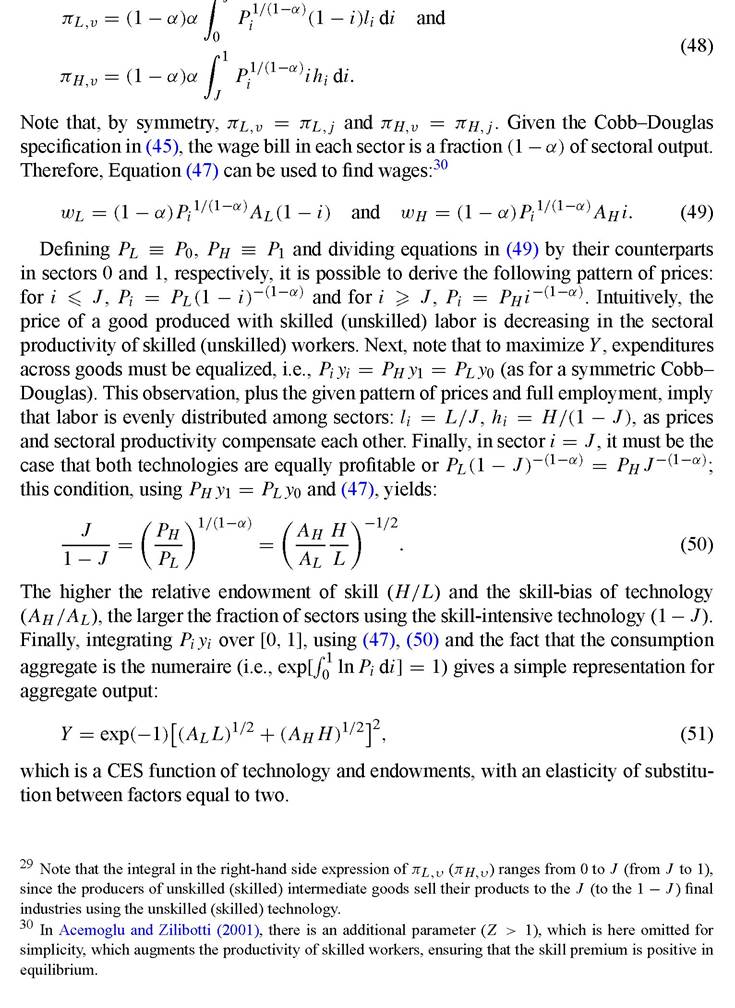
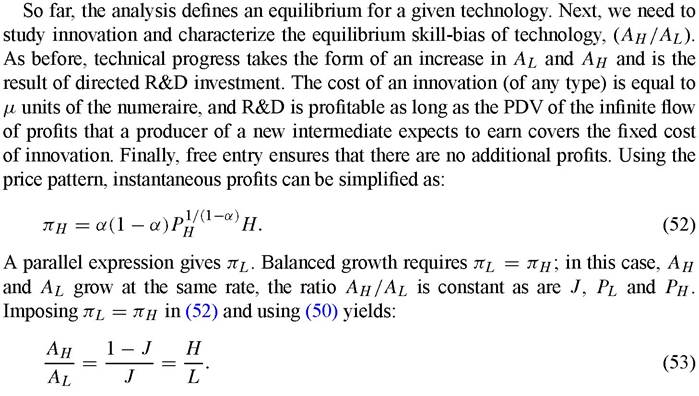
Note that the equilibrium skill-bias is identical to that of (43) in the special case when σ = 2. Further, (53) shows that the higher is the skill endowment of a country, the larger is the range of sectors using the skilled technology. This is a complete characterization of the equilibrium for fully integrated economies developing and selling technologies in their markets with full protection of IPRs and can be interpreted as a description of the collection of rich countries, here called the North.
Consider now Southern economies, where skilled labor is assumed to be relatively more scarce: Assume that intellectual property rights are not en
forced in the South and that there is no North-South trade. It follows that intermediate producers located in the North cannot sell their goods or copyrights to firms located in the South, so that the relevant market for technologies is the Northern market only. Nonetheless, Southern producers can copy Northern innovations at a small but positive cost. As a consequence, no two firms in the South find it profitable to copy the same innovation and all intermediates introduced in the North are immediately copied (provided that the imitation cost is sufficiently small) and sold to Southern producers by a local monopolist. Under these assumptions, firms in the South take the technologies developed in the North as given and do not invest in innovation.[53] This means that both the North and the South use the same technologies, but , i.e., the
skill-bias is determined by the factor endowment of the North, since this is the only market for new technologies. Except for this, the other equilibrium conditions also apply to the South after substituting the new endowments, Hs and Ls.
We are now ready to answer the following questions: are technologies appropriate for the skill endowment of the countries where they are developed? What happens to aggregate productivity if they are used in a different economic environment?
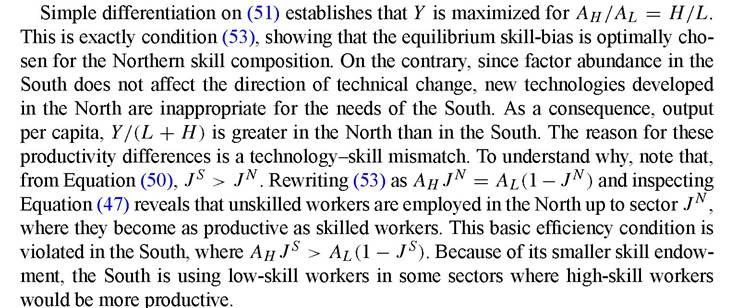
This result can help understand the existence of substantial differences in TFP across countries, even when the technology is common. In particular, Acemoglu and Zilibotti (2001) compare the predictive power of their model in explaining cross-country output differences with that of a comparable neoclassical model, where all countries have access to the same technologies and output is Cobb-Douglas in labor, human and physical capital. Their computations suggest that the proposed mechanism can account for one-third to one half of the total factor productivity gap between the United States and developing countries. Predictions on the pattern of North-South, cross-industry, productivity differences are also tested. Since the South uses the same technology [Al, Ah ] as the rest of the world, but it has a higher relative price for skill-intensive goods, it follows that the value of productivity in LDCs relative to that of the North should be higher in skill-intensive sectors. The empirical analysis supports this prediction.
The view that countries adopt different technologies out of a world “menu”, and that the choice of the appropriate technology depends on factor endowments, particularly on the average skill of the labor force, finds support in the analysis of Caselli and Coleman (2005). However, these authors also find that many poor countries choose technologies inside the world technology frontier, thereby suggesting that barriers to technology adoption may also be important to explain the low total factor productivity of these countries.
4.3. Trade, inequality and appropriate technology
We have seen that directed technical change can help understand inequality, both within and between countries. Several authors have stressed that international trade is another important determinant of income distribution. For example, Wood (1994) argues that the higher competition with imports from LDCs may be responsible for the deterioration in relative wages of low-skill workers in the US in the past decades. Further, there is a widespread concern that globalization may be accompanied by a widening of income differences between rich and poor countries. Although the analysis of these issues goes beyond the scope of this paper, we want to argue that R&D-driven endogenous growth models can fruitfully be used to understand some of the links between trade and inequality. In particular, we now show that trade with LDCs can have a profound impact on income distribution, beyond what is suggested by static trade theory, through its effect on the direction of technical change. By changing the relative prices and the location of production, international trade can change the incentives for developing innovations targeted at specific factors or sectors, systematically benefiting certain groups or countries more than others. A key assumption in deriving these results is that, as in the previous paragraph, LDCs do not provide an adequate protection of IPRs.
First, consider the effect of trade in the benchmark model of directed technical change. The analysis follows Acemoglu (2002, 2003a). Recall that the profitability of an innovation depends on its market size and the price of the goods it produces, as in Equation (39). What happens to technology if we allow free trade in Yl and Yh between a skill-abundant North and a skill-scarce South? The market size for innovations does not change, because inventors continue to sell their machines in the North only. But trade, at first, will increases the relative price of skill-intensive goods in the North. To see this, note that trade generates a single world market with a relative price depending on the world supply of goods. Since skills are scarcer in the world economy than in the North alone, trade will increase the relative price of skill-intensive goods in the North (the opposite will happen in the South). In particular, world prices are now given by Equation (41) using world endowments:

This change in prices, for a given technology, makes skill-complement innovations more profitable and accelerates the creation of skill-complementary machines. Since, along the BG path, both types of innovations must be equally profitable and hence πh = πl, Equation (39) shows that this process continues until the relative price of goods has returned to the pre-trade level in the North. Substituting Equation (54) into (39) and imposing πh = πl, yields the new equilibrium skill bias of technology:

Given that Hn∕Ln > Hw ∕Lw,the new technology is more skill-biased and skilled workers in the North earn higher wages. The effect on the skill premium can be seen by substituting (55) into (42):


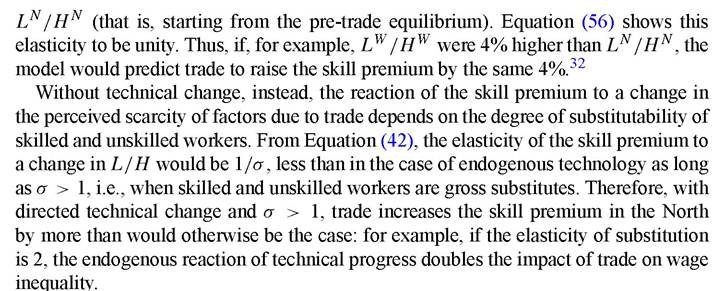
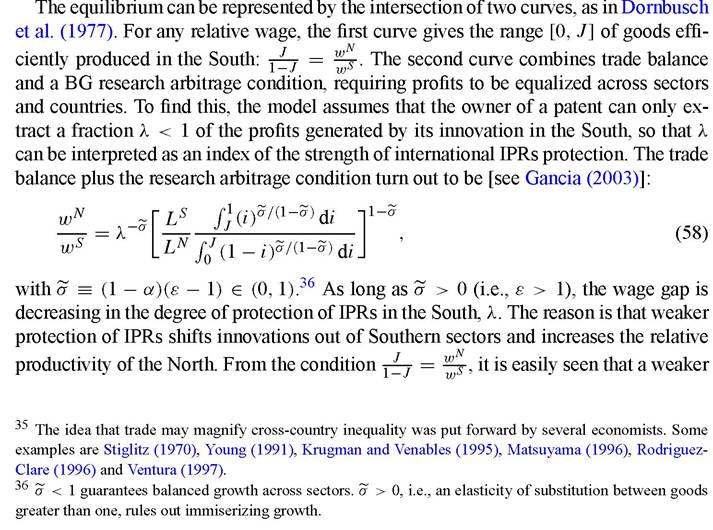
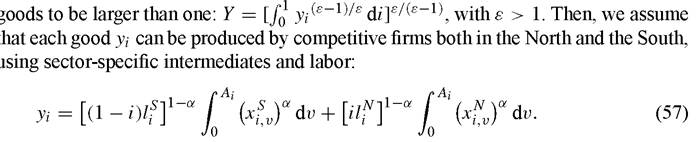
Note that another direct channel through which trade can affect factor prices in models of endogenous technical change is by affecting the reward to innovation. If trade increases the reward to innovation (for example, through the scale effect) and the R&D sector is skill-intensive relative to the rest of the economy, trade will naturally spur wage inequality. This mechanism is studied by Dinopoulos and Segerstrom (1999) in a quality-ladder growth model with no scale effects.[54] [55] What are the implications of trade opening for cross-country income differences? We have seen that trade induces a higher skill bias in technology; given the result of Acemoglu and Zilibotti (2001) that the excessive skill-complementarity of Northern technologies is a cause of low productivity in Souther countries, it may seem natural to conclude that trade would then increase productivity differences. However, this conclusion would be premature. In the absence of any barriers, trade equalizes the price of goods; given that the production functions adopted so far rule out complete specialization, this immediately implies that factor prices and sectoral productivity are also equalized. This does not mean that trade equalizes income levels; because of their different skill-composition, the North and the South will still have differences in income per capita, but nothing general can be said.[56] The fact that trade generates productivity convergence crucially depends on factor prices being equalized by trade. Since factor price equalization is a poor approximation of reality, it is worth exploring the implications of models with endogenous technologies when this property does not hold. A simple way of doing this is to add Ricardian productivity differences, so that trade opening leads to complete specialization. In this case, the endogenous response of technology to weak IPRs in LDCs becomes a force promoting productivity divergence.35 Further, trade with countries providing weak protection for IPRs may have an adverse effect on the growth rate of the world economy. These results, shown by Gancia (2003), can be obtained by modifying Acemoglu and Zilibotti (2001) as follows. First, we allow the elasticity of substitution between final t ι There are three important differences with respect to (45). First, (1 - i) and i now capture Ricardian productivity differences between the North and South, implying that the North is relatively more productive in high index sectors. Second, intermediate goods are sector specific, not factor specific (there is now a continuum [0, 1] of technologies, not only two). Third, there is only one type of labor. Given that the endogenous component of technology (Ai) is still assumed to be common across countries, the sectoral North-South productivity ratio only depends on the Ricardian elements. The new implication is that countries specialize completely under free trade, as each good is only manufactured in the location where it can be produced at a lower cost. protection of IPRs in the South, by raising wN/wS, is accompanied by a reduction in sectors [1 - J] located in the North, because higher wages make the North less competitive. A second result emerges by calculating the growth rate of the world economy. In particular, Gancia (2003) shows the growth rate of the world economy to fall with λ and approach zero if λ is sufficiently low. The reason is that a lower λ shifts innovation towards Northern sectors and, at the same time, induces the relocation of more sectors to the South, where production costs become lower. This, in turn, implies that a wider range of goods becomes subject to weak IPRs and hence, to a low innovation incentive. 5.