Trade, growth and imitation
Growth models with an expanding variety of products are a natural dynamic counterpart to the widely-used trade models based on increasing returns and product differentiation developed in the 1980s [e.g., Helpman and Krugman (1985)].
As such, they offer a simple framework for studying the effects of market integration on growth and other issues in dynamic trade theory. Quality-ladder models have also been proposed in this literature, but they are a less natural counterpart to the static new trade theory, as they do not focus on the number of varieties available in an economy and their growth rate. As we shall see, economic integration can provide both static gains, through the access to a wider range of goods, and dynamic gains, through an increase in the rate at which new varieties are introduced. However, the results may vary when integration is limited to commodity markets with no international diffusion of knowledge [Rivera-Batiz and Romer (1991a)] and when countries differ in their initial stock of knowledge [Devereux and Lapham (1994)].Finally, the analysis in this section is extended to product-cycle trade: the introduction of new products in advanced countries and their subsequent imitation by less developed countries. An important result will be to show that, contrary to the closed economy case, imitation by less developed countries may spur innovation and growth [Helpman (1993)].
3.1. Scale effects, economic integration and trade
In this section, we use the benchmark model to discuss the effects of trade and integration. The model features scale effects. Take two identical countries with identical labor endowment, L = L*. In isolation, both countries would grow at the same rate, as given by (15). But if they merge, the growth rate of the integrated country increases to:
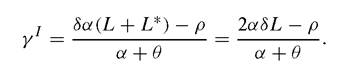
Therefore, the model predicts that economic integration boosts growth.
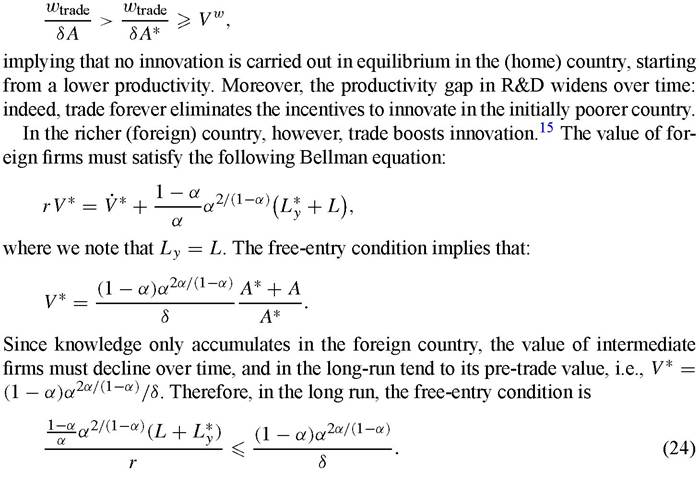
Integration, even if beneficial, may be difficult to achieve. However, in many instances, trade operates as a substitute for economic integration. Rivera-Batiz and Romer (1991a) analyze under which condition trade would attain the same benefits as economic integration. To this aim, they consider two experiments:[42] [43] 1. The economies can trade at no cost in goods and assets, but knowledge spillovers remain localized within national borders; 2. In addition, knowledge spillovers work across borders after trade. In both cases, to simplify the analysis, the two economies are assumed to produce, before trade, disjoint subsets of intermediate goods. This assumptions avoids complications arising from trade turning monopolies into duopolies in those industries which exist in both countries. Clearly, after trade, there would be no incentive for overlap in innovation, and the importance of inputs that were historically produced in both countries would decline to zero over time. We start from the case analyzed by Rivera-Batiz and Romer (1991a), where the two countries are perfectly identical before trade. Namely, L = L* and A0 = A0, where the star denotes the foreign economy, and time zero denotes the moment when trade starts. Since, in a BG equilibrium, γ = δLx, trade can only affect growth via the split of the workforce between production and research. Such a split, however, is not affected by trade, for in the symmetric equilibrium, trade increases the productivity of workers in production and the profitability of research by the same proportion. Since both the cost and private benefit of innovation increase by the same factor, investments in innovation remain unchanged. More formally, the after trade wage is which is twice as large as in the pre-trade equilibrium since at the moment of trade liberalization, A = A*. The free-entry condition becomes, for both countries: which, after simplifying, is identical to (12). Therefore, the split of the workforce between production and research remains unchanged, and trade has no permanent effects on growth. Opening up to free trade, however, induces a once-and-for-all gain: both output and consumption increase in both countries, similarly to an unexpected increase in the stock of knowledge, since final producers in both countries can use a larger set of intermediate goods. This result is not robust to asymmetric initial conditions. Devereux and Lapham (1994) show that if, initially, the two countries have different productivity levels, trade leads to specialization and a rise in the world growth rate.13 Consider the economies described above, but assume that A0 < A0. Recall that free-entry implies: where V, V * denote the PDV of profits for an intermediate firm located at home and abroad, respectively. First, trade in intermediate goods and free capital markets equalize the rate of return to both financial assets (r) and labor (w).[44] [45] Second, monopoly profits are independent of firms’ locations, thereby implying that the value of firms must be the same all over the world: V = V * = Vw. Therefore, at the time of trade liberalization, we must have: [1] See also Rivera-Batiz and Romer (1991b) on the effects of trade restrictions with asymmetric countries. Comparing (24) with (12) shows that trade reduces employment in production and, consequently, increases the long-run research activity in the foreign country, which implies that trade increases growth. In terms of Fig. 1, trade creates an outward shift in the DD schedule, leading to a higher interest rate and faster growth in equilibrium. The result can be interpreted as trade leading to specialization. The home country specializes in final production, while the foreign country diversifies between manufacturing and innovation.[46] This is efficient, since there are country-wide economies of scale in innovation. Although trade leads to zero innovation in the home country, markets are integrated: final good producers, in both countries, can use the same varieties of intermediates and all consumers in the world can invest in the innovative firms of the foreign economy. Therefore, the location of innovation and firms has no impact on the relative welfare of the two countries. Consider now the case when trade induces cross-country flows of ideas, i.e., if the knowledge spillover is determined, after trade, by the world stock of ideas contained in the union of A and A*. When free trade is allowed, the accumulation of knowledge in each country is given by Even if trade did not affect the allocation of the workforce between production and research, the rate of growth of technology would increase. But there is an additional effect; the larger knowledge spillover increases labor productivity in research, inducing an increase of employment in research. Formally, the total effect is equivalent to an increase in parameter S. In terms of Figure 1, trade in goods plus flow of ideas imply an upward shift of the DD locus for both countries. Hence, trade attains the same effect as economic integration (increasing S is equivalent to increasing L). This result is robust to asymmetric initial conditions. 3.2. Innovation, imitation and product cycles The model just presented may be appropriate for describing trade integration between similar countries, but it misses important features of North-South trade. In a seminal article, Vernon (1966) argued that new products are first introduced in rich countries (the North), where R&D capabilities are high and the proximity to large and rich markets facilitates innovation. After some time, when a product reaches a stage of maturity and manufacturing methods become standardized, the good can easily be imitated and then, the bulk of production moves to less developed countries (the South), to take advantage of low wages. The expanding variety model provides a natural framework for studying the introduction of new goods and their subsequent imitation (product cycle trade).[47] We have already discussed imitation within the context of a closed economy. Here, we extend the analysis to the case where a richer North innovates, while a poorer South only engages in imitation. The analysis yields new results that modify some of the previous conclusions on the effect of imitation on innovation. The key questions are, first, how the transfer of production to the South through imitation affects the incentives to innovate and, second, how it affects the income distribution between North and South. Following Helpman (1993), consider a two-region model of innovation, imitation and trade. Assume that R&D, producing new goods, is performed in the North only and that costless imitation takes place in the Southat a constant rate mιs The imitation rate can be interpreted as an inverse measure of protection of Intellectual Property Rights (IPRs). Once a good is copied in the South, it is produced by competitive firms. Therefore, at every point in time, there is a range of goods produced by monopolists in the North and a range At of goods that have been copied and are produced in the South by competitive firms. We use the “labor-for-intermediates” version of the growth model, so that the price of a single variety depends on the prevailing wage rate in the country where it is manufactured. This is an important feature of product cycle models, allowing the North to benefit from low production costs in the South for imitated goods. Therefore, we define the aggregate production function as in (18): 18 The rate of imitation is made endogenous in Grossman and Helpman (1991b). it becomes apparent that a reduction of m increases the share of goods manufactured in the North, both through its direct effect and by reducing γ and r. To understand these results, note that stronger IPRs have two opposite effects. First, a lower imitation rate prolongs the expected duration of the monopoly on a new product developed in the North, thereby increasing the returns to innovation. Second, since firms produce for a longer time in the North, it rises the demand for Northern labor, wN, and hence, the cost of innovation. For the specification with log utility, the latter effect dominates and innovation declines. More generally, the link between the rate of imitation and innovation can go either way [as in Grossman and Helpman (1991a)]. However, the important result here is that tighter IPRs does not necessarily stimulate innovation in the long run. The effect of IPRs on the North-South wage ratio can be found using (27), together with the relative demand for intermediates:19 η1∕ε tιon (30)), a tightening of IPRs raises the relative wage of the North. Helpman (1993) computes welfare changes in the North and in the South (including transitional dynamics) after a change in the imitation rate m, and concludes that the South is unambiguously hurt by a decline in imitation. Moreover, if the imitation rate is not too high, the North can also be worse-off. More recent papers on product cycles, incorporating the notion that stronger IPRs make relocation of production to the South a more attractive option, have come to different conclusions. For example, by assuming that Northern multinationals can produce in the South and that Southern firms can only imitate after production has been transferred to their country, Lai (1998) shows that stronger IPRs increase the rate of product innovation and the relative wage of the South. Similarly, Yang and Maskus (2001) find that if Northern firms can license their technology to Southern producers, being subject to an imitation risk, stronger IPRs reduce the cost of licensing, free resources for R&D and foster growth, with ambiguous effects on relative wages. Finally, the literature on appropriate technology [e.g., Diwan and Rodrik (1991), Acemoglu and Zilibotti (2001), Gancia (2003)] has shown that, when the North and the South have different technological needs, the South has an incentive to protect IPRs in order to attract innovations more suited to their technological needs. Some of these results are discussed in the next sections. 4.