Empirical structures
By ‘empirical structure’ I mean a set-theoretic structure that records, in a systematic way, empirical observations about some aspect or aspects of a previously determined Subjekt.
These can be data related to the aggregate production of a concrete economy during a certain period of time (e.g. the American economy from 1919 to 1929); tables reporting positions of “sparkling points” in the sky during a “long series of nights”, or the data resulting from the comparison of several bodies, as to their weight, by means of an equal-arms balance. Other examples are given by tables recording the observation of business cycles or, more recently, by Patrick Suppes’ record of electroencephalographic data collected in order to establish brain representations of words.3It is not the case that the data collected by means of systematic observations are always recorded in order to test or apply a previously given theory; i.e. they are not necessarily embedded into a partial potential model of some theory T For instance, in spite of their rich algebraic and computational tradition, the Babylonian astronomers did not produce anything that might be deemed as a ‘theory’ of planetary motion similar to that of Ptolemy. This situation is also typical in econometrics, where it is common the production of statistical correlations without the use of much theory. These correlations, normally obtained through the method of ordinary least squares, constitute an elementary form of idealization for which there is nothing resembling a concretization process. But this method is only one of the many methodologies used in order to interpret or organize quantitative observations: the wealth of data in the different sciences is so overwhelming, and the range of methodologies used in quantitative observations is so vast, “that in their full detail [they] are theoretically immeasurable” (cf.
Suppes 2011: 119).Essentially, empirical structures are sets of n-tuples (x1,..., xn), whose coordinates are taken as belonging to certain empirical categories X1,..., Xn. For instance, X1 may be required to be a set of consecutive years, X2 the recorded annual GNP of a country during these years, and so on. These data are usually presented in tables and stored in databases.
Some empirical structures are built in order to serve the purposes of a given scientific theory. These purposes are varied: testing of a particular theoretical systematization, application, or computation of a particular magnitude. At a micro- logical level, sometimes a particular form of a magnitude is posited in order to explain some phenomenon, in which case empirical data are used to check the accuracy of that form. Sometimes, the point is not to check whether the theory is good, but just to apply it in order to obtain realizations useful for some particular purpose (for instance, information in order to put a satellite in a required orbit), or just to compute the value of some magnitude (like the mass of the sun).
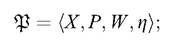
A typical scientific endeavor is that of trying to imbed a data-structure into a partial potential model of a certain theory T For the sake of the example, let us suppose that, out of the observation of the behavior of a consumer, we get a structure of data of the following form:

where X is a set of vectors representing the consumption vectors available to the agent, F is a finite subset of P ? W, P is the family of all possible price systems (vectors), W is the interval of all possible levels of wealth for the agent, and η is a function defined over F recording the observed choice of the agent at each level of prices and wealth (p, w). Function η is obviously finite and discrete, and can be presented as in Table 4.1.
If ≥ is the preference relation of the agent (usually represented by some utility function u: X → R), the models of consumer choice theory T are of the form
74" class="lazyload" data-src="/files/uch_group77/uch_pgroup302/uch_uch7196/image/image073.jpg">
and are defined as those potential models that satisfy the law of utility maximization: η(p, w) is actually optimal within the set {x 2 X∣pχ ≤ w}. Since ≥ (and hence u) indeed smells like T-theoretical, the partial potential models of T have the following aspect:

(Recall that r is the functor that eliminates the theoretical terms of the potential models of T.) Thus, the problem is to show that D is ‘approximately’ imbedded in
that is to say, there exists a partial potential model

such that D is imbedded in p^ and p^ ≈ P (see Figure 4.1).
Table 4.1 Empirical structure D represented as a table
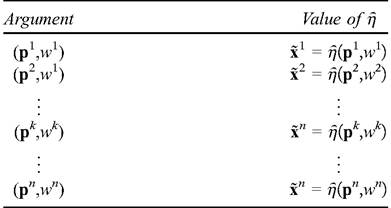
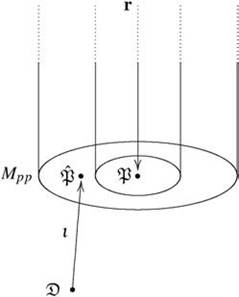
Figure 4.1 Approximated imbedding (ι) of empirical structure D into P
4.3