The structuralist view of theories
Perhaps the most notorious trait of SVT is its famous distinction between terms theoretical with respect to a theory T, T-theoretical, and those terms that are non-theoretical. It is important to stress that this distinction has nothing to do with the old positivist distinction between theoretical (‘non-observational’) terms and observational ones.
The SVT criterion to make the distinction is between those relations that can be determined independently of the laws of the theory, at least in some cases, and those that presuppose that some application of theory T is successful. According to Sneed (1971: 32-3),An example of a T-dependent function is the mass function in an application of classical particle mechanics to a projectile problem. In this case we typically determine the mass of the projectile by “comparing” it to some standard body with a device like an analytical balance or an Atwood’s machine. What we are doing, albeit indirectly, is determining the ratio of the mass of the projectile and the mass of an arbitrarily chosen standard. But, the only reason we believe that these comparison procedures yield mass-ratios, and not just numbers, completely unrelated to classical particle mechanics, is that we believe classical particle mechanics applies (at least approximately) to the physical systems used to make the comparisons. If someone asks why the number (a/g — 1/a/g + 1), calculated from the acceleration observed in an Atwood’s machine experiment, is the mass-ratio of the two bodies involved, we reply by deriving it from the application of classical particle mechanics to this system. I maintain that examination of any acceptable account of how the mass of a projectile might be determined would reveal the same sort of dependence on an assumption that classical particle mechanics applied to the physical system used in making the mass determination.
According to Sneed, there are in cpm, as a matter of fact, exactly two cpm theoretical terms: mass (m) and force (f).6 Be that as it may, in any sophisticated theory, certainly in developed economic theories, terms that are theoretical relative to that theory are expected to be found.
The existence of T-theoretical terms poses problems when someone tries to employ the set-theoretical predicate in order to produce empirical claims. For example, at first sight, an empirical assertion produced by means of the set- theoretical predicate that defined the models of cpm would consist of a sentence like the following:
(1) ‘the motion of this brick along this inclined plane is a system of cpm’
or, in general, where letter σ denotes a concrete physical system,
(2) ‘physical system σ is a system of cpm’.
Nevertheless, due to reasons already exposed in the previous section, a sentence of the form (2) can never be true because the predicate ‘system of cpm’ is true only of mathematical structures, and physical systems are not mathematical structures. It is clear that the subject of predication of empirical assertions has to be a being of the appropriate category.
An entity of the appropriate category that lends itself as a viable subject of predication is a possible model of the theory; i.e. a mathematical structure of the adequate type about which we ignore, in a first moment, whether it satisfies the laws of the theory. Recall that a possible model of cpm would be a structure A = (P, T, s, m, f i that satisfies the characterizations. The empirical assertion would consist precisely of the claim that A satisfies, in addition, the laws of the theory; i.e. it would consist of the claim:
(3) ‘A is a system of cpm’.
Suppose now that to each (putative) real-concrete mechanical system σ 2 Σ there corresponds a possible model As which can be considered as a candidate to represent concrete system σ. A mediated way of saying that cpm applies to σ would consist of affirming the sentence
(4) ‘As is a system of cpm’.
Now, in order to know the truth-value of sentence (4) we need to know the values of the functions in As. The problem is that, since As contains срм-theoretical functions, we cannot determine such functions unless we have good reasons to assume that a claim of the form ‘As, is a system of cpm’ is true, where σ' can be the same concrete system σ or a different one. Therefore, we cannot have the required evidence to know whether As is system of cpm unless we have evidence to know whether As is a system of cpm. Thus, we seem to be confronting a vicious circle or a regressus ad infinitum. This difficulty, which arises whenever we want to use a scientific theory in order to make an empirical claim, is what Sneed has called “the problem of theoretical terms” (which, again, has nothing to do with the logical-empiricist problem of the same name).
In order to solve this problem Sneed was led to the Ramsey sentence. As we have pointed out before, the non-T-theoretical part of a possible model is called a “partial potential model”. Recall that in the case of cpm partial potential models are structures of the form (P, T, s}.
If T is a scientific theory, let M be the class of its models, Mp the class of the potential models, and Mpp that of its partial potential models. Then we have the following relationships: M C Mp and to each element of Mp there corresponds an element of Mpp which results from eliminating the theoretical components of the first. We can represent this correspondence by means of a “forgetful functor” or “cutting-off’ function r: Mp → Mpp. If A 2 Mp, r(A) 2 Mpp shall be called the reduct of A. Suppose now, for the sake of the example, that to each real-concrete mechanical system σ 2 Σ there corresponds a collection of partial potential models {As} that can reasonably be considered as adequate representations of σ.
If σ is, say, the sun-earth system, a typical element of {As} would be a structure that satisfies Kepler’s laws. Hence, a mediated way of saying that (the regional theory of gravitation) of cpm applies to σ consists of asserting the Ramsey sentence
where Bs 2 {As}. The Ramsey sentence solves the problem of theoretical terms, since it only asserts that a structure made up of purely non-T-theoretical terms can be expanded to a structure that is a model of theory T.
Nevertheless, sentence (5) is at best incomplete. In the first place, it does not take into account the fact that diverse applications of the theory are interrelated by certain constraint, that is, certain conditions imposed upon the theoretical terms. An example of a constraint is the one that claims that the mass function of a body with constant mass must receive the same value in all the structures to whose universe it belongs, up to transformations of the system of units. In the second place, sentence (5) asserts a rather strong condition, since it implies that if Bs is an adequate representation of σ, produced independently of the theory T, then there is a model of T whose reduct coincides point by point with Bs. This may turn out to be true but, usually, effectively produced models only match the observed data with a certain degree of approximation. We saw this in our example of the inclined plane, in which the model sets the motion of the brick in 2.198 seconds. Substituting this number for t in (1/2)g (sinα - μcosα)t2 we get 49.99261248 cm, which represents a deviation of 7.875144 ? 10-3 cm with respect to the value independently measured of the
distance traversed by the brick. Hence, it is necessary to reformulate the Ramsey sentence.
Taking into account the former observations, we can express the proposition that theory T applies to real-concrete system σ by means of the sentence

This shall be my first version of the empirical claims of a theory.
These claims can be condensed in a single sentence which is usually called ‘the empirical claim of the theory’. In order to be slightly more systematic, let me introduce some additional concepts.3.5.1 Definition
A theory core is a list of classes Mp, Mpp, r, M, C, such that, for fixed positive integers k, n, with k < n,
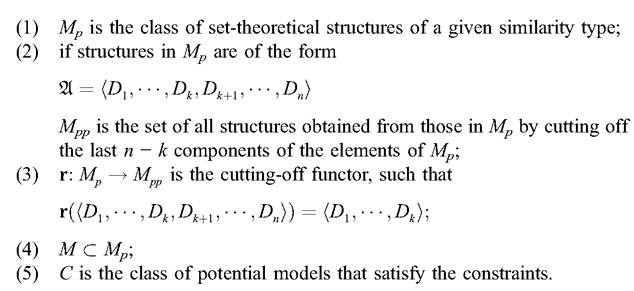
If T is a scientific theory, the structures in Mp are precisely those that satisfy the characterizations of the terms corresponding to D1,., Dk, Dk + і,..., Dn, and so Mp is a similarity type. Mpp turns out to be the class of all those structures that satisfy the characterizations that stipulate the meaning of the non-T-theoretical terms. M is the class of models of T; that is to say, of the structures in Mp that satisfy the nomological statements of T. C is the class of potential models that satisfy the constraints.
The notion of approximation is important in empirical science. Usually, when intra-theoretical approximation is discussed, the discussion is restricted merely to values of numerically-valued functions. It is said, for instance, that function f ‘approximates’ function g if the distance f(x) - g(x)| between the values of the functions is less than a specified positive real number ε. Each scientific theory T can be presumptively or effectively applied to a specified collection Σ of real-concrete systems, which can be described in a non-T-theoretical way. As a
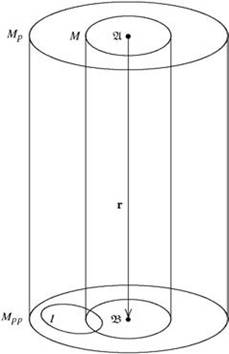
Figure 3.4 Structure of a theory-element
mater of fact, to each concrete system σ there may correspond several different representations (some better than others) in Mpp. Nevertheless, in order to simplify the exposition, I shall assume that to each σ 2 Σ there corresponds exactly one representation As 2 Mpp.
For each type of real-concrete systems σ = {σ}, there exists an admissible approximation relation ≈σ. The admissible degree of approximation between an independent description Bs of σ and a partial potential model r(A) 2 Mpp, obtained out of a model A, depends upon several historical and pragmatic conditions, among which is found the degree of development of the theory, of the measurement instruments, or the type of application in question: It is obvious that the degree of approximation which is required when a small force in a spring is measured does not have to be the same as that demanded when planetary motion is being determined. Thus, for each type of independent description σ we define fuzzy set Aσ as the set of all partial potential models which are admissible approximations for structures describing phenomena of type σ. If B 2 Aσ, we write Bs≈σB. We are now in position to introduce one of the central notions of SVT.
3.5.2 Definition
A theory-element is a triple of classes K, A, and I such that
(1) K = {Mp, Mpp, r, M, C) is a theory core;
(2) A is the class of all fuzzy sets;
(3) I C Mpp is the class of all independently built structures representing real-concrete phenomena to which the theory presumptively applies.
Theory-elements constitute the metatheoretical representations of regional theories. Each regional theory is identified by means of a theory-element. From now on, without loss ofgenerality, we shall assume that all models in M satisfy the constraints; i.e. Thus,
Thus,
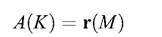
is the class of all partial potential models obtained by ‘derivation’ from models of T If s 2 σ is a real-concrete system, the claim that T applies to σ is a sentence expressing that to partial potential model Bs 2 I there corresponds a partial potential model B 2 r(M) such that Bs≈σB. Hence, the aggregated empirical claim of theory T can be defined as follows.
3.5.3 Definition 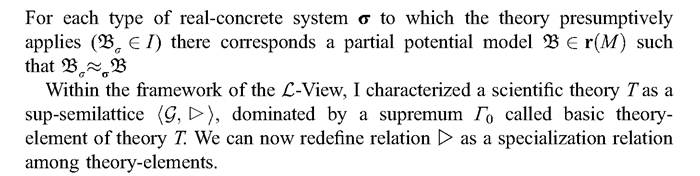
3.5.4 Definition
If E and E0 are theory-elements, then E0 is a specialization of E (E'f E) iff
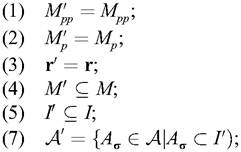
The SVT notion corresponding to (G, >) is that of a theory net, with which we close the present chapter.
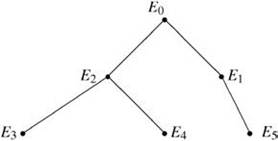
Figure 3.5 A theory net
3.5.3 Definition
A theory net T is a sup-semilattice (E, of theories. A recent defense of this view was given by Muller (2011), who introduces the concept of concrete actual being in order to perform this task. Indeed, according to Marx’s method of political economy, the subject (das Subjekt) of any science is real and concrete (real und konkret); it is an already given concrete organic whole (ein gegebnes konkretes, Iebendiges Ganzes) that remains outside the head (auβerhalb des Kopfes) independent of it (in seiner Selbstdndigkeit bestehen), and must always be kept in mind as a presupposition of the representation (als Voraussetzung stets der Vorstellung vorschweben), when the theoretical method (theoretische Methode) is employed.1
Even though Marx’s Subjekt (in economics), as described according to his method, is far from being “a fully determined real world independent of human description”, some extremely empiricist and instrumentalist philosophers would find it objectionable. Yet, some kind of conceptualization is necessary in order to fix the target system of any intended theorization, if only to know which empirical data or measurements might turn out to be relevant to its understanding, and indeed as a pre-condition to produce any idealized representation of it. Some philosophers have thought that nothing less than a full fledged metaphysical or ontological theory is required for this endeavor.2 Marx’s scientific practice seems to presuppose that only a certain minimal description of das Subjekt, the target system, is necessary in order to determine the real and concrete referent. This description is given by Marx, in the case of economics, in a language which contains general but not idealized terms. He says that, starting with a small number of determinant, abstract, general, and simple concepts (ein- fachste Bestimmungen) of aspects of the target system, a richer concept of the same is built by way of thought (im Weg des Denkens), as a concentration of many determinations (Zussamenfassung vieler Bestimmungen), as a unity of the diverse (Einheit des Mannigfaltigen). Clearly, this concept is not the real Subjekt, but only a ‘spiritual’ (geistig) reproduction of the same, just a concrete totality in thinking (Gedankentotalitdt, als ein Gedankenkonkretum, in fact ein Produkt des Denkens).
Marx claimed that in economics the real Subjekt always had to be seen as an organisches Ganzes and conceptualized, no matter which concrete real given economy was going to be studied, through four general categories: production, distribution, exchange, and consumption. These categories have to be further specified, seen in their mutual ‘interaction’, i.e. in their inner connections, and applied to given properties or relations of the economy under scrutiny. Clearly, the resulting Gedankenkonkretum, no matter to what extent the categories are specified, is still a general concept, but it is nevertheless far from being a theoretical model. Rather, it fixes a target system and opens the possibility of leading inquiries, probing into it, collecting empirical information (empirical data), making some measurements, and eventually the possibility of building idealized theoretical models of some of its aspects. The Gedankenkonkretum is the method by means of which the problems of the lost beings, unavailable stories, and lost content are tackled. In Chapter 6 I will present a map for the general representation of any economic system.
Hence, the construction of the Gedankenkonkretum by way of thought should not be confused with the process of concretization as understood by Leszek Nowak and some structuralists (as Balzer and Zoubek, quoted above, or De Donato 2011). Rather, idealization and concretization in this latter sense must be represented exclusively, in effect, as a relationship between theoretical
Idealization and concretization 57 models. But the reference to the Gedankenkonkretum is the required guide for concretization.
4.2
More on the topic The structuralist view of theories:
- Origins
- A new view of scientific theories
- The concept and relevance of a metatheory
- Construction of idealized models
- 31.3. Ramseyan Humility
- The standard commodity
- The rise of the concept of structure
- Part IV of this handbook applies theories and accounts of collective responsibility to real-world problems, including collective responsibility for: war, global poverty, climate change, conspiracy theories, environmental injustice, and institutional racism.
- GLOSSARY
- Market-determination of abstract labor