A new view of scientific theories
In the introduction to his Representation and Invariance of Scientific Structures (Suppes 2002), Suppes addresses the question about the nature of a scientific theory. Neverthless, in contradistinction to questions for which we can expect a clear and definite answer, like What is a rational number? or What is a nectarine?, Suppes warns that this question
fits neither one of these patterns.
Scientific theories are not like rational numbers or nectarines. Certainly they are not like nectarines, for they are not physical objects. They are like rational numbers in not being physical objects, but they are totally unlike rational numbers in that scientific theories cannot be defined simply or directly in terms of other nonphysical, abstract objects.(Suppes 2002: 2)
Since the question we are considering cannot be answered directly in simple terms, philosophers have intended to address it from different angles. One approach has been what Suppes calls the traditional sketch (also known as the ‘statement view’, ‘Carnap’s approach’, or ‘L-View’), according to which
a scientific theory consists of two parts. One part is an abstract logical calculus, which includes the vocabulary of logic and the primitive symbols of the theory. The logical structure of the theory is fixed by stating the axioms or postulates of the theory in terms of its primitive symbols. For many theories the primitive symbols will be thought of as theoretical terms like ‘electron’ or ‘particle’, which cannot be related in any simple way to observable phenomena.
The second part of the theory is a set of rules that assign an empirical content to the logical calculus by providing what are usually called ‘coordinating definitions’ or ‘empirical interpretations’ for at least some of the primitive and defined symbols of the calculus. It is always emphasized that the first part alone is not sufficient to define a scientific theory; for without a systematic specification of the intended empirical interpretation of the theory, it is not possible in any sense to evaluate the theory as a part of science, although it can be studied simply as a piece of pure mathematics.
(Ibid.: 2, 3)
Notice here Suppes’ use of the term ‘science’: it is not pure mathematics, “but we mean by science, as opposed to mathematics, the development of theory and the confronting of theory with quantitative data” (Suppes 1968: 651).
In order to explain in some detail Suppes’ view of theories, it will be useful to resort to Muller’s precise description of the L-View. Even though the question What is a scientific theory? cannot be answered in a straightforward way, a very common practice has been to think that any particular theory can be identified through a set of sentences formulated in a formal language. More precisely, a representation of a scientific theory T, according to the L-View, is mounted upon a first-order logical language Lt and contains the following eight components: 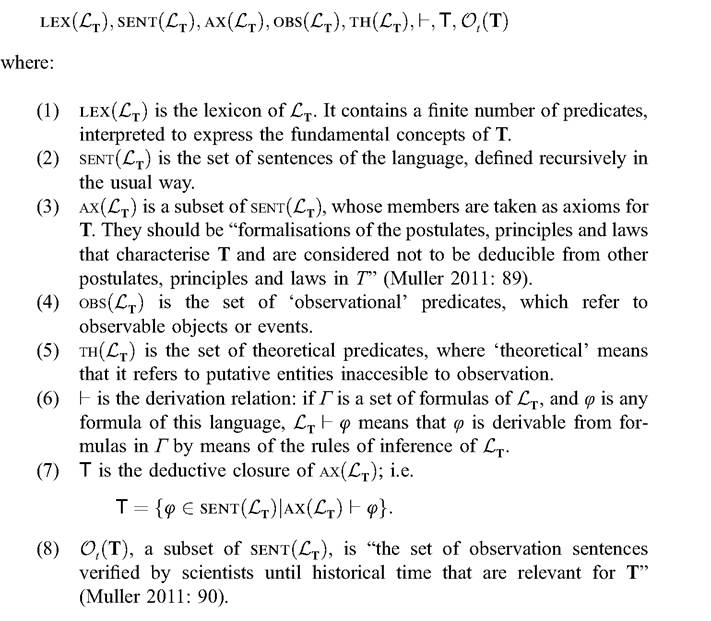
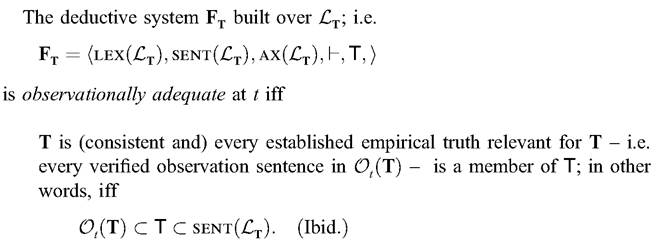
It seems that the scientists working at Rand saw that the formulation of real-life scientific theories within the framework of the L-View was utterly impractical, particularly when the theory under analysis presupposed more than first-order logic (for in such a case it becomes necessary, in order to formulate the theory, to include first-order formulations of all those presupposed theories: set theory, real analysis, and so on). Since complex scientific theories are similar to the theories studied in pure mathematics in their degree of complexity,
in such contexts it is very much simpler to assert things about the models of the theory rather than to talk directly and explicitly about the sentences of the theory, perhaps the main reason for this being that the notion of sentence of the theory is not well defined when the theory is not given in standard formalization.
(Suppes 1967: 58)
Here the relevant notion of model is precisely the one that Bourbaki (1968) defined under the label ‘mathematical structure’.
These structures are introduced by Suppes through the definition of a set-theoretical predicate, like ‘A is a topological space' or ‘A is a game’.Suppes proposed to characterize or identify any scientific theory through a certain class of structures since, even if it appears formulated intrinsically - by means of a certain set of statements (not necessarily capable of being formulated as sentences of first-order logic) - the question of whether such a formulation is adequate, or whether a formulation in first-order logic is feasible, can only be answered after an extrinsic characterization of the same is given. Even though Suppes thought that it is not important to provide precise definitions of the concept of scientific theory in terms of necessary and sufficient conditions, of the form “X is a scientific theory if and only if so-and-so”, and had a certain tendency to shy away from grand schemes about scientific theories and their relations, he recognized that an essential ingredient of any sophisticated scientific discipline is a hierarchy of theories, starting with models of data and culminating with what he calls a fundamental theory.
Muller formulates Suppes’ view of theories - which he calls the Informal- Structural View or 6-View - in a way that facilitates comparison with the L- View. Instead of the eight components of the L-View, the 6-View contains merely two, namely:
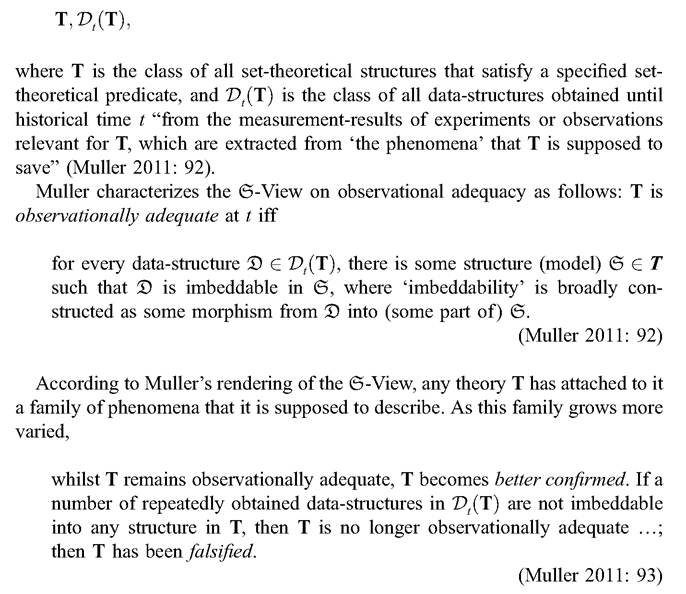
In order to further clarify the 6-View, it will prove useful to compare it with the eight points that characterize the L-View.
Concerning point (1), the language used is plain English (or some vernacular language) with the usual mathematical symbols in the informal language of standard mathematics, even though it has at its disposition the language of first-order logic if it wants to formulate some theory (like set-theory) in a formal way. Thus, the theories are formulated in an informal way, as mathematical theories are usually formulated.
Concerning (2), certainly the set of sentences is not defined in a precise way, but the articulation of sentences follows the grammatical rules of the vernacular language and the conventions regarding the use of mathematical symbols.
In order to formulate the axioms (3), the terms of the theory are divided into primitive and those that can be defined by means of the former. In their scientific use, these terms have a definite meaning, but the 6-View abstracts the set- theoretical form of their extensions, which in any event are sets. Depending upon the meaning of the term, the set can be a ‘bare’ set, a relation, or a function
defined over appropriate sets. The definition of the models of the theory requires a specification of the set-theoretical nature of the extensions of the primitive terms (set, relation, function). Since the theory is scientific (i.e. empirical), specific axioms expressing the laws and/or other theoretical systematizations are also required.
The S-View does not have a clear-cut distinction between ‘observational’ and ‘theoretical’ terms (4, 5), a distinction which is rather positivist. At any rate, it distinguishes among the terms those that define the ‘empirical structures’ representing the phenomena the theory deals with, that the theory is supposed to explain, from those terms used to explain the phenomena. A clear example of this is the distinction in classical mechanics between kinematic and dynamic terms. Position and time are kinematic; mass and force are dynamic. I shall discuss later how this distinction can be made precise in general.
Regarding (6), the derivation rules are those of informal mathematics, with occasional appeal to formalized logic, but the deductive closure of the axioms (7) can be clearly defined if the axioms are written in the formal language of set theory. Nevertheless, the concept is not very useful for the analysis of empirical theories.
Finally, an analogue of the ‘observation’ sentences (6) can be defined, namely those sentences that use only ‘kinematic’ terms. These can be used to characterize empirical structures representing the phenomena to be explained by the theory. It will be useful, in order to fix ideas, to illustrate the S-View by means of a simple example taken from economics.
1.2
More on the topic A new view of scientific theories:
- 35 INSTITUTIONAL RACISM AND INDIVIDUAL RESPONSIBILITY
- FIVE COMPONENTS OF LEGAL COMPETENCIES
- When discussing violence in the Islamic milieu, the word jihad inevitably comes to mind, especially in the modern world.
- REVIEW OF FORENSIC ASSESSMENT INSTRUMENTS
- Beakley Brian, Ludlow Peter (eds.). The Philosophy of Mind: Classical Problems/Contemporary Issues, 2nd edition. — Bradford Book Publication,2006. — 1080 p., 2006
- Somalia
- Fundamental causes of income differences
- LAWS CONTROLLING PROPAGATION AMONG MUSLIMS
- CHAPTER 41 HARMFUL ALGAL BLOOMS INCLUDING Cyanobacterial toxicosis
- The more signs of a victim an individual bears, the more likely he is to attract disaster.