Institutions and organizations
The fundamental economic problem is scarcity. Since the beginning of life on earth, all organisms have engaged in competition for limited resources. The welfare outcomes of this competition have ranged from efficient allocation to war, genocide and extinction.
It is the rules of the game which determine the social welfare consequences. More precisely, it is the long run interaction between the rules of the game and the agents who compete.Institutions - which make up the rules of the game - were at one time thought to have strong efficiency properties in equilibrium. To a large extent, this is no longer the case [for an introduction to the literature, see, for example, North (1993, 1995); or Hoff (2000)]. Institutions can either reinforce market failure or themselves be the source of inefficiency. Moreover, institutions are path dependent, so that bad equilibria forming from historical accident may be locked in, causing poverty to persist.
Among the set of institutions, the state is one of the most important determinants of economic performance; and one of the most common kinds of “government failure” is corruption.[251] In Section 7.1 we review why corruption is thought to be not only bad for growth and development, but also self-reinforcing.
Section 7.2 then looks at the kinship system, a kind of institution that arises spontaneously in many traditional societies to address such market problems as lack of formal insurance. We consider how these systems may potentially form a local poverty trap, by creating hurdles to adoption of new techniques of production. Although the aggregate outcome is impoverishing, it is shown that the kinship system may nevertheless fail to be dismantled as a result of individual incentives.
7.1. Corruption and rent-seeking
Corruption is bad for growth. A number of ways that corruption retards development have been identified in the literature.
First, corruption tends to reduce the incentive to invest by decreasing net returns and raising uncertainty. This effect impacts most heavily on increasing returns technologies with large fixed costs. Once costs are sunk, investors are subject to hold-up by corrupt officials, who can extort large sums. Also, governments and officials who have participated in such schemes find it difficult to commit credibly to new infrastructure projects.Second, corruption diverts public expenditure intended for social overhead capital. At the same time, the allocation of such capital is distorted, because officials prefer infrastructure projects where large side payments are feasible. Corruption also hinders the collection of tax revenue, and hence the resource base of the government seeking to provide public infrastructure. Again, a lack of social overhead capital such as transport and communication networks tends to impact more heavily on the modern sector.
Third, innovators suffer particularly under a corrupt regime, because of their higher need for such official services as permits, patents and licenses [De Soto (1989), Murphy, Shleifer and Vishny (1993)]. The same is true for foreign investors, who bring in new technology. Lambsdorff (2003) finds that on average a 10% worsening in an index of transparency and corruption he constructs leads to a fall of 0.5 percentage points in the ratio of foreign direct investment to GDP.
Not only is corruption damaging to growth, but it also tends to breed more corruption. In other words, there are complementarities in corruption and other rent-seeking activities. It is this increasing returns nature of corruption which may serve to lock in poverty. Some equilibria will be associated with high corruption and low income, where many rent-seekers prey on relatively few producers. Others will have the reverse.
The decision of one official to seek bribes will increase expected net rewards to bribe taking in several ways. The most obvious of these complementarities is that when many agents are corrupt, the probability of detection and punishment for the marginal official is lowered.
A related point is that if corruption is rampant then detection will not entail the same loss of reputation or social stigma as would be the case in an environment where corruption is rare. In other words, corruption is linked to social norms, and is one of the many reasons why they matter for growth.[252] Third, greater corruption tends to reduce the search cost for new bribes.Murphy, Shleifer and Vishny (1993) point outyet another source of potential complementarities in rent-seeking. Their idea is that even if returns to predation are decreasing in an absolute sense, they may still be increasing relative to production. This would occur if the returns to productive activities - the alternative when agents make labor supply decisions - fall faster than those to rent-seeking as the number of rent-seekers increases. The general equilibrium effect is that greater rent-seeking decreases the (opportunity) cost of an additional rent-seeker.
In their model there is a modern sector, where output by any individual is equal to a, and a subsistence technology with which agents can produce output c < a. Alternatively, agents can prey on workers, obtaining for themselves an amount no more than b per person, but limited by the amount of output available for predation. This in turn depends on the number of people working in the productive sectors. The authors assume, in addition, that only modern sector output can be appropriated by rent-seekers, so returns to subsistence farming are always equal to c.
An equilibrium is an allocation of labor across the different occupations such that returns to all are equal, and no individual agent can increase their reward by acting unilaterally. To locate equilibria, we now discuss returns to working in the different sectors as a function of n, which is defined to be the number of rent seekers for each modern sector producer.
Returns to employment in the subsistence sector are always given by c. Rentseekers all take a slice b of the pie until their ratio to modern sector producers n satisfies a — bn = c.
At this ratio, which we denote її, the earnings of the modern sector producers fall to that of the subsistence producers, and the rent-seekers must reduce the size of their take (or earn nothing). After її, the rent-seekers each take (a — c)/n, exactly equalizing returns to modern sector production and subsistence.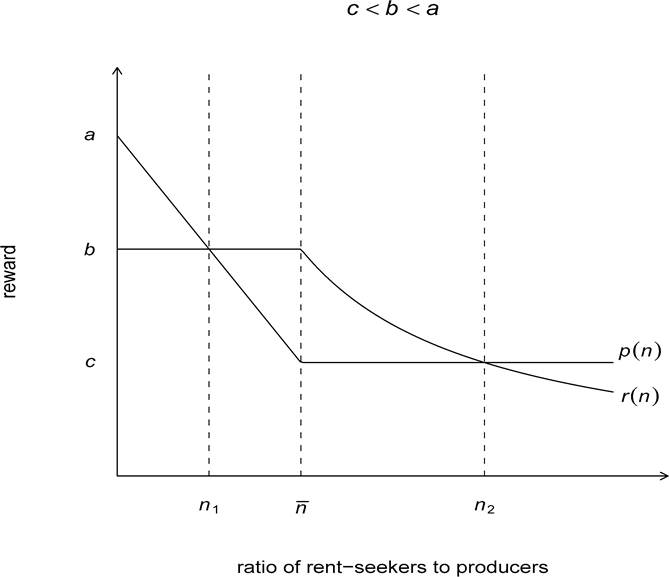
Figure 27.
Let p(n) and r(n) be returns to modern sector production and rent-seeking respectively, so that p(n) = (a — bn)1{n < П} + c1{n ≥ П} and r(n) = b1{n < П} + a-c 1{n ≥ n}. These curves are drawn in Figure 27. The figure shows that there are multiple equilibria whenever the parameters satisfy c < b < a. One is where all work in the modern sector. Then n = 0, and p(n) = p(0) = a > r(n) = b > c. This allocation is an equilibrium, where all agents earn the relatively high revenue available from modern sector production. In addition, because b > c, the payoff functions n → p(n) and n → r(n) intersect above n,at n2. This is again an equilibrium, where the payoffs to working in the subsistence sector, the modern sector and the rent-seeking sector are all equal and given by c.
Notice that b does not affect income in either of these two equilibria. However, it does affect which one is likely to prevail. If b declines below c, for example, then only the good equilibrium will remain. If it increases above a, then the bad equilibrium will be unique. When there are two equilibria, higher b increases the basin of attraction for the bad equilibrium under myopic Marshallian dynamics.
In summary, the model exhibits a general equilibrium complementarity to corruption, which helps illustrate why corruption tends to be self-reinforcing, therefore causing poverty to persist. These kind of stories are important, because in practice corruption and related crimes tend to show a great deal of variation across time and space, often without obvious exogenous characteristics that would cause such variation.
There are many other models which exhibit self-reinforcement and path dependence in corruption. One is Tirole (1996), who studies the evolution of individual and group reputation. In his model, past behavior provides information about traits, such as honesty, ability and diligence. However, individual behavior is not perfectly observed. As a result, actions of the group or cohort to which the individual belongs have predictive power when trying to infer the traits of the individual. It follows that outcomes and hence incentives for the individual are affected by the actions of the group.
In this case we can imagine the following scenario. Young agents progressively joint an initial cohort of workers, a large number of whom are known to be corrupt. Because the behavior of new agents is imperfectly observed, they inherit the suspicion which already falls on the older workers. As a result, they may have little incentive to act honestly, and drift easily to corruption. This outcome in turn perpetuates the group’s reputation for corrupt action.
One can contemplate many more such feedback mechanisms. For example, it is often said that the low wages of petty officials drive them to corruption. But if corruption lowers national output and hence income, then this will reduce the tax base, which in turn decreases the amount of resources with which to pay wages. For further discussion of corruption and poverty traps see Bardhan (1997).[253]
7.2. Kinshipsystems
All countries and economies are made up of people who at one time were organized in small tribes with their own experiences, customs, taboos and conventions. Over time these tribes were united into cities, states and countries; and the economies within which they operated grew larger and more sophisticated. Some of these economies became vibrant and strong. Others have stagnated. According to North (1993, p. 4):
The reason for differing success is straightforward. The complexity of the environment increased as human beings became increasingly interdependent, and more complex institutional structures were necessary to capture the potential gains from trade.
Such evolution required that the society develop institutions that will permit anonymous, impersonal exchange across time and space. But to the extent that “local experience” had produced diverse mental models and institutions with respect to the gains from such cooperation, the likelihood of creating the necessary institutions to capture the gains from trade of more complex contracting varied.North and other development thinkers have emphasized that success depends on institutions rewarding efficient, productive activity; and having sufficient flexibility to cope with the structural changes experienced in the transition to modernity. The degree of flexibility and ability to adapt determines to what extent an economy can take advantage of the application of science, of new techniques, and of specialization and the effective division of labor.
To illustrate these ideas, in this section we review recent analysis of the “kin” system, an institution found in many traditional societies, usually defined as an informal set of shared rights and obligations between extended family and friends for the purpose of mutual assistance.[254] Where markets and state institutions are less developed, the kin system replaces formal insurance and social security by implementing various forms of community risk sharing, and by the provision of other social services [Hoff and Sen (2005)]. The question we ask in the remainder of this section is how, in the process of development, the kin system interacts with the nascent modern sector, and whether or not it may serve to impede the diffusion of new technologies and the exploitation of gains from trade.
An interesting example of such analysis is Baker (2004), who interprets Africa’s lack of robust growth as a failure of technology diffusion caused by institutional barriers. She presents a model of a rural Africanvillage, and suggests two path dependent mechanisms related to the kin system which may serve to retard growth. Both of them involve community risk sharing, and indicate how technology adoption may have positive network externalities beyond simple social learning.
The first mechanism concerns risk sharing among kin members in the form of interest free “loans” with no fixed repayment schedule. Kin members in need can expect to receive these transfers from the better off, who in turn must comply or face various social sanctions (including, in the countries Baker studied, accusations of witchcraft as the source of their good fortune). Beyond the obvious incentive effects on those who might seek to improve their circumstances by using new technology, Baker suggests that a kin member who adopts new techniques may face significant additional uncertainty vis-a-vis income net of transfers if the kin group makes mistakes in estimating his or her true profits. Such a miscalculation may lead to excessive demands for “gifts” or other transfers.
As Baker points out, the uncertainty effect of the transfers will be larger for those who adopt new technology, where costs and revenue are harder for the other kin to estimate. For example, the kin may have difficulty in measuring the real costs of new techniques, such as fertilizer or more expensive seed, causing them to overestimate true profits. (New techniques are often associated with higher revenues combined with higher costs.)
On the other hand, cost and net profit will be easier to estimate if more kin members have experience of the new techniques. In other words, uncertainty will be mitigated for the marginal adopter if more of his or her fellow kin members adopt the same technology. As a result there are positive network externalities in terms of expected cost. This mechanism generates a coordination problem, whereby a critical mass of co-adopters may be necessary to make the new technology more attractive than the old. This need for coordination may present a barrier to adoption.
At the same time, the coordination barrier would not seem to be insurmountable. Perhaps a kin group can negotiate to a better equilibrium when the gains are genuinely large? Baker suggests that in fact this will not be easy, because the risk sharing problem interacts with other path dependent institutions.
One of these concerns the nature of old age insurance among self-employed African farmers. Given the lack of state pensions and the difficulty of accumulating assets, support in old age may be contingent on the old providing some form of useful service to the household from which resources are to be acquired. And the most likely candidate for productive service from elderly farmers is the benefit of their experience. The problem here is that the value of this service provided by the old depends on a stagnant technology which does not change from generation to generation. Under new techniques the experience of old farmers may become redundant. If old farmers are able to resist the introduction of new techniques then it will be in their interests to do so. Once again, this is a source of multiple equilibria. The reason is that if the newer technology were already adopted then presumably it would be supported by old farmers, because this is then the methodology in which they have experience.
Another interesting study of the kin system has been conducted recently by Hoff and Sen (2005). They analyze the migration of kin members from rural areas to modern sector jobs, and show how network externalities arise in the migration decision. Even if kin members can coordinate on simultaneous migration, Hoff and Sen suggest that the kin group may put up barriers to prevent the loss of their most productive members. It is shown that even when the kin decisions are made by a majority, the barriers can be inefficient in terms of aggregate group welfare.
A simplified version of their story runs as follows. Kin members who do migrate may find themselves besieged by their less fortunate brethren. The latter come seeking not only “gifts” of cash transfers, but also help in finding jobs in the modern sector for themselves. Realizing this, employers will find it profitable to restrict employment of kin members. Here we assume these barriers are so high that migration while maintaining kin ties is never optimal. As a result, kin members choose between remaining in the rural sector or migrating while breaking their kin ties.
The kin group is thought of as a continuum of members with total mass of one. A fraction α ∈ (0, 1) of the kin receive job offers in the modern sector. The utility of remaining in the rural sector is
us(α) = so + b(1 - α), (29)
where here and elsewhere α ≤ α is the fraction of the kin who break ties and move. The constant s0 is a stand-alone payoff to rural occupation. The constant b is positive, so that utility of staying is higher when more kin members remain. On the other hand,
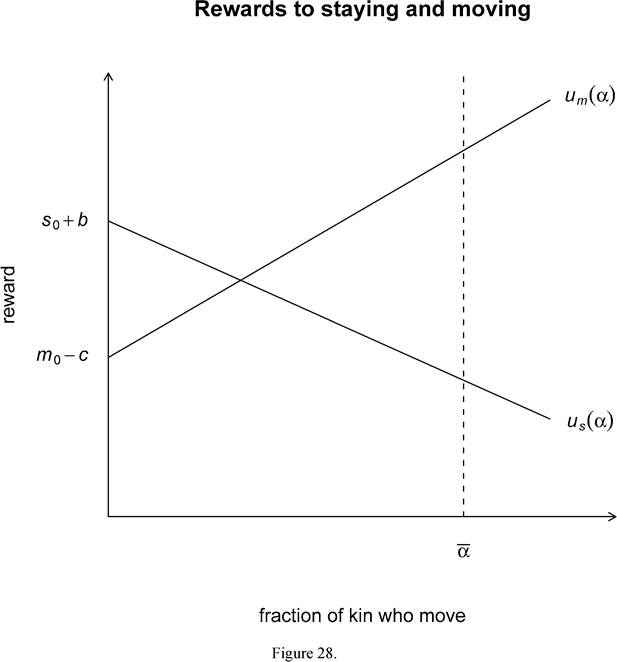
the utility of moving to the modern sector is

where m0 is a payoff to working in the modern sector and c is a positive constant. The function α → c(1 — α) is the cost of ending kin membership (measured in the utility equivalent of various social sanctions which we will not describe). It is assumed that the cost of breaking kin ties for the marginal kin member decreases as more members leave the kin group and shift to the modern sector.[255]
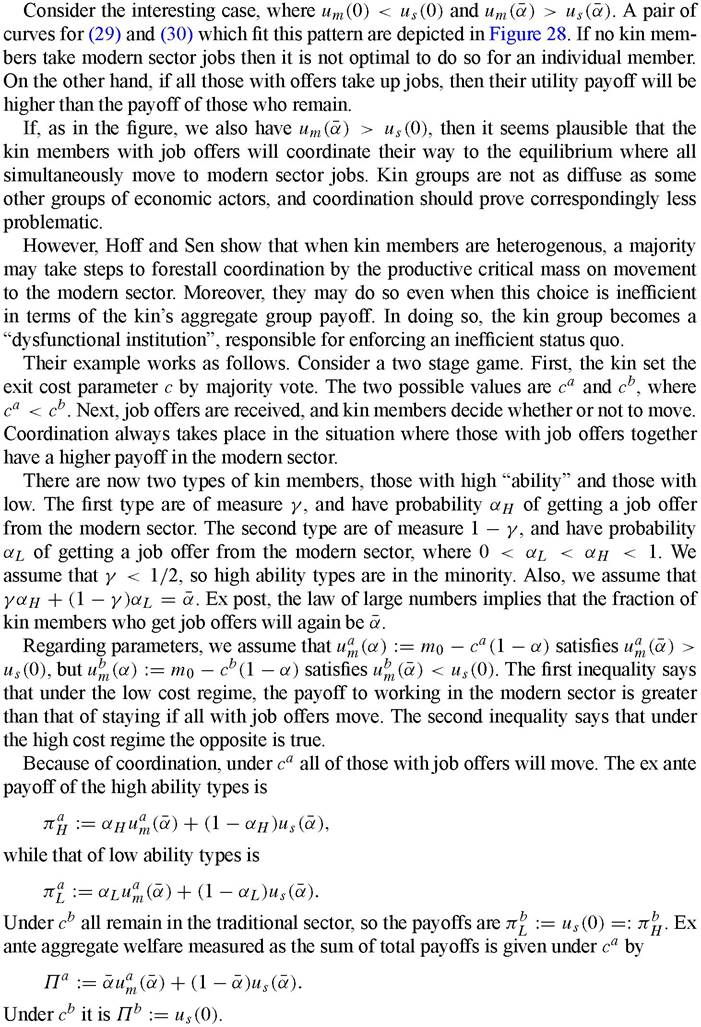
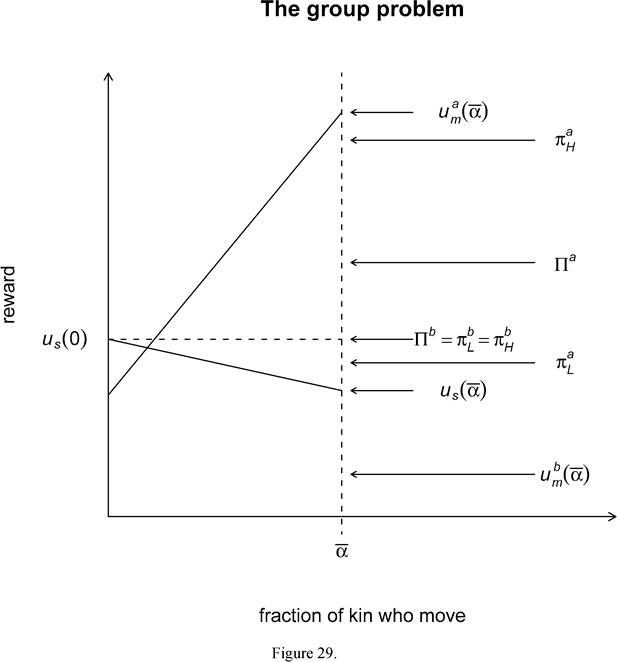
What Hoff and Sen point out is that under some parameters it is possible to have
id="Picutre 367" class="lazyload" data-src="/files/uch_group77/uch_pgroup302/uch_uch7198/image/image366.jpg">


8.
More on the topic Institutions and organizations:
- Building a GoodJobs Economy
- The Challenges of Military Organizations
- Appendix 5.1: Relevant projects implemented by REDASP
- The Myth of the Good Prehistoric Savage: The Origins of Social Differentiation and Complexity
- Fundamental causes of income differences
- Human geopolitics and imperialism are of prehistoric provenance in the sense that human groups fought with each other, made alliances, and some used coercion to extract resources from others well before the invention of writing, cities, or states.1
- Abstract
- Conclusion