Introduction
The term “general-purpose technology”, or GPT, has seen extensive use in recent treatments of the role of technology in economic growth, and is usually reserved for changes that transform both household life and the ways in which firms conduct business.
Steam, electricity, internal combustion, and information technology (IT) are often classified as GPTs for this reason. They affected the whole economy.As David (1991) has pointed out, however, a GPT does not deliver productivity gains immediately upon arrival. Figure 1 shows the evolution of the growth in output per manhour in the U.S. economy over the past 130 years, with periods of rapid diffusion of the two major GPTs shaded and the dashed line representing long-term trends as generated with the Hodrick-Prescott (HP) filter.[121] Productivity growth was apparently quite rapid during the heyday of steam power (c. 1870), but fell as Electrification arrived in the 1890s, with the defining moment in the transition probably being the startup of the first hydro-electric facility at Niagara Falls in 1894. It was only in the period after 1915, which saw the diffusion of machines operated by stand-alone secondary motors and the widespread establishment of centralized power grids, that Electricity finally pervaded businesses and households more generally and measures of productivity began to rise.
Figure 1 also shows that the arrival of IT, which we date with Intel’s invention in 1971 of the “4004” microprocessor (the key component of the personal computer or “PC”), did not reverse the decline in productivity growth that had begun more than a decade earlier. It seems only now that we are finally seeing computers show up in the productivity figures.
But it is not obvious that the startup of the Niagara Falls dam and the invention of the 4004 chip should define the birth of the two GPTs.
After all, Thomas Edison invented the incandescent bulb in 1879 and by 1882 the world’s first large central power station had been installed at Pearl Street in New York City, twelve years before we mark Electricity’s “arrival”. And large mainframe computers predicted the winner of the 1952 U.S. Presidential election, nearly two decades prior to the advent of the microprocessor. An objective measure is needed, though, and we shall define the start of a GPT era as the point in time when the GPT achieves a one-percent diffusion in the median sector. This is another way to arrive at 1894 and 1971 as the starting points where the shading begins in Figure 1. Similarly, we would say that the era is over when the diffusion curve flattens out. For Electrification, it takes until about 1929 for net adoption to reach a plateau, whereas new adoption of IT is still rising today so that, on that criterion, the IT epoch continues.Each shaded area in Figure 1 contains a productivity-growth slowdown in its initial phases. Will the growth slowdown of the current IT era be followed by a rise in growth
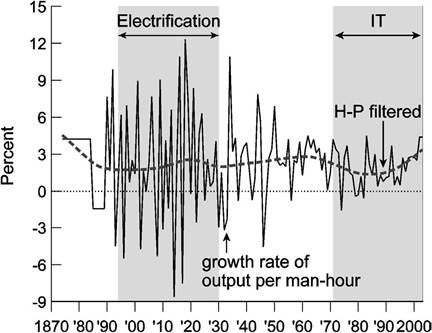
Figure 1. Annual growth in output per man-hour, 1874-2004.
in the first half of the 21st century? If the second shaded area in Figure 1 is in some fundamental respects like the first shaded area, then we can expect growth to pick up over the next several decades. In Jovanovic and Rousseau (2002a) we have argued that the first half of the 21st century will have higher growth than, say, the 1950s and 1960s. Gordon (2000), on the other hand, is pessimistic, arguing that IT does not measure up to Electricity and that it will not have such positive results. This chapter, while documenting key differences between the diffusion paths of the two technologies, will in the end conclude that the two GPT eras are strikingly similar in a number of respects. If anything, our finding that IT is the more “revolutionary” of the two GPTs suggests that its full impact is yet to be seen.
This chapter is organized around the presentation of a collection of facts. The facts are described mainly through graphs and tables which provide evidence on a set of models that we shall mention as we go along. A primarily analytic survey is Greenwood and Jovanovic (2001).
1.1. WhatisaGPT?
So, what are these “fundamental” features of GPTs that would allow us to compare one to another? And more generally, what criteria can one use to distinguish a GPT from other technologies? Bresnahan and Trajtenberg (1996) argue that a GPT should have the following three characteristics:
1. Pervasiveness - The GPT should spread to most sectors.
2. Improvement - The GPT should get better over time and, hence, should keep lowering the costs of its users.
3. Innovation spawning - The GPT should make it easier to invent and produce new products or processes.
Most technologies possess each of these characteristics to some degree, and thus a GPT cannot differ qualitatively from these other technologies. Note, too, that the third property is, in a sense, a version of the first property if we phrase the latter to say that the GPT should also spread to the innovation sector. Moreover, this list can be expanded to include more subtle features of GPTs, a subject that we consider in Section 3. Yet we find these three basic characteristics to be a useful starting point for evaluating and comparing the impact of various technologies through history. Investigating how Electricity and IT measure up on these three dimensions is the focus of Section 2. But first, we summarize our overall findings.
1.2. Summaryoffindings
The evidence shows similarities and differences between the Electrification and the IT eras. Electrification was more pervasive (#1), whereas IT has a clear lead in terms of improvement (#2) and innovation spawning (#3). Let us list the similarities and differences in more detail.
1.2.1. Similarities between the Electrification and IT eras
1.
In both eras productivity growth rates are below those attained in the decades immediately preceding the GPT’s arrival.2. Measures of reallocation and invention - the entry and exit of firms to the stock market, investment by new firms relative to incumbents, and grants of patents and trademarks - are all higher during the GPT eras.
3. Private consumption rises gradually during each GPT era.
4. Real interest rates are about the same during the two GPT eras, and about three percentage points higher than from 1930 to 1970 - the period between the rapid adoptions of Electricity and IT.
1.2.2. Differences between the Electrification and IT eras
1. Innovation measures are growing much faster for IT than for Electrification - patents and trademarks surge much more strongly during the IT era, and the price of IT is falling 100 times faster, at least, than did the price of electricity.
2. IT is spreading more slowly than did Electrification, and it comprises a smaller part of the capital stock. Its net adoption continues to rise in the United States.
3. The productivity slowdown is stronger in the IT era.
4. No comparable sudden collapse of the stock market occurred early on in the Electrification era.
5. The Electrification era saw a surplus in the U.S. trade balance, in part because Europe had to finance a string of wars, whereas the IT era finds the United States with consistent trade deficits.
The differences seem to be quite important. But overall the evidence clearly supports the view that technological progress is uneven, that it does entail the episodic arrival of GPTs, and that these GPTs bring on turbulence and lower growth early on and higher growth and prosperity later. The bottom line is that with a wider body of data and fifteen more years of it than David (1991) had at his disposal, we confirm his hypothesis that Electrification and IT adoption are manifestations of the same force at work, namely the introduction of a GPT.
2.
More on the topic Introduction:
- 1 Introduction
- Introduction
- Introduction
- 19 Introduction
- Introduction
- Introduction
- INTRODUCTION
- Introduction
- Introduction
- Introduction