Introduction
Life in the 1800s. Imagine living as a typical American child in the nineteenth century. You have six brothers and/or sisters. You live in a house, outside of an urban area, with no running water, no central heating, and no electricity.
Your father labors 70 hours a week in the agricultural economy. Your mother probably puts in about the same amount of time doing work at home. Less than half of your years between the ages of 5 and 20 will be devoted to school. So, perhaps you are playing in the family kitchen that contains a cast iron range, a table, and a dresser. But, more likely you are helping your parents by doing one of a litany of chores: carrying wood or water into the house, washing clothes on a scrub board or ironing them with a flat iron, looking after younger siblings, preparing meals, cleaning the house, making clothes, tending crops or animals, etc. In this era, household production is an incredibly labor-intensive process. What changed this situation? The catalyst for the ensuing economic transformation to modern day life was technological progress, both in the market and at home, or so it will be argued here.1.1. Technological progress in the market
Fertility. Over the period from 1830 to 1990 real wages increased by a factor of 9 - see Figure 1.[142] This rise was propelled by a near 7-fold increase in market-sector total factor productivity (TFP) between 1800 and 1990. Such tremendous technological advance had a dramatic impact on everyday life. As an example, consider the effect that economic progress could have had on fertility. Raising children takes time. A secular increase in real wages implies that the opportunity cost of having a child, when measured in terms of market goods, will rise. The utility value of an extra unit of market consumption relative to an extra child should fall, however, as market goods become more abundant with economic development.
So long as the marginal utility of market goods falls by less than the increase in real wages fertility should decline. And so fertility did decline, from 7 kids per woman in 1800 to 2 today.Industrialization and skilled labor. At the start of the 1800s America was largely a rural economy. Over seventy percent of workers were employed in agriculture - see Figure 2.[143] Less than 50 percent of children between the ages of 5 and 20 went to school. From 1800 to 1940 technological advance in the nonagricultural sector of the U.S. economy was twice as fast as in the agricultural sector. Furthermore, agricultural goods had a lower income elasticity than nonagricultural ones. These two facts together implied that the demand for labor in the nonagricultural sector of the economy rose relative to the demand for labor in the agricultural sector. Since the nonagricultural sector required
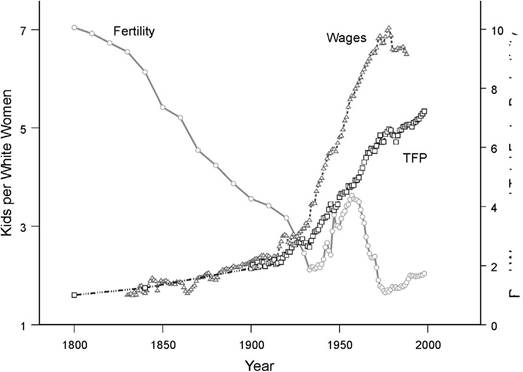
Real Wages and Total Factor Productivity
Figure 1. Technological progress in the market and fertility.
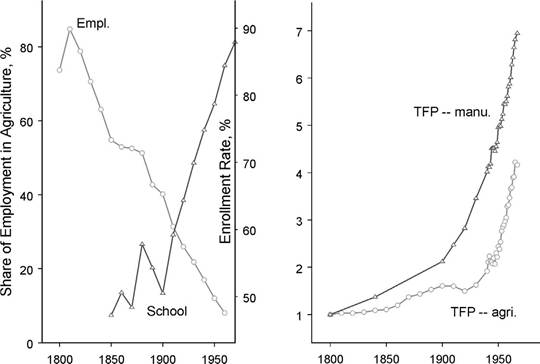
Figure 2. The decline in agriculture and the rise in skilled labor.
a more skill-intensive labor force than did the agricultural sector, the demand for skilled labor rose too.
Child labor. Children formed an important part of the labor force in the nineteenth century. Exact numbers are hard to come by, though. First, the data before 1870 is scarce. Lebergott (1964, p. 50) reports that 43 percent of textile workers in Massa-
Table 1
Children aged 10-15 as percentage of the gainfully employed
| Year | All occupations | Agriculture | Manufacturing | Mining |
| 1870 | 13.2 | 9.3 | 5.6 | 7.1 |
| 1880 | 16.8 | 11.6 | 6.7 | |
| 1890 | 18.1 | 11.5 | 2.8 | |
| 1900 | 18.2 | 11.4 | 3.2 | 2.1 |
| 1910 | 15.0 | 9.8 | 2.4 | 0.8 |
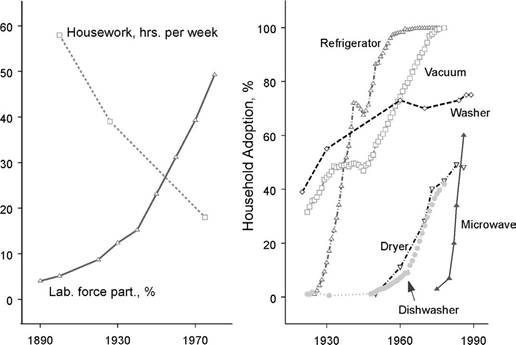
| 1920 | 11.3 | 8.0 | 1.3 | home sector, given the elusive nature of output and inputs, the evidence on technological progress is circumstantial. The household sector in the American economy was basically a cottage industry until the dawning of the Second Industrial Revolution. With the onset of the electric age a host of new appliances were ushered in: washing machines, refrigerators, etc. It took time for these new capital goods to diffuse through the econ-
Figure 3. Technological progress in the home and female labor-force participation. omy, as Figure 3 shows.[145] At the same time, the principles of scientific management were being applied to everyday household tasks. The large table and isolated dresser that characterized a kitchen of the 1800s were replaced by continuous countertops and built-in cabinets. This wave of technological progress in the home freed up tremendous amounts of labor - see Figure 3. The time spent on housework fell from 58 hours per week in 1900 to just 18 in 1975. Married women could now enter the labor force, and they did in droves. Fertility. Technological progress in the household sector could also have had implications for fertility. Labor-saving household goods that ease the burden of housework will lower the cost of raising children. Fertility should rise. In fact it did; between 1936 and 1957 fertility increased by 53 percent - see Figure 1. 1.3. Thegoal The goal here is to persuade you that standard Solow (1956)-Ramsey (1928) growth theory can be fruitfully employed to explain these phenomena. Specifically, all of these facts can be accounted for by modifying the standard growth paradigm to incorporate fertility decisions, household production, human capital investment in children, laborforce participation, and multiple sectors. It will be argued that technological progress is the engine driving economic transformation. A selective review of the literature is provided in Section 7. 2.
More economic literature on Economics.Studio
More on the topic Introduction:
-
Distribution of productive forces -
Economic theory -
General economic issues -
History of economic scientists -
Macroeconomics -
World economy -
-
Conflictology -
Ecology -
Economy -
Finance -
History -
Law -
Medicine -
Philosophy -
Religious studies -
|